U.S. Atomic Energy Commission · July 1954, with the Commission's record of Project Sunshine, August 1953 to April 1958
Every leaf of the Department of Energy's OpenNet releases, free to read here in full, with a word-for-word transcription facing each leaf and no sign-up. Of the edition's 160 annotations, 10 are shown here; the other 150 are in the printed book.
Reproduced from the copy published free by OSTI OpenNet. The transcription and the 160 notes are ours.
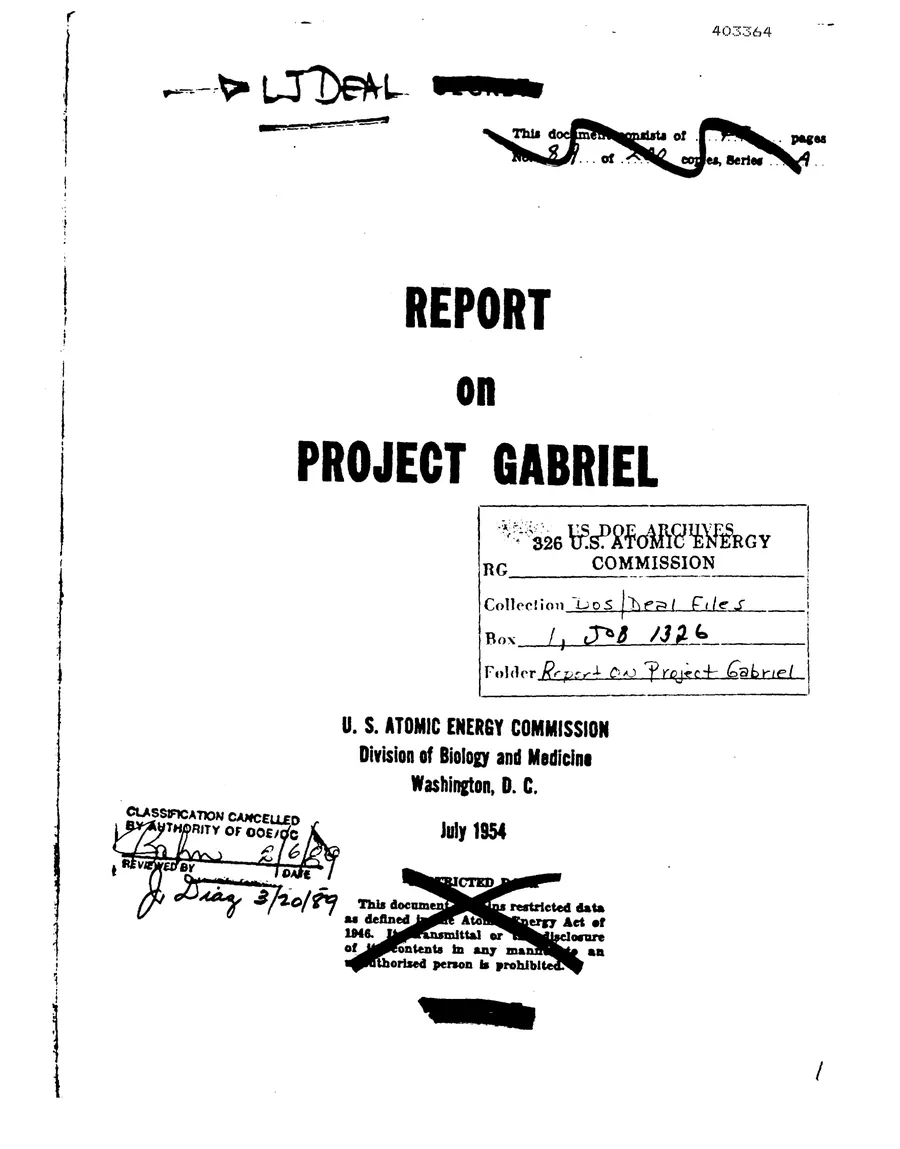
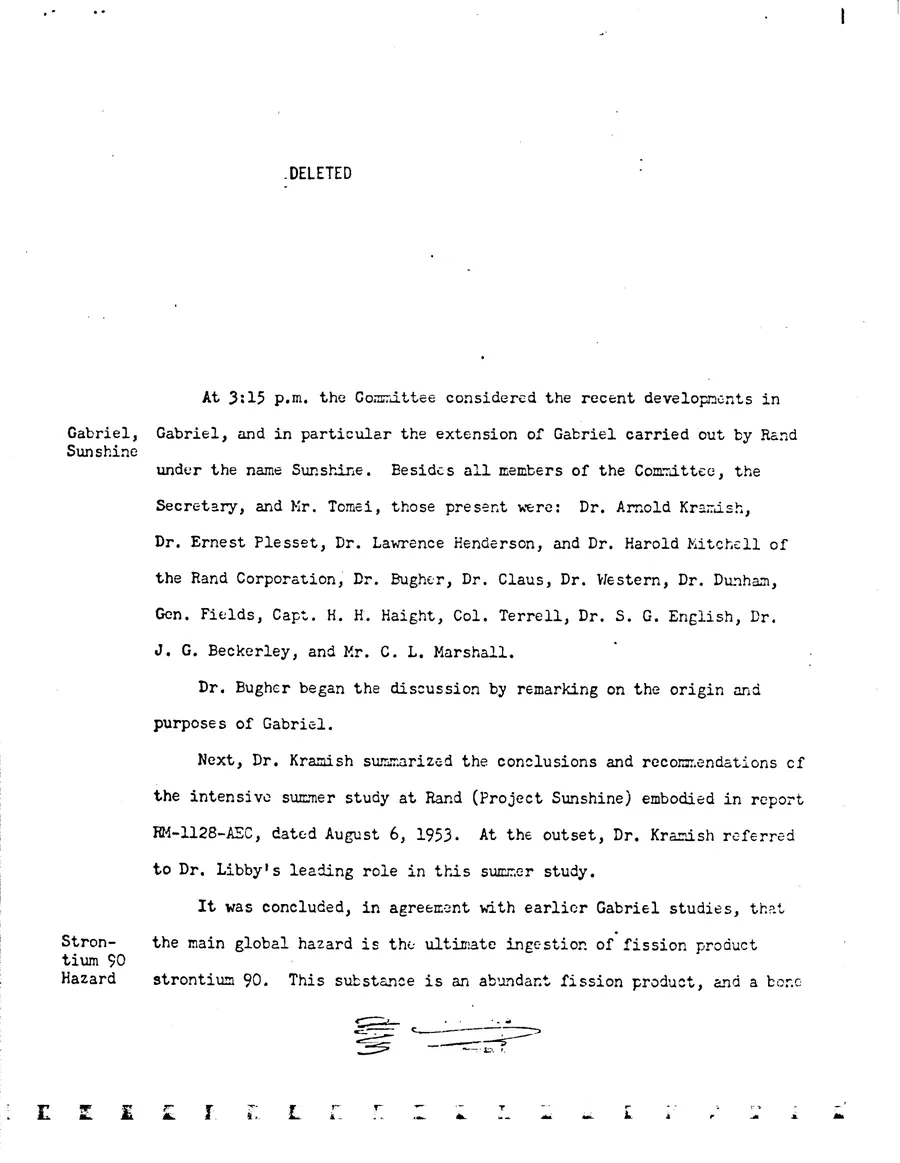
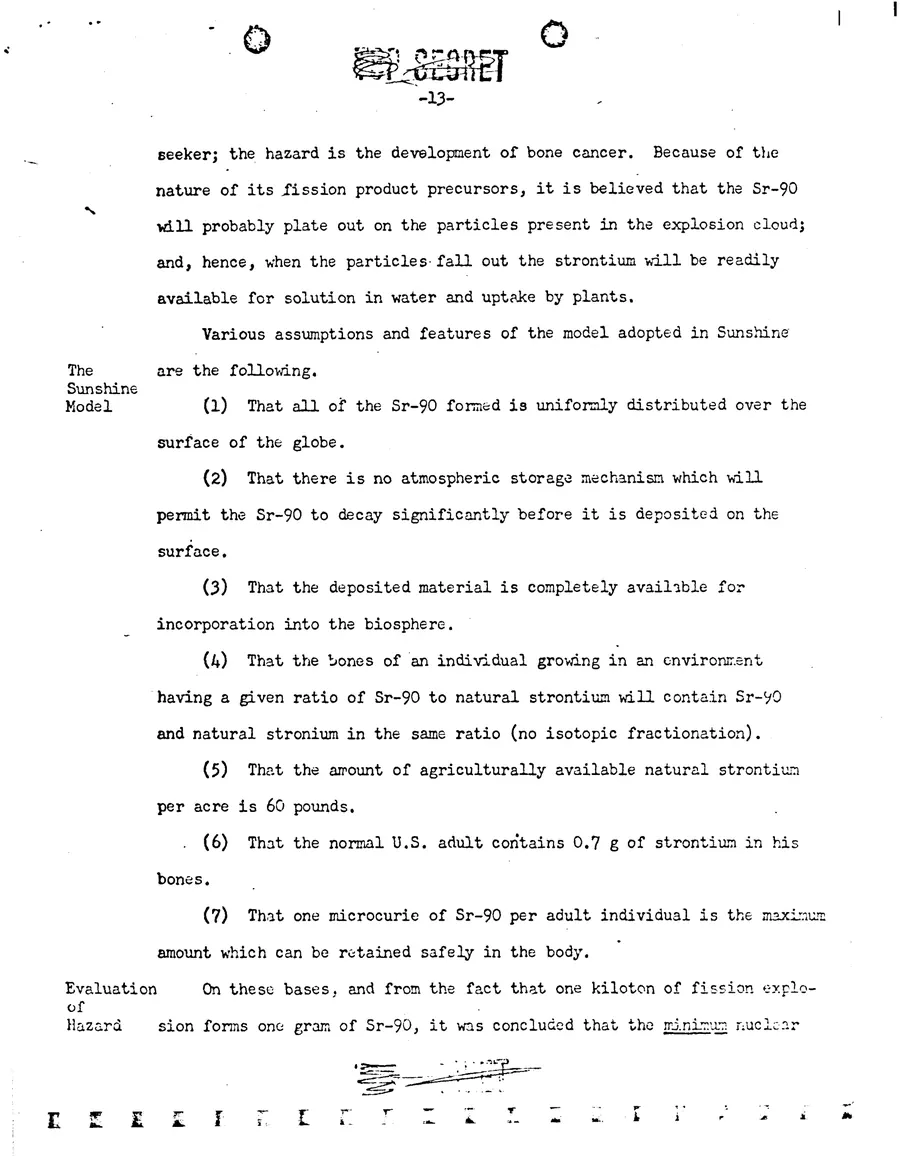
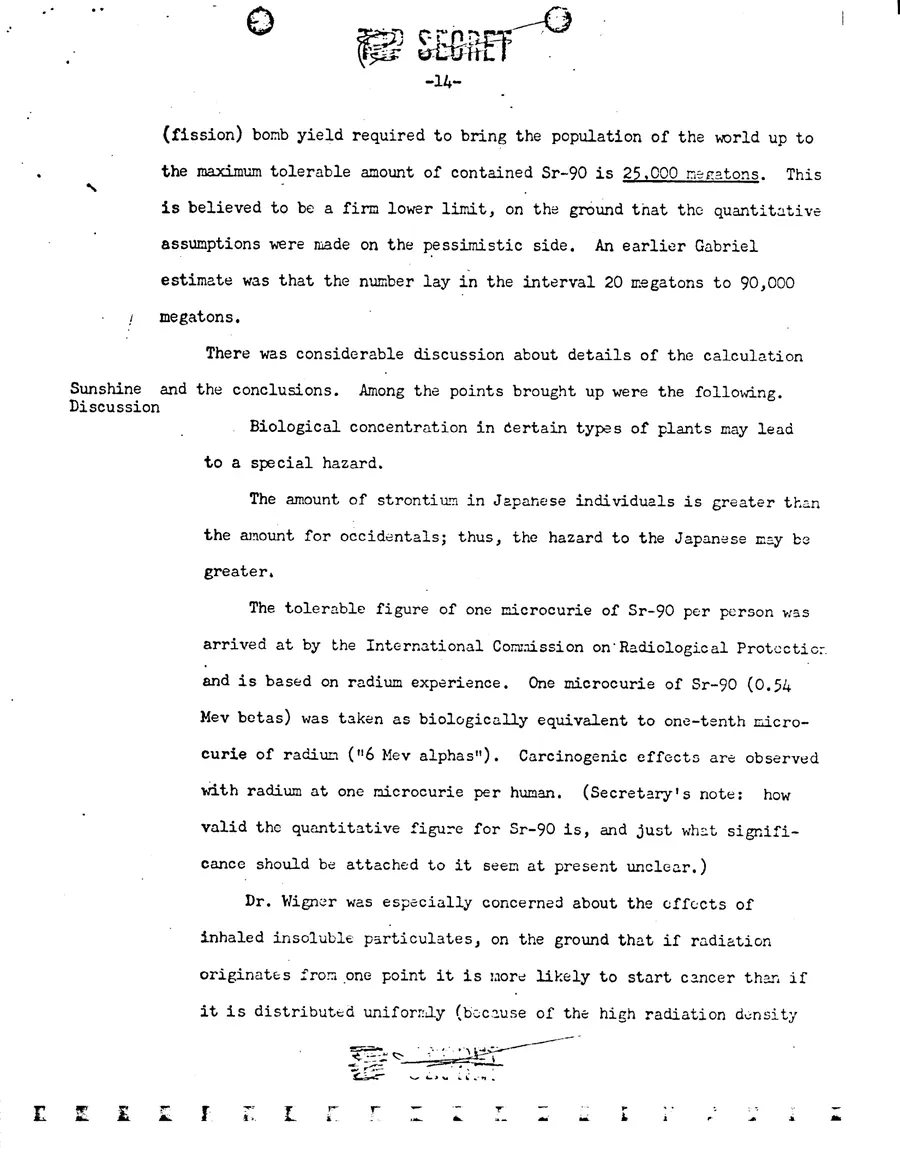
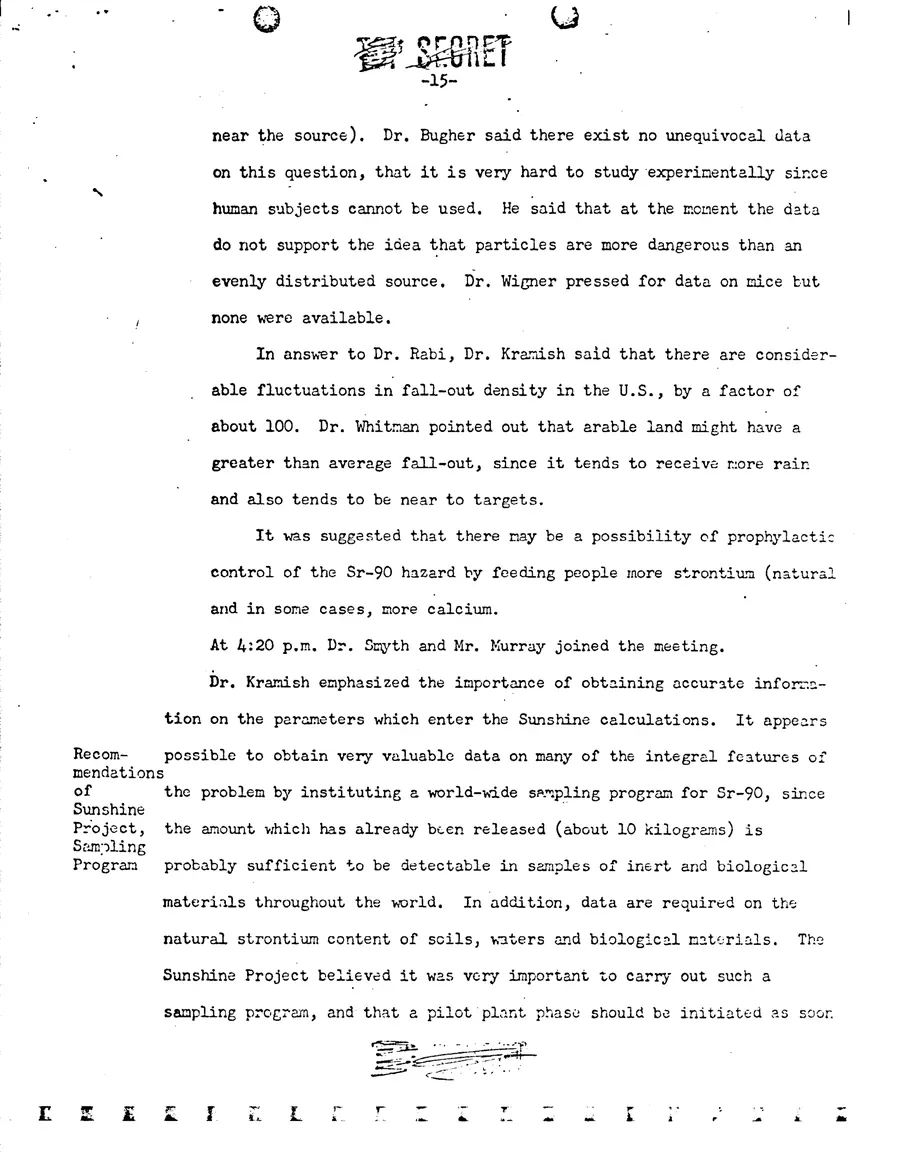
403364 (typed accession, head right) · LJ DEAL (handwritten, head left, with an arrow) · SECRET (obliterated, head) · This document consists of __ pages / No. 8 of 20 copies, Series A (head right, overprinted) · US DOE ARCHIVES / 326 U.S. ATOMIC ENERGY COMMISSION / RG / Collection DOS/Deal Files / Box 1, Job 1326 / Folder Report on Project Gabriel (archives stamp, completed in hand) · CLASSIFICATION CANCELLED BY AUTHORITY OF DOE/OC / [signature] 2/6/89 / REVIEWED BY J. Diaz 3/20/89 (stamp, foot left) · RESTRICTED DATA / This document contains restricted data as defined in the Atomic Energy Act of 1946. Its transmittal or the disclosure of its contents in any manner to an unauthorized person is prohibited. (foot, struck through with a cross) · SECRET (obliterated, foot) · handwritten leaf number 1 (foot right)
Order restored. PART I. The Report on Project Gabriel, July 1954: 35 of its 44 leaves, in the record's own order.
REPORT on PROJECT GABRIEL
U. S. ATOMIC ENERGY COMMISSION
Division of Biology and Medicine
Washington, D. C.
July 1954
Textual notes on this leaf (2)
No. 8 of 20 copies, Series A
The copy-control block at the head is overprinted by the obliterated classification stamp; the page count is unreadable and the copy number reads as 8 of 20. CONFIRM against the raw scan.
LJ DEAL
Handwritten at the head with an arrow. The OpenNet catalogue credits the report to L. J. Deal of the Division of Biology and Medicine; the report itself carries no author. PRESERVED as a hand annotation.
SECRET (obliterated, head) · SECRET (obliterated, foot) · DOE ARCHIVES (stamp, foot right) · handwritten leaf number 2 (foot right)
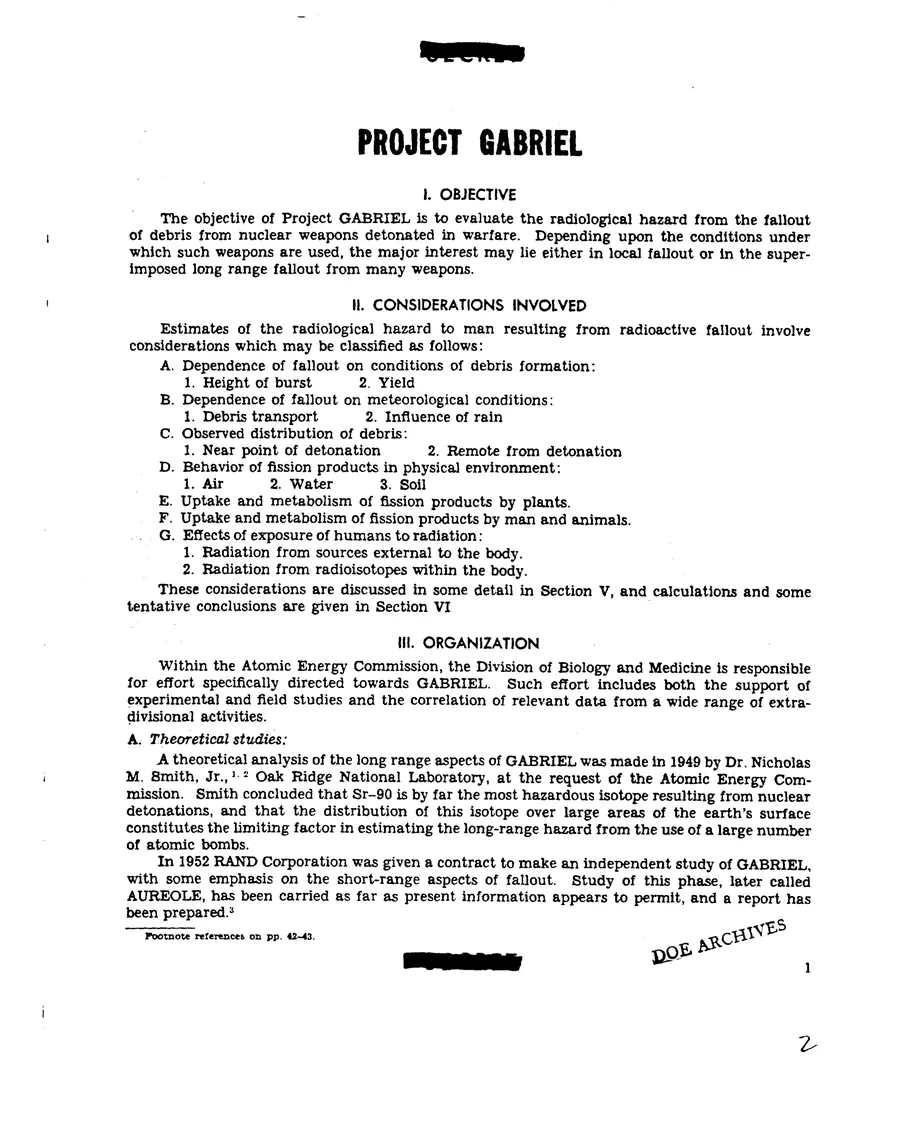
PROJECT GABRIEL
I. OBJECTIVE
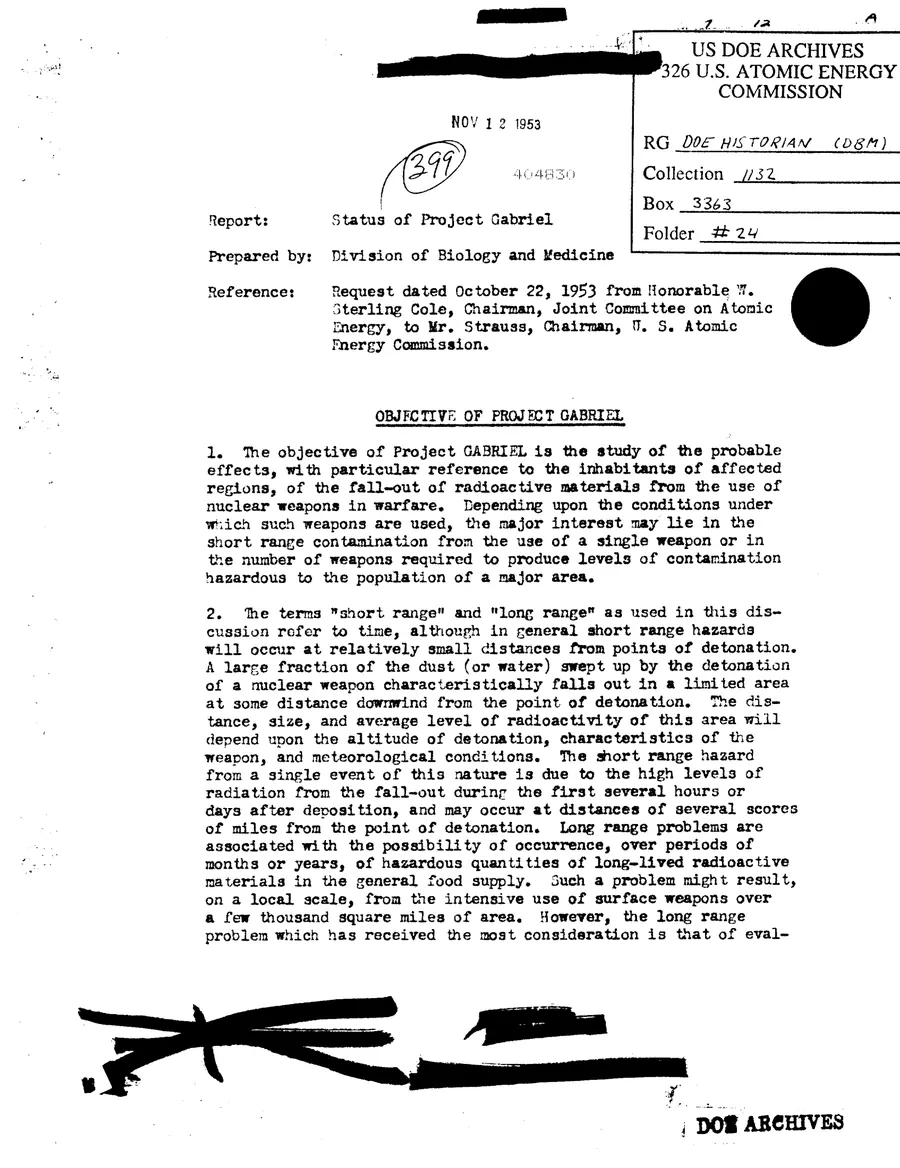
The objective of Project GABRIEL is to evaluate the radiological hazard from the fallout of debris from nuclear weapons detonated in warfare. Depending upon the conditions under which such weapons are used, the major interest may lie either in local fallout or in the superimposed long range fallout from many weapons.
II. CONSIDERATIONS INVOLVED
Estimates of the radiological hazard to man resulting from radioactive fallout involve considerations which may be classified as follows:
A. Dependence of fallout on conditions of debris formation: 1. Height of burst 2. Yield
B. Dependence of fallout on meteorological conditions: 1. Debris transport 2. Influence of rain
C. Observed distribution of debris: 1. Near point of detonation 2. Remote from detonation
D. Behavior of fission products in physical environment: 1. Air 2. Water 3. Soil
E. Uptake and metabolism of fission products by plants.
F. Uptake and metabolism of fission products by man and animals.
G. Effects of exposure of humans to radiation: 1. Radiation from sources external to the body. 2. Radiation from radioisotopes within the body.
These considerations are discussed in some detail in Section V, and calculations and some tentative conclusions are given in Section VI
III. ORGANIZATION
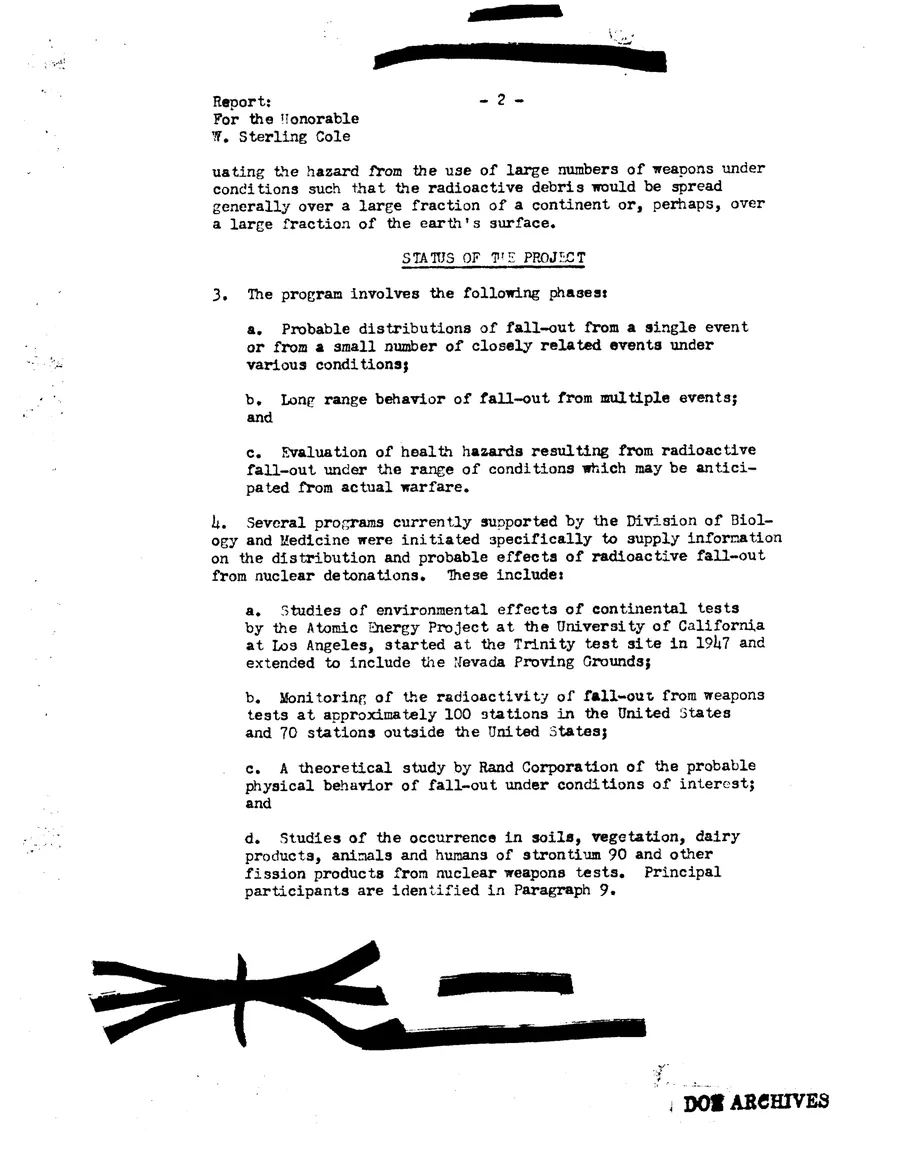
Within the Atomic Energy Commission, the Division of Biology and Medicine is responsible for effort specifically directed towards GABRIEL. Such effort includes both the support of experimental and field studies and the correlation of relevant data from a wide range of extra-divisional activities.
A. Theoretical studies:
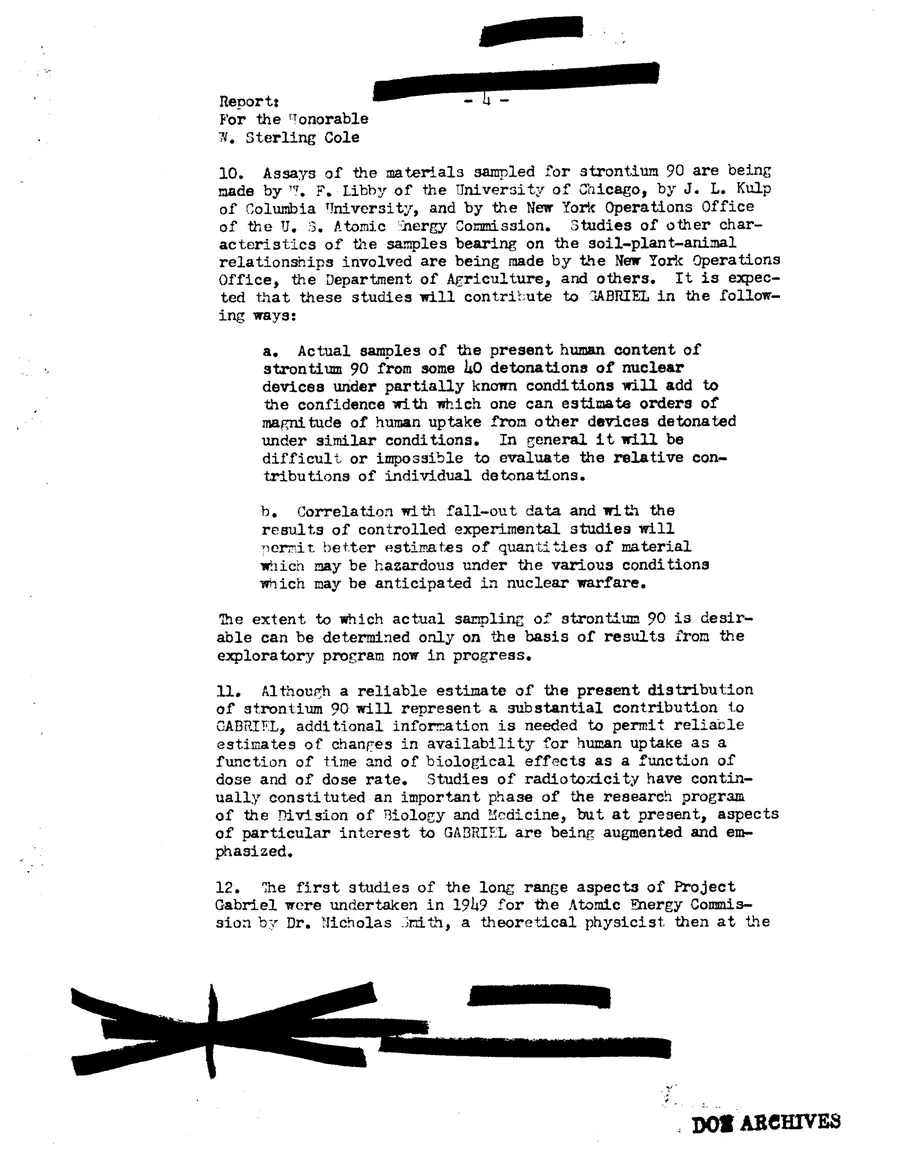
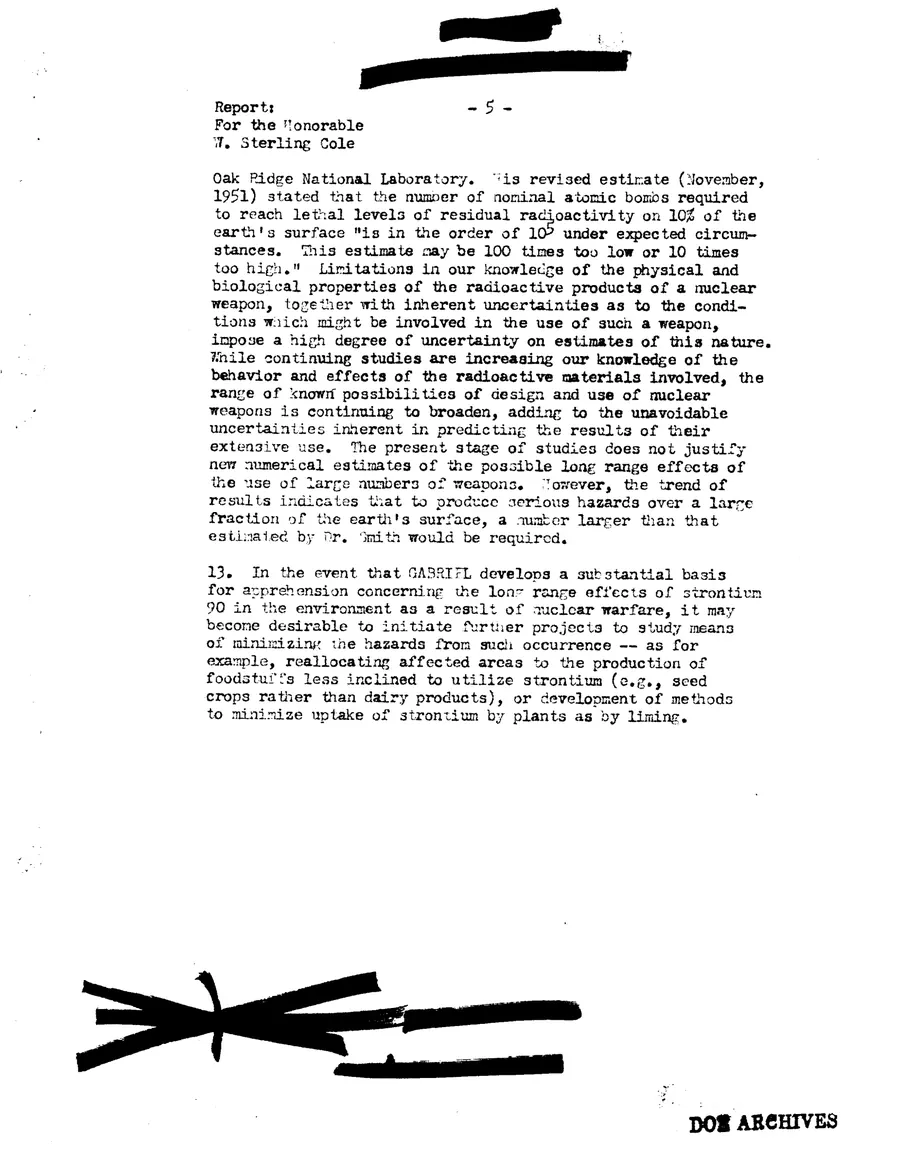
A theoretical analysis of the long range aspects of GABRIEL was made in 1949 by Dr. Nicholas M. Smith, Jr.,^{1, 2} Oak Ridge National Laboratory, at the request of the Atomic Energy Commission. Smith concluded that Sr-90 is by far the most hazardous isotope resulting from nuclear detonations, and that the distribution of this isotope over large areas of the earth's surface constitutes the limiting factor in estimating the long-range hazard from the use of a large number of atomic bombs.
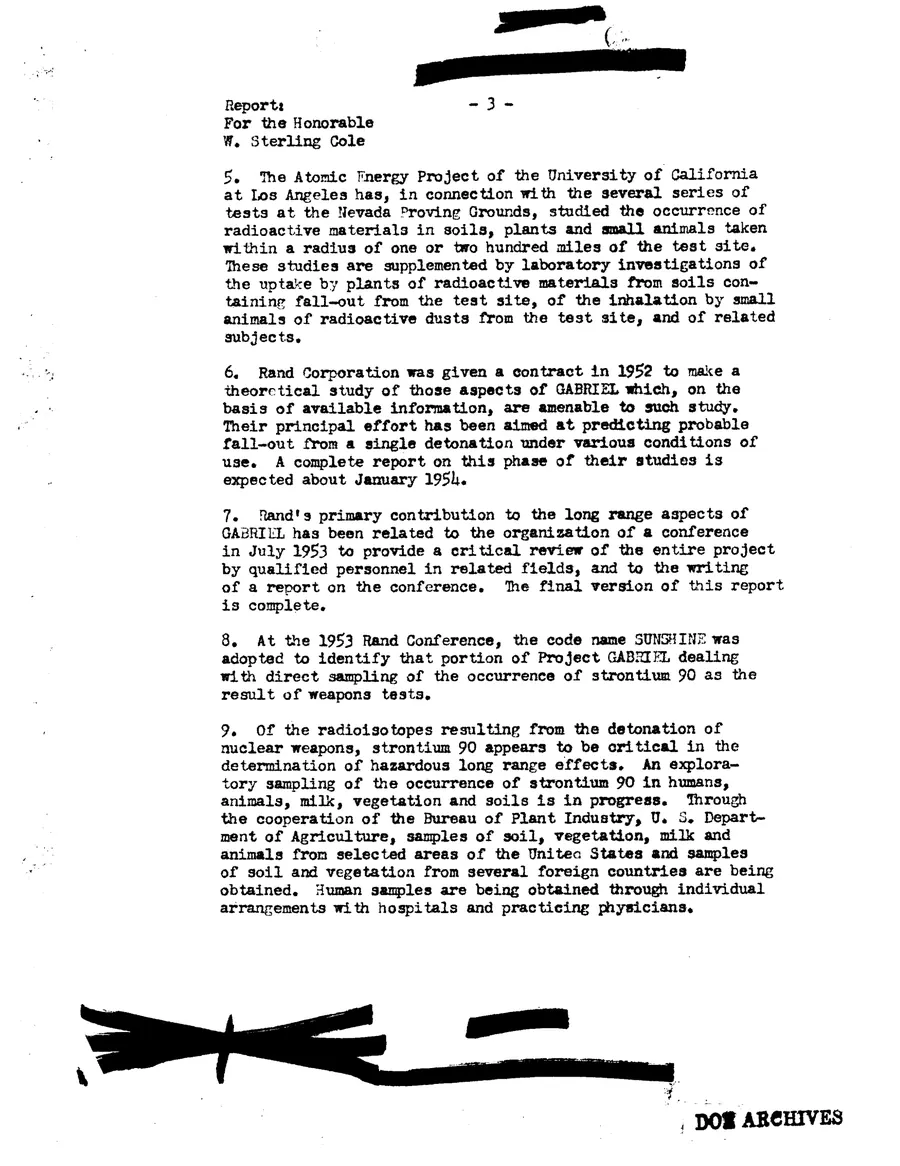
In 1952 RAND Corporation was given a contract to make an independent study of GABRIEL, with some emphasis on the short-range aspects of fallout. Study of this phase, later called AUREOLE, has been carried as far as present information appears to permit, and a report has been prepared.^3
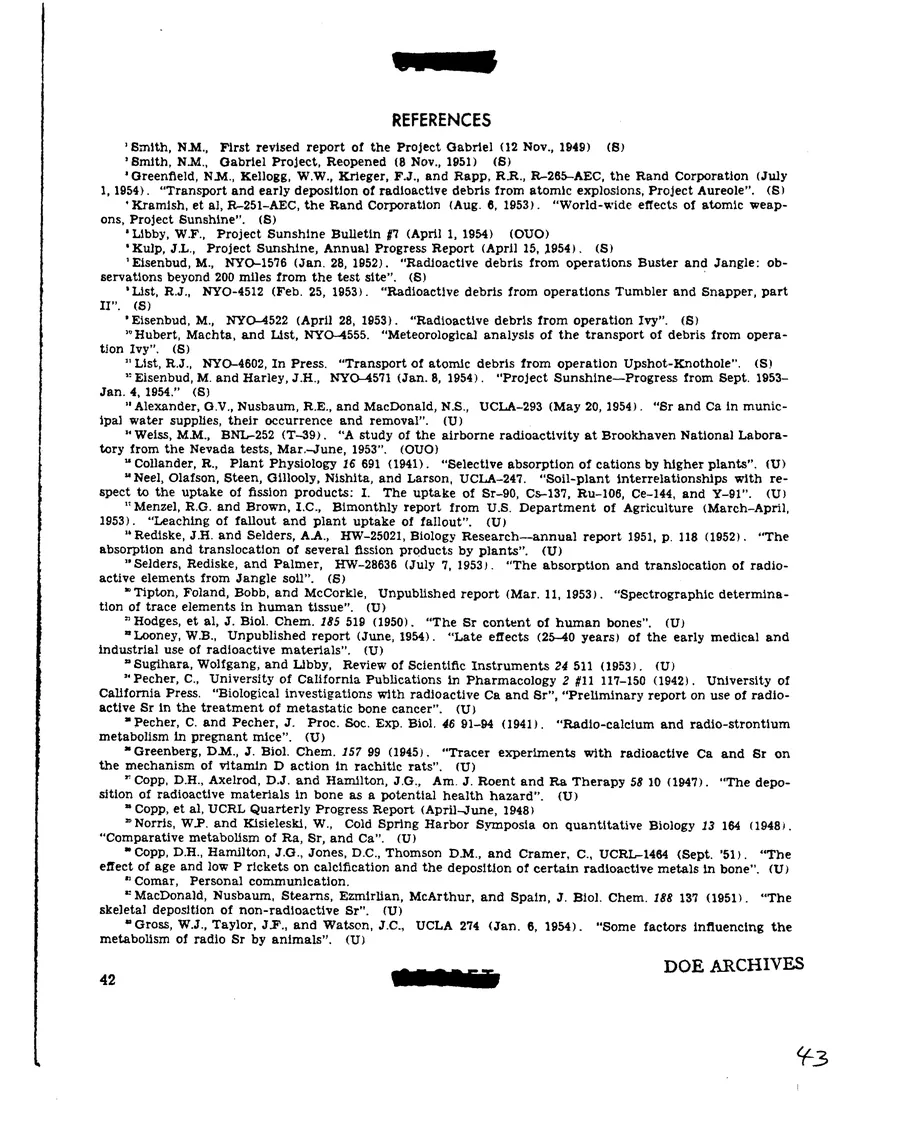
Footnote references on pp. 42-43.
Textual notes on this leaf (1)
are given in Section VI
No full stop closes the sentence on the page. PRESERVED as written.
SECRET (obliterated, head) · SECRET (obliterated, foot) · DOE ARCHIVES (stamp, foot right) · handwritten leaf number 3 (foot right)
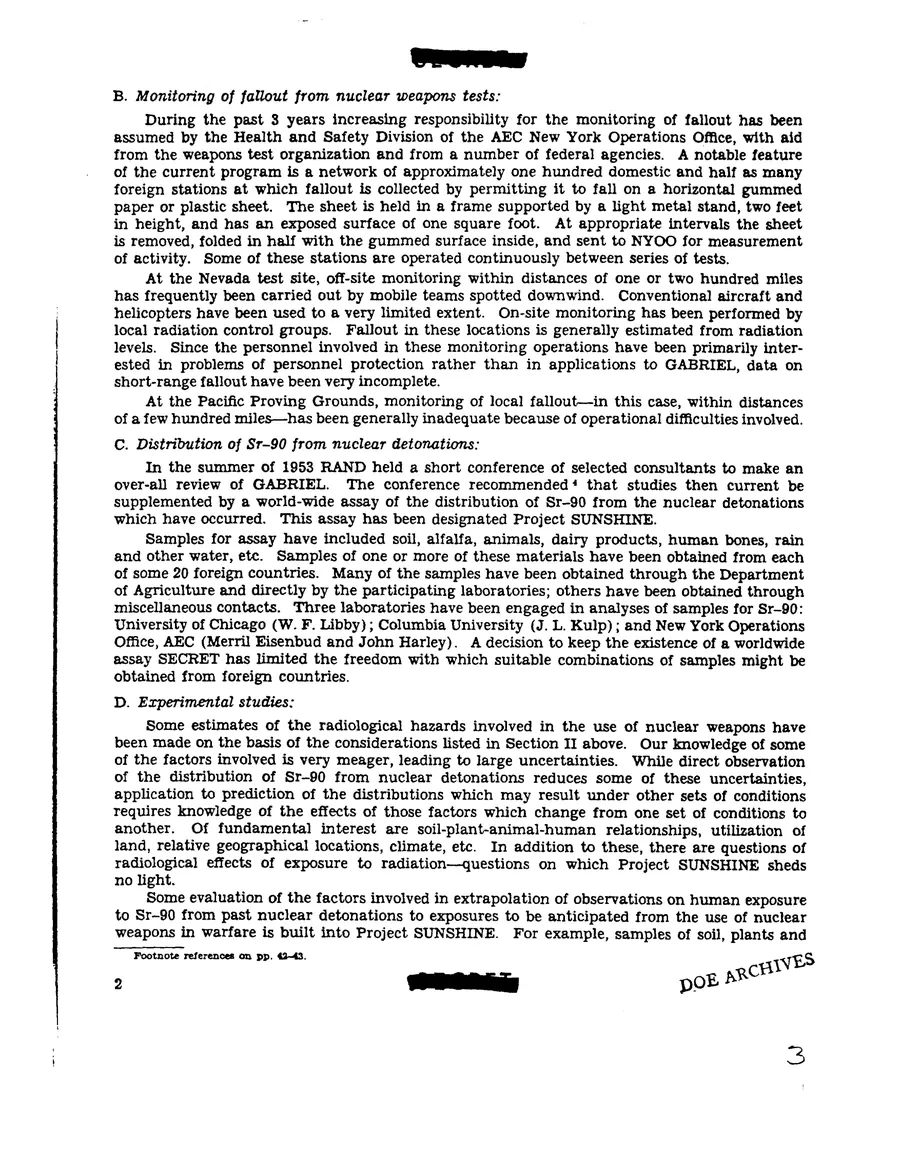
B. Monitoring of fallout from nuclear weapons tests:
During the past 3 years increasing responsibility for the monitoring of fallout has been assumed by the Health and Safety Division of the AEC New York Operations Office, with aid from the weapons test organization and from a number of federal agencies. A notable feature of the current program is a network of approximately one hundred domestic and half as many foreign stations at which fallout is collected by permitting it to fall on a horizontal gummed paper or plastic sheet. The sheet is held in a frame supported by a light metal stand, two feet in height, and has an exposed surface of one square foot. At appropriate intervals the sheet is removed, folded in half with the gummed surface inside, and sent to NYOO for measurement of activity. Some of these stations are operated continuously between series of tests.
At the Nevada test site, off-site monitoring within distances of one or two hundred miles has frequently been carried out by mobile teams spotted downwind. Conventional aircraft and helicopters have been used to a very limited extent. On-site monitoring has been performed by local radiation control groups. Fallout in these locations is generally estimated from radiation levels. Since the personnel involved in these monitoring operations have been primarily interested in problems of personnel protection rather than in applications to GABRIEL, data on short-range fallout have been very incomplete.
At the Pacific Proving Grounds, monitoring of local fallout—in this case, within distances of a few hundred miles—has been generally inadequate because of operational difficulties involved.
C. Distribution of Sr-90 from nuclear detonations:
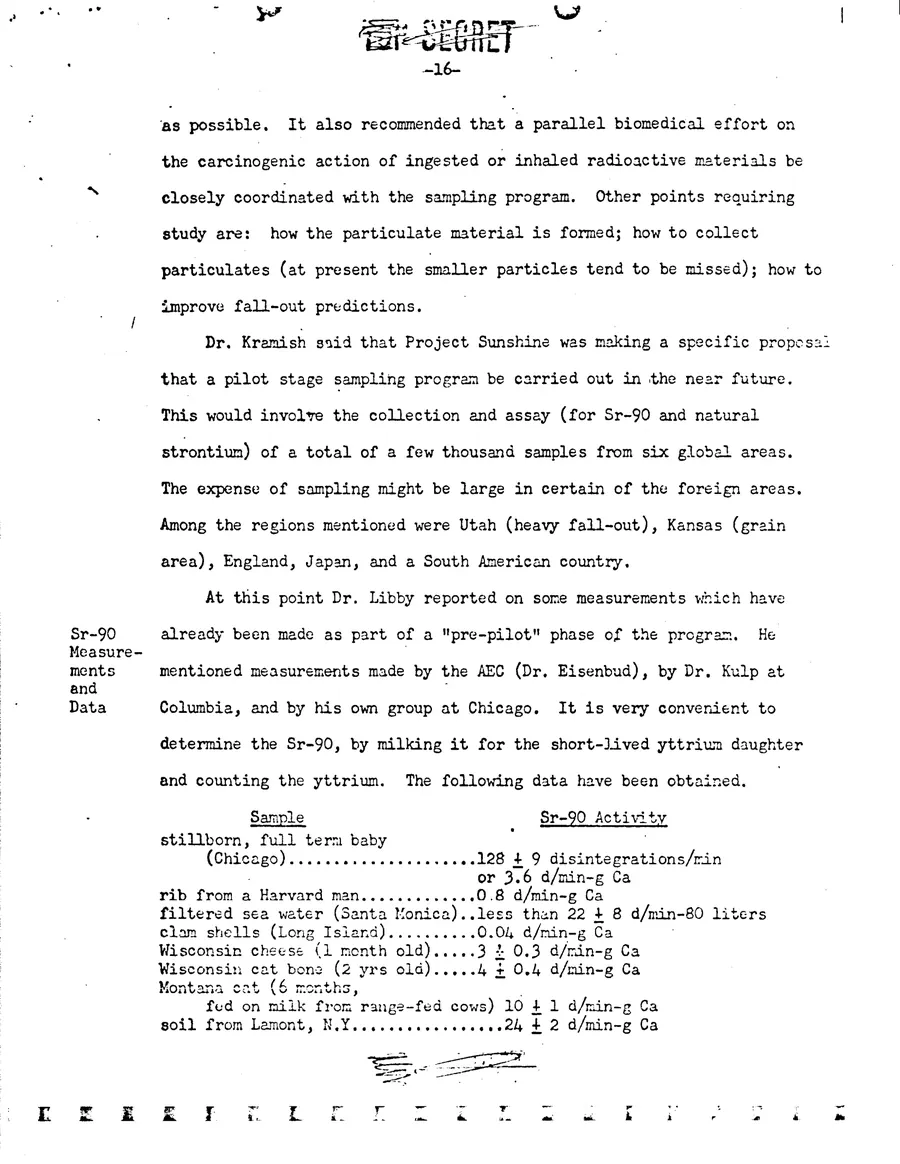
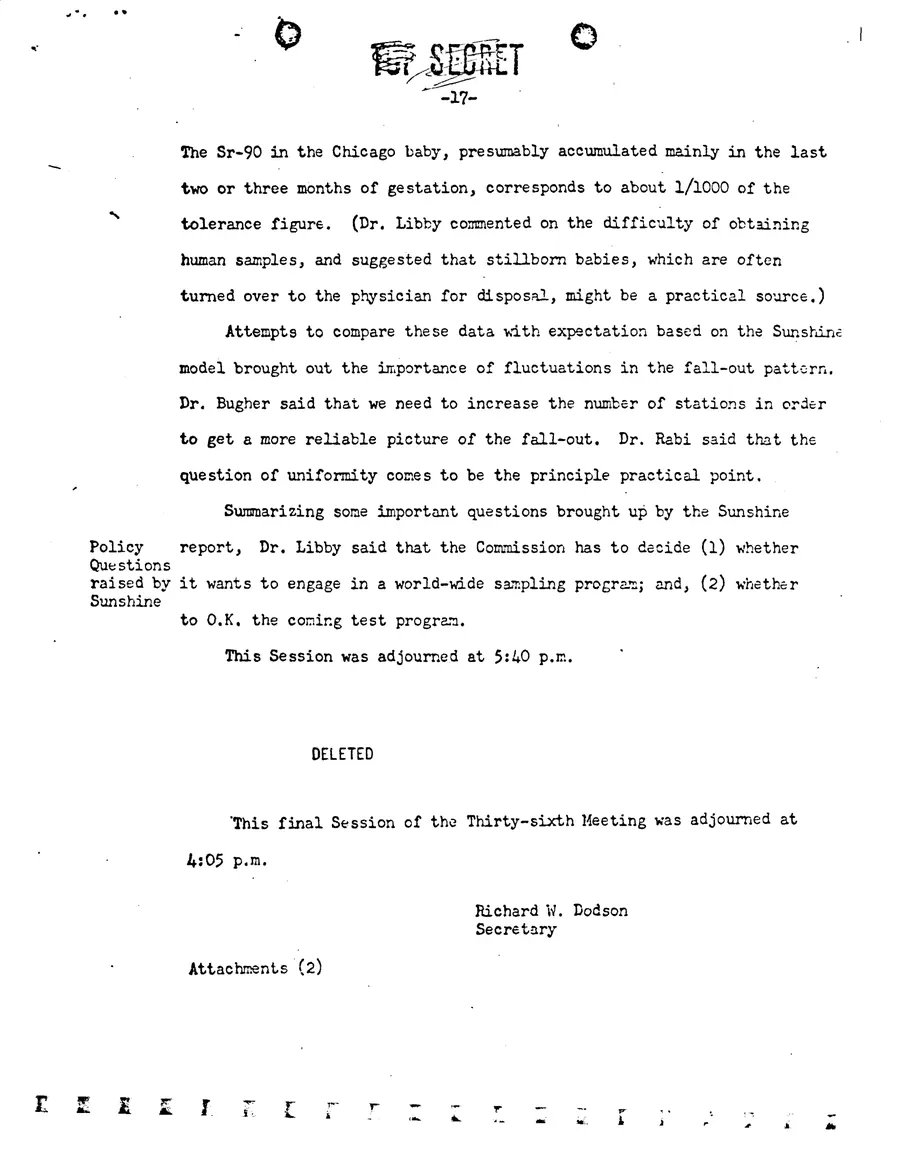
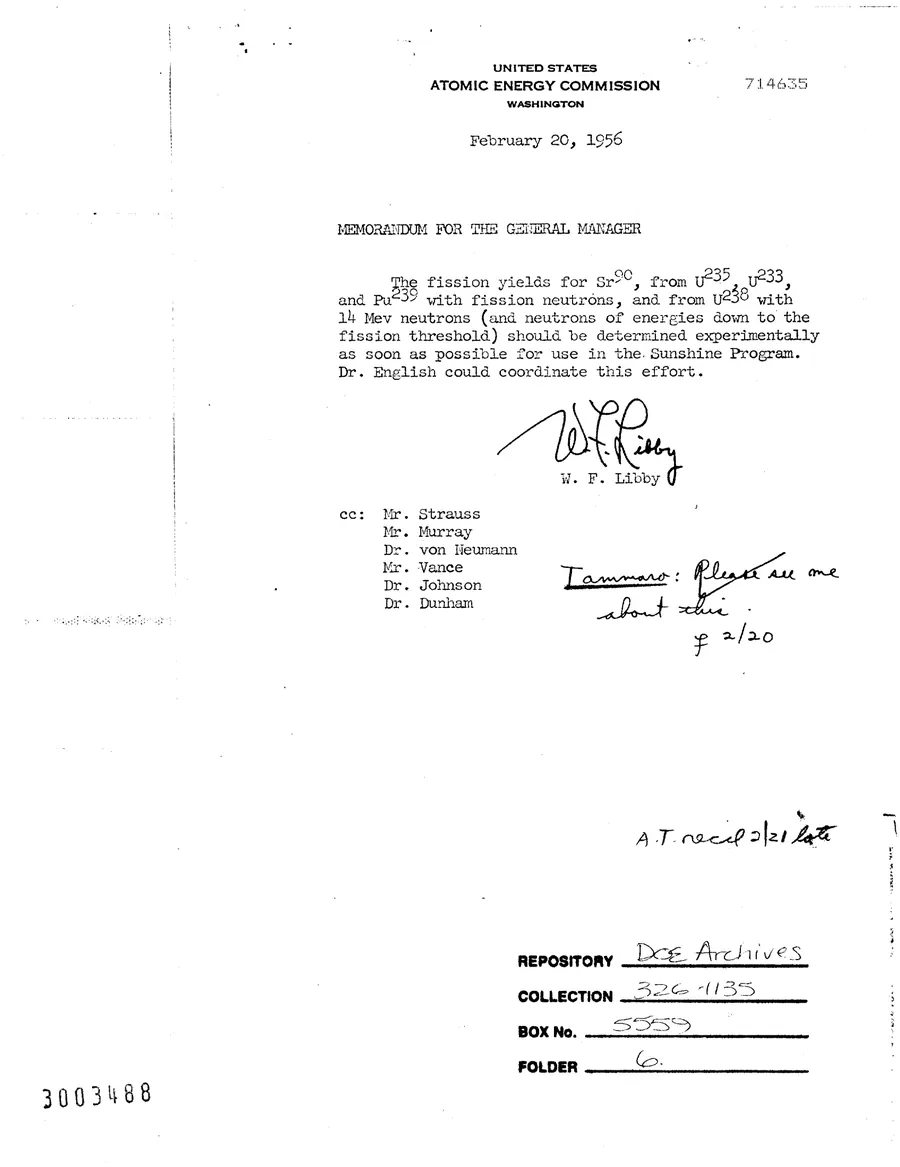
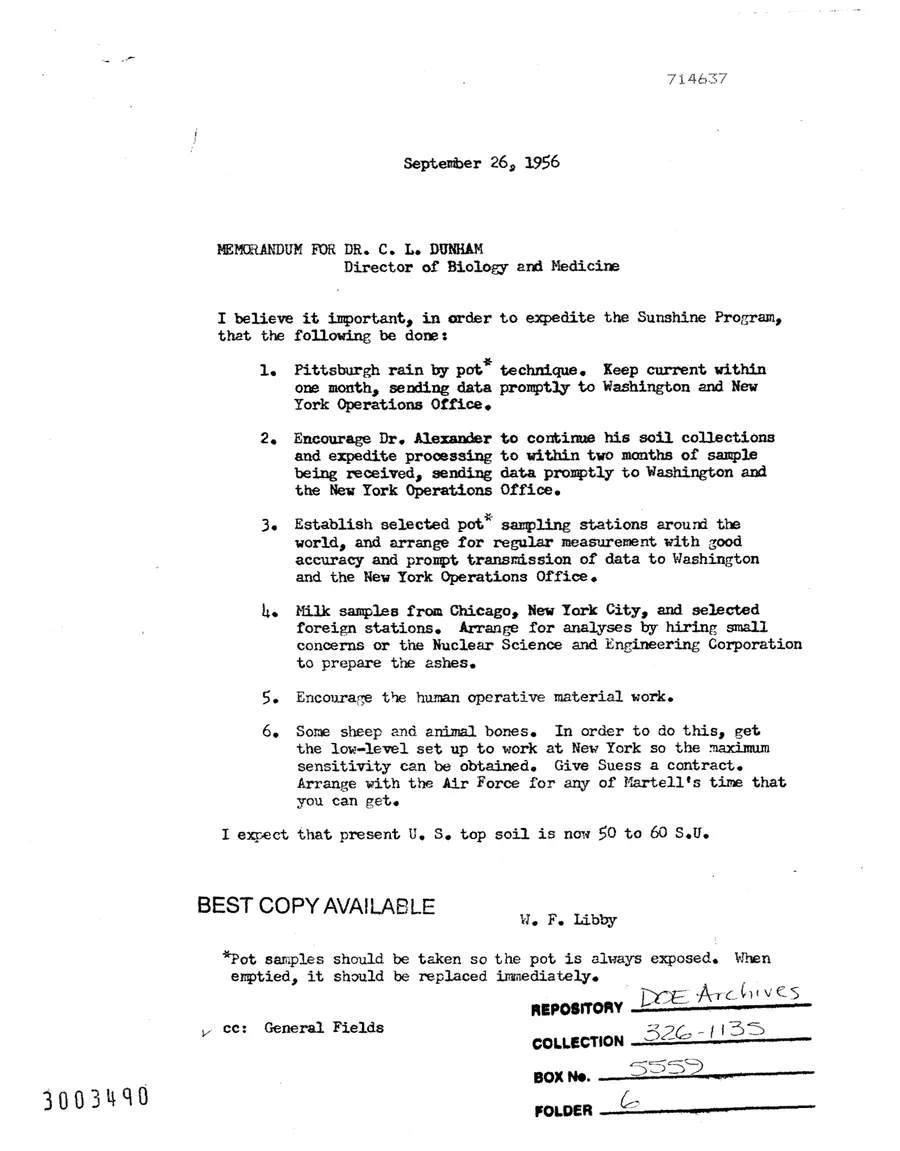
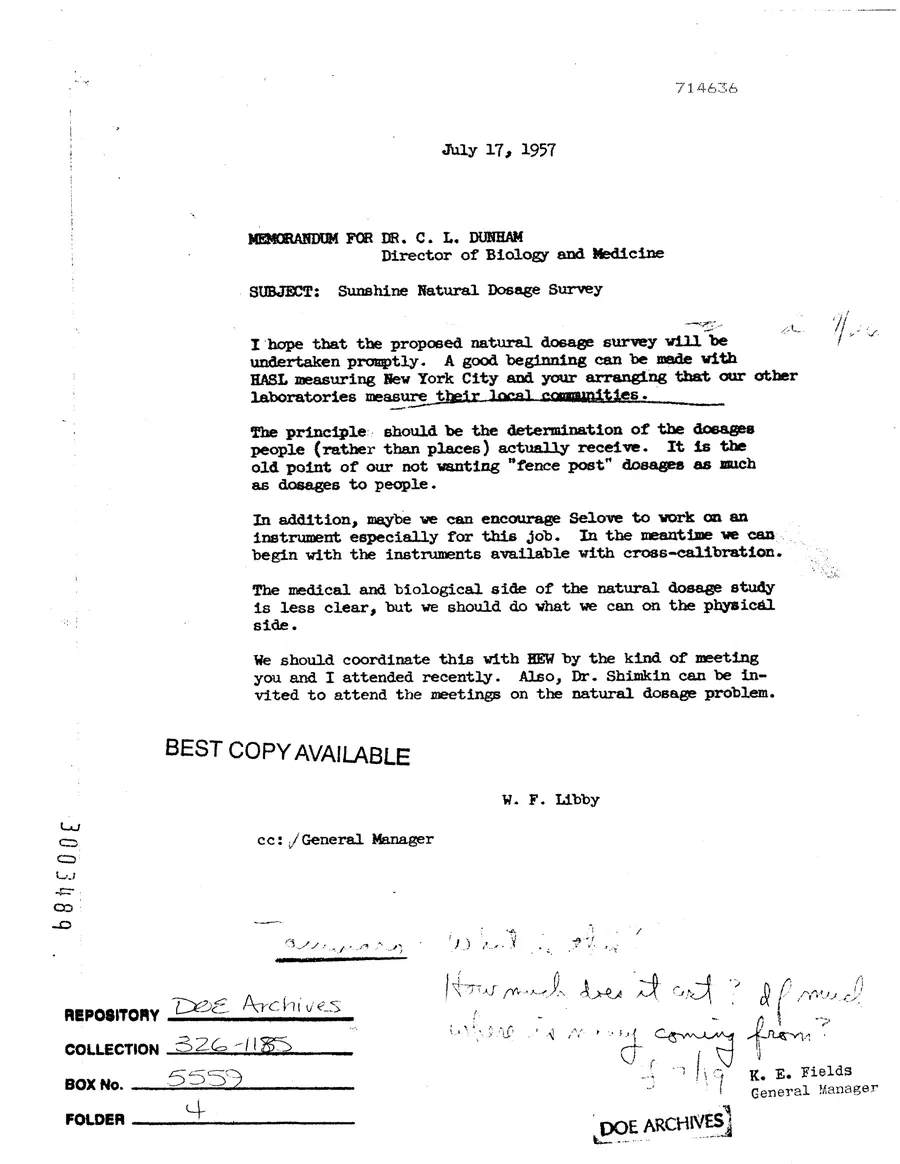
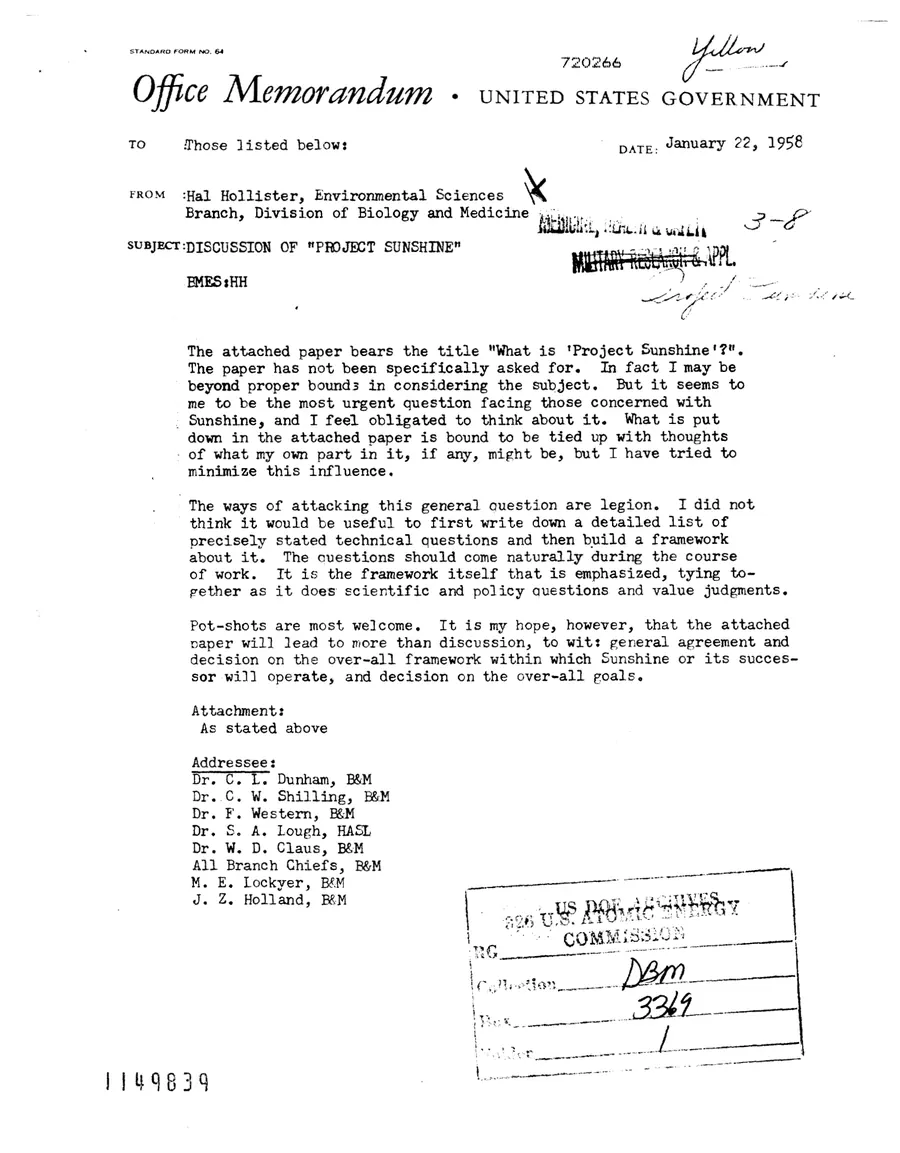
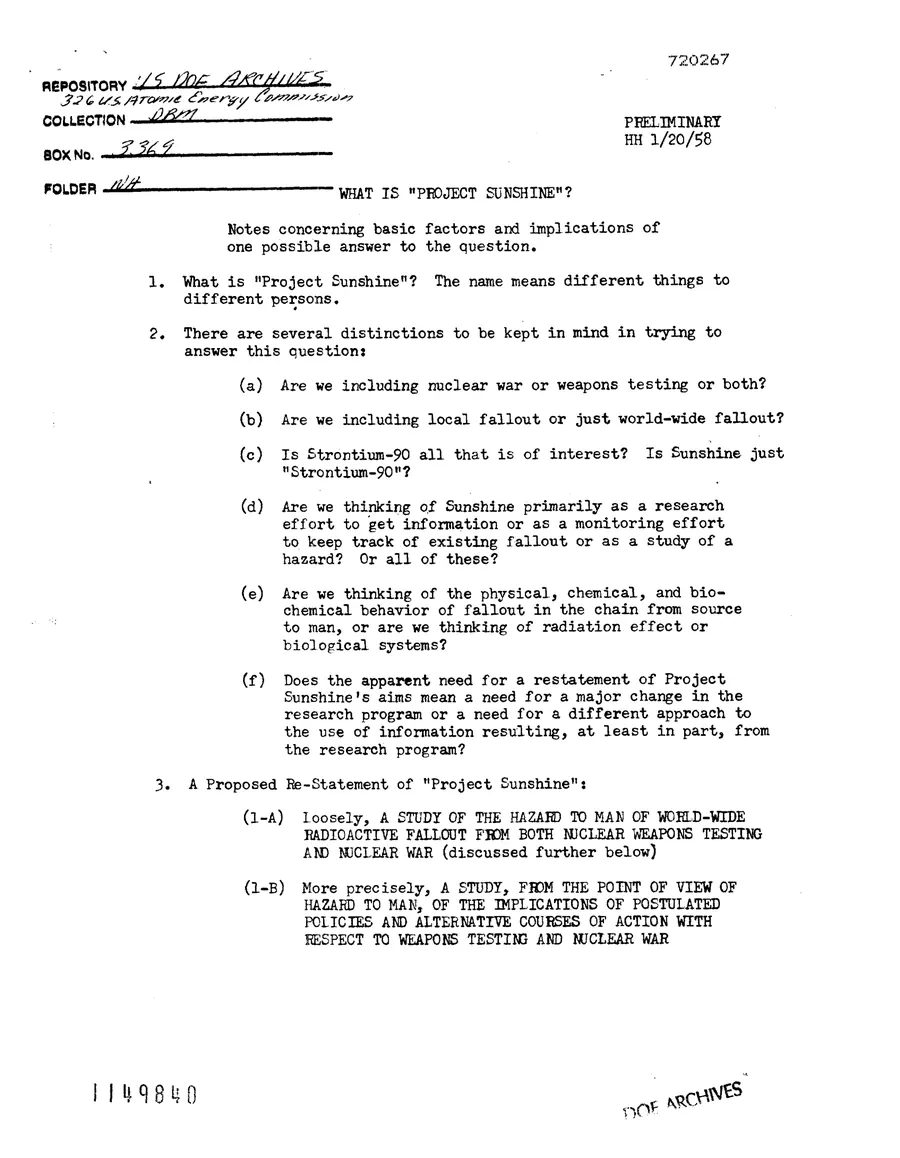
In the summer of 1953 RAND held a short conference of selected consultants to make an over-all review of GABRIEL. The conference recommended^4 that studies then current be supplemented by a world-wide assay of the distribution of Sr-90 from the nuclear detonations which have occurred. This assay has been designated Project SUNSHINE.
Samples for assay have included soil, alfalfa, animals, dairy products, human bones, rain and other water, etc. Samples of one or more of these materials have been obtained from each of some 20 foreign countries. Many of the samples have been obtained through the Department of Agriculture and directly by the participating laboratories; others have been obtained through miscellaneous contacts. Three laboratories have been engaged in analyses of samples for Sr-90: University of Chicago (W. F. Libby); Columbia University (J. L. Kulp); and New York Operations Office, AEC (Merril Eisenbud and John Harley). A decision to keep the existence of a worldwide assay SECRET has limited the freedom with which suitable combinations of samples might be obtained from foreign countries.
D. Experimental studies:
Some estimates of the radiological hazards involved in the use of nuclear weapons have been made on the basis of the considerations listed in Section II above. Our knowledge of some of the factors involved is very meager, leading to large uncertainties. While direct observation of the distribution of Sr-90 from nuclear detonations reduces some of these uncertainties, application to prediction of the distributions which may result under other sets of conditions requires knowledge of the effects of those factors which change from one set of conditions to another. Of fundamental interest are soil-plant-animal-human relationships, utilization of land, relative geographical locations, climate, etc. In addition to these, there are questions of radiological effects of exposure to radiation—questions on which Project SUNSHINE sheds no light.
Some evaluation of the factors involved in extrapolation of observations on human exposure to Sr-90 from past nuclear detonations to exposures to be anticipated from the use of nuclear weapons in warfare is built into Project SUNSHINE. For example, samples of soil, plants and
SECRET (obliterated, head) · SECRET (obliterated, foot) · DOE ARCHIVES (stamp, foot right) · handwritten leaf number 4 (foot right)
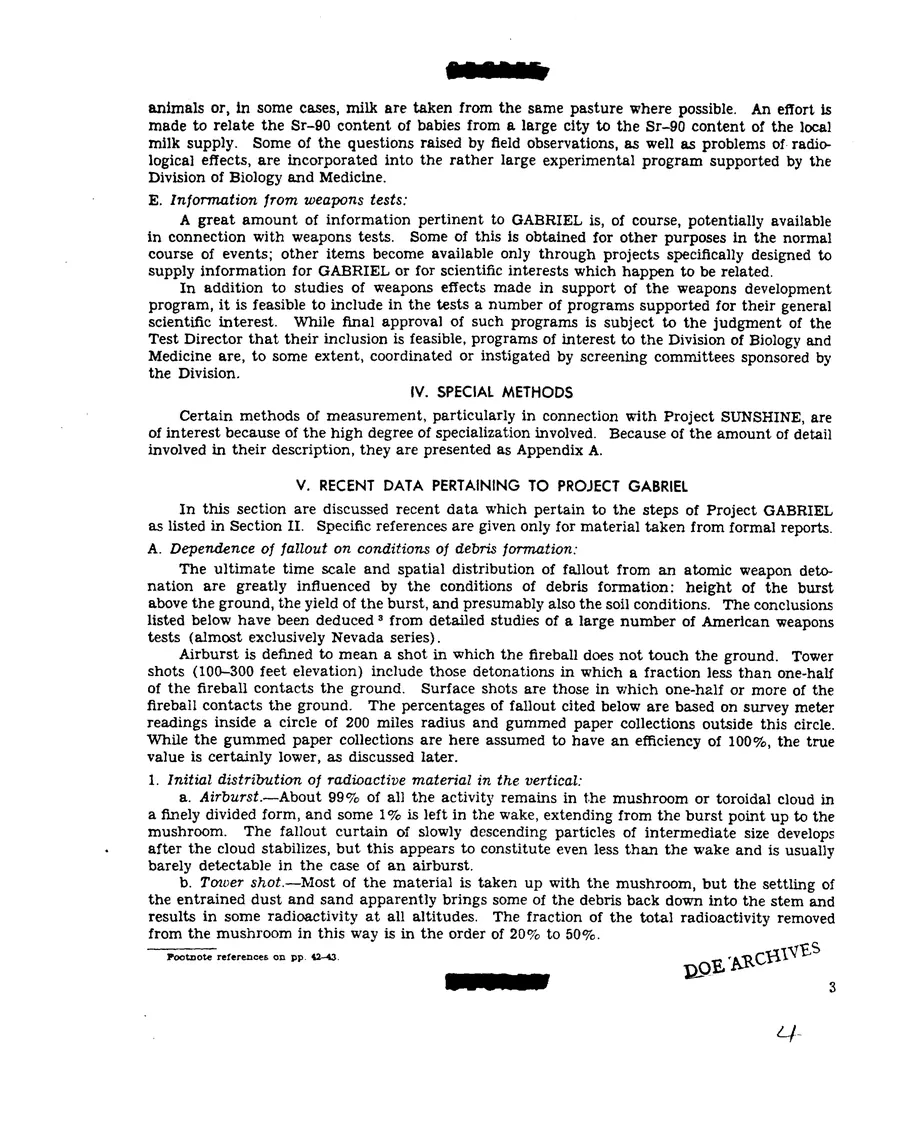
animals or, in some cases, milk are taken from the same pasture where possible. An effort is made to relate the Sr-90 content of babies from a large city to the Sr-90 content of the local milk supply. Some of the questions raised by field observations, as well as problems of radiological effects, are incorporated into the rather large experimental program supported by the Division of Biology and Medicine.
E. Information from weapons tests:
A great amount of information pertinent to GABRIEL is, of course, potentially available in connection with weapons tests. Some of this is obtained for other purposes in the normal course of events; other items become available only through projects specifically designed to supply information for GABRIEL or for scientific interests which happen to be related.
In addition to studies of weapons effects made in support of the weapons development program, it is feasible to include in the tests a number of programs supported for their general scientific interest. While final approval of such programs is subject to the judgment of the Test Director that their inclusion is feasible, programs of interest to the Division of Biology and Medicine are, to some extent, coordinated or instigated by screening committees sponsored by the Division.
IV. SPECIAL METHODS
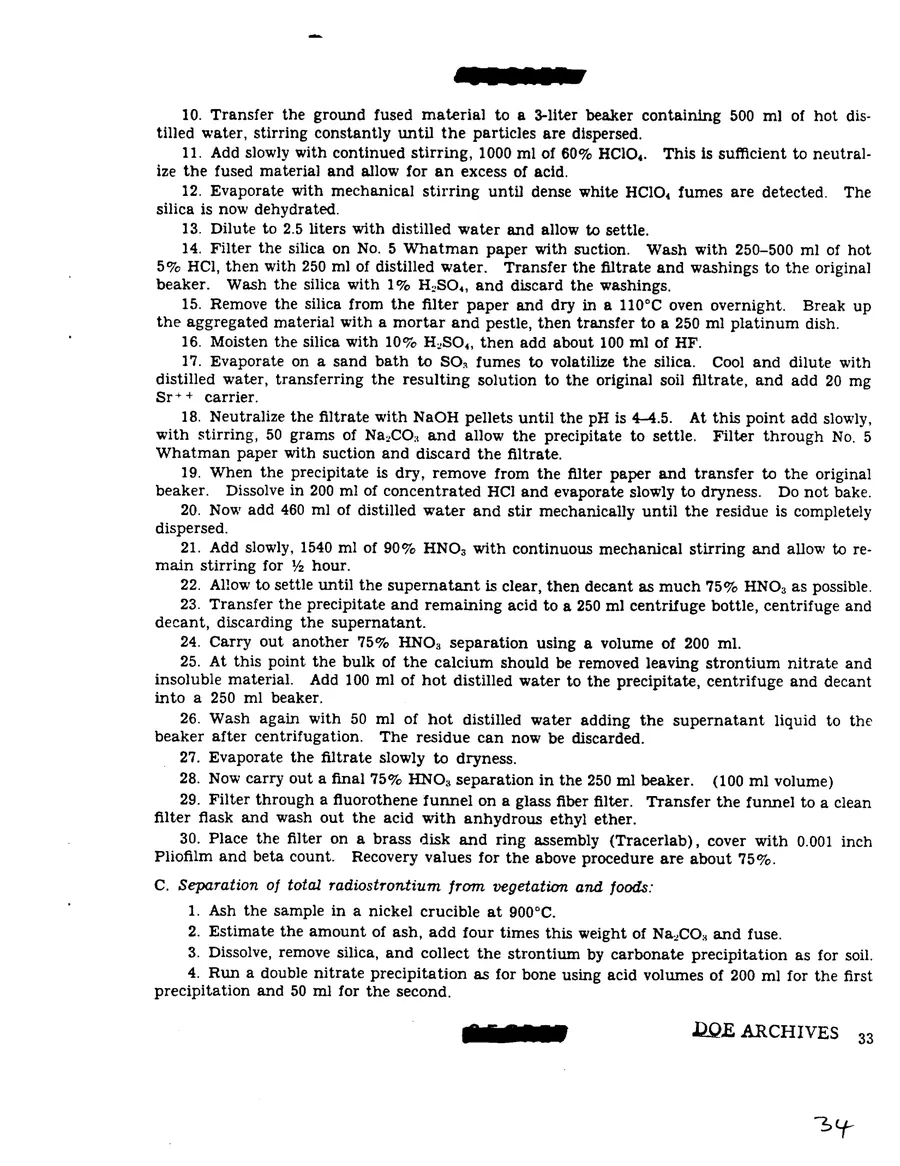
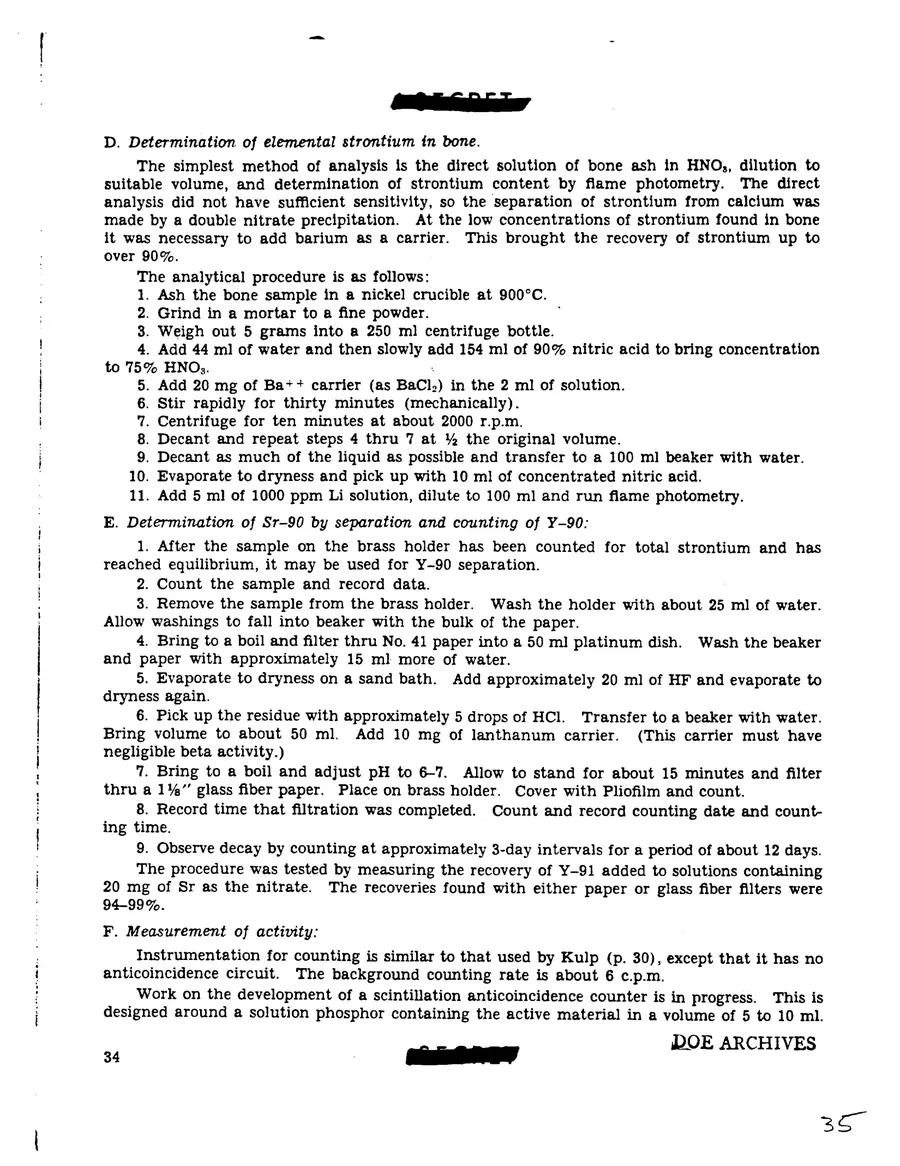
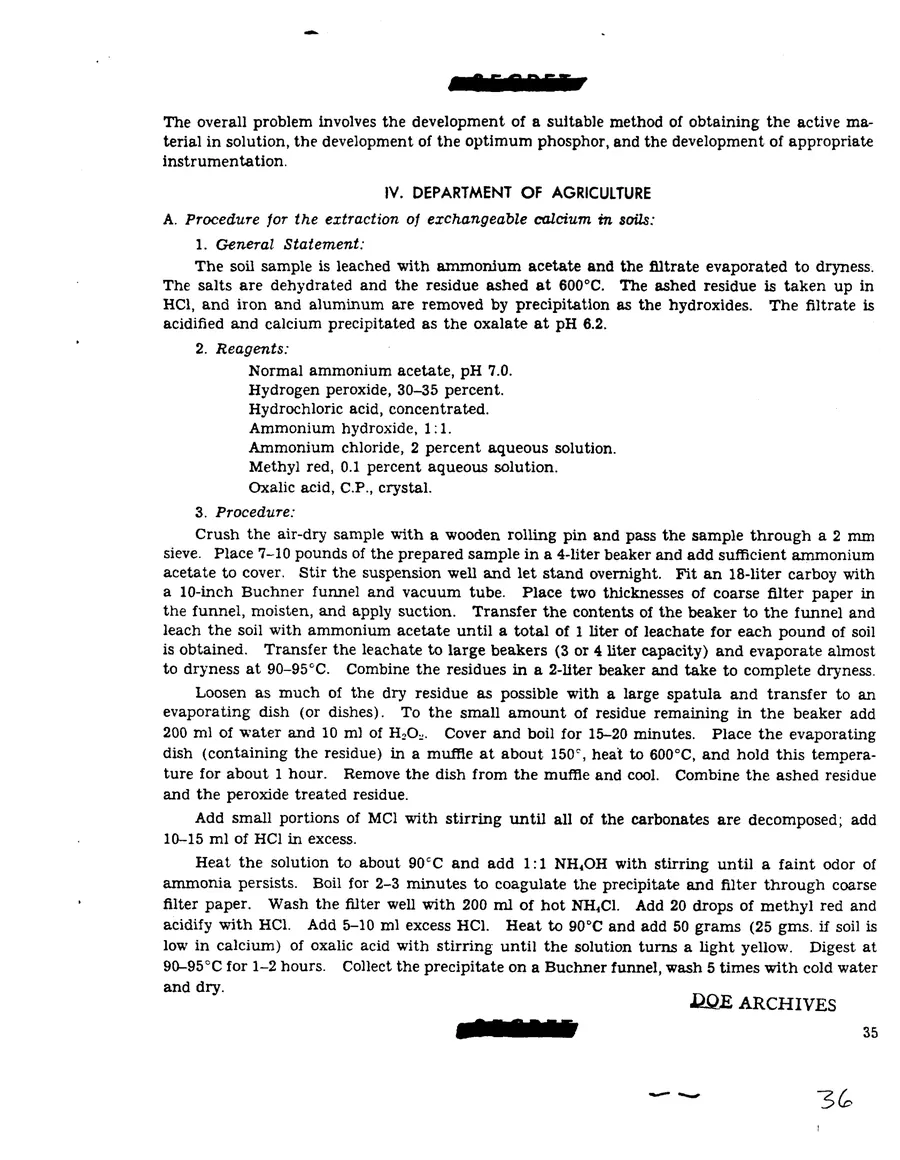
Certain methods of measurement, particularly in connection with Project SUNSHINE, are of interest because of the high degree of specialization involved. Because of the amount of detail involved in their description, they are presented as Appendix A.
V. RECENT DATA PERTAINING TO PROJECT GABRIEL
In this section are discussed recent data which pertain to the steps of Project GABRIEL as listed in Section II. Specific references are given only for material taken from formal reports.
A. Dependence of fallout on conditions of debris formation:
The ultimate time scale and spatial distribution of fallout from an atomic weapon detonation are greatly influenced by the conditions of debris formation: height of the burst above the ground, the yield of the burst, and presumably also the soil conditions. The conclusions listed below have been deduced^3 from detailed studies of a large number of American weapons tests (almost exclusively Nevada series).
Airburst is defined to mean a shot in which the fireball does not touch the ground. Tower shots (100-300 feet elevation) include those detonations in which a fraction less than one-half of the fireball contacts the ground. Surface shots are those in which one-half or more of the fireball contacts the ground. The percentages of fallout cited below are based on survey meter readings inside a circle of 200 miles radius and gummed paper collections outside this circle. While the gummed paper collections are here assumed to have an efficiency of 100%, the true value is certainly lower, as discussed later.
1. Initial distribution of radioactive material in the vertical:
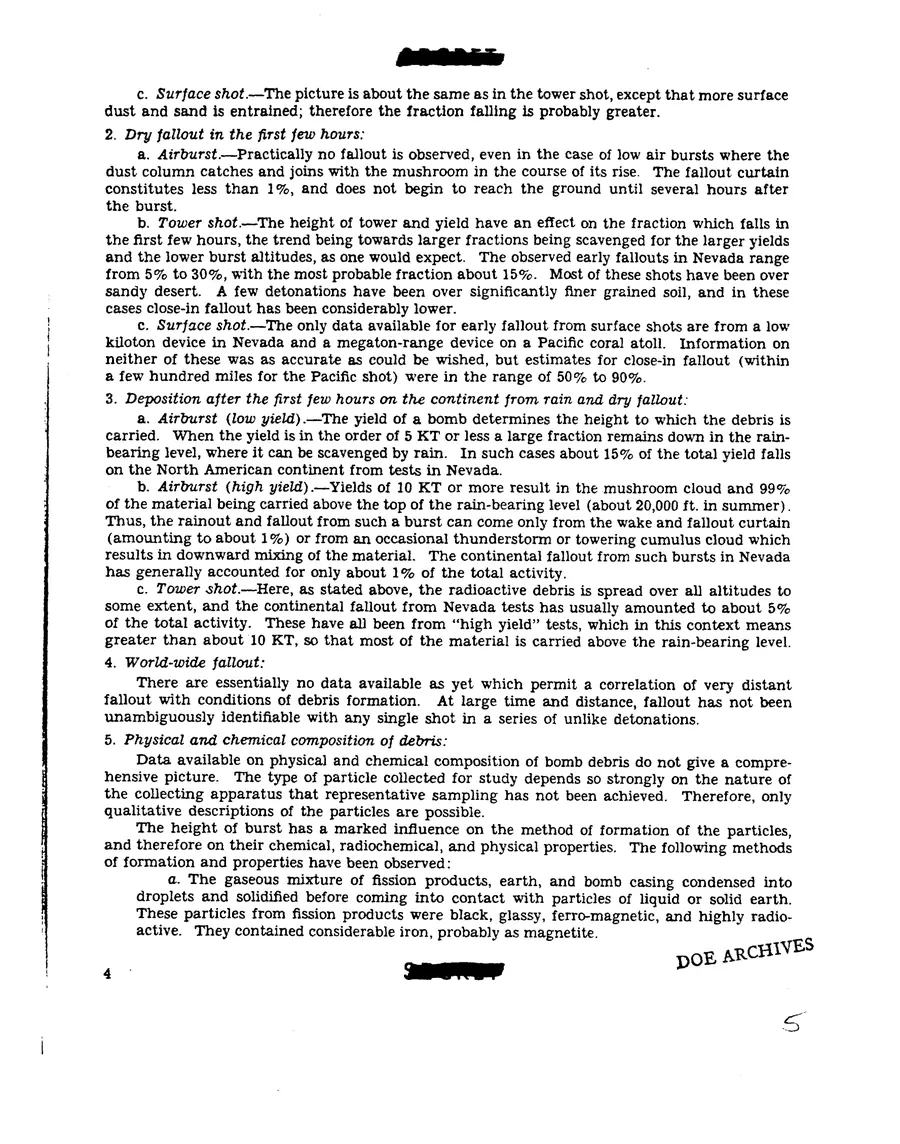
a. Airburst.—About 99% of all the activity remains in the mushroom or toroidal cloud in a finely divided form, and some 1% is left in the wake, extending from the burst point up to the mushroom. The fallout curtain of slowly descending particles of intermediate size develops after the cloud stabilizes, but this appears to constitute even less than the wake and is usually barely detectable in the case of an airburst.
b. Tower shot.—Most of the material is taken up with the mushroom, but the settling of the entrained dust and sand apparently brings some of the debris back down into the stem and results in some radioactivity at all altitudes. The fraction of the total radioactivity removed from the mushroom in this way is in the order of 20% to 50%.
SECRET (obliterated, head) · SECRET (obliterated, foot) · DOE ARCHIVES (stamp, foot right) · handwritten leaf number 5 (foot right)
c. Surface shot.—The picture is about the same as in the tower shot, except that more surface dust and sand is entrained; therefore the fraction falling is probably greater.
2. Dry fallout in the first few hours:
a. Airburst.—Practically no fallout is observed, even in the case of low air bursts where the dust column catches and joins with the mushroom in the course of its rise. The fallout curtain constitutes less than 1%, and does not begin to reach the ground until several hours after the burst.
b. Tower shot.—The height of tower and yield have an effect on the fraction which falls in the first few hours, the trend being towards larger fractions being scavenged for the larger yields and the lower burst altitudes, as one would expect. The observed early fallouts in Nevada range from 5% to 30%, with the most probable fraction about 15%. Most of these shots have been over sandy desert. A few detonations have been over significantly finer grained soil, and in these cases close-in fallout has been considerably lower.
c. Surface shot.—The only data available for early fallout from surface shots are from a low kiloton device in Nevada and a megaton-range device on a Pacific coral atoll. Information on neither of these was as accurate as could be wished, but estimates for close-in fallout (within a few hundred miles for the Pacific shot) were in the range of 50% to 90%.
3. Deposition after the first few hours on the continent from rain and dry fallout:
a. Airburst (low yield).—The yield of a bomb determines the height to which the debris is carried. When the yield is in the order of 5 KT or less a large fraction remains down in the rain-bearing level, where it can be scavenged by rain. In such cases about 15% of the total yield falls on the North American continent from tests in Nevada.
b. Airburst (high yield).—Yields of 10 KT or more result in the mushroom cloud and 99% of the material being carried above the top of the rain-bearing level (about 20,000 ft. in summer). Thus, the rainout and fallout from such a burst can come only from the wake and fallout curtain (amounting to about 1%) or from an occasional thunderstorm or towering cumulus cloud which results in downward mixing of the material. The continental fallout from such bursts in Nevada has generally accounted for only about 1% of the total activity.
c. Tower shot.—Here, as stated above, the radioactive debris is spread over all altitudes to some extent, and the continental fallout from Nevada tests has usually amounted to about 5% of the total activity. These have all been from “high yield” tests, which in this context means greater than about 10 KT, so that most of the material is carried above the rain-bearing level.
4. World-wide fallout:
There are essentially no data available as yet which permit a correlation of very distant fallout with conditions of debris formation. At large time and distance, fallout has not been unambiguously identifiable with any single shot in a series of unlike detonations.
5. Physical and chemical composition of debris:
Data available on physical and chemical composition of bomb debris do not give a comprehensive picture. The type of particle collected for study depends so strongly on the nature of the collecting apparatus that representative sampling has not been achieved. Therefore, only qualitative descriptions of the particles are possible.
The height of burst has a marked influence on the method of formation of the particles, and therefore on their chemical, radiochemical, and physical properties. The following methods of formation and properties have been observed:
a. The gaseous mixture of fission products, earth, and bomb casing condensed into droplets and solidified before coming into contact with particles of liquid or solid earth. These particles from fission products were black, glassy, ferro-magnetic, and highly radioactive. They contained considerable iron, probably as magnetite.
SECRET (obliterated, head) · SECRET (obliterated, foot) · DOE ARCHIVES (stamp, foot right) · handwritten leaf number 6 (foot right)
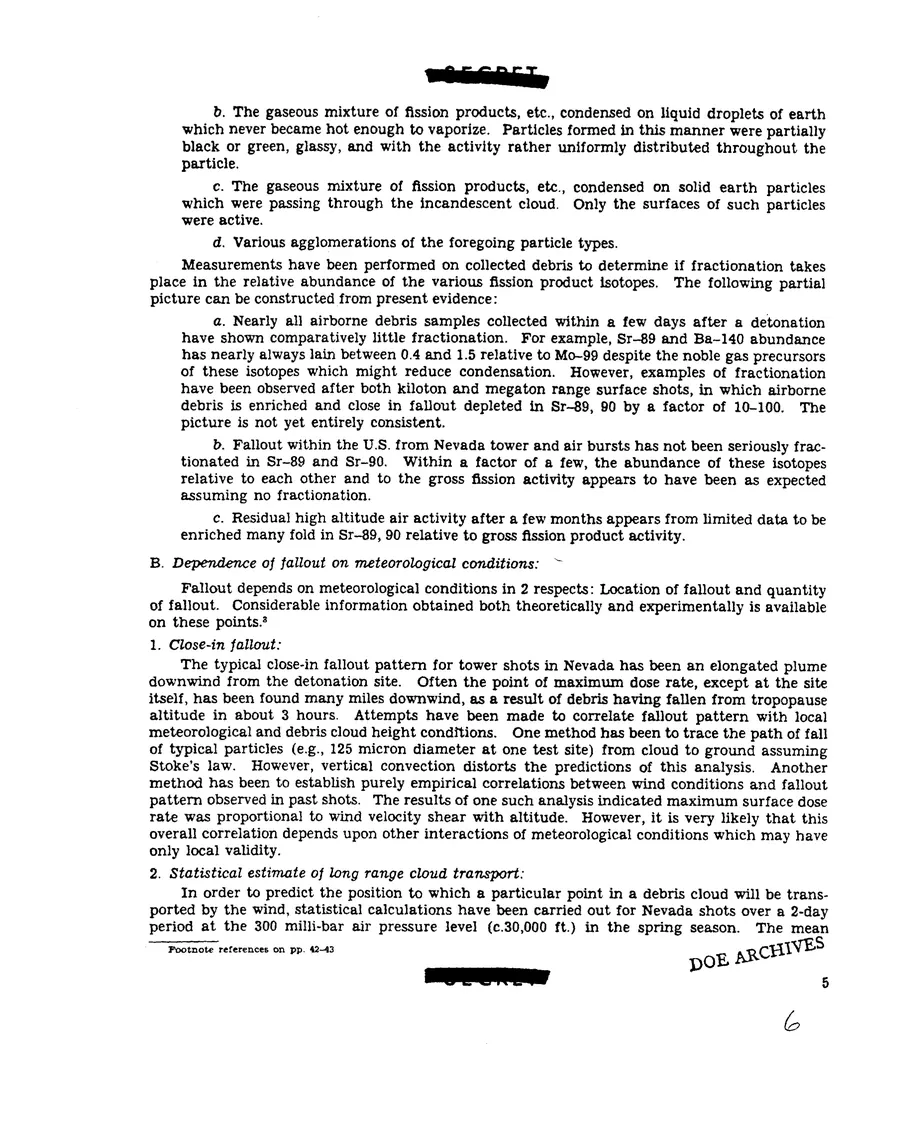
b. The gaseous mixture of fission products, etc., condensed on liquid droplets of earth which never became hot enough to vaporize. Particles formed in this manner were partially black or green, glassy, and with the activity rather uniformly distributed throughout the particle.
c. The gaseous mixture of fission products, etc., condensed on solid earth particles which were passing through the incandescent cloud. Only the surfaces of such particles were active.
d. Various agglomerations of the foregoing particle types.
Measurements have been performed on collected debris to determine if fractionation takes place in the relative abundance of the various fission product isotopes. The following partial picture can be constructed from present evidence:
a. Nearly all airborne debris samples collected within a few days after a detonation have shown comparatively little fractionation. For example, Sr-89 and Ba-140 abundance has nearly always lain between 0.4 and 1.5 relative to Mo-99 despite the noble gas precursors of these isotopes which might reduce condensation. However, examples of fractionation have been observed after both kiloton and megaton range surface shots, in which airborne debris is enriched and close in fallout depleted in Sr-89, 90 by a factor of 10-100. The picture is not yet entirely consistent.
b. Fallout within the U.S. from Nevada tower and air bursts has not been seriously fractionated in Sr-89 and Sr-90. Within a factor of a few, the abundance of these isotopes relative to each other and to the gross fission activity appears to have been as expected assuming no fractionation.
c. Residual high altitude air activity after a few months appears from limited data to be enriched many fold in Sr-89, 90 relative to gross fission product activity.
B. Dependence of fallout on meteorological conditions:
Fallout depends on meteorological conditions in 2 respects: Location of fallout and quantity of fallout. Considerable information obtained both theoretically and experimentally is available on these points.^3
1. Close-in fallout:
The typical close-in fallout pattern for tower shots in Nevada has been an elongated plume downwind from the detonation site. Often the point of maximum dose rate, except at the site itself, has been found many miles downwind, as a result of debris having fallen from tropopause altitude in about 3 hours. Attempts have been made to correlate fallout pattern with local meteorological and debris cloud height conditions. One method has been to trace the path of fall of typical particles (e.g., 125 micron diameter at one test site) from cloud to ground assuming Stoke's law. However, vertical convection distorts the predictions of this analysis. Another method has been to establish purely empirical correlations between wind conditions and fallout pattern observed in past shots. The results of one such analysis indicated maximum surface dose rate was proportional to wind velocity shear with altitude. However, it is very likely that this overall correlation depends upon other interactions of meteorological conditions which may have only local validity.
2. Statistical estimate of long range cloud transport:
In order to predict the position to which a particular point in a debris cloud will be transported by the wind, statistical calculations have been carried out for Nevada shots over a 2-day period at the 300 milli-bar air pressure level (c.30,000 ft.) in the spring season. The mean
Footnote references on pp. 42-43
Textual notes on this leaf (2)
Stoke's law
Reads 'Stoke's' where 'Stokes' law' would be expected. The document's own usage. PRESERVED as written.
Footnote references on pp. 42-43
The footnote line on this page has no closing full stop, unlike the same line on the other pages. PRESERVED as written.
SECRET (obliterated, head) · SECRET (obliterated, foot) · DOE ARCHIVES (stamp, foot right) · handwritten leaf number 7 (foot right)
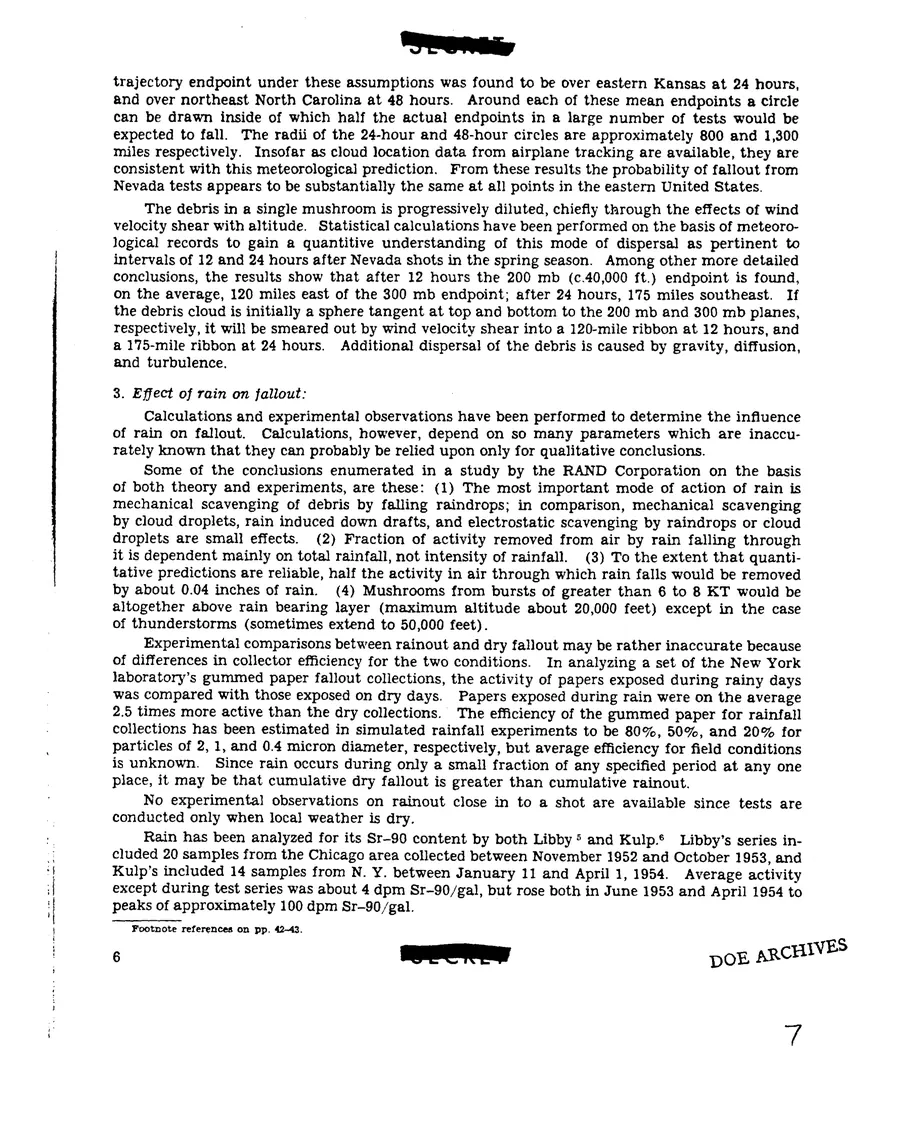
trajectory endpoint under these assumptions was found to be over eastern Kansas at 24 hours, and over northeast North Carolina at 48 hours. Around each of these mean endpoints a circle can be drawn inside of which half the actual endpoints in a large number of tests would be expected to fall. The radii of the 24-hour and 48-hour circles are approximately 800 and 1,300 miles respectively. Insofar as cloud location data from airplane tracking are available, they are consistent with this meteorological prediction. From these results the probability of fallout from Nevada tests appears to be substantially the same at all points in the eastern United States.
The debris in a single mushroom is progressively diluted, chiefly through the effects of wind velocity shear with altitude. Statistical calculations have been performed on the basis of meteorological records to gain a quantitive understanding of this mode of dispersal as pertinent to intervals of 12 and 24 hours after Nevada shots in the spring season. Among other more detailed conclusions, the results show that after 12 hours the 200 mb (c.40,000 ft.) endpoint is found, on the average, 120 miles east of the 300 mb endpoint; after 24 hours, 175 miles southeast. If the debris cloud is initially a sphere tangent at top and bottom to the 200 mb and 300 mb planes, respectively, it will be smeared out by wind velocity shear into a 120-mile ribbon at 12 hours, and a 175-mile ribbon at 24 hours. Additional dispersal of the debris is caused by gravity, diffusion, and turbulence.
3. Effect of rain on fallout:
Calculations and experimental observations have been performed to determine the influence of rain on fallout. Calculations, however, depend on so many parameters which are inaccurately known that they can probably be relied upon only for qualitative conclusions.
Some of the conclusions enumerated in a study by the RAND Corporation on the basis of both theory and experiments, are these: (1) The most important mode of action of rain is mechanical scavenging of debris by falling raindrops; in comparison, mechanical scavenging by cloud droplets, rain induced down drafts, and electrostatic scavenging by raindrops or cloud droplets are small effects. (2) Fraction of activity removed from air by rain falling through it is dependent mainly on total rainfall, not intensity of rainfall. (3) To the extent that quantitative predictions are reliable, half the activity in air through which rain falls would be removed by about 0.04 inches of rain. (4) Mushrooms from bursts of greater than 6 to 8 KT would be altogether above rain bearing layer (maximum altitude about 20,000 feet) except in the case of thunderstorms (sometimes extend to 50,000 feet).
Experimental comparisons between rainout and dry fallout may be rather inaccurate because of differences in collector efficiency for the two conditions. In analyzing a set of the New York laboratory's gummed paper fallout collections, the activity of papers exposed during rainy days was compared with those exposed on dry days. Papers exposed during rain were on the average 2.5 times more active than the dry collections. The efficiency of the gummed paper for rainfall collections has been estimated in simulated rainfall experiments to be 80%, 50%, and 20% for particles of 2, 1, and 0.4 micron diameter, respectively, but average efficiency for field conditions is unknown. Since rain occurs during only a small fraction of any specified period at any one place, it may be that cumulative dry fallout is greater than cumulative rainout.
No experimental observations on rainout close in to a shot are available since tests are conducted only when local weather is dry.
Rain has been analyzed for its Sr-90 content by both Libby^5 and Kulp.^6 Libby's series included 20 samples from the Chicago area collected between November 1952 and October 1953, and Kulp's included 14 samples from N. Y. between January 11 and April 1, 1954. Average activity except during test series was about 4 dpm Sr-90/gal, but rose both in June 1953 and April 1954 to peaks of approximately 100 dpm Sr-90/gal.
Footnote references on pp. 42-43.
Textual notes on this leaf (1)
quantitive
Reads 'quantitive' where 'quantitative' would be expected; the same page spells 'quantitative' correctly two paragraphs later. The document's own error. PRESERVED as written.
SECRET (obliterated, head) · SECRET (obliterated, foot) · DOE ARCHIVES (stamp, foot right) · handwritten leaf number 8 (foot right)
4. Atmospheric storage of debris:
The length of storage of debris in the atmosphere influences both the uniformity of geographical distribution of fallout and the rate at which it becomes available for oral uptake. The significance of height of burst and yield have already been mentioned. Storage is greater for airbursts than for tower shots than for surface shots. Also, it is greater for those shots whose cloud penetrates into the stratosphere than for those whose cloud remains in the troposphere than for those whose cloud remains in the rain-bearing layer. The mixture of the various types of shots in any one weapon test series has made it difficult to interpret observed storage in terms of these parameters. However, certain limits may be set from the experimental data now available.
Reasoning from present observed geographical distribution of fallout to storage time, one obtains a certain amount of information on this time. For tower or air shots in Nevada (spring, 1953), it is shown below that fallout per unit area in the eastern half of the United States was only a few times as great as that in western Europe. When allowance is made for spread in latitude of cloud trajectories at increased distance from detonation site, it appears that half life of storage under these conditions is greater than one week.
It is also shown below that an estimate of at least 15% of the debris from this same test series had fallen out by June 14, 1953. Allowing for gummed paper inefficiency and insufficient time for fallout from the final large shot, it seems probable that the half time for fallout was less than 2 months.
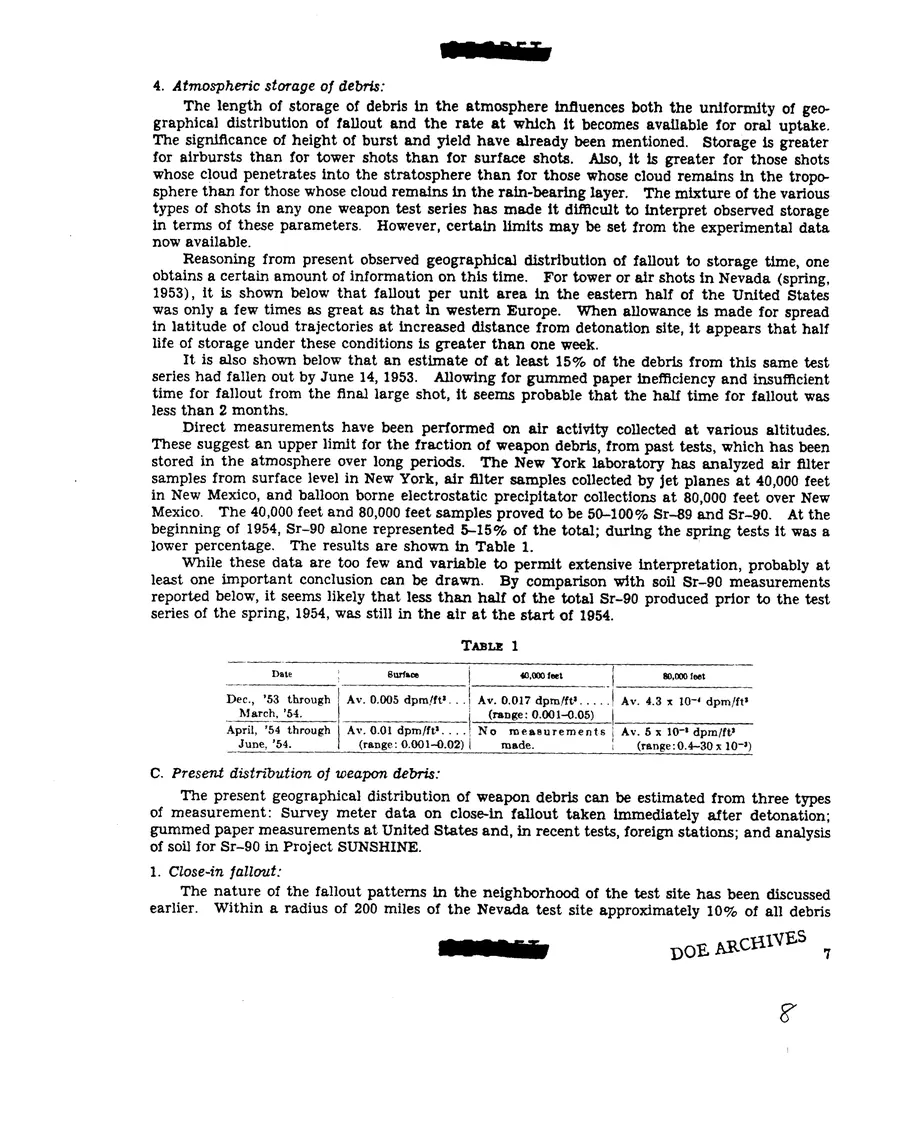
Direct measurements have been performed on air activity collected at various altitudes. These suggest an upper limit for the fraction of weapon debris, from past tests, which has been stored in the atmosphere over long periods. The New York laboratory has analyzed air filter samples from surface level in New York, air filter samples collected by jet planes at 40,000 feet in New Mexico, and balloon borne electrostatic precipitator collections at 80,000 feet over New Mexico. The 40,000 feet and 80,000 feet samples proved to be 50-100% Sr-89 and Sr-90. At the beginning of 1954, Sr-90 alone represented 5-15% of the total; during the spring tests it was a lower percentage. The results are shown in Table 1.
While these data are too few and variable to permit extensive interpretation, probably at least one important conclusion can be drawn. By comparison with soil Sr-90 measurements reported below, it seems likely that less than half of the total Sr-90 produced prior to the test series of the spring, 1954, was still in the air at the start of 1954.
TABLE 1
Date — Surface — 40,000 feet — 80,000 feet
Dec., '53 through March, '54. — Av. 0.005 dpm/ft^2 — Av. 0.017 dpm/ft^2 (range: 0.001-0.05) — Av. 4.3 x 10^{-4} dpm/ft^2
April, '54 through June, '54. — Av. 0.01 dpm/ft^2 (range: 0.001-0.02) — No measurements made. — Av. 5 x 10^{-3} dpm/ft^2 (range: 0.4-30 x 10^{-3})
C. Present distribution of weapon debris:
The present geographical distribution of weapon debris can be estimated from three types of measurement: Survey meter data on close-in fallout taken immediately after detonation; gummed paper measurements at United States and, in recent tests, foreign stations; and analysis of soil for Sr-90 in Project SUNSHINE.
1. Close-in fallout:
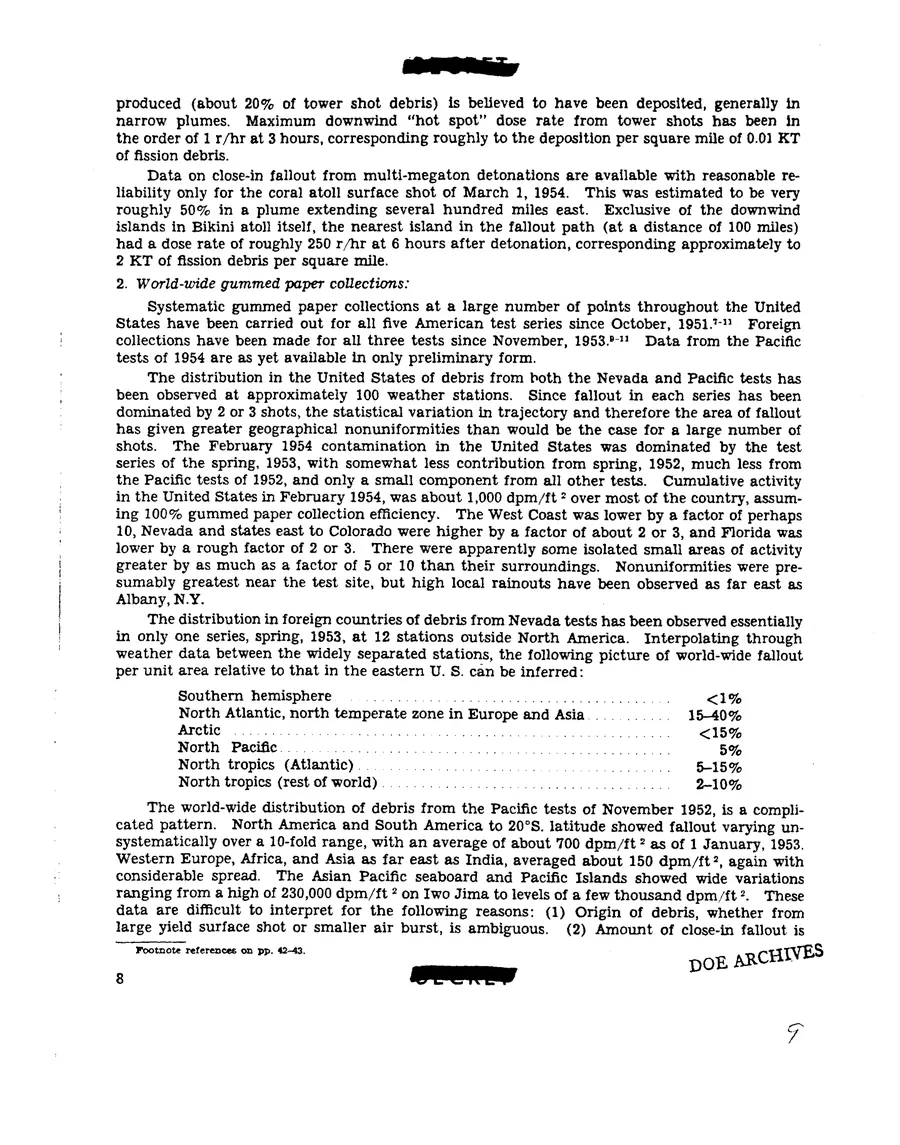
The nature of the fallout patterns in the neighborhood of the test site has been discussed earlier. Within a radius of 200 miles of the Nevada test site approximately 10% of all debris
Textual notes on this leaf (1)
TABLE 1
A four-column ruled table on the page. Set here row by row with em rules between the columns; the column heads are the document's. The exponents in the 80,000 feet column are small and partly filled in the scan: CONFIRM 10^{-4} and 10^{-3} against the raw scan.
SECRET (obliterated, head) · SECRET (obliterated, foot) · DOE ARCHIVES (stamp, foot right) · handwritten leaf number 9 (foot right)
produced (about 20% of tower shot debris) is believed to have been deposited, generally in narrow plumes. Maximum downwind “hot spot” dose rate from tower shots has been in the order of 1 r/hr at 3 hours, corresponding roughly to the deposition per square mile of 0.01 KT of fission debris.
Data on close-in fallout from multi-megaton detonations are available with reasonable reliability only for the coral atoll surface shot of March 1, 1954. This was estimated to be very roughly 50% in a plume extending several hundred miles east. Exclusive of the downwind islands in Bikini atoll itself, the nearest island in the fallout path (at a distance of 100 miles) had a dose rate of roughly 250 r/hr at 6 hours after detonation, corresponding approximately to 2 KT of fission debris per square mile.
2. World-wide gummed paper collections:
Systematic gummed paper collections at a large number of points throughout the United States have been carried out for all five American test series since October, 1951.^{7-11} Foreign collections have been made for all three tests since November, 1953.^{9-11} Data from the Pacific tests of 1954 are as yet available in only preliminary form.
The distribution in the United States of debris from both the Nevada and Pacific tests has been observed at approximately 100 weather stations. Since fallout in each series has been dominated by 2 or 3 shots, the statistical variation in trajectory and therefore the area of fallout has given greater geographical nonuniformities than would be the case for a large number of shots. The February 1954 contamination in the United States was dominated by the test series of the spring, 1953, with somewhat less contribution from spring, 1952, much less from the Pacific tests of 1952, and only a small component from all other tests. Cumulative activity in the United States in February 1954, was about 1,000 dpm/ft^2 over most of the country, assuming 100% gummed paper collection efficiency. The West Coast was lower by a factor of perhaps 10, Nevada and states east to Colorado were higher by a factor of about 2 or 3, and Florida was lower by a rough factor of 2 or 3. There were apparently some isolated small areas of activity greater by as much as a factor of 5 or 10 than their surroundings. Nonuniformities were presumably greatest near the test site, but high local rainouts have been observed as far east as Albany, N.Y.
The distribution in foreign countries of debris from Nevada tests has been observed essentially in only one series, spring, 1953, at 12 stations outside North America. Interpolating through weather data between the widely separated stations, the following picture of world-wide fallout per unit area relative to that in the eastern U. S. can be inferred:
Southern hemisphere . . . <1%
North Atlantic, north temperate zone in Europe and Asia . . . 15-40%
Arctic . . . <15%
North Pacific . . . 5%
North tropics (Atlantic) . . . 5-15%
North tropics (rest of world) . . . 2-10%
The world-wide distribution of debris from the Pacific tests of November 1952, is a complicated pattern. North America and South America to 20°S. latitude showed fallout varying unsystematically over a 10-fold range, with an average of about 700 dpm/ft^2 as of 1 January, 1953. Western Europe, Africa, and Asia as far east as India, averaged about 150 dpm/ft^2, again with considerable spread. The Asian Pacific seaboard and Pacific Islands showed wide variations ranging from a high of 230,000 dpm/ft^2 on Iwo Jima to levels of a few thousand dpm/ft^2. These data are difficult to interpret for the following reasons: (1) Origin of debris, whether from large yield surface shot or smaller air burst, is ambiguous. (2) Amount of close-in fallout is
SECRET (obliterated, head) · SECRET (obliterated, foot) · DOE ARCHIVES (stamp, foot right) · handwritten leaf number 10 (foot right)
completely unknown. (3) Complicated wind structure blew debris below 10,000 feet and above tropopause to the west, intervening debris to the east.
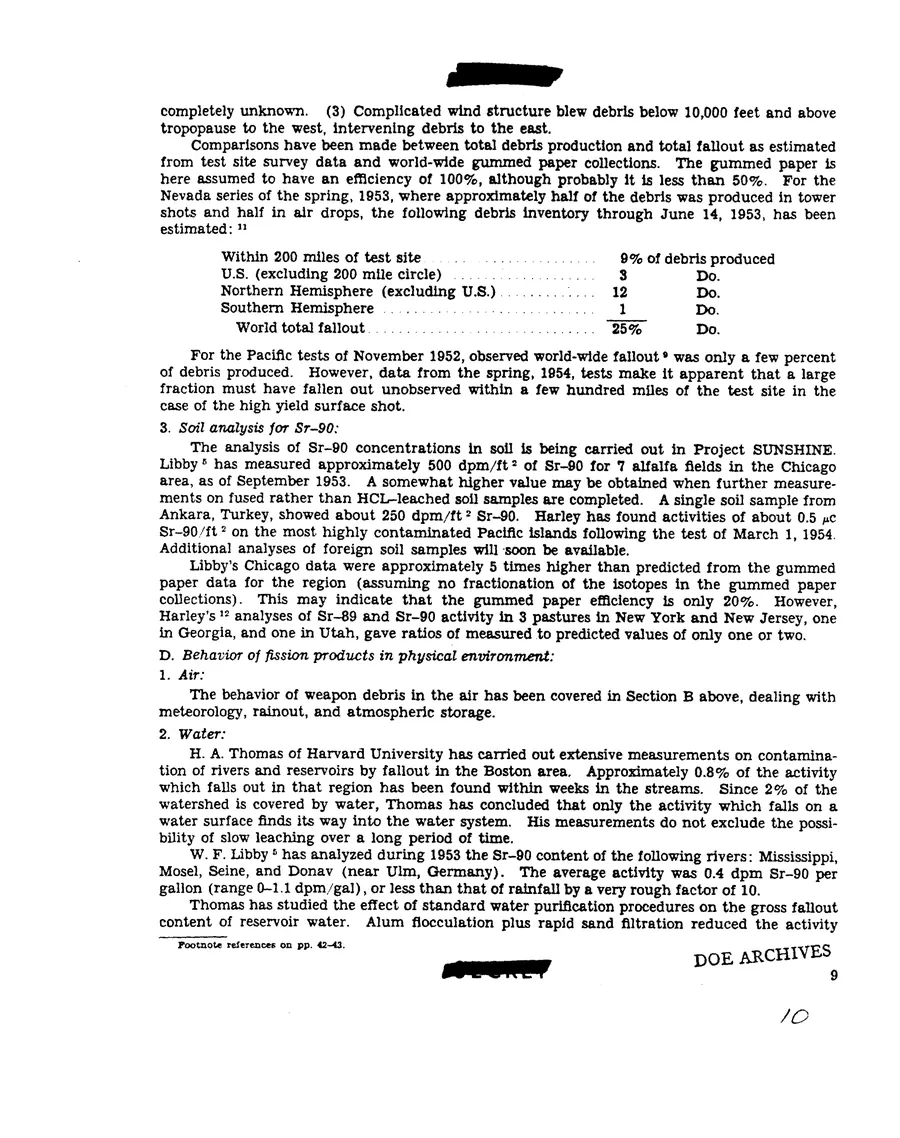
Comparisons have been made between total debris production and total fallout as estimated from test site survey data and world-wide gummed paper collections. The gummed paper is here assumed to have an efficiency of 100%, although probably it is less than 50%. For the Nevada series of the spring, 1953, where approximately half of the debris was produced in tower shots and half in air drops, the following debris inventory through June 14, 1953, has been estimated:^11
Within 200 miles of test site . . . 9% of debris produced
U.S. (excluding 200 mile circle) . . . 3 Do.
Northern Hemisphere (excluding U.S.) . . . 12 Do.
Southern Hemisphere . . . 1 Do.
World total fallout . . . 25% Do.
For the Pacific tests of November 1952, observed world-wide fallout^9 was only a few percent of debris produced. However, data from the spring, 1954, tests make it apparent that a large fraction must have fallen out unobserved within a few hundred miles of the test site in the case of the high yield surface shot.
3. Soil analysis for Sr-90:
The analysis of Sr-90 concentrations in soil is being carried out in Project SUNSHINE. Libby^5 has measured approximately 500 dpm/ft^2 of Sr-90 for 7 alfalfa fields in the Chicago area, as of September 1953. A somewhat higher value may be obtained when further measurements on fused rather than HCL-leached soil samples are completed. A single soil sample from Ankara, Turkey, showed about 250 dpm/ft^2 Sr-90. Harley has found activities of about 0.5 μc Sr-90/ft^2 on the most highly contaminated Pacific islands following the test of March 1, 1954. Additional analyses of foreign soil samples will soon be available.
Libby's Chicago data were approximately 5 times higher than predicted from the gummed paper data for the region (assuming no fractionation of the isotopes in the gummed paper collections). This may indicate that the gummed paper efficiency is only 20%. However, Harley's^12 analyses of Sr-89 and Sr-90 activity in 3 pastures in New York and New Jersey, one in Georgia, and one in Utah, gave ratios of measured to predicted values of only one or two.
D. Behavior of fission products in physical environment:
1. Air:
The behavior of weapon debris in the air has been covered in Section B above, dealing with meteorology, rainout, and atmospheric storage.
2. Water:
H. A. Thomas of Harvard University has carried out extensive measurements on contamination of rivers and reservoirs by fallout in the Boston area. Approximately 0.8% of the activity which falls out in that region has been found within weeks in the streams. Since 2% of the watershed is covered by water, Thomas has concluded that only the activity which falls on a water surface finds its way into the water system. His measurements do not exclude the possibility of slow leaching over a long period of time.
W. F. Libby^5 has analyzed during 1953 the Sr-90 content of the following rivers: Mississippi, Mosel, Seine, and Donav (near Ulm, Germany). The average activity was 0.4 dpm Sr-90 per gallon (range 0-1.1 dpm/gal), or less than that of rainfall by a very rough factor of 10.
Thomas has studied the effect of standard water purification procedures on the gross fallout content of reservoir water. Alum flocculation plus rapid sand filtration reduced the activity
Footnote references on pp. 42-43.
Textual notes on this leaf (2)
HCL-leached
Capital L in 'HCL' where the report elsewhere prints 'HCl'. The document's own inconsistency. PRESERVED as written.
Donav (near Ulm, Germany)
The Danube is spelled 'Donav'. The document's own spelling. PRESERVED as written.
SECRET (obliterated, head) · SECRET (obliterated, foot) · DOE ARCHIVES (stamp, foot right) · handwritten leaf number 11 (foot right)
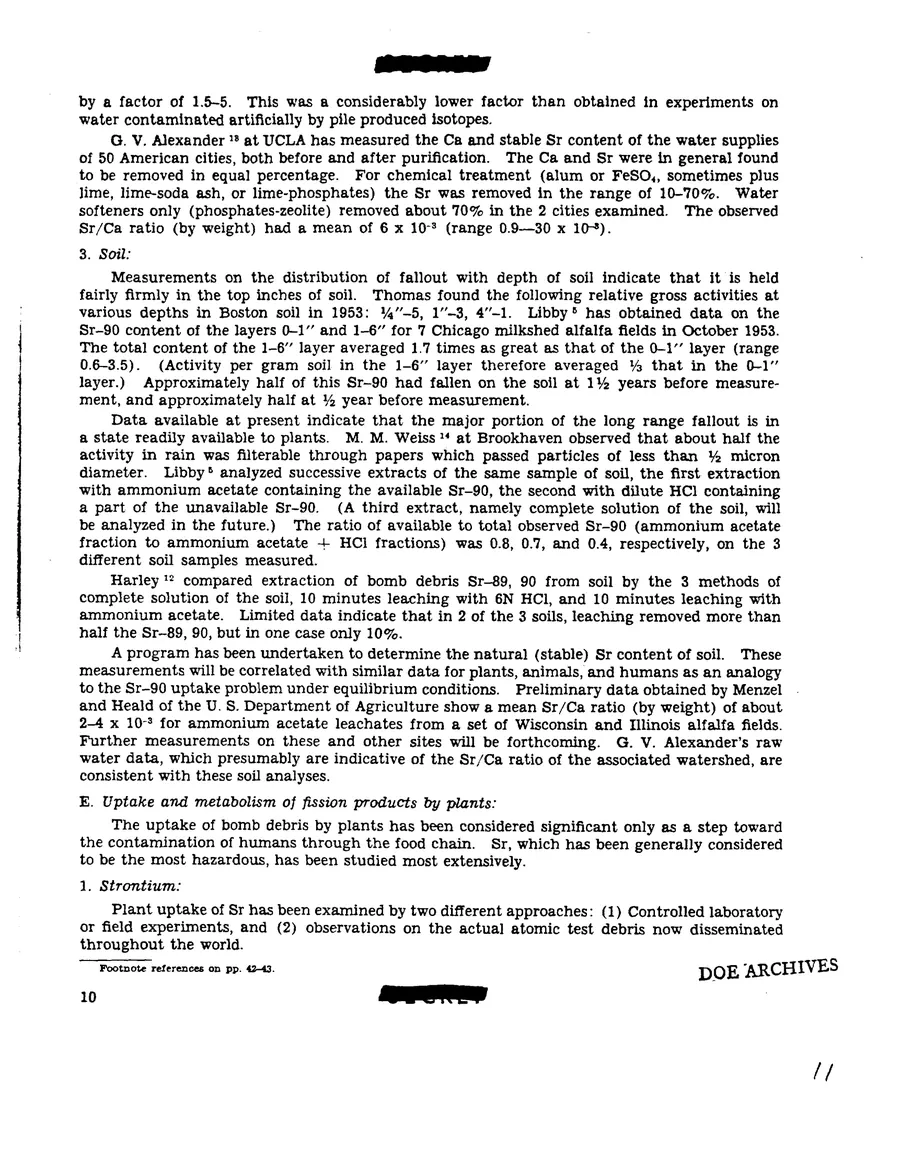
by a factor of 1.5-5. This was a considerably lower factor than obtained in experiments on water contaminated artificially by pile produced isotopes.
G. V. Alexander^13 at UCLA has measured the Ca and stable Sr content of the water supplies of 50 American cities, both before and after purification. The Ca and Sr were in general found to be removed in equal percentage. For chemical treatment (alum or FeSO_4, sometimes plus lime, lime-soda ash, or lime-phosphates) the Sr was removed in the range of 10-70%. Water softeners only (phosphates-zeolite) removed about 70% in the 2 cities examined. The observed Sr/Ca ratio (by weight) had a mean of 6 x 10^{-3} (range 0.9—30 x 10^{-3}).
3. Soil:
Measurements on the distribution of fallout with depth of soil indicate that it is held fairly firmly in the top inches of soil. Thomas found the following relative gross activities at various depths in Boston soil in 1953: ¼"-5, 1"-3, 4"-1. Libby^5 has obtained data on the Sr-90 content of the layers 0-1" and 1-6" for 7 Chicago milkshed alfalfa fields in October 1953. The total content of the 1-6" layer averaged 1.7 times as great as that of the 0-1" layer (range 0.6-3.5). (Activity per gram soil in the 1-6" layer therefore averaged ⅓ that in the 0-1" layer.) Approximately half of this Sr-90 had fallen on the soil at 1½ years before measurement, and approximately half at ½ year before measurement.
Data available at present indicate that the major portion of the long range fallout is in a state readily available to plants. M. M. Weiss^14 at Brookhaven observed that about half the activity in rain was filterable through papers which passed particles of less than ½ micron diameter. Libby^5 analyzed successive extracts of the same sample of soil, the first extraction with ammonium acetate containing the available Sr-90, the second with dilute HCl containing a part of the unavailable Sr-90. (A third extract, namely complete solution of the soil, will be analyzed in the future.) The ratio of available to total observed Sr-90 (ammonium acetate fraction to ammonium acetate + HCl fractions) was 0.8, 0.7, and 0.4, respectively, on the 3 different soil samples measured.
Harley^12 compared extraction of bomb debris Sr-89, 90 from soil by the 3 methods of complete solution of the soil, 10 minutes leaching with 6N HCl, and 10 minutes leaching with ammonium acetate. Limited data indicate that in 2 of the 3 soils, leaching removed more than half the Sr-89, 90, but in one case only 10%.
A program has been undertaken to determine the natural (stable) Sr content of soil. These measurements will be correlated with similar data for plants, animals, and humans as an analogy to the Sr-90 uptake problem under equilibrium conditions. Preliminary data obtained by Menzel and Heald of the U. S. Department of Agriculture show a mean Sr/Ca ratio (by weight) of about 2-4 x 10^{-3} for ammonium acetate leachates from a set of Wisconsin and Illinois alfalfa fields. Further measurements on these and other sites will be forthcoming. G. V. Alexander's raw water data, which presumably are indicative of the Sr/Ca ratio of the associated watershed, are consistent with these soil analyses.
E. Uptake and metabolism of fission products by plants:
The uptake of bomb debris by plants has been considered significant only as a step toward the contamination of humans through the food chain. Sr, which has been generally considered to be the most hazardous, has been studied most extensively.
1. Strontium:
Plant uptake of Sr has been examined by two different approaches: (1) Controlled laboratory or field experiments, and (2) observations on the actual atomic test debris now disseminated throughout the world.
Footnote references on pp. 42-43.
Textual notes on this leaf (1)
FeSO_4
The subscript 4 of the chemical formula is set here as '_4' and rendered as a subscript at merge. Not a reading problem.
SECRET (obliterated, head) · SECRET (obliterated, foot) · DOE ARCHIVES (stamp, foot right) · handwritten leaf number 12 (foot right)
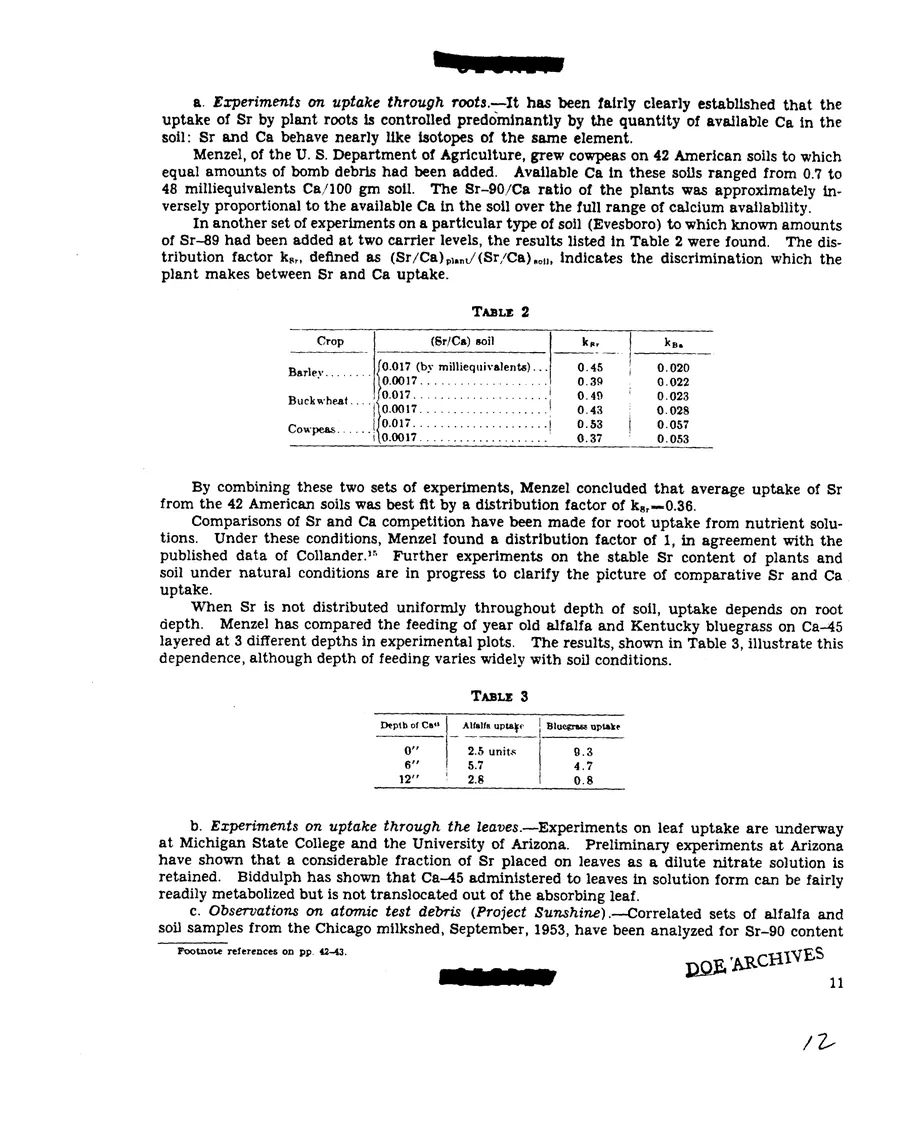
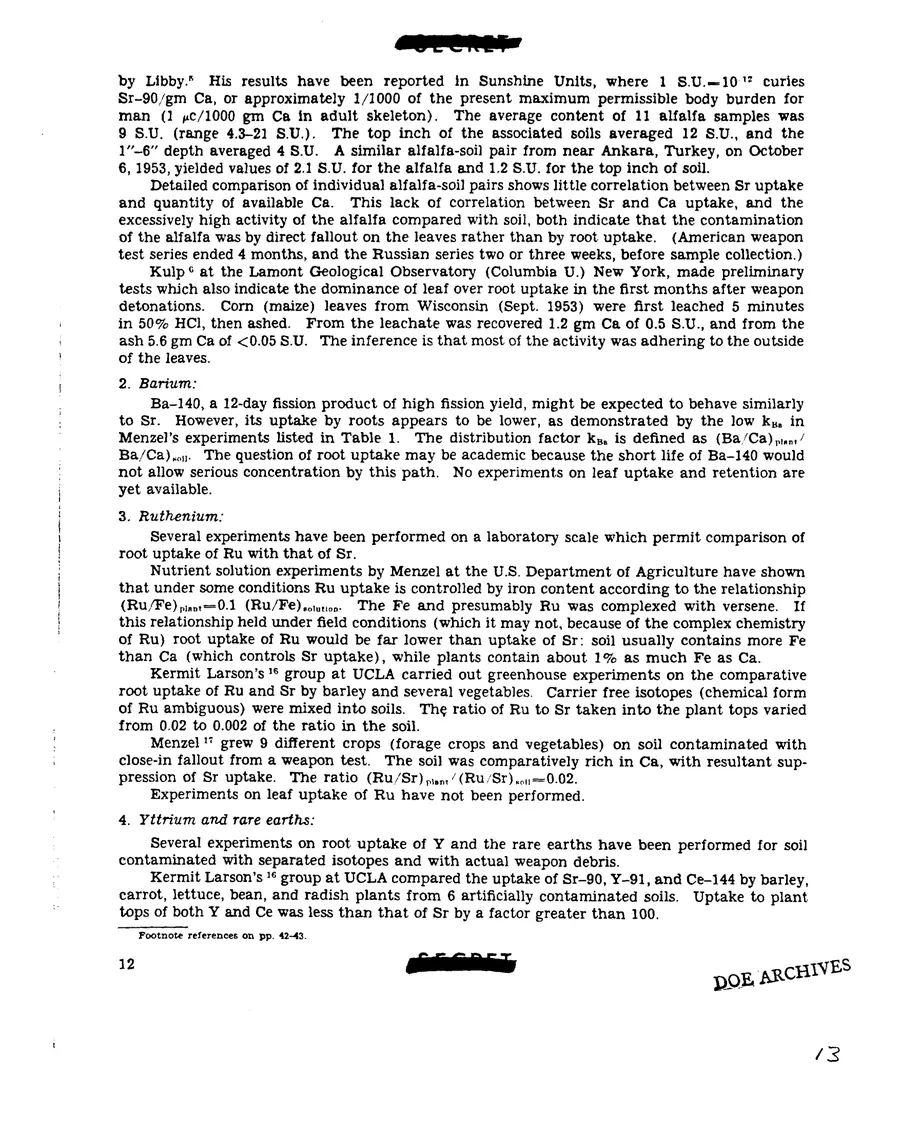
a. Experiments on uptake through roots.—It has been fairly clearly established that the uptake of Sr by plant roots is controlled predominantly by the quantity of available Ca in the soil: Sr and Ca behave nearly like isotopes of the same element.
Menzel, of the U. S. Department of Agriculture, grew cowpeas on 42 American soils to which equal amounts of bomb debris had been added. Available Ca in these soils ranged from 0.7 to 48 milliequivalents Ca/100 gm soil. The Sr-90/Ca ratio of the plants was approximately inversely proportional to the available Ca in the soil over the full range of calcium availability.
In another set of experiments on a particular type of soil (Evesboro) to which known amounts of Sr-89 had been added at two carrier levels, the results listed in Table 2 were found. The distribution factor k_Sr, defined as (Sr/Ca)_plant/(Sr/Ca)_soil, indicates the discrimination which the plant makes between Sr and Ca uptake.
By combining these two sets of experiments, Menzel concluded that average uptake of Sr from the 42 American soils was best fit by a distribution factor of k_Sr=0.36.
Comparisons of Sr and Ca competition have been made for root uptake from nutrient solutions. Under these conditions, Menzel found a distribution factor of 1, in agreement with the published data of Collander.^15 Further experiments on the stable Sr content of plants and soil under natural conditions are in progress to clarify the picture of comparative Sr and Ca uptake.
When Sr is not distributed uniformly throughout depth of soil, uptake depends on root depth. Menzel has compared the feeding of year old alfalfa and Kentucky bluegrass on Ca-45 layered at 3 different depths in experimental plots. The results, shown in Table 3, illustrate this dependence, although depth of feeding varies widely with soil conditions.
TABLE 3
Depth of Ca^45 — Alfalfa uptake — Bluegrass uptake
0" — 2.5 units — 9.3
6" — 5.7 — 4.7
12" — 2.8 — 0.8
b. Experiments on uptake through the leaves.—Experiments on leaf uptake are underway at Michigan State College and the University of Arizona. Preliminary experiments at Arizona have shown that a considerable fraction of Sr placed on leaves as a dilute nitrate solution is retained. Biddulph has shown that Ca-45 administered to leaves in solution form can be fairly readily metabolized but is not translocated out of the absorbing leaf.
c. Observations on atomic test debris (Project Sunshine).—Correlated sets of alfalfa and soil samples from the Chicago milkshed, September, 1953, have been analyzed for Sr-90 content
Footnote references on pp. 42-43.
Textual notes on this leaf (2)
k_Sr, (Sr/Ca)_plant/(Sr/Ca)_soil
The document sets Sr, Ba, plant and soil as subscripts. They are written here with an underscore and rendered as subscripts at merge; where the face lacks a subscript letter the label is set on the line. Not a reading problem.
TABLE 2 / TABLE 3
Ruled tables on the page, set here row by row with em rules between the columns. In Table 2 each crop spans two rows joined by a brace; the crop name is repeated on each row here so the pairing survives.
SECRET (obliterated, head) · SECRET (obliterated, foot) · DOE ARCHIVES (stamp, foot right) · handwritten leaf number 13 (foot right)
by Libby.^5 His results have been reported in Sunshine Units, where 1 S.U.=10^{-12} curies Sr-90/gm Ca, or approximately 1/1000 of the present maximum permissible body burden for man (1 μc/1000 gm Ca in adult skeleton). The average content of 11 alfalfa samples was 9 S.U. (range 4.3-21 S.U.). The top inch of the associated soils averaged 12 S.U., and the 1"-6" depth averaged 4 S.U. A similar alfalfa-soil pair from near Ankara, Turkey, on October 6, 1953, yielded values of 2.1 S.U. for the alfalfa and 1.2 S.U. for the top inch of soil.
Detailed comparison of individual alfalfa-soil pairs shows little correlation between Sr uptake and quantity of available Ca. This lack of correlation between Sr and Ca uptake, and the excessively high activity of the alfalfa compared with soil, both indicate that the contamination of the alfalfa was by direct fallout on the leaves rather than by root uptake. (American weapon test series ended 4 months, and the Russian series two or three weeks, before sample collection.)
Kulp^6 at the Lamont Geological Observatory (Columbia U.) New York, made preliminary tests which also indicate the dominance of leaf over root uptake in the first months after weapon detonations. Corn (maize) leaves from Wisconsin (Sept. 1953) were first leached 5 minutes in 50% HCl, then ashed. From the leachate was recovered 1.2 gm Ca of 0.5 S.U., and from the ash 5.6 gm Ca of <0.05 S.U. The inference is that most of the activity was adhering to the outside of the leaves.
2. Barium:
Ba-140, a 12-day fission product of high fission yield, might be expected to behave similarly to Sr. However, its uptake by roots appears to be lower, as demonstrated by the low k_Ba in Menzel's experiments listed in Table 1. The distribution factor k_Ba is defined as (Ba/Ca)_plant/(Ba/Ca)_soil. The question of root uptake may be academic because the short life of Ba-140 would not allow serious concentration by this path. No experiments on leaf uptake and retention are yet available.
3. Ruthenium:
Several experiments have been performed on a laboratory scale which permit comparison of root uptake of Ru with that of Sr.
Nutrient solution experiments by Menzel at the U.S. Department of Agriculture have shown that under some conditions Ru uptake is controlled by iron content according to the relationship (Ru/Fe)_plant=0.1 (Ru/Fe)_solution. The Fe and presumably Ru was complexed with versene. If this relationship held under field conditions (which it may not, because of the complex chemistry of Ru) root uptake of Ru would be far lower than uptake of Sr: soil usually contains more Fe than Ca (which controls Sr uptake), while plants contain about 1% as much Fe as Ca.
Kermit Larson's^16 group at UCLA carried out greenhouse experiments on the comparative root uptake of Ru and Sr by barley and several vegetables. Carrier free isotopes (chemical form of Ru ambiguous) were mixed into soils. The ratio of Ru to Sr taken into the plant tops varied from 0.02 to 0.002 of the ratio in the soil.
Menzel^17 grew 9 different crops (forage crops and vegetables) on soil contaminated with close-in fallout from a weapon test. The soil was comparatively rich in Ca, with resultant suppression of Sr uptake. The ratio (Ru/Sr)_plant/(Ru/Sr)_soil=0.02.
Experiments on leaf uptake of Ru have not been performed.
4. Yttrium and rare earths:
Several experiments on root uptake of Y and the rare earths have been performed for soil contaminated with separated isotopes and with actual weapon debris.
Kermit Larson's^16 group at UCLA compared the uptake of Sr-90, Y-91, and Ce-144 by barley, carrot, lettuce, bean, and radish plants from 6 artificially contaminated soils. Uptake to plant tops of both Y and Ce was less than that of Sr by a factor greater than 100.
Footnote references on pp. 42-43.
Textual notes on this leaf (1)
listed in Table 1
The k_Ba values referred to are printed in Table 2 on the previous page, not Table 1. The document's own cross-reference. PRESERVED as written.
SECRET (obliterated, head) · SECRET (obliterated, foot) · DOE ARCHIVES (stamp, foot right) · handwritten leaf number 14 (foot right)
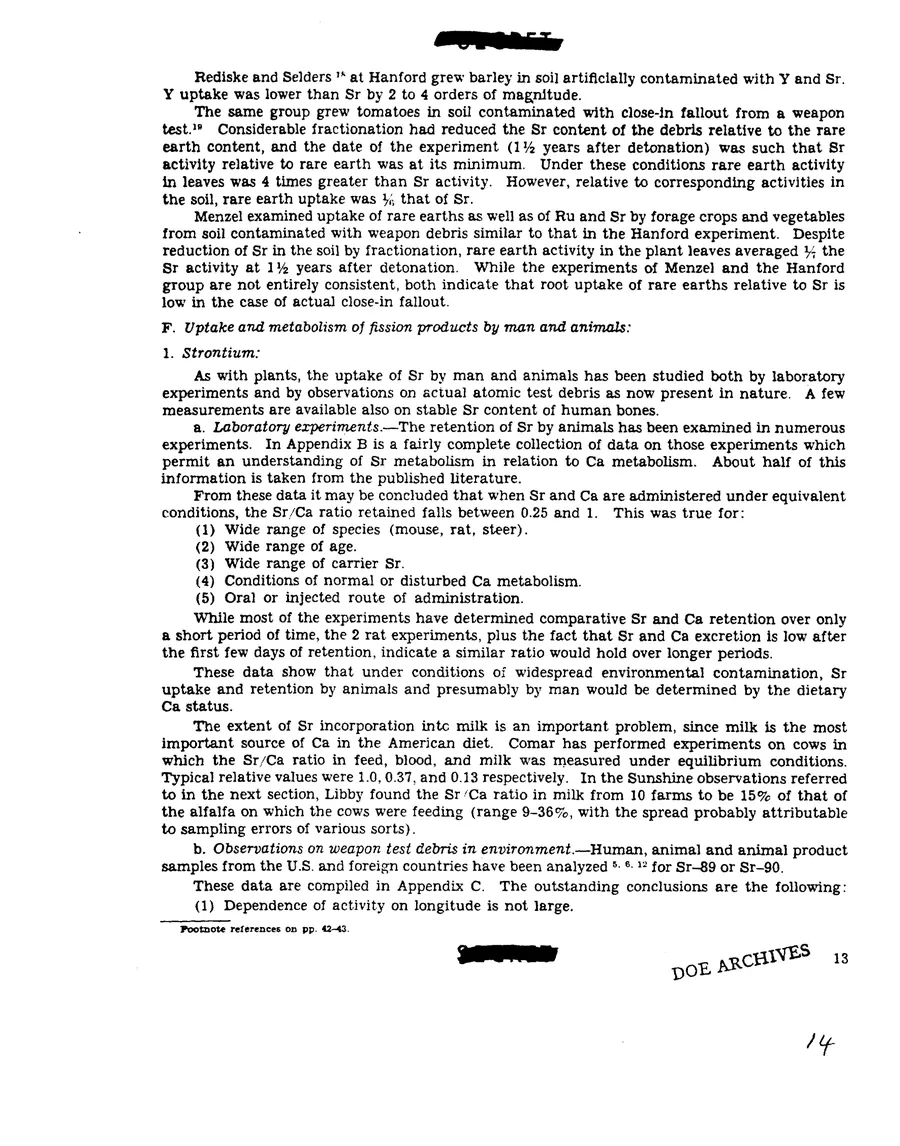
Rediske and Selders^18 at Hanford grew barley in soil artificially contaminated with Y and Sr. Y uptake was lower than Sr by 2 to 4 orders of magnitude.
The same group grew tomatoes in soil contaminated with close-in fallout from a weapon test.^19 Considerable fractionation had reduced the Sr content of the debris relative to the rare earth content, and the date of the experiment (1½ years after detonation) was such that Sr activity relative to rare earth was at its minimum. Under these conditions rare earth activity in leaves was 4 times greater than Sr activity. However, relative to corresponding activities in the soil, rare earth uptake was 1/6 that of Sr.
Menzel examined uptake of rare earths as well as of Ru and Sr by forage crops and vegetables from soil contaminated with weapon debris similar to that in the Hanford experiment. Despite reduction of Sr in the soil by fractionation, rare earth activity in the plant leaves averaged 1/7 the Sr activity at 1½ years after detonation. While the experiments of Menzel and the Hanford group are not entirely consistent, both indicate that root uptake of rare earths relative to Sr is low in the case of actual close-in fallout.
F. Uptake and metabolism of fission products by man and animals:
1. Strontium:
As with plants, the uptake of Sr by man and animals has been studied both by laboratory experiments and by observations on actual atomic test debris as now present in nature. A few measurements are available also on stable Sr content of human bones.
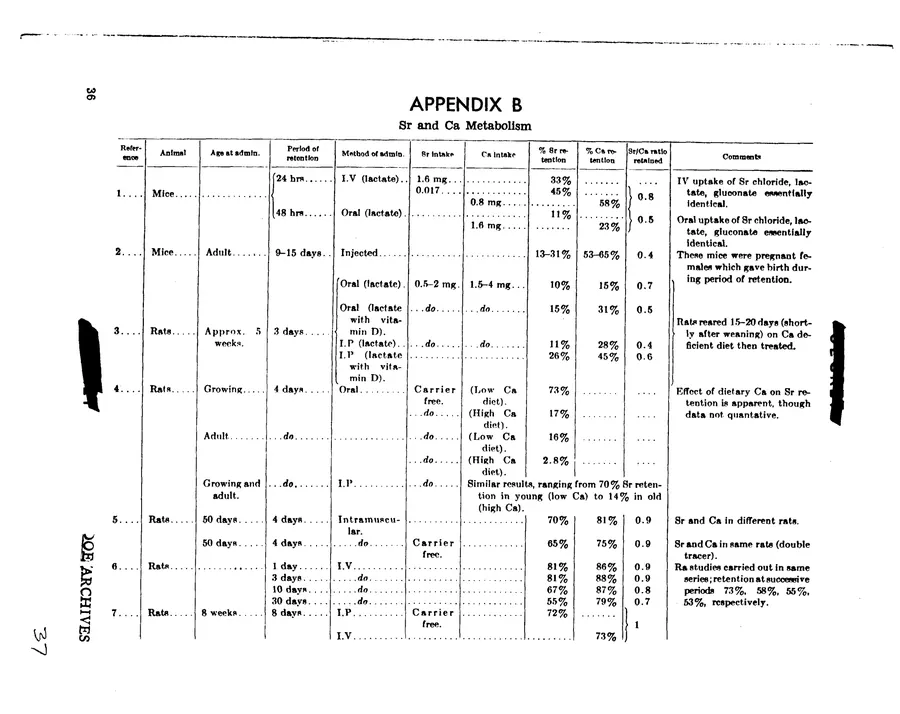
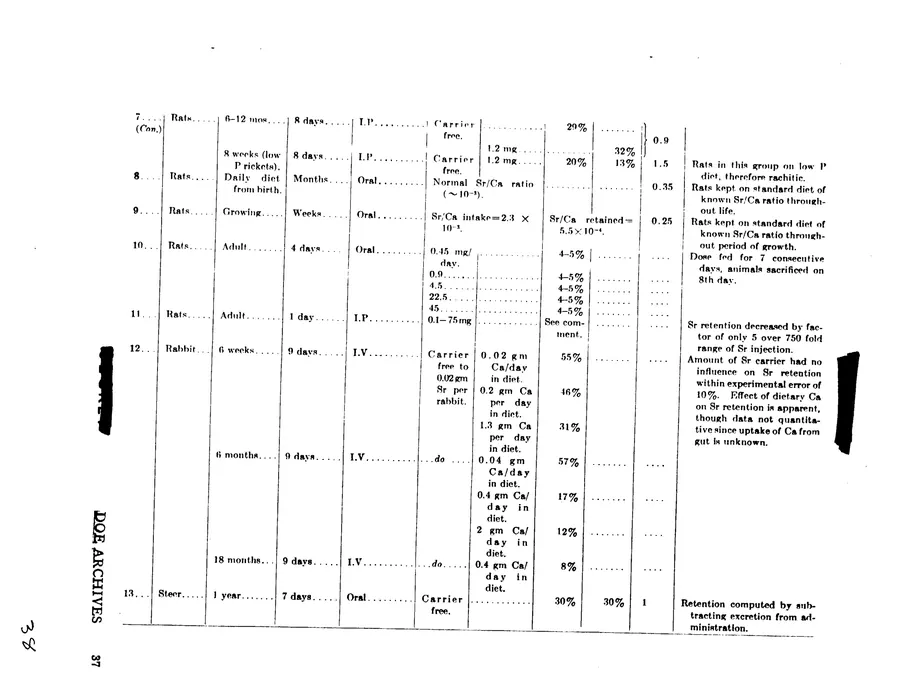
a. Laboratory experiments.—The retention of Sr by animals has been examined in numerous experiments. In Appendix B is a fairly complete collection of data on those experiments which permit an understanding of Sr metabolism in relation to Ca metabolism. About half of this information is taken from the published literature.
From these data it may be concluded that when Sr and Ca are administered under equivalent conditions, the Sr/Ca ratio retained falls between 0.25 and 1. This was true for:
(1) Wide range of species (mouse, rat, steer).
(2) Wide range of age.
(3) Wide range of carrier Sr.
(4) Conditions of normal or disturbed Ca metabolism.
(5) Oral or injected route of administration.
While most of the experiments have determined comparative Sr and Ca retention over only a short period of time, the 2 rat experiments, plus the fact that Sr and Ca excretion is low after the first few days of retention, indicate a similar ratio would hold over longer periods.
These data show that under conditions of widespread environmental contamination, Sr uptake and retention by animals and presumably by man would be determined by the dietary Ca status.
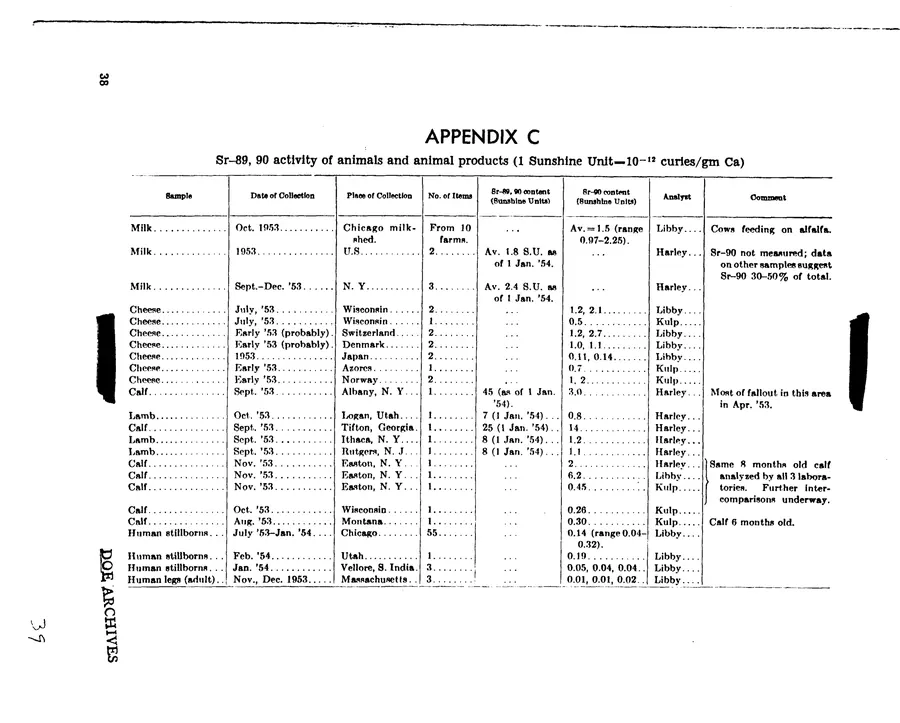
The extent of Sr incorporation into milk is an important problem, since milk is the most important source of Ca in the American diet. Comar has performed experiments on cows in which the Sr/Ca ratio in feed, blood, and milk was measured under equilibrium conditions. Typical relative values were 1.0, 0.37, and 0.13 respectively. In the Sunshine observations referred to in the next section, Libby found the Sr/Ca ratio in milk from 10 farms to be 15% of that of the alfalfa on which the cows were feeding (range 9-36%, with the spread probably attributable to sampling errors of various sorts).
b. Observations on weapon test debris in environment.—Human, animal and animal product samples from the U.S. and foreign countries have been analyzed^{5, 6, 12} for Sr-89 or Sr-90.
These data are compiled in Appendix C. The outstanding conclusions are the following:
(1) Dependence of activity on longitude is not large.
Footnote references on pp. 42-43.
Textual notes on this leaf (2)
rare earth uptake was 1/6 that of Sr
The fraction is a small stacked fraction in the scan and its denominator is partly filled in; read as one-sixth. CONFIRM against the raw scan.
averaged 1/7 the Sr activity
A small stacked fraction, read as one-seventh; the denominator is partly filled in. CONFIRM against the raw scan.
SECRET (obliterated, head) · SECRET (obliterated, foot) · DOE ARCHIVES (stamp, foot right) · handwritten leaf number 15 (foot right)
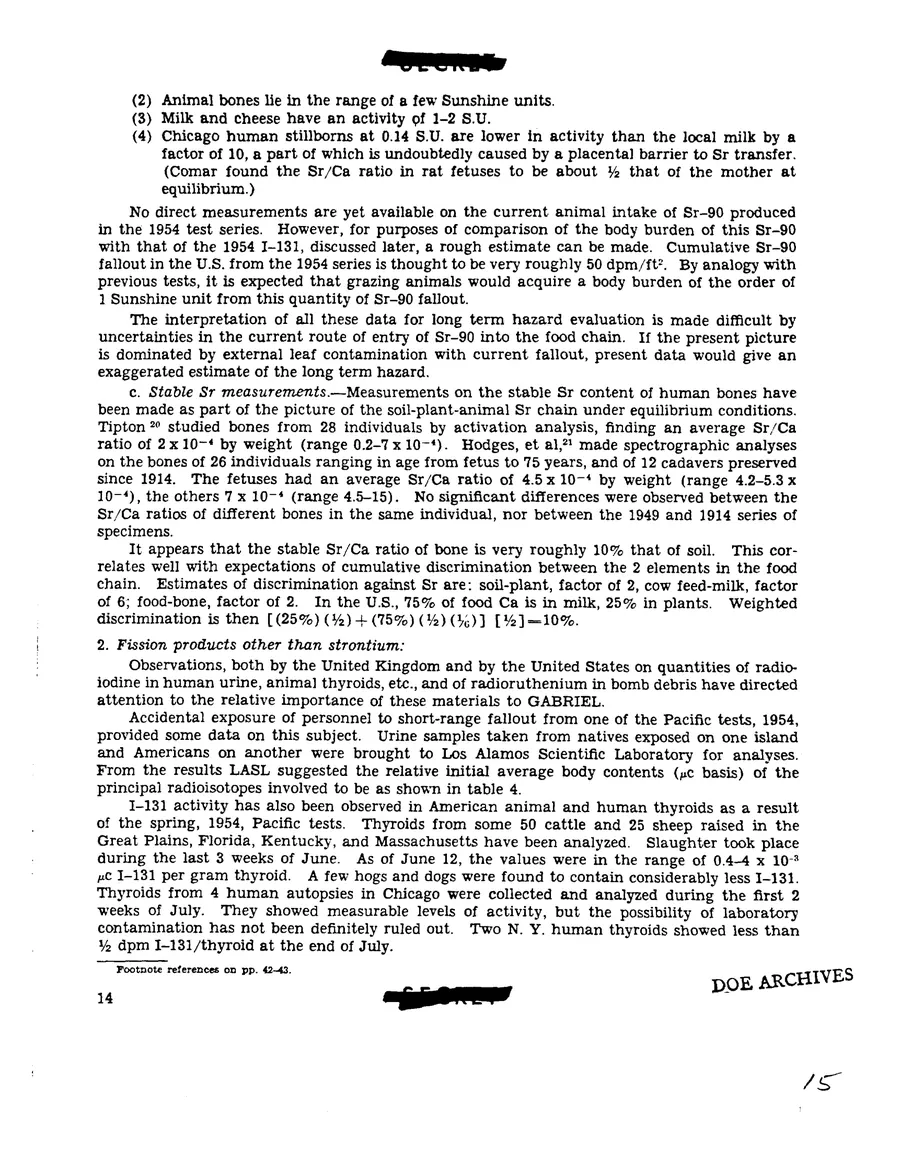
(2) Animal bones lie in the range of a few Sunshine units.
(3) Milk and cheese have an activity of 1-2 S.U.
(4) Chicago human stillborns at 0.14 S.U. are lower in activity than the local milk by a factor of 10, a part of which is undoubtedly caused by a placental barrier to Sr transfer. (Comar found the Sr/Ca ratio in rat fetuses to be about ½ that of the mother at equilibrium.)
No direct measurements are yet available on the current animal intake of Sr-90 produced in the 1954 test series. However, for purposes of comparison of the body burden of this Sr-90 with that of the 1954 I-131, discussed later, a rough estimate can be made. Cumulative Sr-90 fallout in the U.S. from the 1954 series is thought to be very roughly 50 dpm/ft^2. By analogy with previous tests, it is expected that grazing animals would acquire a body burden of the order of 1 Sunshine unit from this quantity of Sr-90 fallout.
The interpretation of all these data for long term hazard evaluation is made difficult by uncertainties in the current route of entry of Sr-90 into the food chain. If the present picture is dominated by external leaf contamination with current fallout, present data would give an exaggerated estimate of the long term hazard.
c. Stable Sr measurements.—Measurements on the stable Sr content of human bones have been made as part of the picture of the soil-plant-animal Sr chain under equilibrium conditions. Tipton^20 studied bones from 28 individuals by activation analysis, finding an average Sr/Ca ratio of 2 x 10^{-4} by weight (range 0.2-7 x 10^{-4}). Hodges, et al,^21 made spectrographic analyses on the bones of 26 individuals ranging in age from fetus to 75 years, and of 12 cadavers preserved since 1914. The fetuses had an average Sr/Ca ratio of 4.5 x 10^{-4} by weight (range 4.2-5.3 x 10^{-4}), the others 7 x 10^{-4} (range 4.5-15). No significant differences were observed between the Sr/Ca ratios of different bones in the same individual, nor between the 1949 and 1914 series of specimens.
It appears that the stable Sr/Ca ratio of bone is very roughly 10% that of soil. This correlates well with expectations of cumulative discrimination between the 2 elements in the food chain. Estimates of discrimination against Sr are: soil-plant, factor of 2, cow feed-milk, factor of 6; food-bone, factor of 2. In the U.S., 75% of food Ca is in milk, 25% in plants. Weighted discrimination is then [(25%)(½)+(75%)(½)(1/6)] [½]=10%.
2. Fission products other than strontium:
Observations, both by the United Kingdom and by the United States on quantities of radioiodine in human urine, animal thyroids, etc., and of radioruthenium in bomb debris have directed attention to the relative importance of these materials to GABRIEL.
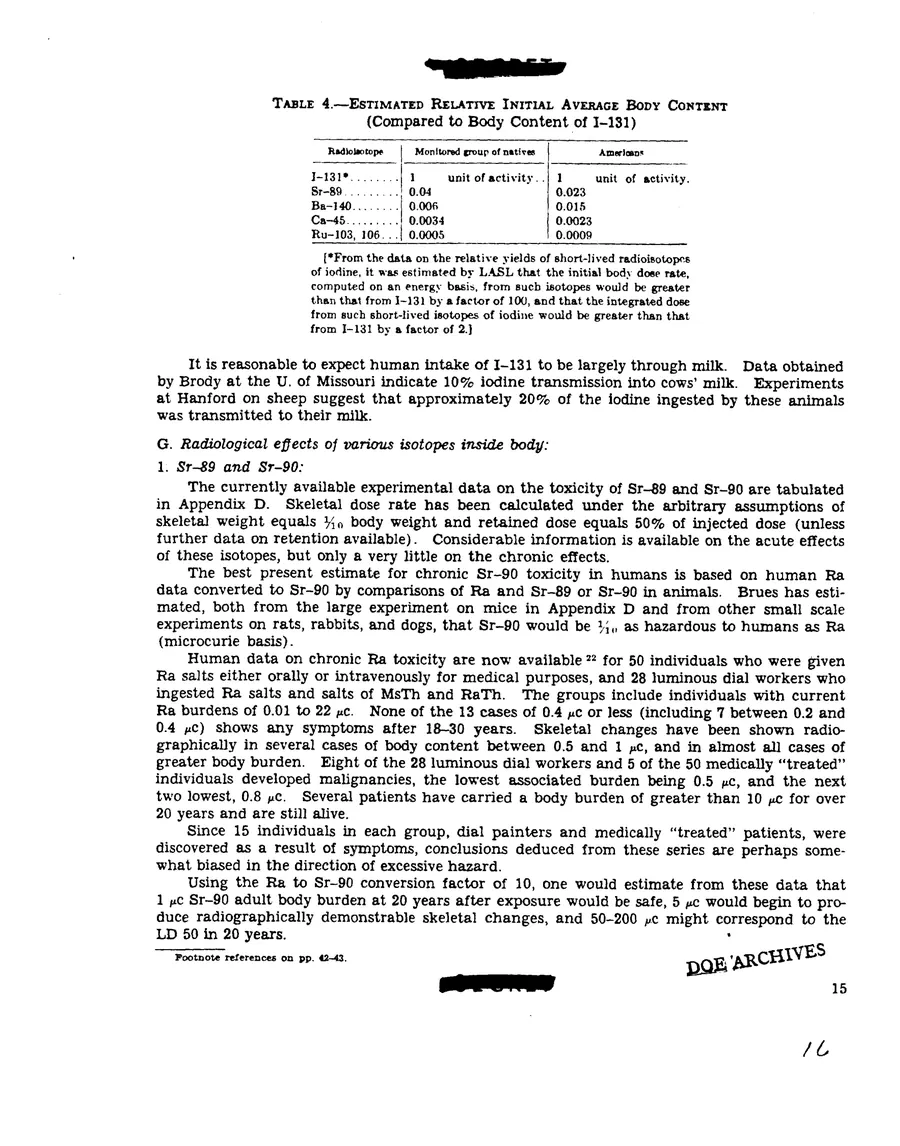
Accidental exposure of personnel to short-range fallout from one of the Pacific tests, 1954, provided some data on this subject. Urine samples taken from natives exposed on one island and Americans on another were brought to Los Alamos Scientific Laboratory for analyses. From the results LASL suggested the relative initial average body contents (μc basis) of the principal radioisotopes involved to be as shown in table 4.
I-131 activity has also been observed in American animal and human thyroids as a result of the spring, 1954, Pacific tests. Thyroids from some 50 cattle and 25 sheep raised in the Great Plains, Florida, Kentucky, and Massachusetts have been analyzed. Slaughter took place during the last 3 weeks of June. As of June 12, the values were in the range of 0.4-4 x 10^{-3} μc I-131 per gram thyroid. A few hogs and dogs were found to contain considerably less I-131. Thyroids from 4 human autopsies in Chicago were collected and analyzed during the first 2 weeks of July. They showed measurable levels of activity, but the possibility of laboratory contamination has not been definitely ruled out. Two N. Y. human thyroids showed less than ½ dpm I-131/thyroid at the end of July.
Footnote references on pp. 42-43.
Textual notes on this leaf (2)
[(25%)(½)+(75%)(½)(1/6)] [½]=10%
The square brackets are the document's own, part of the printed arithmetic; they are not an editorial insertion. The one-sixth is a small stacked fraction: CONFIRM against the raw scan.
Hodges, et al,
Comma after 'al' with no full stop. The document's own punctuation. PRESERVED as written.
SECRET (obliterated, head) · SECRET (obliterated, foot) · DOE ARCHIVES (stamp, foot right) · handwritten leaf number 16 (foot right)
TABLE 4.—ESTIMATED RELATIVE INITIAL AVERAGE BODY CONTENT (Compared to Body Content of I-131)
Radioisotope — Monitored group of natives — Americans
I-131* — 1 unit of activity — 1 unit of activity.
Sr-89 — 0.04 — 0.023
Ba-140 — 0.006 — 0.015
Ca-45 — 0.0034 — 0.0023
Ru-103, 106 — 0.0005 — 0.0009
[*From the data on the relative yields of short-lived radioisotopes of iodine, it was estimated by LASL that the initial body dose rate, computed on an energy basis, from such isotopes would be greater than that from I-131 by a factor of 100, and that the integrated dose from such short-lived isotopes of iodine would be greater than that from I-131 by a factor of 2.]
It is reasonable to expect human intake of I-131 to be largely through milk. Data obtained by Brody at the U. of Missouri indicate 10% iodine transmission into cows' milk. Experiments at Hanford on sheep suggest that approximately 20% of the iodine ingested by these animals was transmitted to their milk.
G. Radiological effects of various isotopes inside body:
1. Sr-89 and Sr-90:
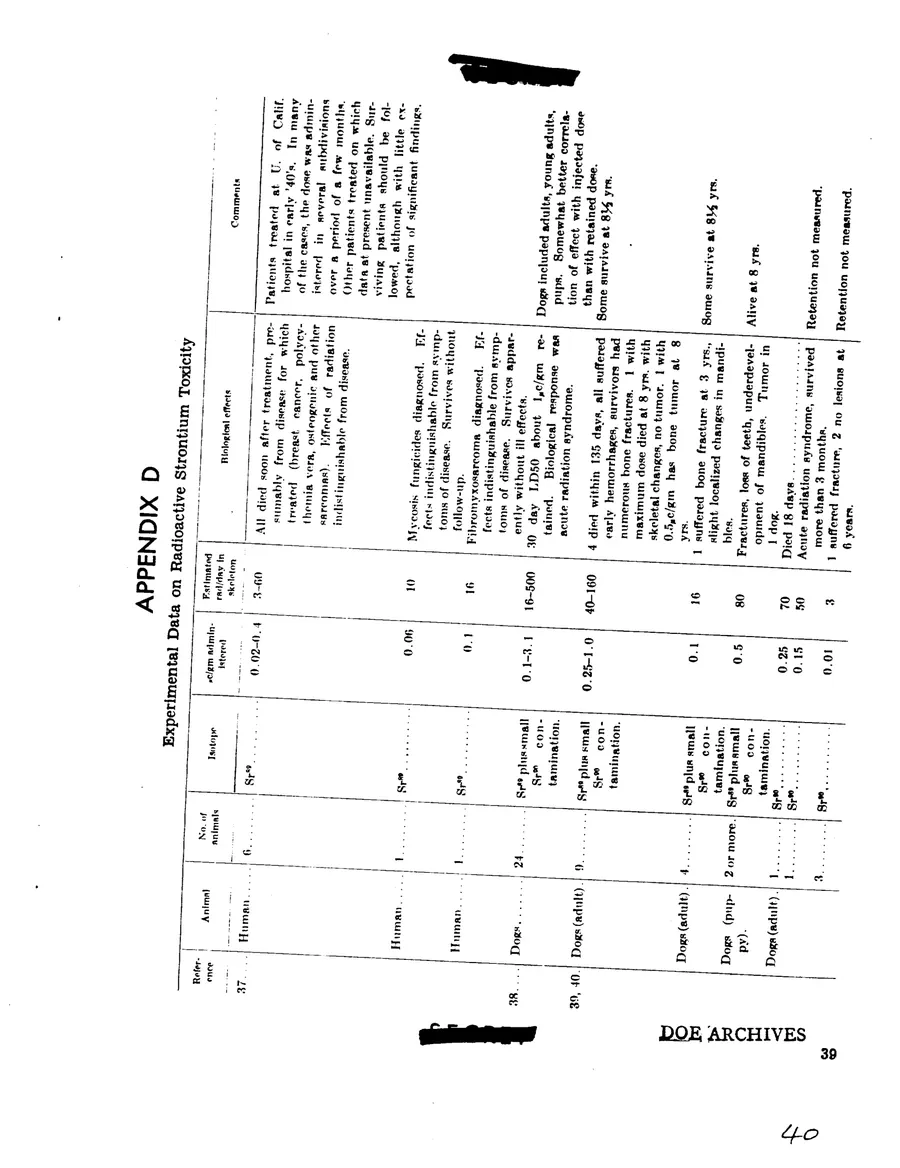
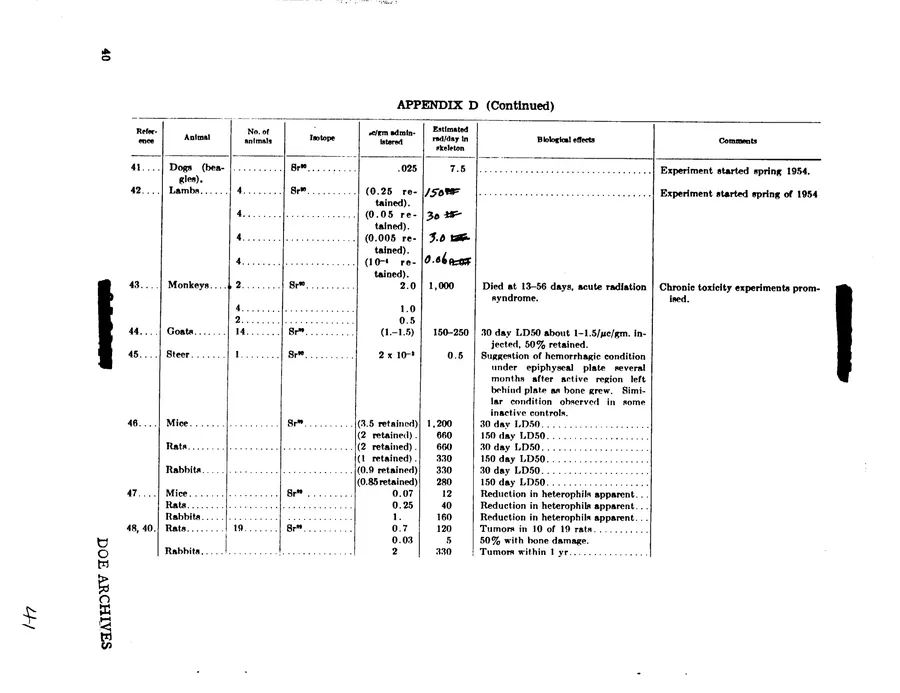
The currently available experimental data on the toxicity of Sr-89 and Sr-90 are tabulated in Appendix D. Skeletal dose rate has been calculated under the arbitrary assumptions of skeletal weight equals 1/10 body weight and retained dose equals 50% of injected dose (unless further data on retention available). Considerable information is available on the acute effects of these isotopes, but only a very little on the chronic effects.
The best present estimate for chronic Sr-90 toxicity in humans is based on human Ra data converted to Sr-90 by comparisons of Ra and Sr-89 or Sr-90 in animals. Brues has estimated, both from the large experiment on mice in Appendix D and from other small scale experiments on rats, rabbits, and dogs, that Sr-90 would be 1/10 as hazardous to humans as Ra (microcurie basis).
Human data on chronic Ra toxicity are now available^22 for 50 individuals who were given Ra salts either orally or intravenously for medical purposes, and 28 luminous dial workers who ingested Ra salts and salts of MsTh and RaTh. The groups include individuals with current Ra burdens of 0.01 to 22 μc. None of the 13 cases of 0.4 μc or less (including 7 between 0.2 and 0.4 μc) shows any symptoms after 18-30 years. Skeletal changes have been shown radiographically in several cases of body content between 0.5 and 1 μc, and in almost all cases of greater body burden. Eight of the 28 luminous dial workers and 5 of the 50 medically “treated” individuals developed malignancies, the lowest associated burden being 0.5 μc, and the next two lowest, 0.8 μc. Several patients have carried a body burden of greater than 10 μc for over 20 years and are still alive.
Since 15 individuals in each group, dial painters and medically “treated” patients, were discovered as a result of symptoms, conclusions deduced from these series are perhaps somewhat biased in the direction of excessive hazard.
Using the Ra to Sr-90 conversion factor of 10, one would estimate from these data that 1 μc Sr-90 adult body burden at 20 years after exposure would be safe, 5 μc would begin to produce radiographically demonstrable skeletal changes, and 50-200 μc might correspond to the LD 50 in 20 years.
Footnote references on pp. 42-43.
Textual notes on this leaf (2)
[*From the data on the relative yields
The square brackets enclosing the table footnote are the document's own, not an editorial insertion.
skeletal weight equals 1/10 body weight
Small stacked fractions (one-tenth, twice on the page) read from the scan; the denominators are partly filled in. CONFIRM against the raw scan.
SECRET (obliterated, head) · SECRET (obliterated, foot centre) · DOE ARCHIVES (stamp, foot right, set on a rising slant) · handwritten leaf number 17 (foot right)
It is hoped that the chronic toxicity experiments now in progress at the University of Utah can be extended so as to permit comparison of Sr-90 with Ra, MsTh, and Pu in dogs. Such a comparison would give a much more reliable conversion factor between Ra and Sr than is now available.
2. I-131:
In view of the probable importance of I-131 in GABRIEL, it would be desirable to compile a critical review of the dependence of thyroid damage on I-131 dose. This will be done in the near future. The sources of information are almost entirely in the open literature.
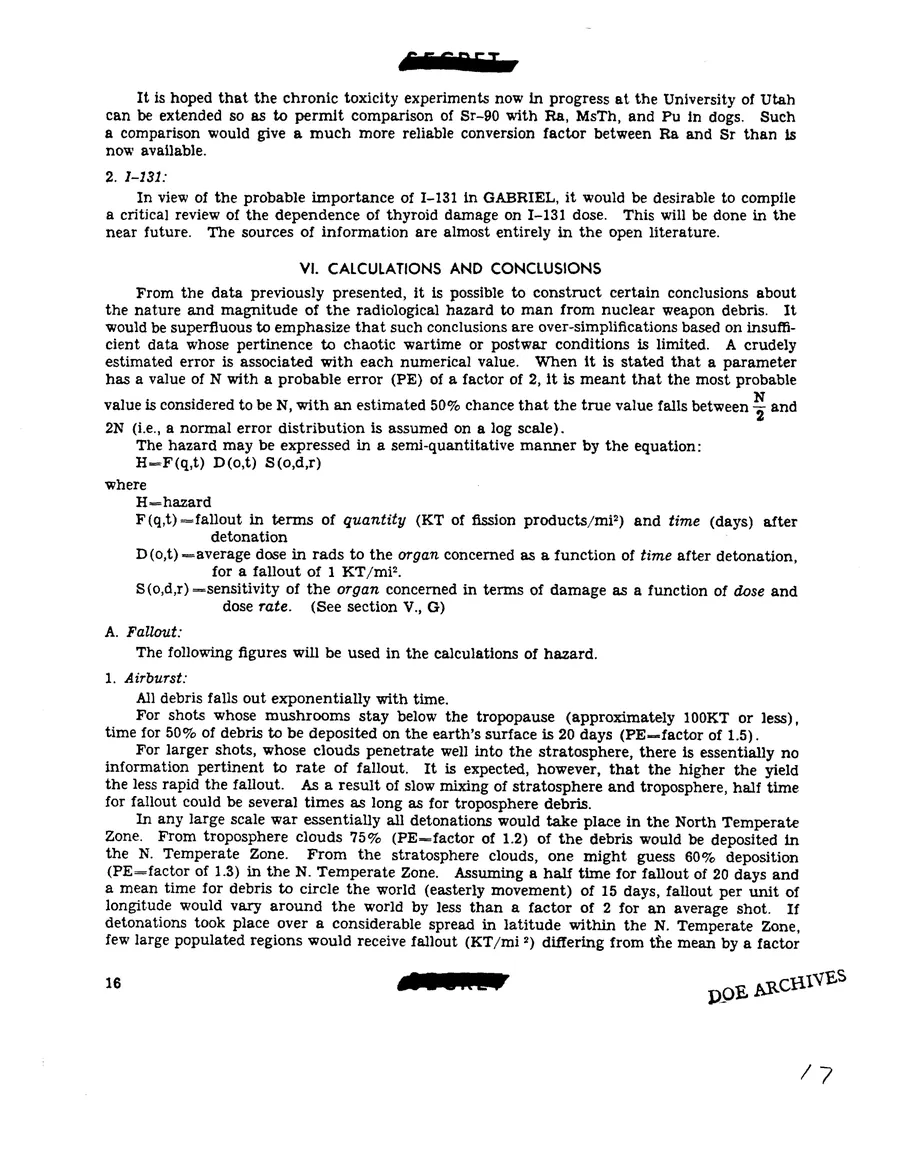
VI. CALCULATIONS AND CONCLUSIONS
From the data previously presented, it is possible to construct certain conclusions about the nature and magnitude of the radiological hazard to man from nuclear weapon debris. It would be superfluous to emphasize that such conclusions are over-simplifications based on insufficient data whose pertinence to chaotic wartime or postwar conditions is limited. A crudely estimated error is associated with each numerical value. When it is stated that a parameter has a value of N with a probable error (PE) of a factor of 2, it is meant that the most probable value is considered to be N, with an estimated 50% chance that the true value falls between N/2 and 2N (i.e., a normal error distribution is assumed on a log scale).
The hazard may be expressed in a semi-quantitative manner by the equation:
H=F(q,t) D(o,t) S(o,d,r)
where
H=hazard
F(q,t)=fallout in terms of quantity (KT of fission products/mi^2) and time (days) after detonation
D(o,t)=average dose in rads to the organ concerned as a function of time after detonation, for a fallout of 1 KT/mi^2.
S(o,d,r)=sensitivity of the organ concerned in terms of damage as a function of dose and dose rate. (See section V., G)
A. Fallout:
The following figures will be used in the calculations of hazard.
1. Airburst:
All debris falls out exponentially with time.
For shots whose mushrooms stay below the tropopause (approximately 100KT or less), time for 50% of debris to be deposited on the earth's surface is 20 days (PE=factor of 1.5).
For larger shots, whose clouds penetrate well into the stratosphere, there is essentially no information pertinent to rate of fallout. It is expected, however, that the higher the yield the less rapid the fallout. As a result of slow mixing of stratosphere and troposphere, half time for fallout could be several times as long as for troposphere debris.
In any large scale war essentially all detonations would take place in the North Temperate Zone. From troposphere clouds 75% (PE=factor of 1.2) of the debris would be deposited in the N. Temperate Zone. From the stratosphere clouds, one might guess 60% deposition (PE=factor of 1.3) in the N. Temperate Zone. Assuming a half time for fallout of 20 days and a mean time for debris to circle the world (easterly movement) of 15 days, fallout per unit of longitude would vary around the world by less than a factor of 2 for an average shot. If detonations took place over a considerable spread in latitude within the N. Temperate Zone, few large populated regions would receive fallout (KT/mi ^2) differing from the mean by a factor
Textual notes on this leaf (3)
between N/2 and 2N
The page sets N over 2 as a stacked fraction dropped below the baseline of its line. Written here as N/2 and set as a fraction at merge. Not a reading problem.
fallout (KT/mi ^2) differing from the mean
The document prints a space between 'mi' and its superscript 2 here, where it sets 'mi^2' closed up everywhere else on the page. PRESERVED as written.
S(o,d,r)=sensitivity
The equals signs throughout this leaf are printed as a long double-struck rule that reproduces as an em dash in the scan; they are equals signs and are set as such.
SECRET (obliterated, head) · SECRET (obliterated, foot centre) · DOE ARCHIVES (stamp, foot right, on a rising slant) · handwritten leaf number 18 (foot right)
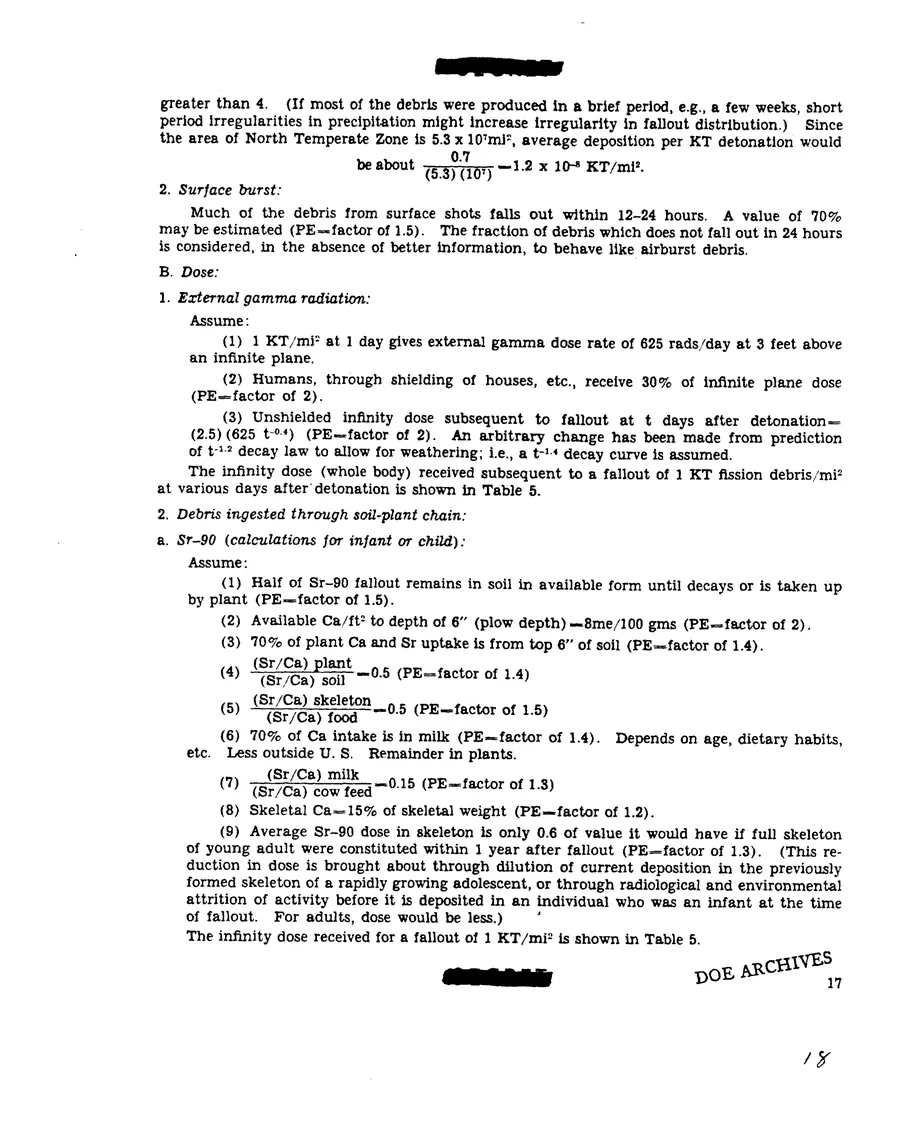
greater than 4. (If most of the debris were produced in a brief period, e.g., a few weeks, short period irregularities in precipitation might increase irregularity in fallout distribution.) Since the area of North Temperate Zone is 5.3 x 10^7mi^2, average deposition per KT detonation would be about 0.7/(5.3) (10^7)=1.2 x 10^{-8} KT/mi^2.
2. Surface burst:
Much of the debris from surface shots falls out within 12-24 hours. A value of 70% may be estimated (PE=factor of 1.5). The fraction of debris which does not fall out in 24 hours is considered, in the absence of better information, to behave like airburst debris.
B. Dose:
1. External gamma radiation:
Assume:
(1) 1 KT/mi^2 at 1 day gives external gamma dose rate of 625 rads/day at 3 feet above an infinite plane.
(2) Humans, through shielding of houses, etc., receive 30% of infinite plane dose (PE=factor of 2).
(3) Unshielded infinity dose subsequent to fallout at t days after detonation=(2.5)(625 t^{-0.4}) (PE=factor of 2). An arbitrary change has been made from prediction of t^{-1.2} decay law to allow for weathering; i.e., a t^{-1.4} decay curve is assumed.
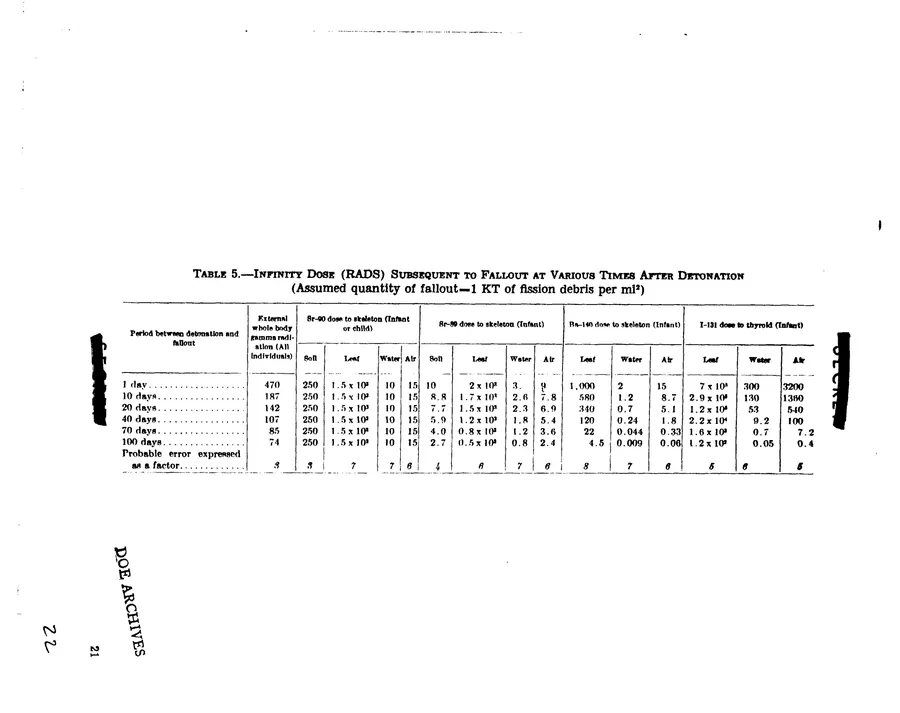
The infinity dose (whole body) received subsequent to a fallout of 1 KT fission debris/mi^2 at various days after detonation is shown in Table 5.
2. Debris ingested through soil-plant chain:
a. Sr-90 (calculations for infant or child):
Assume:
(1) Half of Sr-90 fallout remains in soil in available form until decays or is taken up by plant (PE=factor of 1.5).
(2) Available Ca/ft^2 to depth of 6" (plow depth)=8me/100 gms (PE=factor of 2).
(3) 70% of plant Ca and Sr uptake is from top 6" of soil (PE=factor of 1.4).
(4)(Sr/Ca) plant / (Sr/Ca) soil=0.5 (PE=factor of 1.4)
(5) (Sr/Ca) skeleton / (Sr/Ca) food=0.5 (PE=factor of 1.5)
(6) 70% of Ca intake is in milk (PE=factor of 1.4). Depends on age, dietary habits, etc. Less outside U. S. Remainder in plants.
(7) (Sr/Ca) milk / (Sr/Ca) cow feed=0.15 (PE=factor of 1.3)
(8) Skeletal Ca=15% of skeletal weight (PE=factor of 1.2).
(9) Average Sr-90 dose in skeleton is only 0.6 of value it would have if full skeleton of young adult were constituted within 1 year after fallout (PE=factor of 1.3). (This reduction in dose is brought about through dilution of current deposition in the previously formed skeleton of a rapidly growing adolescent, or through radiological and environmental attrition of activity before it is deposited in an individual who was an infant at the time of fallout. For adults, dose would be less.)
The infinity dose received for a fallout of 1 KT/mi^2 is shown in Table 5.
Textual notes on this leaf (4)
be about 0.7/(5.3) (10^7)=1.2 x 10^{-8} KT/mi^2.
Printed as a centred display fraction, 0.7 over (5.3) (10^7), set on the same line as the words 'be about'. Written here with a solidus. The exponent -8 was checked on a 600 dpi crop. CONFIRM the sense of the display against the raw scan.
(4) (Sr/Ca) plant / (Sr/Ca) soil=0.5
Assumptions (4), (5) and (7) are printed as stacked fractions with a horizontal rule; written here with a solidus and set as fractions at merge. Not a reading problem.
(2.5)(625 t^{-0.4})
The exponent is a small superscript reading -0.4; checked on a 600 dpi crop. CONFIRM against the raw scan.
(plow depth)=8me/100 gms
The abbreviation is 'me' (milliequivalents), lower case and unpunctuated, as printed. PRESERVED as written.
SECRET (obliterated, head) · SECRET (obliterated, foot centre) · DOE ARCHIVES (stamp, foot right, on a rising slant) · handwritten leaf number 19 (foot right)
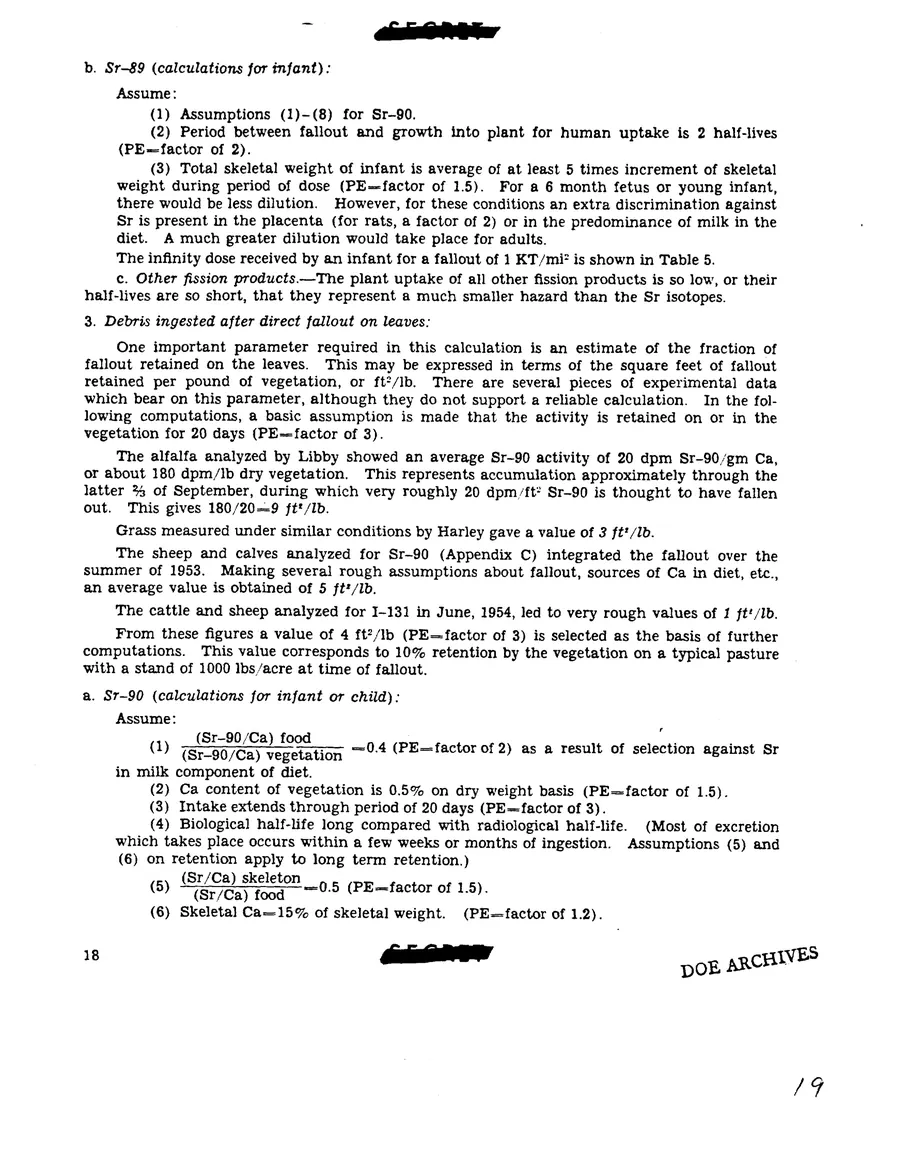
b. Sr-89 (calculations for infant):
Assume:
(1) Assumptions (1)-(8) for Sr-90.
(2) Period between fallout and growth into plant for human uptake is 2 half-lives (PE=factor of 2).
(3) Total skeletal weight of infant is average of at least 5 times increment of skeletal weight during period of dose (PE=factor of 1.5). For a 6 month fetus or young infant, there would be less dilution. However, for these conditions an extra discrimination against Sr is present in the placenta (for rats, a factor of 2) or in the predominance of milk in the diet. A much greater dilution would take place for adults.
The infinity dose received by an infant for a fallout of 1 KT/mi^2 is shown in Table 5.
c. Other fission products.—The plant uptake of all other fission products is so low, or their half-lives are so short, that they represent a much smaller hazard than the Sr isotopes.
3. Debris ingested after direct fallout on leaves:
One important parameter required in this calculation is an estimate of the fraction of fallout retained on the leaves. This may be expressed in terms of the square feet of fallout retained per pound of vegetation, or ft^2/lb. There are several pieces of experimental data which bear on this parameter, although they do not support a reliable calculation. In the following computations, a basic assumption is made that the activity is retained on or in the vegetation for 20 days (PE=factor of 3).
The alfalfa analyzed by Libby showed an average Sr-90 activity of 20 dpm Sr-90/gm Ca, or about 180 dpm/lb dry vegetation. This represents accumulation approximately through the latter ⅔ of September, during which very roughly 20 dpm/ft^2 Sr-90 is thought to have fallen out. This gives 180/20=9 ft^2/lb.
Grass measured under similar conditions by Harley gave a value of 3 ft^2/lb.
The sheep and calves analyzed for Sr-90 (Appendix C) integrated the fallout over the summer of 1953. Making several rough assumptions about fallout, sources of Ca in diet, etc., an average value is obtained of 5 ft^2/lb.
The cattle and sheep analyzed for I-131 in June, 1954, led to very rough values of 1 ft^2/lb.
From these figures a value of 4 ft^2/lb (PE=factor of 3) is selected as the basis of further computations. This value corresponds to 10% retention by the vegetation on a typical pasture with a stand of 1000 lbs/acre at time of fallout.
a. Sr-90 (calculations for infant or child):
Assume:
(1) (Sr-90/Ca) food / (Sr-90/Ca) vegetation=0.4 (PE=factor of 2) as a result of selection against Sr in milk component of diet.
(2) Ca content of vegetation is 0.5% on dry weight basis (PE=factor of 1.5).
(3) Intake extends through period of 20 days (PE=factor of 3).
(4) Biological half-life long compared with radiological half-life. (Most of excretion which takes place occurs within a few weeks or months of ingestion. Assumptions (5) and (6) on retention apply to long term retention.)
(5) (Sr/Ca) skeleton / (Sr/Ca) food=0.5 (PE=factor of 1.5).
(6) Skeletal Ca=15% of skeletal weight. (PE=factor of 1.2).
Textual notes on this leaf (3)
the latter ⅔ of September
A small stacked two-thirds fraction; read on a 600 dpi crop. CONFIRM against the raw scan.
This gives 180/20=9 ft^2/lb.
The values 9 ft^2/lb, 3 ft^2/lb, 5 ft^2/lb and 1 ft^2/lb are set in italic where the same unit is roman elsewhere on the page. The document's own styling; not recorded as a distinction here.
(1) (Sr-90/Ca) food / (Sr-90/Ca) vegetation=0.4
Assumptions (1) and (5) are printed as stacked fractions with a horizontal rule; written here with a solidus and set as fractions at merge.
SECRET (obliterated, head) · SECRET (obliterated, foot centre) · DOE ARCHIVES (stamp, foot right, on a rising slant) · handwritten leaf number 20 (foot right)
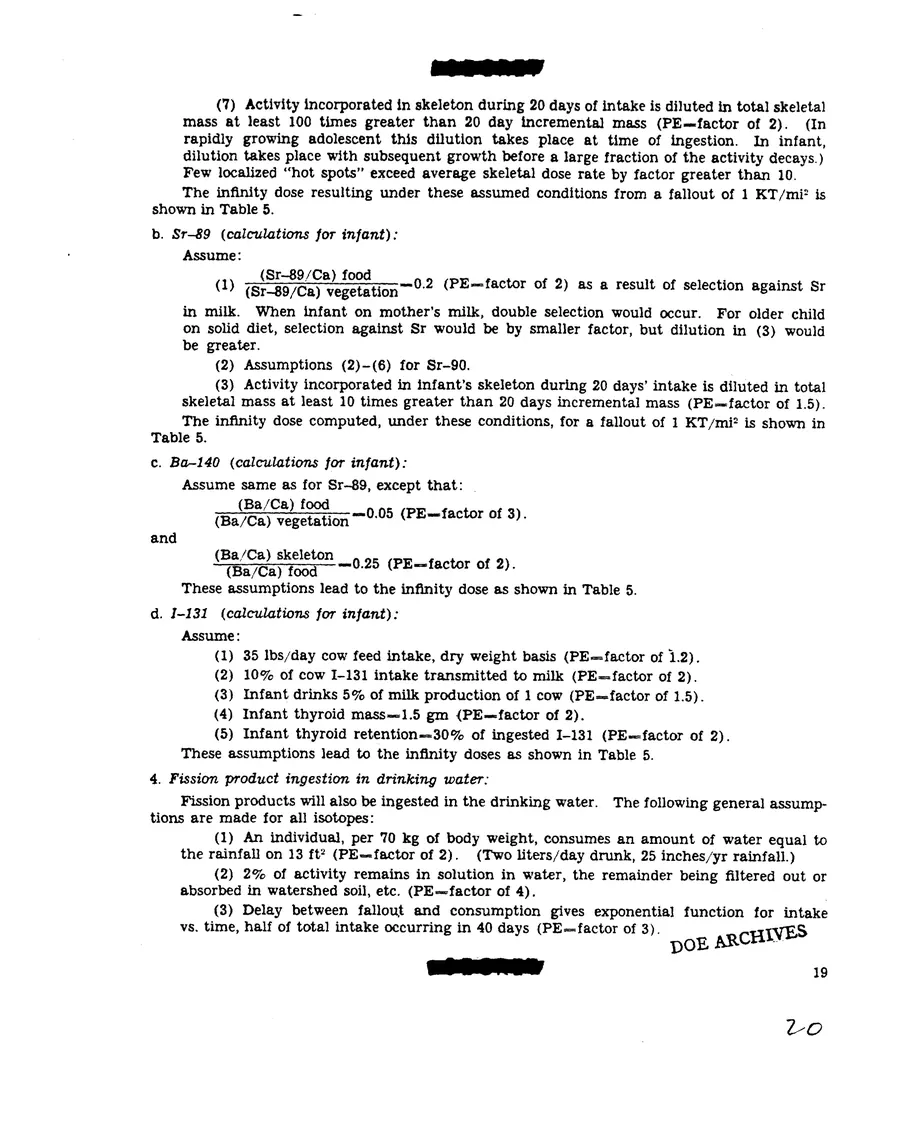
(7) Activity incorporated in skeleton during 20 days of intake is diluted in total skeletal mass at least 100 times greater than 20 day incremental mass (PE=factor of 2). (In rapidly growing adolescent this dilution takes place at time of ingestion. In infant, dilution takes place with subsequent growth before a large fraction of the activity decays.) Few localized “hot spots” exceed average skeletal dose rate by factor greater than 10.
The infinity dose resulting under these assumed conditions from a fallout of 1 KT/mi^2 is shown in Table 5.
b. Sr-89 (calculations for infant):
Assume:
(1) (Sr-89/Ca) food / (Sr-89/Ca) vegetation=0.2 (PE=factor of 2) as a result of selection against Sr in milk. When infant on mother's milk, double selection would occur. For older child on solid diet, selection against Sr would be by smaller factor, but dilution in (3) would be greater.
(2) Assumptions (2)-(6) for Sr-90.
(3) Activity incorporated in infant's skeleton during 20 days' intake is diluted in total skeletal mass at least 10 times greater than 20 days incremental mass (PE=factor of 1.5).
The infinity dose computed, under these conditions, for a fallout of 1 KT/mi^2 is shown in Table 5.
c. Ba-140 (calculations for infant):
Assume same as for Sr-89, except that:
(Ba/Ca) food / (Ba/Ca) vegetation=0.05 (PE=factor of 3).
and
(Ba/Ca) skeleton / (Ba/Ca) food=0.25 (PE=factor of 2).
These assumptions lead to the infinity dose as shown in Table 5.
(2) 10% of cow I-131 intake transmitted to milk (PE=factor of 2).
(3) Infant drinks 5% of milk production of 1 cow (PE=factor of 1.5).
(4) Infant thyroid mass=1.5 gm (PE=factor of 2).
(5) Infant thyroid retention=30% of ingested I-131 (PE=factor of 2).
These assumptions lead to the infinity doses as shown in Table 5.
4. Fission product ingestion in drinking water:
Fission products will also be ingested in the drinking water. The following general assumptions are made for all isotopes:
(1) An individual, per 70 kg of body weight, consumes an amount of water equal to the rainfall on 13 ft^2 (PE=factor of 2). (Two liters/day drunk, 25 inches/yr rainfall.)
(2)2% of activity remains in solution in water, the remainder being filtered out or absorbed in watershed soil, etc. (PE=factor of 4).
(3) Delay between fallout and consumption gives exponential function for intake vs. time, half of total intake occurring in 40 days (PE=factor of 3).
Textual notes on this leaf (1)
(Ba/Ca) food / (Ba/Ca) vegetation=0.05
Printed as a stacked fraction on a display line of its own, with no hanging number, between the words 'except that:' and 'and'. Written here with a solidus.
SECRET (obliterated, head) · SECRET (partly obliterated, foot centre; the strike here is thin enough that the letters SECRET are still legible under it) · DOE ARCHIVES (stamp, foot right) · handwritten leaf number 21 (foot right)
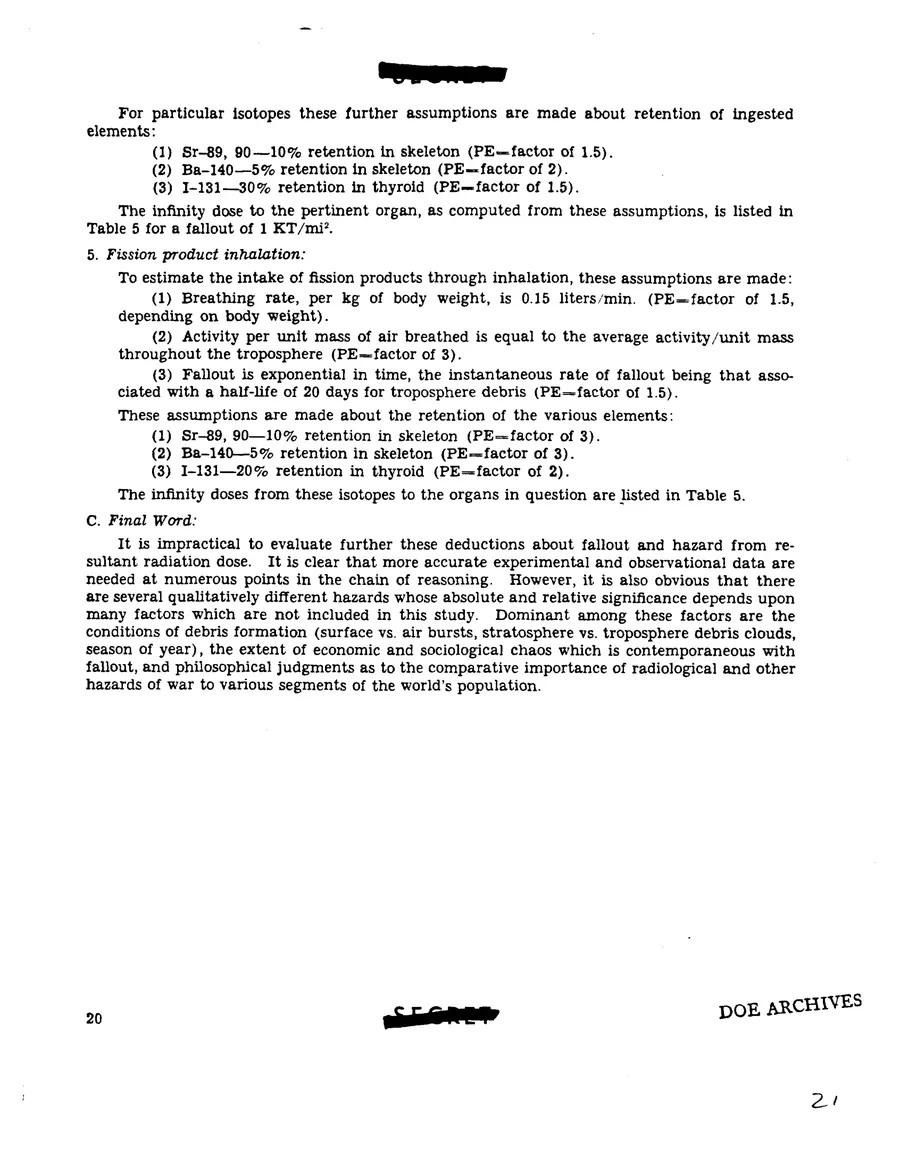
For particular isotopes these further assumptions are made about retention of ingested elements:
(1) Sr-89, 90—10% retention in skeleton (PE=factor of 1.5).
(2) Ba-140—5% retention in skeleton (PE=factor of 2).
(3)I-131—30% retention in thyroid (PE=factor of 1.5).
The infinity dose to the pertinent organ, as computed from these assumptions, is listed in Table 5 for a fallout of 1 KT/mi^2.
5. Fission product inhalation:
To estimate the intake of fission products through inhalation, these assumptions are made:
(1) Breathing rate, per kg of body weight, is 0.15 liters/min. (PE=factor of 1.5, depending on body weight).
(2) Activity per unit mass of air breathed is equal to the average activity/unit mass throughout the troposphere (PE=factor of 3).
(3) Fallout is exponential in time, the instantaneous rate of fallout being that associated with a half-life of 20 days for troposphere debris (PE=factor of 1.5).
These assumptions are made about the retention of the various elements:
(1) Sr-89, 90—10% retention in skeleton (PE=factor of 3).
(2) Ba-140—5% retention in skeleton (PE=factor of 3).
(3) I-131—20% retention in thyroid (PE=factor of 2).
The infinity doses from these isotopes to the organs in question are listed in Table 5.
C. Final Word:
It is impractical to evaluate further these deductions about fallout and hazard from resultant radiation dose. It is clear that more accurate experimental and observational data are needed at numerous points in the chain of reasoning. However, it is also obvious that there are several qualitatively different hazards whose absolute and relative significance depends upon many factors which are not included in this study. Dominant among these factors are the conditions of debris formation (surface vs. air bursts, stratosphere vs. troposphere debris clouds, season of year), the extent of economic and sociological chaos which is contemporaneous with fallout, and philosophical judgments as to the comparative importance of radiological and other hazards of war to various segments of the world's population.
Textual notes on this leaf (1)
0.15 liters/min.
The solidus is printed as a shallow diagonal that the OCR layer reads as a tilde; on the image it is a solidus. Settled as 'liters/min.'
SECRET (obliterated, left margin, printed sideways with the table) · SECRET (obliterated, right margin, printed sideways with the table) · DOE ARCHIVES (stamp, foot left, printed sideways) · handwritten leaf number 22 (foot left, written sideways)
TABLE 5.—INFINITY DOSE (RADS) SUBSEQUENT TO FALLOUT AT VARIOUS TIMES AFTER DETONATION
(Assumed quantity of fallout—1 KT of fission debris per mi^2)
Period between detonation and fallout · External whole body gamma radiation (All individuals) · Sr-90 dose to skeleton (Infant or child) · · · · Sr-89 dose to skeleton (Infant) · · · · Ba-140 dose to skeleton (Infant) · · · I-131 dose to thyroid (Infant) · ·
· · Soil · Leaf · Water · Air · Soil · Leaf · Water · Air · Leaf · Water · Air · Leaf · Water · Air
1 day · 470 · 250 · 1.5 x 10^3 · 10 · 15 · 10 · 2 x 10^3 · 3. · 9 · 1,000 · 2 · 15 · 7 x 10^5 · 300 · 3200
10 days · 187 · 250 · 1.5 x 10^3 · 10 · 15 · 8.8 · 1.7 x 10^3 · 2.6 · 7.8 · 580 · 1.2 · 8.7 · 2.9 x 10^5 · 130 · 1360
20 days · 142 · 250 · 1.5 x 10^3 · 10 · 15 · 7.7 · 1.5 x 10^3 · 2.3 · 6.9 · 340 · 0.7 · 5.1 · 1.2 x 10^5 · 53 · 540
40 days · 107 · 250 · 1.5 x 10^3 · 10 · 15 · 5.9 · 1.2 x 10^3 · 1.8 · 5.4 · 120 · 0.24 · 1.8 · 2.2 x 10^4 · 9.2 · 100
70 days · 85 · 250 · 1.5 x 10^3 · 10 · 15 · 4.0 · 0.8 x 10^3 · 1.2 · 3.6 · 22 · 0.044 · 0.33 · 1.6 x 10^3 · 0.7 · 7.2
100 days · 74 · 250 · 1.5 x 10^3 · 10 · 15 · 2.7 · 0.5 x 10^3 · 0.8 · 2.4 · 4.5 · 0.009 · 0.06 · 1.2 x 10^2 · 0.05 · 0.4
Probable error expressed as a factor · 3 · 3 · 7 · 7 · 6 · 4 · 6 · 7 · 6 · 8 · 7 · 6 · 5 · 6 · 5
Textual notes on this leaf (8)
Period between detonation and fallout · External whole body gamma radiation (All individuals) · Sr-90 dose to skeleton (Infant or child) · · · ·
The table has a two-tier head: four spanning group captions (Sr-90, Sr-89, Ba-140, I-131) over sixteen column heads. It is given here as two header rows — the first carrying the group captions with empty cells under each span, the second carrying Soil/Leaf/Water/Air. Sixteen columns throughout. Not a reading problem.
1.5 x 10^3
The exponent of the Sr-90 Leaf column is a small superscript that is filled in on every one of the six rows. It was re-rendered at 1400 dpi; the clearest impressions (rows 3 and 4) read 3, and the value is constant down the column as Sr-90's 28-year half life requires. CONFIRM against the raw scan.
2 x 10^3 / 1.7 x 10^3 / 1.5 x 10^3 / 1.2 x 10^3 / 0.8 x 10^3 / 0.5 x 10^3
The exponents of the Sr-89 Leaf column are likewise filled in. Read as 3 throughout: the mantissas fall from 2 to 0.5 over 100 days, which is the 50.5-day Sr-89 decay and matches the neighbouring Sr-89 Soil column exactly. CONFIRM against the raw scan.
7 x 10^5 / 2.9 x 10^5 / 1.2 x 10^5 / 2.2 x 10^4 / 1.6 x 10^3 / 1.2 x 10^2
The I-131 Leaf exponents are small and partly filled; only the 4 in row 4 is unambiguous. Read as 5, 5, 5, 4, 3, 2. CONFIRM against the raw scan.
1360
The third digit of the I-131 Air value at 10 days is filled and could be read 6 or 8. Read as 1360. CONFIRM against the raw scan.
3. · 9
The Sr-89 Water value at 1 day is printed as '3.' with a full stop and no following digit, and the Sr-89 Air value at 1 day as a bare '9' set slightly high in the cell with a small mark beneath it. PRESERVED as written.
The probable-error row is set in italic figures whose 5, 6 and 8 are hard to separate. Re-rendered at 1200 dpi in two halves and read column by column. CONFIRM the 6/8 readings against the raw scan.
TABLE 5.—INFINITY DOSE (RADS)
The caption is set in small capitals; given here in full capitals. The leaf is printed sideways (landscape) within a portrait page.
Order restored. Nine leaves are not printed here: one marked blank by hand, then eight of Appendix A written by Chicago and Columbia.
FIGURE 1
III. NEW YORK OPERATIONS OFFICE, AEC
Analytical methods for determining total strontium, total radiostrontium, and Sr-90 are discussed. The majority of the samples encountered were bone, soil, vegetation, or foods. Where different procedures are required for handling these different types of samples, the methods are given separately.
A. Separation of total radiostrontium from five grams of bone ash:
1. Ash the bone sample in nickel crucible at 900°C.
2. Grind in a mortar to a fine powder.
3. Weigh out 5 grams into a 250 ml centrifuge bottle.
4. Add 44 ml of water and then slowly add 154 ml of 90% nitric acid to bring concentration to 75% HNO_3.
5. Add 20 mg of Sr carrier (as Sr(NO_3)_2) in 2 ml of solution.
6. Stir rapidly for thirty minutes. (Mechanically)
7. Centrifuge for 10 minutes at about 2,000 rpm.
8. Decant, dissolve the precipitate in 23 ml of water and transfer to a 250 ml beaker, add slowly 77 ml of 90% HNO_3 and stir mechanically for thirty minutes.
Textual notes on this leaf (3)
FIGURE 1
RIGHTS. The photograph on this leaf is the report's only plate and it belongs with the laboratory description in the preceding, excluded part of Appendix A: the AEC's own Section III says at p. 34 that its counting instrumentation 'is similar to that used by Kulp (p. 30)', and p. 30 falls inside the Columbia University Lamont Geophysical Observatory pages that this edition excludes. The plate is unattributed on the page. Flagged for the rights review — it sits physically on the first AEC leaf but is not obviously AEC-authored matter.
III. NEW YORK OPERATIONS OFFICE, AEC
The section number and heading are printed in a lighter sans-serif face used for all top-level headings in this appendix. The AEC New York Operations Office is an AEC field office; the text of Section III is the Commission's own.
Sr(NO_3)_2
Printed with the 3 and the 2 as subscripts; written here with underscores and set as subscripts at merge.
9. Filter through a fluorothene funnel on to a glass fiber filter. Transfer the funnel to a clean filter flask and wash the acid from the precipitate with anhydrous ethyl ether.
NOTE.— The fluorothene funnels are a modification of the Tracerlab stainless steel funnel, designed for preparing precipitates for counting on filter paper. The glass fiber filters are available from H. Reeve Angel and Co., Inc., 52 Duane St., New York 7, N. Y., as catalog number X-934-AH. They are more retentive than paper filters and are unaffected by 75% HNO_3.
10. Place the filter paper on a brass disk and ring assembly (Tracerlab), cover with 0.001 inch Pliofilm and beta count.
One of the standard methods for separating strontium from calcium and many other metals is the precipitation of strontium in strong nitric acid. By the addition of carrier strontium, this method has been adapted to the determination of radiostrontium. Strontium, barium, and lead are relatively more insoluble as the concentration is increased. Since other nitrates also become more insoluble with increased concentration, the selection of the strength to be used represents a compromise. Based on experimental studies, 75% HNO_3 was selected as the optimum concentration.
In the analyses 20 mg of carrier strontium is added to each sample before starting the procedure. This may be an excessive quantity, but this amount of carrier can be tolerated in beta counting and a large excess is helpful when dealing with moderately soluble precipitates such as the strontium salts used.
An experiment was performed to determine the effect of calcium on the recovery of Sr-90. Solubility measurements indicated that 200 ml of 75% HNO_3 would cause a loss of 2.6 mg of Sr or a 13% loss when using 20 mg of Sr carrier. Calcium was found to have a salting effect so that Sr recovery is improved by operating close to calcium saturation. The solubility of calcium in 75% HNO_3 is equivalent to 23.5 grams of CaO per liter. If no calcium is present, a minimum of HNO_3 should be used.
Experience showed that the presence of other fission products does not interfere in the method of analysis used for bone samples.
B. Separation of total radiostrontium from one hundred grams of soil:
The method described below is designed to insure recovery of the radiostrontium regardless of its state or of the nature of the soil. However, tests of leaching methods, using 6 N HCl or 1 N ammonium acetate, have shown good recovery and are to be preferred for handling large samples of soil. Details of this method are included here partly because the method is being used for certain cases and partly because of the applicability of a portion of the procedure to separation of radiostrontium from samples of vegetation and foods.
1. Dry the entire sample in an oven at 110°C.
2. Sample, using standard sampling procedure (quartering process) until approximately 125 grams of soil is obtained as a representative sample.
3. Ignite in a nickel crucible at 900°C.
4. Weigh out 100 grams of the ignited material.
5. Add 400 grams of Na_2CO_3 and mix thoroughly.
6. Fuse in a muffle at 900°C (minimum temperature) for 45 minutes (minimum time), until the melt is clear and homogeneous.
7. Cool by immersing in a beaker of cold water, withdrawing quickly at first. Continue immersing and withdrawing until the crucible is cool enough to place on a transite board. The Na_2CO_3 should not be wet at any time.
8. When the crucible is cool, turn it upside down, tap the bottom with a pestle and allow the solid fused material to fall into a mortar.
9. Break up the fused material in a hand grinder, transfer to an automatic grinder and grind to a fine powder.
Textual notes on this leaf (2)
NOTE.—The fluorothene funnels
The note is set two points smaller than the surrounding text and full measure; the word NOTE is in small capitals with a spaced full stop and em rule. Given here as a run-in heading.
H. Reeve Angel and Co., Inc., 52 Duane St., New York 7, N. Y., as catalog number X-934-AH.
A named commercial supplier and product number in the AEC's own procedural note. Not third-party text; recorded for completeness.
10. Transfer the ground fused material to a 3-liter beaker containing 500 ml of hot distilled water, stirring constantly until the particles are dispersed.
11. Add slowly with continued stirring, 1000 ml of 60% HClO_4. This is sufficient to neutralize the fused material and allow for an excess of acid.
12. Evaporate with mechanical stirring until dense white HClO_4 fumes are detected. The silica is now dehydrated.
13. Dilute to 2.5 liters with distilled water and allow to settle.
14. Filter the silica on No. 5 Whatman paper with suction. Wash with 250-500 ml of hot 5% HCl, then with 250 ml of distilled water. Transfer the filtrate and washings to the original beaker. Wash the silica with 1% H_2SO_4, and discard the washings.
15. Remove the silica from the filter paper and dry in a 110°C oven overnight. Break up the aggregated material with a mortar and pestle, then transfer to a 250 ml platinum dish.
16. Moisten the silica with 10% H_2SO_4, then add about 100 ml of HF.
17.Evaporate on a sand bath to SO_3 fumes to volatilize the silica. Cool and dilute with distilled water, transferring the resulting solution to the original soil filtrate, and add 20 mg Sr^{++} carrier.
18. Neutralize the filtrate with NaOH pellets until the pH is 4-4.5. At this point add slowly, with stirring, 50 grams of Na_2CO_3 and allow the precipitate to settle. Filter through No. 5 Whatman paper with suction and discard the filtrate.
19. When the precipitate is dry, remove from the filter paper and transfer to the original beaker. Dissolve in 200 ml of concentrated HCl and evaporate slowly to dryness. Do not bake.
20. Now add 460 ml of distilled water and stir mechanically until the residue is completely dispersed.
21. Add slowly, 1540 ml of 90% HNO_3 with continuous mechanical stirring and allow to remain stirring for ½ hour.
22. Allow to settle until the supernatant is clear, then decant as much 75% HNO_3 as possible.
23. Transfer the precipitate and remaining acid to a 250 ml centrifuge bottle, centrifuge and decant, discarding the supernatant.
24. Carry out another 75% HNO_3 separation using a volume of 200 ml.
25. At this point the bulk of the calcium should be removed leaving strontium nitrate and insoluble material. Add 100 ml of hot distilled water to the precipitate, centrifuge and decant into a 250 ml beaker.
26. Wash again with 50 ml of hot distilled water adding the supernatant liquid to the beaker after centrifugation. The residue can now be discarded.
27. Evaporate the filtrate slowly to dryness.
28. Now carry out a final 75% HNO_3 separation in the 250 ml beaker. (100 ml volume)
29. Filter through a fluorothene funnel on a glass fiber filter. Transfer the funnel to a clean filter flask and wash out the acid with anhydrous ethyl ether.
30. Place the filter on a brass disk and ring assembly (Tracerlab), cover with 0.001 inch Pliofilm and beta count. Recovery values for the above procedure are about 75%.
C. Separation of total radiostrontium from vegetation and foods:
1. Ash the sample in a nickel crucible at 900°C.
2. Estimate the amount of ash, add four times this weight of Na_2CO_3 and fuse.
3. Dissolve, remove silica, and collect the strontium by carbonate precipitation as for soil.
4. Run a double nitrate precipitation as for bone using acid volumes of 200 ml for the first precipitation and 50 ml for the second.
Textual notes on this leaf (2)
the pH is 4-4.5
The hyphen between 4 and 4.5 is printed with the heavier double stroke this face uses for an equals sign, so it can be misread as '4=4.5'. It is a range. Settled as 4-4.5.
20 mg Sr^{++} carrier.
The two plus signs are printed as raised superscripts. Written here with braces and set as a superscript at merge.
The simplest method of analysis is the direct solution of bone ash in HNO_3, dilution to suitable volume, and determination of strontium content by flame photometry. The direct analysis did not have sufficient sensitivity, so the separation of strontium from calcium was made by a double nitrate precipitation. At the low concentrations of strontium found in bone it was necessary to add barium as a carrier. This brought the recovery of strontium up to over 90%.
The analytical procedure is as follows:
1. Ash the bone sample in a nickel crucible at 900°C.
2. Grind in a mortar to a fine powder.
3. Weigh out 5 grams into a 250 ml centrifuge bottle.
4. Add 44 ml of water and then slowly add 154 ml of 90% nitric acid to bring concentration to 75% HNO_3.
5. Add 20 mg of Ba^{++} carrier (as BaCl_2) in the 2 ml of solution.
6. Stir rapidly for thirty minutes (mechanically).
7. Centrifuge for ten minutes at about 2000 r.p.m.
8. Decant and repeat steps 4 thru 7 at ½ the original volume.
9. Decant as much of the liquid as possible and transfer to a 100 ml beaker with water.
10. Evaporate to dryness and pick up with 10 ml of concentrated nitric acid.
11. Add 5 ml of 1000 ppm Li solution, dilute to 100 ml and run flame photometry.
E. Determination of Sr-90 by separation and counting of Y-90:
1. After the sample on the brass holder has been counted for total strontium and has reached equilibrium, it may be used for Y-90 separation.
2. Count the sample and record data.
3. Remove the sample from the brass holder. Wash the holder with about 25 ml of water. Allow washings to fall into beaker with the bulk of the paper.
4. Bring to a boil and filter thru No. 41 paper into a 50 ml platinum dish. Wash the beaker and paper with approximately 15 ml more of water.
5. Evaporate to dryness on a sand bath. Add approximately 20 ml of HF and evaporate to dryness again.
6. Pick up the residue with approximately 5 drops of HCl. Transfer to a beaker with water. Bring volume to about 50 ml. Add 10 mg of lanthanum carrier. (This carrier must have negligible beta activity.)
7. Bring to a boil and adjust pH to 6-7. Allow to stand for about 15 minutes and filter thru a 1⅛" glass fiber paper. Place on brass holder. Cover with Pliofilm and count.
8. Record time that filtration was completed. Count and record counting date and counting time.
9. Observe decay by counting at approximately 3-day intervals for a period of about 12 days.
The procedure was tested by measuring the recovery of Y-91 added to solutions containing 20 mg of Sr as the nitrate. The recoveries found with either paper or glass fiber filters were 94-99%.
F. Measurement of activity:
Instrumentation for counting is similar to that used by Kulp (p. 30), except that it has no anticoincidence circuit. The background counting rate is about 6 c.p.m.
Work on the development of a scintillation anticoincidence counter is in progress. This is designed around a solution phosphor containing the active material in a volume of 5 to 10 ml.
Textual notes on this leaf (4)
D. Determination of elemental strontium in bone.
This heading ends in a full stop where the other lettered headings in this section (A, B, C, E, F) all end in a colon. PRESERVED as written.
filter thru a 1⅛" glass fiber paper
A small stacked fraction read as one-eighth, giving a 1⅛-inch paper. CONFIRM against the raw scan.
Instrumentation for counting is similar to that used by Kulp (p. 30)
RIGHTS. The AEC's own text cross-refers to p. 30, which falls inside the Columbia University Lamont Geophysical Observatory pages excluded from this edition; the reference will point at a leaf the reader does not have. It also identifies the photograph on raw p32 (printed p. 31) with the excluded Lamont apparatus.
Add 20 mg of Ba^{++} carrier (as BaCl_2) in the 2 ml of solution.
Reads 'in the 2 ml of solution' where the parallel step in Section A (raw p32, step 5) reads 'in 2 ml of solution'. The document's own inconsistency. PRESERVED as written.
SECRET (obliterated, head) · SECRET (obliterated, foot centre) · DOE ARCHIVES (stamp, foot right) · handwritten leaf number 36 (foot right) · a short pair of ink strokes in the foot margin left of the leaf number, apparently a pen trial
The overall problem involves the development of a suitable method of obtaining the active material in solution, the development of the optimum phosphor, and the development of appropriate instrumentation.
IV. DEPARTMENT OF AGRICULTURE
A. Procedure for the extraction of exchangeable calcium in soils:
1. General Statement:
The soil sample is leached with ammonium acetate and the filtrate evaporated to dryness. The salts are dehydrated and the residue ashed at 600°C. The ashed residue is taken up in HCl, and iron and aluminum are removed by precipitation as the hydroxides. The filtrate is acidified and calcium precipitated as the oxalate at pH 6.2.
2. Reagents:
Normal ammonium acetate, pH 7.0.
Hydrogen peroxide, 30-35 percent.
Hydrochloric acid, concentrated.
Ammonium hydroxide, 1:1.
Ammonium chloride, 2 percent aqueous solution.
Methyl red, 0.1 percent aqueous solution.
Oxalic acid, C.P., crystal.
3. Procedure:
Crush the air-dry sample with a wooden rolling pin and pass the sample through a 2 mm sieve. Place 7-10 pounds of the prepared sample in a 4-liter beaker and add sufficient ammonium acetate to cover. Stir the suspension well and let stand overnight. Fit an 18-liter carboy with a 10-inch Buchner funnel and vacuum tube. Place two thicknesses of coarse filter paper in the funnel, moisten, and apply suction. Transfer the contents of the beaker to the funnel and leach the soil with ammonium acetate until a total of 1 liter of leachate for each pound of soil is obtained. Transfer the leachate to large beakers (3 or 4 liter capacity) and evaporate almost to dryness at 90-95°C. Combine the residues in a 2-liter beaker and take to complete dryness.
Loosen as much of the dry residue as possible with a large spatula and transfer to an evaporating dish (or dishes). To the small amount of residue remaining in the beaker add 200 ml of water and 10 ml of H_2O_2. Cover and boil for 15-20 minutes. Place the evaporating dish (containing the residue) in a muffle at about 150°, heat to 600°C, and hold this temperature for about 1 hour. Remove the dish from the muffle and cool. Combine the ashed residue and the peroxide treated residue.
Add small portions of MCl with stirring until all of the carbonates are decomposed; add 10-15 ml of HCl in excess.
Heat the solution to about 90°C and add 1:1 NH_4OH with stirring until a faint odor of ammonia persists. Boil for 2-3 minutes to coagulate the precipitate and filter through coarse filter paper. Wash the filter well with 200 ml of hot NH_4Cl. Add 20 drops of methyl red and acidify with HCl. Add 5-10 ml excess HCl. Heat to 90°C and add 50 grams (25 gms. if soil is low in calcium) of oxalic acid with stirring until the solution turns a light yellow. Digest at 90-95°C for 1-2 hours. Collect the precipitate on a Buchner funnel, wash 5 times with cold water and dry.
Textual notes on this leaf (3)
Add small portions of MCl with stirring
Reads 'MCl' where 'HCl' is plainly meant — the same sentence goes on to call for '10-15 ml of HCl in excess'. The document's own typographical error. PRESERVED as written.
IV. DEPARTMENT OF AGRICULTURE
SECTION BOUNDARY. Section III, NEW YORK OPERATIONS OFFICE, AEC ends with the first paragraph of this leaf ('...the development of appropriate instrumentation.') and Section IV, DEPARTMENT OF AGRICULTURE, begins immediately below it in mid-page. The USDA is a U.S. government department, so this section is government-authored like the AEC's own; it is not contractor text.
in a muffle at about 150°, heat to 600°C
The first temperature is given as a bare degree sign with no C where the second carries it. PRESERVED as written.
SECRET (obliterated, left margin, printed sideways with the table) · SECRET (obliterated, right margin, printed sideways with the table) · DOE ARCHIVES (stamp, foot left, printed sideways) · handwritten leaf number 37 (foot left, written sideways) · a heavy printer's rule and offset ink smear across the head of the leaf
APPENDIX B
Sr and Ca Metabolism
Reference · Animal · Age at admin. · Period of retention · Method of admin. · Sr intake · Ca intake · % Sr retention · % Ca retention · Sr/Ca ratio retained · Comments
1 · Mice · · 24 hrs · I.V (lactate) · 1.6 mg · · 33% · · · IV uptake of Sr chloride, lactate, gluconate essentially identical.
· · · · · 0.017 · · 45% · · 0.8 ·
· · · · · · 0.8 mg · · 58% · ·
· · · 48 hrs · Oral (lactate) · · · 11% · · 0.5 · Oral uptake of Sr chloride, lactate, gluconate essentially identical.
· · · · · · 1.6 mg · · 23% · ·
2 · Mice · Adult · 9-15 days · Injected · · · 13-31% · 53-65% · 0.4 · These mice were pregnant females which gave birth during period of retention.
3 · Rats · Approx. 5 weeks. · 3 days · Oral (lactate) · 0.5-2 mg · 1.5-4 mg · 10% · 15% · 0.7 · Rats reared 15-20 days (shortly after weaning) on Ca deficient diet then treated.
· · · · Oral (lactate with vitamin D). · do · do · 15% · 31% · 0.5 ·
· · · · I.P (lactate) · do · do · 11% · 28% · 0.4 ·
· · · · I.P (lactate with vitamin D). · · · 26% · 45% · 0.6 ·
4 · Rats · Growing · 4 days · Oral · Carrier free. · (Low Ca diet). · 73% · · · Effect of dietary Ca on Sr retention is apparent, though data not quantative.
· · · · · do · (High Ca diet). · 17% · · ·
· · Adult · do · · do · (Low Ca diet). · 16% · · ·
· · · · · do · (High Ca diet). · 2.8% · · ·
· · Growing and adult. · do · I.P · do · Similar results, ranging from 70% Sr retention in young (low Ca) to 14% in old (high Ca). · · · ·
5 · Rats · 50 days · 4 days · Intramuscular. · · · 70% · 81% · 0.9 · Sr and Ca in different rats.
· · 50 days · 4 days · do · Carrier free. · · 65% · 75% · 0.9 · Sr and Ca in same rats (double tracer).
6 · Rats · · 1 day · I.V · · · 81% · 86% · 0.9 · Ra studies carried out in same series; retention at successive periods 73%, 58%, 55%, 53%, respectively.
· · · 3 days · do · · · 81% · 88% · 0.9 ·
· · · 10 days · do · · · 67% · 87% · 0.8 ·
· · · 30 days · do · · · 55% · 79% · 0.7 ·
7 · Rats · 8 weeks · 8 days · I.P · Carrier free. · · 72% · · 1 ·
· · · · I.V · · · · 73% · ·
Textual notes on this leaf (5)
though data not quantative.
Reads 'quantative' where 'quantitative' is meant; the same table spells it correctly on the next leaf ('though data not quantitative since uptake of Ca from gut is unknown'). The document's own error. PRESERVED as written.
Similar results, ranging from 70% Sr retention in young (low Ca) to 14% in old (high Ca).
This sentence is set across the Ca intake, % Sr retention, % Ca retention and Sr/Ca columns as a single spanned cell. It is placed here in the Ca intake cell with the three cells to its right left empty.
0.8 / 0.5 / 1
In the Sr/Ca ratio column these three values are printed once against a brace spanning two or three rows. The value is given here on the row where it is printed and the other rows of its brace are left empty; no value is repeated.
do
The table's ditto is printed as an italic 'do' preceded and followed by leader dots. Given here as a bare 'do' in the cell.
Reference · Animal · Age at admin.
The Reference column carries its own numbering 1-13, which does NOT key to the report's References list on raw pp43-44 (where reference 1 is Smith's first Gabriel report). The appendix supplies no key. Comparison of the entries against the References list indicates the appendix numbers run 23 behind — Appendix B 1 = reference 24 (Pecher), 2 = 25 (Pecher and Pecher, pregnant mice), 6 = 29 (Norris and Kisieleski, the Ra series), 12 = 35 (Kidman, Tutt, Vaughan, rabbit), 13 = 36 (Comar, steer) — but that correspondence is inferred, not printed. Recorded as a completeness note.
SECRET (obliterated, left margin, printed sideways with the table) · SECRET (obliterated, right margin, printed sideways with the table) · DOE ARCHIVES (stamp, foot left, printed sideways) · handwritten leaf number 38 (foot left, written sideways)
7 (Con.) · Rats · 6-12 mos. · 8 days · I.P · Carrier free. · · 29% · · 0.9 ·
· · · · · · 1.2 mg · · 32% · ·
· · 8 weeks (low P rickets). · 8 days · I.P · Carrier free. · 1.2 mg · 20% · 13% · 1.5 · Rats in this group on low P diet, therefore rachitic.
8 · Rats · Daily diet from birth. · Months · Oral · Normal Sr/Ca ratio (∼10^{-3}). · · · · 0.35 · Rats kept on standard diet of known Sr/Ca ratio throughout life.
9 · Rats · Growing · Weeks · Oral · Sr/Ca intake=2.3 x 10^{-3}. · · Sr/Ca retained=5.5x10^{-4}. · · 0.25 · Rats kept on standard diet of known Sr/Ca ratio throughout period of growth.
10 · Rats · Adult · 4 days · Oral · 0.45 mg/day. · · 4-5% · · · Dose fed for 7 consecutive days, animals sacrificed on 8th day.
· · · · · 0.9 · · 4-5% · · ·
· · · · · 4.5 · · 4-5% · · ·
· · · · · 22.5 · · 4-5% · · ·
· · · · · 45 · · 4-5% · · ·
11 · Rats · Adult · 1 day · I.P · 0.1—75 mg · · See comment. · · · Sr retention decreased by factor of only 5 over 750 fold range of Sr injection.
12 · Rabbit · 6 weeks · 9 days · I.V · Carrier free to 0.02 gm Sr per rabbit. · 0.02 gm Ca/day in diet. · 55% · · · Amount of Sr carrier had no influence on Sr retention within experimental error of 10%. Effect of dietary Ca on Sr retention is apparent, though data not quantitative since uptake of Ca from gut is unknown.
· · · · · · 0.2 gm Ca per day in diet. · 46% · · ·
· · · · · · 1.3 gm Ca per day in diet. · 31% · · ·
· · 6 months · 9 days · I.V · do · 0.04 gm Ca/day in diet. · 57% · · ·
· · · · · · 0.4 gm Ca/day in diet. · 17% · · ·
· · · · · · 2 gm Ca/day in diet. · 12% · · ·
· · 18 months · 9 days · I.V · do · 0.4 gm Ca/day in diet. · 8% · · ·
13 · Steer · 1 year · 7 days · Oral · Carrier free. · · 30% · 30% · 1 · Retention computed by subtracting excretion from administration.
Textual notes on this leaf (6)
7 (Con.)
COMPLETENESS. This leaf carries no title and no column heads: Appendix B runs on from raw p37 with the rules alone, and only the '(Con.)' under the reference number marks it as a continuation. The column order is that of the head on raw p37 and is followed here. There is no printed 'APPENDIX B (Continued)' line, unlike Appendix D on raw p41.
Normal Sr/Ca ratio (∼10^{-3}).
The tilde is the document's 'of the order of' sign and the exponent is small and filled. Read as -3, which agrees with the 2.3 x 10^{-3} intake printed on the next line. CONFIRM against the raw scan.
Sr/Ca retained=5.5x10^{-4}.
Printed in the % Sr retention column, not in the Sr/Ca ratio column; the multiplication sign is closed up to the digits as shown. PRESERVED in the column where it stands.
0.1—75 mg
The range is printed with a long rule rather than the short hyphen used for ranges elsewhere in the table, and 'mg' is closed up to the 75. PRESERVED as written.
though data not quantitative since uptake of Ca from gut is unknown.
Spelled correctly here, where the same phrase on raw p37 reads 'quantative'. Both spellings PRESERVED as written.
0.9 / 1.5
In the Sr/Ca ratio column the 0.9 is printed against a brace spanning the first two rows. Given on the row where printed; the braced row left empty.
SECRET (obliterated, left margin, printed sideways with the table) · SECRET (obliterated, right margin, printed sideways with the table) · DOE ARCHIVES (stamp, foot left, printed sideways) · handwritten leaf number 39 (foot left, written sideways) · a heavy printer's rule and offset ink smear across the head of the leaf
APPENDIX C
Sr-89, 90 activity of animals and animal products (1 Sunshine Unit=10^{-12} curies/gm Ca)
Sample · Date of Collection · Place of Collection · No. of Items · Sr-89, 90 content (Sunshine Units) · Sr-90 content (Sunshine Units) · Analyst · Comment
Milk · Oct. 1953 · Chicago milkshed. · From 10 farms. · … · Av.=1.5 (range 0.97-2.25). · Libby · Cows feeding on alfalfa.
Milk · 1953 · U.S. · 2 · Av. 1.8 S.U. as of 1 Jan. ’54. · … · Harley · Sr-90 not measured; data on other samples suggest Sr-90 30-50% of total.
Milk · Sept.-Dec. ’53 · N. Y. · 3 · Av. 2.4 S.U. as of 1 Jan. ’54. · … · Harley ·
Cheese · July, ’53 · Wisconsin · 2 · … · 1.2, 2.1 · Libby ·
Cheese · July, ’53 · Wisconsin · 1 · … · 0.5 · Kulp ·
Cheese · Early ’53 (probably) · Switzerland · 2 · … · 1.2, 2.7 · Libby ·
Cheese · Early ’53 (probably) · Denmark · 2 · … · 1.0, 1.1 · Libby ·
Cheese · 1953 · Japan · 2 · … · 0.11, 0.14 · Libby ·
Cheese · Early ’53 · Azores · 1 · … · 0.7 · Kulp ·
Cheese · Early ’53 · Norway · 2 · … · 1, 2 · Kulp ·
Calf · Sept. ’53 · Albany, N. Y. · 1 · 45 (as of 1 Jan. ’54). · 3.0 · Harley · Most of fallout in this area in Apr. ’53.
Lamb · Oct. ’53 · Logan, Utah · 1 · 7 (1 Jan. ’54) · 0.8 · Harley ·
Calf · Sept. ’53 · Tifton, Georgia · 1 · 25 (1 Jan. ’54) · 14 · Harley ·
Lamb · Sept. ’53 · Ithaca, N. Y. · 1 · 8 (1 Jan. ’54) · 1.2 · Harley ·
Lamb · Sept. ’53 · Rutgers, N. J. · 1 · 8 (1 Jan. ’54) · 1.1 · Harley ·
Calf · Nov. ’53 · Easton, N. Y. · 1 · … · 2 · Harley · Same 8 months old calf analyzed by all 3 laboratories. Further intercomparisons underway.
Calf · Nov. ’53 · Easton, N. Y. · 1 · … · 6.2 · Libby ·
Calf · Nov. ’53 · Easton, N. Y. · 1 · … · 0.45 · Kulp ·
Calf · Oct. ’53 · Wisconsin · 1 · … · 0.26 · Kulp ·
Calf · Aug. ’53 · Montana · 1 · … · 0.30 · Kulp · Calf 6 months old.
Human stillborns · July ’53-Jan. ’54 · Chicago · 55 · … · 0.14 (range 0.04-0.32). · Libby ·
Human stillborns · Feb. ’54 · Utah · 1 · … · 0.19 · Libby ·
Human stillborns · Jan. ’54 · Vellore, S. India · 3 · … · 0.05, 0.04, 0.04 · Libby ·
Human legs (adult) · Nov., Dec. 1953 · Massachusetts · 3 · … · 0.01, 0.01, 0.02 · Libby ·
Textual notes on this leaf (4)
(1 Sunshine Unit=10^{-12} curies/gm Ca)
The equals sign in the caption is printed as the long double-struck rule this face uses and can be read as a dash. Settled as an equals sign, which is how the same definition is given in the body of the report (raw p13, printed p. 12).
…
A centred three-dot mark, distinct from the dotted leaders that fill empty cells elsewhere in the table, is printed in the Sr-89, 90 and Sr-90 columns where no assay exists. Kept as an ellipsis to preserve the distinction.
Same 8 months old calf analyzed by all 3 laboratories. Further intercomparisons underway.
This comment is printed once against a brace spanning the three Easton, N. Y. calf rows. Given on the first of those rows; the other two left empty.
Analyst · Libby / Kulp / Harley
RIGHTS-ADJACENT. The Analyst column credits two university contractors — Libby (University of Chicago) and Kulp (Columbia University, Lamont) — alongside Harley of the AEC New York Operations Office. The table itself is the AEC's own compilation of assay results reported to it, not contractor prose; recorded so the rights review can see the attribution.
SECRET (obliterated, head centre) · SECRET (obliterated, foot centre) · DOE ARCHIVES (stamp, foot right) · handwritten leaf number 40 (foot right)
APPENDIX D
Experimental Data on Radioactive Strontium Toxicity
Reference · Animal · No. of animals · Isotope · μc/gm administered · Estimated rad/day in skeleton · Biological effects · Comments
37 · Human · 6 · Sr^{89} · 0.02-0.4 · 3-60 · All died soon after treatment, presumably from disease for which treated (breast cancer, polycythemia vera, osteogenic and other sarcomas). Effects of radiation indistinguishable from disease. · Patients treated at U. of Calif. hospital in early ’40's. In many of the cases, the dose was administered in several subdivisions over a period of a few months. Other patients treated on which data at present unavailable. Surviving patients should be followed, although with little expectation of significant findings.
· Human · 1 · Sr^{89} · 0.06 · 10 · Mycosis fungicides diagnosed. Effects indistinguishable from symptoms of disease. Survives without follow-up. ·
· Human · 1 · Sr^{89} · 0.1 · 16 · Fibromyxosarcoma diagnosed. Effects indistinguishable from symptoms of disease. Survives apparently without ill effects. ·
38 · Dogs · 24 · Sr^{89} plus small Sr^{90} contamination. · 0.1-3.1 · 16-500 · 30 day LD50 about 1 μc/gm retained. Biological response was acute radiation syndrome. · Dogs included adults, young adults, pups. Somewhat better correlation of effect with injected dose than with retained dose. Some survive at 8½ yrs.
39, 40 · Dogs (adult) · 9 · Sr^{89} plus small Sr^{90} contamination. · 0.25-1.0 · 40-160 · 4 died within 135 days, all suffered early hemorrhages, survivors had numerous bone fractures. 1 with maximum dose died at 8 yrs. with skeletal changes, no tumor. 1 with 0.5 μc/gm has bone tumor at 8 yrs. ·
· Dogs (adult) · 4 · Sr^{89} plus small Sr^{90} contamination. · 0.1 · 16 · 1 suffered bone fracture at 3 yrs., slight localized changes in mandibles. · Some survive at 8½ yrs.
· Dogs (puppy). · 2 or more. · Sr^{89} plus small Sr^{90} contamination. · 0.5 · 80 · Fractures, loss of teeth, underdevelopment of mandibles. Tumor in 1 dog. · Alive at 8 yrs.
· Dogs (adult) · 1 · Sr^{90} · 0.25 · 70 · Died 18 days ·
· · 1 · Sr^{90} · 0.15 · 50 · Acute radiation syndrome, survived more than 3 months. · Retention not measured.
· · 3 · Sr^{90} · 0.01 · 3 · 1 suffered fracture, 2 no lesions at 6 years. · Retention not measured.
Textual notes on this leaf (5)
Mycosis fungicides diagnosed.
Reads 'fungicides' where 'fungoides' is meant (mycosis fungoides, the cutaneous lymphoma). The document's own error. PRESERVED as written.
APPENDIX D
The table is printed sideways on a portrait leaf, reading up the page, while the SECRET and DOE ARCHIVES markings on the same leaf are set the normal way up. The PDF text layer recovers nothing at all from this leaf; it was read from a rotated 400 dpi render.
in early ’40's.
The decade is printed with both a leading turned comma and a possessive apostrophe. PRESERVED as written.
Sr^{89} plus small Sr^{90} contamination.
The isotope superscripts throughout Appendix D are small filled figures. Read here as 89 and 90 from the rotated render; the pairing agrees with references 38 and 39/40 in the References list, which are Sr-89 dog studies. CONFIRM against the raw scan.
0.02-0.4 · 3-60
The μ of 'μc/gm administered' is printed as a small script mu partly filled in the scan. Settled as μc/gm, the unit used throughout the report.
SECRET (obliterated, left margin, printed sideways with the table) · SECRET (obliterated, right margin, printed sideways with the table) · DOE ARCHIVES (stamp, foot left, printed sideways) · handwritten leaf number 41 (foot left, written sideways) · manuscript corrections in ink in the Estimated rad/day in skeleton column: on each of the four reference-42 (Lambs) rows the printed figure is struck through and a new figure written to its left — 150, 30, 3.0 and 0.06 respectively. The struck printed figures are obliterated by the strike and cannot be read.
APPENDIX D (Continued)
Reference · Animal · No. of animals · Isotope · μc/gm administered · Estimated rad/day in skeleton · Biological effects · Comments
41 · Dogs (beagles). · · Sr^{90} · .025 · 7.5 · · Experiment started spring 1954.42 · Lambs · 4 · Sr^{90} · (0.25 retained). · 150 · · Experiment started spring of 1954
· · 4 · · (0.05 retained). · 30 · ·
· · 4 · · (0.005 retained). · 3.0 · ·
· · 4 · · (10^{-4} retained). · 0.06 · ·
43 · Monkeys · 2 · Sr^{90} · 2.0 · 1,000 · Died at 13-56 days, acute radiation syndrome. · Chronic toxicity experiments promised.
· · 4 · · 1.0 · · ·
· · 2 · · 0.5 · · ·
44 · Goats · 14 · Sr^{90} · (1.-1.5) · 150-250 · 30 day LD50 about 1-1.5/μc/gm. injected, 50% retained. ·
45 · Steer · 1 · Sr^{90} · 2 x 10^{-3} · 0.5 · Suggestion of hemorrhagic condition under epiphyseal plate several months after active region left behind plate as bone grew. Similar condition observed in some inactive controls. ·
46 · Mice · · Sr^{89} · (3.5 retained) · 1,200 · 30 day LD50 ·
· · · · (2 retained). · 660 · 150 day LD50 ·
· Rats · · · (2 retained). · 660 · 30 day LD50 ·
· · · · (1 retained). · 330 · 150 day LD50 ·
· Rabbits · · · (0.9 retained) · 330 · 30 day LD50 ·
· · · · (0.85 retained) · 280 · 150 day LD50 ·
47 · Mice · · Sr^{89} · 0.07 · 12 · Reduction in heterophils apparent ·
· Rats · · · 0.25 · 40 · Reduction in heterophils apparent ·
· Rabbits · · · 1. · 160 · Reduction in heterophils apparent ·
48, 40. · Rats · 19 · Sr^{89} · 0.7 · 120 · Tumors in 10 of 19 rats ·
· · · · 0.03 · 5 · 50% with bone damage. ·
· Rabbits · · · 2 · 330 · Tumors within 1 yr ·
Textual notes on this leaf (6)
150 · 30 · 3.0 · 0.06
HAND CORRECTION. All four Estimated rad/day figures for reference 42 (Lambs) are manuscript. On each row the printed figure has been struck through in ink and a new figure written to its left. The struck printed figures are [illegible] under the strike. The manuscript readings 150, 30 and 3.0 are clear at 1600 dpi; the fourth is written '0.06' or possibly '0.66' against the adjoining strike, and is given as 0.06 because the other three rows scale at exactly 600 rad/day per μc/gm retained, which puts 10^{-4} retained at 0.06. CONFIRM the fourth figure against the raw scan.
48, 40.
Reads '48, 40.' where '48, 49.' is meant: the same pair of studies is printed '48, 49.' at the head of the next leaf, and reference 40 is Brues's Sr-toxicity conference notes, cited two rows above against the dog series. The document's own typographical error. PRESERVED as written.
30 day LD50 about 1-1.5/μc/gm. injected, 50% retained.
A stray solidus stands between the range and the unit, and a full stop follows 'gm' mid-sentence. PRESERVED as written.
Experiment started spring of 1954
No closing full stop, unlike the parallel comment on the row above ('Experiment started spring 1954.'). PRESERVED as written.
Sr^{90} / Sr^{89}
The isotope superscripts on this leaf are filled blobs at every magnification tried up to 1200 dpi. They are read as 90 for references 41-45 and 89 for references 46-48 on the shape of the second figure and on the References list, where 46 (Anthony, Lathrop and Snyder, MDDC 1364), 47 (Simmons and Jacobson, MDDC 1387) and 48 (Brues, Lisco and Finkel, MDDC 145) are all Sr-89 papers. Reference 44 is the least certain: its printed superscript reads 90 here while its entry in the References list is Swift, Prosser and Mika on 'Effects of Sr-89 and x radiation on goats'. CONFIRM the whole column against the raw scan.
.025
Printed with no leading zero, where every other figure in the column carries one. PRESERVED as written.
SECRET (obliterated, left margin, printed sideways with the table) · SECRET (obliterated, right margin, printed sideways with the table) · DOE ARCHIVES (stamp, foot left, printed sideways) · handwritten leaf number 42 (foot left, written sideways)
48, 49. · Mice · 2,100 altogether. · Sr^{89} · 5 · 820 · Mean life duration about ½ control. · The most extensive experiment on chronic Sr toxicity. Tumor latent period appears to vary as inverse square root of dose. Dependence of incidence on dose suggests that each quantity of absorbed radiation confers on tissue absorbing it a probability of tumor formation which is without limit in time.
· · · · 2.5 · 410 · ·
· · · · 1 · 160 · Significant reduction in mean life duration. ·
· · · · 0.5 · 80 · Negligible reduction in mean life duration. ·
· · · · 0.25 · 40 · ·
· · · · 0.1 · 16 · ·
· · · · 0.05 · 8 · Significantly higher tumor incidence than controls at this and all higher dose levels. ·
50 · Humans: x and gamma irradiation of bone produce malignant tumors. Incidence apparently low. 11 cases reviewed, mostly 200 KV. x-ray treatment. In most cases, estimated bone dose about 8,000-10,000 rads. One case about 5,000 rads. Latent period 6-22 years.
Textual notes on this leaf (5)
Mean life duration about ½ control.
A small stacked fraction, read as one-half at 1000 dpi; the denominator is partly filled. CONFIRM against the raw scan.
50 · Humans: x and gamma irradiation of bone produce malignant tumors.
Reference 50 is set as a single line of text running the full width of the table under the reference number, with no column rules crossing it. Given here as one cell after the reference number.
48, 49.
Printed correctly here as '48, 49.', which is what shows the '48, 40.' on the preceding leaf to be an error.
Humans: x and gamma irradiation of bone produce malignant tumors.
Reads 'produce' where 'produces' would be expected after a compound subject taken as singular. The document's own grammar. PRESERVED as written.
APPENDIX D (Continued)
COMPLETENESS. This leaf carries no title and no column heads; Appendix D runs on from raw p41 with the rules alone. The table ends two-fifths of the way down the leaf and the remaining three-fifths are blank. The column order is that of the head on raw pp40-41 and is followed here.
SECRET (obliterated, head) · SECRET (obliterated, foot centre) · DOE ARCHIVES (stamp, foot right) · handwritten leaf number 43 (foot right) · a heavy printer's rule down the whole of the left margin, hooking inward at head and foot
REFERENCES
^1 Smith, N.M., First revised report of the Project Gabriel (12 Nov., 1949) (S)
^2Smith, N.M., Gabriel Project, Reopened (8 Nov., 1951) (S)
^3 Greenfield, N.M., Kellogg, W.W., Krieger, F.J., and Rapp, R.R., R-265-AEC, the Rand Corporation (July 1, 1954). “Transport and early deposition of radioactive debris from atomic explosions, Project Aureole”. (S)
^4 Kramish, et al, R-251-AEC, the Rand Corporation (Aug. 6, 1953). “World-wide effects of atomic weapons, Project Sunshine”. (S)
^7 Eisenbud, M., NYO-1576 (Jan. 28, 1952). “Radioactive debris from operations Buster and Jangle: observations beyond 200 miles from the test site”. (S)
^8 List, R.J., NYO-4512 (Feb. 25, 1953). “Radioactive debris from operations Tumbler and Snapper, part II”. (S)
^9 Eisenbud, M., NYO-4522 (April 28, 1953). “Radioactive debris from operation Ivy”. (S)
^10 Hubert, Machta, and List, NYO-4555. “Meteorological analysis of the transport of debris from operation Ivy”. (S)
^11 List, R.J., NYO-4602, In Press. “Transport of atomic debris from operation Upshot-Knothole”. (S)
^12 Eisenbud, M. and Harley, J.H., NYO-4571 (Jan. 8, 1954). “Project Sunshine—Progress from Sept. 1953-Jan. 4, 1954.” (S)
^13 Alexander, G.V., Nusbaum, R.E., and MacDonald, N.S., UCLA-293 (May 20, 1954). “Sr and Ca in municipal water supplies, their occurrence and removal”. (U)
^14 Weiss, M.M., BNL-252 (T-39). “A study of the airborne radioactivity at Brookhaven National Laboratory from the Nevada tests, Mar.-June, 1953”. (OUO)
^15 Collander, R., Plant Physiology 16 691 (1941). “Selective absorption of cations by higher plants”. (U)
^16 Neel, Olafson, Steen, Gillooly, Nishita, and Larson, UCLA-247. “Soil-plant interrelationships with respect to the uptake of fission products: I. The uptake of Sr-90, Cs-137, Ru-106, Ce-144, and Y-91”. (U)
^17 Menzel, R.G. and Brown, I.C., Bimonthly report from U.S. Department of Agriculture (March-April, 1953). “Leaching of fallout and plant uptake of fallout”. (U)
^18 Rediske, J.H. and Selders, A.A., HW-25021, Biology Research—annual report 1951, p. 118 (1952). “The absorption and translocation of several fission products by plants”. (U)
^19 Selders, Rediske, and Palmer, HW-28636 (July 7, 1953). “The absorption and translocation of radioactive elements from Jangle soil”. (S)
^20 Tipton, Foland, Bobb, and McCorkle, Unpublished report (Mar. 11, 1953). “Spectrographic determination of trace elements in human tissue”. (U)
^21 Hodges, et al, J. Biol. Chem. 185 519 (1950). “The Sr content of human bones”. (U)
^22 Looney, W.B., Unpublished report (June, 1954). “Late effects (25-40 years) of the early medical and industrial use of radioactive materials”. (U)
^23 Sugihara, Wolfgang, and Libby, Review of Scientific Instruments 24 511 (1953). (U)
^24 Pecher, C., University of California Publications in Pharmacology 2 #11 117-150 (1942). University of California Press. “Biological investigations with radioactive Ca and Sr”, “Preliminary report on use of radioactive Sr in the treatment of metastatic bone cancer”. (U)
^25 Pecher, C. and Pecher, J. Proc. Soc. Exp. Biol. 46 91-94 (1941). “Radio-calcium and radio-strontium metabolism in pregnant mice”. (U)
^26 Greenberg, D.M., J. Biol. Chem. 157 99 (1945). “Tracer experiments with radioactive Ca and Sr on the mechanism of vitamin D action in rachitic rats”. (U)
^27 Copp, D.H., Axelrod, D.J. and Hamilton, J.G., Am. J. Roent and Ra Therapy 58 10 (1947). “The deposition of radioactive materials in bone as a potential health hazard”. (U)
^28 Copp, et al, UCRL Quarterly Progress Report (April-June, 1948)
^29 Norris, W.P. and Kisieleski, W., Cold Spring Harbor Symposia on quantitative Biology 13 164 (1948). “Comparative metabolism of Ra, Sr, and Ca”. (U)
^30 Copp, D.H., Hamilton, J.G., Jones, D.C., Thomson D.M., and Cramer, C., UCRL-1464 (Sept. ’51). “The effect of age and low P rickets on calcification and the deposition of certain radioactive metals in bone”. (U)
^31 Comar, Personal communication.
^32 MacDonald, Nusbaum, Stearns, Ezmirlian, McArthur, and Spain, J. Biol. Chem. 188 137 (1951). “The skeletal deposition of non-radioactive Sr”. (U)
^33 Gross, W.J., Taylor, J.F., and Watson, J.C., UCLA 274 (Jan. 6, 1954). “Some factors influencing the metabolism of radio Sr by animals”. (U)
Textual notes on this leaf (10)
^1 ... ^33
The reference numerals are printed as small raised figures at the head of each entry, with no full stop. They are almost solid at 200 dpi and only partly resolved at 600 dpi; the sequence is settled by counting the entries and by the run continuing 34-50 on the next leaf, which ends at 50 exactly as the Appendix D reference column requires. Written here as ^n and set as superscripts at merge.
Greenfield, N.M., Kellogg, W.W., Krieger, F.J., and Rapp, R.R.
RAND's R-265-AEC report is credited to Greenfield with the initials N.M. — the same initials the list gives Smith in references 1 and 2. The RAND author is N. M. Greenfield in this printing. PRESERVED as written.
R-251-AEC
The OCR layer reads this as 'W251-AEC'. On a 600 dpi crop it is plainly R-251-AEC, matching the R-265-AEC of the entry above.
“Project Sunshine—Progress from Sept. 1953-Jan. 4, 1954.” (S)
The closing quotation mark falls after the full stop here, where every other title in the list closes the quotation before its stop. PRESERVED as written.
Copp, et al, UCRL Quarterly Progress Report (April-June, 1948)
Reference 28 carries no title, no closing full stop and no classification letter, unlike every other entry in the list. PRESERVED as written.
Comar, Personal communication.
Reference 31 carries no classification letter, where the same author's second personal communication (reference 42, on the next leaf) is marked (U). PRESERVED as written.
Thomson D.M.
No comma between surname and initials, unlike the other names in the same entry. PRESERVED as written.
Cold Spring Harbor Symposia on quantitative Biology
Lower-case 'quantitative' inside an otherwise capitalised journal title. PRESERVED as written.
Am. J. Roent and Ra Therapy
The journal's name is abbreviated in the document's own shorthand (American Journal of Roentgenology and Radium Therapy). PRESERVED as written.
RIGHTS
The References list is the AEC's own bibliography. It cites contractor and university reports (RAND R-265-AEC and R-251-AEC, Libby's Project Sunshine Bulletin #7, Kulp's Annual Progress Report, UCLA-293, UCLA-247, UCLA 274, BNL-252, HW-25021, HW-28636) and journal articles, but reproduces no third-party text beyond the titles. No entry on this leaf is contractor-authored prose.
^34 MacDonald, Nusbaum, Ezmirlian, Barbara, Spain and Rounds, Arch. Biochem. Biophysics, 43 118 (1953). “Mechanisms in skeletal accumulation of ions”. (U)
^35 Kidman, Tutt, Vaughan, J. Pathology and Bacteriology 62 209 (1950). “The retention and excretion of radioactive Sr. and Y (Sr^{89}, Sr^{90}, Y^{90}) in the healthy rabbit”. (U)
^36 Comar, ORO-110 (1954) (U)
^37Letter from J.G. Hamilton to Dunham dated Apr. 6, 1954. (S)
^38 Swift, M.N., and Prosser, C.L., MDDC 1388 (Aug. ’47). “The excretion, retention, distribution and clinical effects of Sr^{89} in the dog”. (U)
^39 Finkel and Clark, ANL 5200 (1954). (U)
^40 Brues, Notes for Sr toxicity conference at Washington, Jan. 1954. (U)
^41 Arnold, James, Personal communication. (U)
^42 Comar, Personal communication. (U)
^43 Edington, et al, Nature 172 122 (1953). (U)
^44 Swift, M.N., Prosser, C.L., and Mika, E.S., AECU 108, (June ’46). “Effects of Sr^{89} and x radiation on goats”. (U)
^45 Rust, Colonel John., Personal communication. (U)
^46 Anthony, D., Lathrop, K., and Snyder, R., MDDC 1364 (Aug. ’47). “Radiotoxicity of injected Sr^{89} for rats, mice, and rabbits. Part III. Lethal action and clinical changes”. (U)
^47 Simmons, E.L., and Jacobson, L.O., MDDC 1387 (May ’47). “Radiotoxicity of injected Sr^{89} for rats, mice, and rabbits. Part IV. The hematological effects of enterally and parenterally administered Sr^{89} in mammals”. (U)
^48 Brues, A.M., Lisco, H., and Finkel, M.P., MDDC 145 (1946). “Carcinogenic action of some substances which may be a problem in certain future industries”. (U)
^49 Brues, A.M., J. Clin. Investigation 28 1286 (1949). “Biological hazards and toxicity of radioactive isotopes”. (U)
^50 Cahan, Woodward, Higinbothan, Stewart, Coley, Cancer 1 3 (1948). “Sarcoma arising in irradiated bone”. (U)
Textual notes on this leaf (8)
(Sr^{89}, Sr^{90}, Y^{90})
The three mass numbers are filled superscripts. The second reads 90 clearly at 2200 dpi; the first and third are solid. Read as Sr-89, Sr-90 and Y-90, which is the isotope set of the Kidman, Tutt and Vaughan rabbit paper. CONFIRM against the raw scan.
Sr^{89} in the dog / Sr^{89} and x radiation on goats / Sr^{89} for rats, mice, and rabbits
The mass numbers in the titles of references 38, 44, 46 and 47 are solid blobs at every magnification tried up to 2200 dpi. All four are read as 89: these are the wartime MDDC/AECU Sr-89 radiotoxicity papers, and Appendix D on raw p41 gives references 46 and 47 as Sr-89. CONFIRM against the raw scan.
MacDonald, Nusbaum, Ezmirlian, Barbara, Spain and Rounds
The list of authors includes 'Barbara' where the parallel entry at reference 32 gives 'Stearns'. The document's own reading; 'Barbara' appears to be a given name set as a surname. PRESERVED as written.
Rust, Colonel John.,
A full stop after 'John' followed by a comma. PRESERVED as written.
Higinbothan
Reads 'Higinbothan' where 'Higinbotham' would be expected. The document's own spelling. PRESERVED as written.
Comar, ORO-110 (1954) (U)
The OCR layer renders the report number as 'ORO-11O' with a capital letter O; on the image the final character is the digit zero. Settled as ORO-110.
Kidman, Tutt, Vaughan
No initials are given for any of the three authors, unlike most entries in the list. PRESERVED as written.
COMPLETENESS
The References list ends at 50 and the remaining two-thirds of the leaf are blank. Reference 50 is the last citation in the report and raw p44 is the last leaf of the document; the report is complete as released.
TOP SECRET (head centre, obliterated by a heavy ink strike) · This document consists of ___ pages / Copy No. ___ of ___ copies (copy-control line, head centre and right, typed on rules; every figure is struck through and unreadable) · SECURITY INFORMATION (head centre, beneath the copy-control line, struck through) · 0000881 (accession number, typed, head right) · circular rubber stamp, a letter R inside a ring (head right, beside a manuscript bracket) · AUTHENTICATED Nov. 2, 19[53] / U. S. ATOMIC ENERGY COMMISSION / BY: R. W. Dodson, [illegible] / DOCUMENT NO. GAC-75-FA (authentication block, centre right, filled in by hand and then cancelled with a large manuscript X) · Restricted Data / This document contains restricted data as defined in the Atomic Energy Act of 1946. Its transmittal or the disclosure of its contents to an unauthorized person is prohibited. (legend, left of centre, cancelled with a manuscript stroke) · ruled review box: [signature] · Class. U · Date 5/28/80 (centre right) · DETERMINED TO BE UNCLASSIFIED / AUTHORITY, DOE, DPC / BY R. A. Carpenter DATE [illegible] (stamp, centre, with a manuscript arrow drawn to it) · CLASSIFICATION CANCELLED OR CHANGED TO [struck through] / BY AUTHORITY OF DOE/DPC / JOHN E. HANCOCK / REVIEWED BY [initials] DATE 6/12/79 (stamp, centre right, set askew; 'Deleted version only' is written across and beyond it in hand) · DELETED VERSION ONLY (large stamp, lower centre) · GROUP 1 / Excluded from automatic downgrading and declassification (stamp, lower right, cancelled with a manuscript X) · CLASSIFICATION CANCELLED OR CHANGED TO S/RD G1 / BY AUTHORITY OF CRB 6-18-64 / BY [signature] DATE 7-23-64 (stamp, left margin, printed sideways, cancelled with a manuscript X) · a row of ink offsets across the foot, transferred from a facing sheet
Order restored. PART II. The Commission's record of Sunshine, 1953-58, by date. First: the General Advisory Committee, 17-19 August 1953.
MINUTES
Thirty-sixth Meeting of the General Advisory Committee to the U. S. Atomic Energy Commission
August 17, 18, and 19, 1953
Washington, D. C.
Textual notes on this leaf (6)
This document consists of ___ pages / Copy No. ___ of ___ copies
The copy-control figures were typed in and are then crossed through with heavy ink. Nothing in the group is recoverable at 800 dpi. Recorded as blanks, not guessed.
BY: R. W. Dodson, [illegible]
The surname is legible as Dodson and agrees with OpenNet's cataloguing of the record to R. W. Dodson of the General Advisory Committee. The word following the comma is a title of some kind and is crossed by the cancelling X; it is not read here. CONFIRM.
DOCUMENT NO. GAC-75-FA
The three letters before the first hyphen are faint and could be read LAC. GAC is taken because the document is a General Advisory Committee minute and the letterforms fit. CONFIRM.
CLASSIFICATION CANCELLED OR CHANGED TO S/RD G1
The stamp runs sideways up the left margin and is itself cancelled. The entry after 'CHANGED TO' is manuscript and is read S/RD G1 — Secret / Restricted Data, Group 1. The final character group is the least certain. CONFIRM.
DATE 6/12/79
The last digit of the year is closed at the top and could be an 8. Read as 9. CONFIRM.
DELETED VERSION ONLY
Preserved: this is the release class of the whole record. The minutes reproduced here are the deleted version, and the leaf that follows says which pages were removed.
a row of ink offsets across the foot, transferred from a facing sheet, and a short vertical rule at the head right — the same pair of artefacts that appear on the leaf carrying the title · a broken vertical line of offsets down the left edge
PAGES 1 THRU 11 DELETED
Textual notes on this leaf (1)
PAGES 1 THRU 11 DELETED
This line is the whole of the leaf and it is transcribed as body text, not as a stamp: it is the release's own statement of what was withheld, struck on a sheet inserted in place of the eleven leaves. It is set in a sans-serif typewriter face unlike the rest of the minutes, which are in an elite serif face — that is, it was added at review, not typed in 1953.
SECRET (foot centre, wholly obliterated by a heavy manuscript scribble; the word is not legible under it and is identified from its position and from the other leaves of the record) · a short vertical rule at the head right · a row of ink offsets across the foot, transferred from a facing sheet · a broken vertical line of offsets down the left edge
DELETED
Gabriel, Sunshine
At 3:15 p.m. the Committee considered the recent developments in Gabriel, and in particular the extension of Gabriel carried out by Rand under the name Sunshine. Besides all members of the Committee, the Secretary, and Mr. Tomei, those present were: Dr. Arnold Kramish, Dr. Ernest Plesset, Dr. Lawrence Henderson, and Dr. Harold Mitchell of the Rand Corporation, Dr. Bugher, Dr. Claus, Dr. Western, Dr. Dunham, Gen. Fields, Capt. H. H. Haight, Col. Terrell, Dr. S. G. English, Dr. J. G. Beckerley, and Mr. C. L. Marshall.
Dr. Bugher began the discussion by remarking on the origin and purposes of Gabriel.
Next, Dr. Kramish summarized the conclusions and recommendations of the intensive summer study at Rand (Project Sunshine) embodied in report RM-1128-AEC, dated August 6, 1953. At the outset, Dr. Kramish referred to Dr. Libby's leading role in this summer study.
Strontium 90 Hazard
It was concluded, in agreement with earlier Gabriel studies, that the main global hazard is the ultimate ingestion of fission product strontium 90. This substance is an abundant fission product, and a bone
Textual notes on this leaf (7)
no folio
The leaf prints no page number. The head carries only a rule and the scanner's offsets; the classification stamp on this leaf sits at the foot, and no number was struck beside it. By its position in the record it should be printed page 12 — it is the first leaf after PAGES 1 THRU 11 DELETED — but twelve is a reconstruction from the leaves either side and is not on the page. `printed` is null.
DELETED
Stands alone near the head, in the sans-serif review typeface rather than the minutes' elite serif face. Transcribed as body text: it marks a withheld passage at the top of the leaf. See the same mark on printed page 17.
Gabriel, Sunshine
A marginal caption typed into the left margin beside the paragraph that follows, not a heading in the text. Set as a heading because the renderer has no marginal caption. Same treatment as 'Strontium 90 Hazard' below and 'Policy Questions raised by Sunshine' on printed page 17.
RM-1128-AEC, dated August 6, 1953
Read at 900 dpi; all four digits are clean. This is the RAND summer-study report the minutes are summarising, and it is a DIFFERENT document from RM-1280-AEC of 1 June 1954 and from R-251-AEC. None of the three is reproduced in this edition: all are contractor work. The number is recorded here because the minutes name it and the volume's own research base had not.
Mr. Tomei
So typed. CONFIRM: the letterforms are clear but the name appears once in the record and is not otherwise identified in it.
Dr. Lawrence Henderson
So typed. CONFIRM: RAND's staff member of that period is usually given as Lawrence J. Henderson, Jr.; the minutes print no middle initial and no suffix, and the reading here is what is on the leaf.
and a bone
The leaf ends mid-sentence; the sentence continues on the next leaf.
SECRET (head centre, cancelled with a heavy manuscript scribble) · two circular ink blots at the head, left and right of the SECRET stamp · SECRET (foot centre, cancelled with a heavy manuscript scribble) · two short vertical rules at the head right · a row of ink offsets across the foot, transferred from a facing sheet
seeker; the hazard is the development of bone cancer. Because of the nature of its fission product precursors, it is believed that the Sr-90 will probably plate out on the particles present in the explosion cloud; and, hence, when the particles fall out the strontium will be readily available for solution in water and uptake by plants.
Various assumptions and features of the model adopted in Sunshine are the following.
The Sunshine Model
(1) That all of the Sr-90 formed is uniformly distributed over the surface of the globe.
(2) That there is no atmospheric storage mechanism which will permit the Sr-90 to decay significantly before it is deposited on the surface.
(3) That the deposited material is completely available for incorporation into the biosphere.
(4) That the bones of an individual growing in an environment having a given ratio of Sr-90 to natural strontium will contain Sr-90 and natural stronium in the same ratio (no isotopic fractionation).
(5) That the amount of agriculturally available natural strontium per acre is 60 pounds.
(6) That the normal U.S. adult contains 0.7 g of strontium in his bones.
(7) That one microcurie of Sr-90 per adult individual is the maximum amount which can be retained safely in the body.
Evaluation of Hazard
On these bases, and from the fact that one kiloton of fission explosion forms one gram of Sr-90, it was concluded that the minimum nuclear
Textual notes on this leaf (5)
seeker;
The leaf opens flush left and completes the phrase 'a bone / seeker' begun at the foot of the leaf before it.
and natural stronium in the same ratio
The document's own error, preserved. Read at 800 dpi: the second 't' is absent from the paper, not from the scan. The same sentence spells the word correctly nine words earlier.
The Sunshine Model / Evaluation of Hazard
Marginal captions typed into the left margin beside the paragraphs they caption, not headings in the text. Set as headings because the renderer has no marginal caption.
the minimum nuclear
'minimum' is underlined on the leaf. The underline is typed, not drawn. The renderer does not carry underlining, so it is recorded here and in the Textual Notes.
minimum nuclear
The leaf ends mid-phrase; the sentence continues on the next leaf.
SECRET (head centre, cancelled with a heavy manuscript scribble) · two circular ink blots at the head, left and right of the SECRET stamp, with a manuscript stroke drawn between them · SECRET (foot centre, cancelled with a heavy manuscript scribble and a long diagonal stroke) · a short vertical rule at the head right · a row of ink offsets across the foot, transferred from a facing sheet
(fission) bomb yield required to bring the population of the world up to the maximum tolerable amount of contained Sr-90 is 25,000 megatons. This is believed to be a firm lower limit, on the ground that the quantitative assumptions were made on the pessimistic side. An earlier Gabriel estimate was that the number lay in the interval 20 megatons to 90,000 megatons.
Sunshine Discussion
There was considerable discussion about details of the calculation and the conclusions. Among the points brought up were the following.
Biological concentration in certain types of plants may lead to a special hazard.
The amount of strontium in Japanese individuals is greater than the amount for occidentals; thus, the hazard to the Japanese may be greater.
The tolerable figure of one microcurie of Sr-90 per person was arrived at by the International Commission on Radiological Protection and is based on radium experience. One microcurie of Sr-90 (0.54 Mev betas) was taken as biologically equivalent to one-tenth microcurie of radium ("6 Mev alphas"). Carcinogenic effects are observed with radium at one microcurie per human. (Secretary's note: how valid the quantitative figure for Sr-90 is, and just what significance should be attached to it seem at present unclear.)
Dr. Wigner was especially concerned about the effects of inhaled insoluble particulates, on the ground that if radiation originates from one point it is more likely to start cancer than if it is distributed uniformly (because of the high radiation density
Textual notes on this leaf (6)
(fission) bomb yield
The leaf opens flush left and completes 'the minimum nuclear' from the foot of the leaf before it.
is 25,000 megatons.
'25,000 megatons' is underlined on the leaf. The underline is typed. The renderer does not carry underlining, so it is recorded here and in the Textual Notes.
Sunshine Discussion
A marginal caption typed into the left margin, not a heading in the text. It sits beside the second line of the paragraph that follows it.
(Secretary's note: how valid the quantitative figure for Sr-90 is, and just what significance should be attached to it seem at present unclear.)
The secretary's own interjection, in parentheses, inside the paragraph. It is left where it stands and is not set apart: the minutes make no typographic distinction and neither does this transcription.
greater.
The full stop after 'greater' sits high, at mid-letter height, and could be a comma with a broken tail. Read as a full stop: the sentence is complete and the next line begins a new indented paragraph. CONFIRM.
high radiation density
The leaf ends mid-parenthesis; the sentence continues on the next leaf.
SECRET (head centre, cancelled with a heavy manuscript scribble) · two circular ink blots at the head, left and right of the SECRET stamp · SECRET (foot centre, cancelled with a heavy manuscript scribble and a long diagonal stroke) · a short vertical rule at the head right · a row of ink offsets across the foot, transferred from a facing sheet · a broken vertical line of offsets down the left edge
near the source). Dr. Bugher said there exist no unequivocal data on this question, that it is very hard to study experimentally since human subjects cannot be used. He said that at the moment the data do not support the idea that particles are more dangerous than an evenly distributed source. Dr. Wigner pressed for data on mice but none were available.
In answer to Dr. Rabi, Dr. Kramish said that there are considerable fluctuations in fall-out density in the U.S., by a factor of about 100. Dr. Whitman pointed out that arable land might have a greater than average fall-out, since it tends to receive more rain and also tends to be near to targets.
It was suggested that there may be a possibility of prophylactic control of the Sr-90 hazard by feeding people more strontium (natural and in some cases, more calcium.
At 4:20 p.m. Dr. Smyth and Mr. Murray joined the meeting.
Recommendations of Sunshine Project, Sampling Program
Dr. Kramish emphasized the importance of obtaining accurate information on the parameters which enter the Sunshine calculations. It appears possible to obtain very valuable data on many of the integral features of the problem by instituting a world-wide sampling program for Sr-90, since the amount which has already been released (about 10 kilograms) is probably sufficient to be detectable in samples of inert and biological materials throughout the world. In addition, data are required on the natural strontium content of soils, waters and biological materials. The Sunshine Project believed it was very important to carry out such a sampling program, and that a pilot plant phase should be initiated as soon
Textual notes on this leaf (6)
near the source).
The leaf opens flush left and closes the parenthesis opened at the foot of the leaf before it.
more strontium (natural and in some cases, more calcium.
The document's own error, preserved. The parenthesis is opened and never closed, and the sentence ends with a full stop inside it. Checked at 800 dpi: no closing bracket was struck on the paper. The comma after 'cases' is also as typed.
Recommendations of Sunshine Project, Sampling Program
A six-line marginal caption typed into the left margin, not a heading in the text. It runs down beside the paragraph that follows it.
Dr. Whitman
So typed. CONFIRM: read as Whitman, the letterforms being clear; the name is not otherwise identified in the record.
Mr. Murray
So typed, with the courtesy title Mr. and not Commissioner, though Thomas E. Murray was a Commissioner of the AEC in August 1953. The style is the secretary's and is left as printed.
initiated as soon
The leaf ends mid-sentence; it continues on the next leaf.
SECRET (head centre, cancelled with a heavy manuscript scribble) · two circular ink blots at the head, left and right of the SECRET stamp, one of them struck through · SECRET (foot centre, cancelled with a heavy manuscript scribble and a long diagonal stroke) · a short vertical rule at the head right · a row of ink offsets across the foot, transferred from a facing sheet · a broken vertical line of offsets down the left edge
as possible. It also recommended that a parallel biomedical effort on the carcinogenic action of ingested or inhaled radioactive materials be closely coordinated with the sampling program. Other points requiring study are: how the particulate material is formed; how to collect particulates (at present the smaller particles tend to be missed); how to improve fall-out predictions.
Dr. Kramish said that Project Sunshine was making a specific proposal that a pilot stage sampling program be carried out in the near future. This would involve the collection and assay (for Sr-90 and natural strontium) of a total of a few thousand samples from six global areas. The expense of sampling might be large in certain of the foreign areas. Among the regions mentioned were Utah (heavy fall-out), Kansas (grain area), England, Japan, and a South American country.
Sr-90 Measurements and Data
At this point Dr. Libby reported on some measurements which have already been made as part of a "pre-pilot" phase of the program. He mentioned measurements made by the AEC (Dr. Eisenbud), by Dr. Kulp at Columbia, and by his own group at Chicago. It is very convenient to determine the Sr-90, by milking it for the short-lived yttrium daughter and counting the yttrium. The following data have been obtained.
Sample · Sr-90 Activity
stillborn, full term baby (Chicago) · 128 ± 9 disintegrations/min or 3.6 d/min-g Ca
rib from a Harvard man · 0.8 d/min-g Ca
filtered sea water (Santa Monica) · less than 22 ± 8 d/min-80 liters
clam shells (Long Island) · 0.04 d/min-g Ca
Wisconsin cheese (1 month old) · 3 ± 0.3 d/min-g Ca
Wisconsin cat bone (2 yrs old) · 4 ± 0.4 d/min-g Ca
Montana cat (6 months, fed on milk from range-fed cows) · 10 ± 1 d/min-g Ca
soil from Lamont, N.Y. · 24 ± 2 d/min-g Ca
Textual notes on this leaf (7)
as possible.
The leaf opens flush left and completes 'initiated as soon' from the foot of the leaf before it.
Sample / Sr-90 Activity
Both column heads are underlined on the leaf. The table is not ruled: the sample column is joined to the activity column by rows of full stops, which are leader dots and are not transcribed. Cells are separated here by the middle dot.
stillborn, full term baby (Chicago) · 128 ± 9 disintegrations/min or 3.6 d/min-g Ca
The activity for this row runs to two typed lines, the second beginning 'or'. It is kept in the one cell. This is the Chicago baby the minutes return to on printed page 17.
less than 22 ± 8 d/min-80 liters
So typed. The unit is not of the form used in every other row and the hyphen before 80 is where a slash or a space would be expected. Preserved as struck; read at 700 dpi. CONFIRM.
soil from Lamont, N.Y.
Lamont, with an o. Read at 700 dpi. The PDF's own text layer renders this word 'Lament' throughout the volume's sources and that reading is wrong.
Wisconsin cat bone (2 yrs old) · Montana cat (6 months, fed on milk from range-fed cows)
Both entries are cats, as typed, in a list otherwise of foodstuffs, sea water, soil and two human samples.
Sr-90 Measurements and Data
A marginal caption typed into the left margin, not a heading in the text.
SECRET (head centre, cancelled with a manuscript stroke) · two circular ink blots at the head, left and right of the SECRET stamp · a short vertical rule at the head right · a row of ink offsets across the foot, transferred from a facing sheet
Order restored. The last leaf of the minutes, printed page 17. It is bound second in the released scan and is restored here to its place.
The Sr-90 in the Chicago baby, presumably accumulated mainly in the last two or three months of gestation, corresponds to about 1/1000 of the tolerance figure. (Dr. Libby commented on the difficulty of obtaining human samples, and suggested that stillborn babies, which are often turned over to the physician for disposal, might be a practical source.)
Attempts to compare these data with expectation based on the Sunshine model brought out the importance of fluctuations in the fall-out pattern. Dr. Bugher said that we need to increase the number of stations in order to get a more reliable picture of the fall-out. Dr. Rabi said that the question of uniformity comes to be the principle practical point.
Policy Questions raised by Sunshine
Summarizing some important questions brought up by the Sunshine report, Dr. Libby said that the Commission has to decide (1) whether it wants to engage in a world-wide sampling program; and, (2) whether to O.K. the coming test program.
This Session was adjourned at 5:40 p.m.
DELETED
This final Session of the Thirty-sixth Meeting was adjourned at 4:05 p.m.
Richard W. Dodson
Secretary
Attachments (2)
Textual notes on this leaf (6)
The Sr-90 in the Chicago baby,
The leaf opens flush left, without a paragraph indent: this sentence continues a paragraph begun on printed page 16, which is the leaf bound before it in this edition.
the principle practical point
The document's own error, preserved. The sense requires 'principal'. Typed as 'principle'.
Policy Questions raised by Sunshine
Not a heading in the text. It is a four-line caption typed into the left margin beside the paragraph that follows it, in the running style the secretary uses through these minutes. It is set here as a heading because the renderer has no marginal caption, and it is placed where it stands on the leaf.
DELETED
Stands alone, centred, between two adjournment sentences, in the same sans-serif review typeface as the PAGES 1 THRU 11 DELETED leaf and not in the minutes' own elite serif face. Transcribed as body text because it is what the released page says at that point, and it marks a withheld passage between the adjournment of one session and the adjournment of the meeting.
This Session was adjourned at 5:40 p.m. / This final Session ... was adjourned at 4:05 p.m.
Both times stand as printed. The later hour belongs to the earlier session and the earlier hour to the final one: the sessions ran over three days, and the withheld passage marked DELETED falls between them.
-17-
The folio the leaf prints. It is the highest folio in the released record and the leaf carries the secretary's signature and the attachment count, which is why this edition binds it last. In the OpenNet PDF it sits at position 2 of 8. See sequence.json, order_rulings.gac36_leaf_order.
two heavy black obliteration bars across the head centre, the upper short and the lower long, covering the classification marking the sheet was issued under · NOV 1 2 1953 (date stamp, head centre; the day is struck as two separate figures) · 399 (manuscript figure in ink, head centre left, ringed with a long looping oval whose tail runs down the left margin) · 404830 (typed accession number, head centre right, very faint) · US DOE ARCHIVES / 326 U.S. ATOMIC ENERGY COMMISSION / RG DOE HISTORIAN (D&M) / Collection 1132 / Box 3363 / Folder #24 (printed archives box, head right, completed in hand) · 1 12 A (three manuscript marks in pencil above the archives box, head right, widely spaced) · a large solid ink disc, right margin beside the reference block, printed through from the reverse · a broad manuscript obliteration across the foot, six or seven brush strokes crossing one another, cancelling a stamp that is no longer readable · DOE ARCHIVES (stamp, foot right, the second letter filled with ink) · a scatter of small ink specks down the left margin
Order restored. Status of Project Gabriel, 12 November 1953, all five leaves. Written for the Joint Committee on Atomic Energy.
Report: Status of Project Gabriel
Prepared by: Division of Biology and Medicine
Reference: Request dated October 22, 1953 from Honorable W. Sterling Cole, Chairman, Joint Committee on Atomic Energy, to Mr. Strauss, Chairman, U. S. Atomic Energy Commission.
OBJECTIVE OF PROJECT GABRIEL
1. The objective of Project GABRIEL is the study of the probable effects, with particular reference to the inhabitants of affected regions, of the fall-out of radioactive materials from the use of nuclear weapons in warfare. Depending upon the conditions under which such weapons are used, the major interest may lie in the short range contamination from the use of a single weapon or in the number of weapons required to produce levels of contamination hazardous to the population of a major area.
2. The terms "short range" and "long range" as used in this discussion refer to time, although in general short range hazards will occur at relatively small distances from points of detonation. A large fraction of the dust (or water) swept up by the detonation of a nuclear weapon characteristically falls out in a limited area at some distance downwind from the point of detonation. The distance, size, and average level of radioactivity of this area will depend upon the altitude of detonation, characteristics of the weapon, and meteorological conditions. The short range hazard from a single event of this nature is due to the high levels of radiation from the fall-out during the first several hours or days after deposition, and may occur at distances of several scores of miles from the point of detonation. Long range problems are associated with the possibility of occurrence, over periods of months or years, of hazardous quantities of long-lived radioactive materials in the general food supply. Such a problem might result, on a local scale, from the intensive use of surface weapons over a few thousand square miles of area. However, the long range problem which has received the most consideration is that of eval-
Textual notes on this leaf (6)
Report: Status of Project Gabriel
The three header lines are typed as a hanging label column, the labels flush left and the values on a common indent. Set here as three paragraphs with the label kept in place, since the renderer has no label column.
RG DOE HISTORIAN (D&M)
Manuscript entry in the archives box. The parenthesis holds three characters; the middle one is drawn as a looped ampersand but could be a capital B, giving DBM. Read as D&M. CONFIRM.
1 12 A
Three pencil marks above the archives box, in a different hand from the box entries. The first could be a 1 or a 7 and the last is a capital A or a script Q. Recorded as marks, not read as a folio. CONFIRM.
404830
Typed at the head, half printed. The fourth figure is broken and could be an 8 or a 6. Read as 404830. CONFIRM.
the most consideration is that of eval-
The leaf breaks off mid-word at the foot. The hyphen is the typewriter's own line-break and the word is completed on the next leaf. Kept as printed.
no printed folio
The leaf prints no folio. The ringed 399 at the head is an archival hand, not the document's pagination, and the report's own numbering begins on the leaf that follows. printed is null; nothing is inferred.
two heavy black obliteration bars across the head centre, matching those on the first leaf, covering the classification marking · a small smudged ink mark at the head right, level with the upper bar · a broad manuscript obliteration across the foot, five or six crossing brush strokes, cancelling a stamp that is no longer readable · DOE ARCHIVES (stamp, foot right, the second letter filled with ink) · a scatter of small ink specks and short pencil ticks down the left margin
Report:
For the Honorable
W. Sterling Cole
uating the hazard from the use of large numbers of weapons under conditions such that the radioactive debris would be spread generally over a large fraction of a continent or, perhaps, over a large fraction of the earth's surface.
STATUS OF THE PROJECT
3.The program involves the following phases:
a. Probable distributions of fall-out from a single event or from a small number of closely related events under various conditions;
b. Long range behavior of fall-out from multiple events; and
c. Evaluation of health hazards resulting from radioactive fall-out under the range of conditions which may be anticipated from actual warfare.
4. Several programs currently supported by the Division of Biology and Medicine were initiated specifically to supply information on the distribution and probable effects of radioactive fall-out from nuclear detonations. These include:
a. Studies of environmental effects of continental tests by the Atomic Energy Project at the University of California at Los Angeles, started at the Trinity test site in 1947 and extended to include the Nevada Proving Grounds;
b. Monitoring of the radioactivity of fall-out from weapons tests at approximately 100 stations in the United States and 70 stations outside the United States;
c. A theoretical study by Rand Corporation of the probable physical behavior of fall-out under conditions of interest; and
d. Studies of the occurrence in soils, vegetation, dairy products, animals and humans of strontium 90 and other fission products from nuclear weapons tests. Principal participants are identified in Paragraph 9.
Textual notes on this leaf (5)
Report:
For the Honorable
W. Sterling Cole
The running head, typed flush left at the head of every leaf after the first. Kept as document text, on three lines as typed. The folio stands to its right and is recorded in printed, not here.
uating the hazard from the use
The leaf opens mid-word: this completes 'evaluating', broken by the typewriter at the foot of the leaf before it. Kept as printed.
-2-
The folio the leaf prints, typed between two hyphens at the head centre. Read at 900 dpi. The report's folios run 2 to 5 and the first leaf prints none.
animals and humans of strontium 90
The document writes the isotope in words and figures, unhyphenated and with no superscript, where the GAC minutes in this volume write Sr-90. The report's own form is kept.
identified in Paragraph 9
Capital P on Paragraph, and the cross-reference points forward to a numbered paragraph on the fourth leaf of the report. The document's own capitalisation is kept.
two heavy black obliteration bars across the head centre, covering the classification marking; the lower bar is the longer · a faint round ink mark at the head right, in the gap between the two bars · a broad manuscript obliteration across the foot, crossing brush strokes with a separate short bar to their right · DOE ARCHIVES (stamp, foot right, the second letter filled with ink) · a scatter of small ink specks and pencil ticks down the left margin
Report:
For the Honorable
W. Sterling Cole
5. The Atomic Energy Project of the University of California at Los Angeles has, in connection with the several series of tests at the Nevada Proving Grounds, studied the occurrence of radioactive materials in soils, plants and small animals taken within a radius of one or two hundred miles of the test site. These studies are supplemented by laboratory investigations of the uptake by plants of radioactive materials from soils containing fall-out from the test site, of the inhalation by small animals of radioactive dusts from the test site, and of related subjects.
6. Rand Corporation was given a contract in 1952 to make a theoretical study of those aspects of GABRIEL which, on the basis of available information, are amenable to such study. Their principal effort has been aimed at predicting probable fall-out from a single detonation under various conditions of use. A complete report on this phase of their studies is expected about January 1954.
7. Rand's primary contribution to the long range aspects of GABRIEL has been related to the organization of a conference in July 1953 to provide a critical review of the entire project by qualified personnel in related fields, and to the writing of a report on the conference. The final version of this report is complete.
8. At the 1953 Rand Conference, the code name SUNSHINE was adopted to identify that portion of Project GABRIEL dealing with direct sampling of the occurrence of strontium 90 as the result of weapons tests.
9. Of the radioisotopes resulting from the detonation of nuclear weapons, strontium 90 appears to be critical in the determination of hazardous long range effects. An exploratory sampling of the occurrence of strontium 90 in humans, animals, milk, vegetation and soils is in progress. Through the cooperation of the Bureau of Plant Industry, U. S. Department of Agriculture, samples of soil, vegetation, milk and animals from selected areas of the United States and samples of soil and vegetation from several foreign countries are being obtained. Human samples are being obtained through individual arrangements with hospitals and practicing physicians.
Textual notes on this leaf (7)
Report:
For the Honorable
W. Sterling Cole
The running head, typed flush left, as on the leaf before. The folio stands to its right and is recorded in printed.
-3-
The folio the leaf prints, typed between two hyphens at the head centre and read at 900 dpi.
the code name SUNSHINE was adopted
The leaf records where the name this volume is titled for came from: it was fixed at a contractor conference in July 1953 to mark off one part of the older Gabriel work. Set in capitals as typed.
expected about January 1954
The final figure is struck lightly and could be read as a 4 or a 6 at 300 dpi; at 900 dpi the crossbar of the 4 is clear against the 1953 dates elsewhere on the leaf. Read as 1954. CONFIRM.
Rand's primary contribution
The contractor's name is typed Rand throughout this leaf, in upper and lower case, not as an acronym. The document's own form is kept.
one or two hundred miles
Written in words, not figures, unlike the station counts on the leaf before. Kept as typed.
Human samples are being obtained
The last sentence of paragraph 9 states, in the report's own flat administrative register, the arrangement by which human material reached the programme. It is transcribed exactly and without comment; the introduction to this volume carries the discussion.
two heavy black obliteration bars across the head centre, the lower one running down across the folio · a broad manuscript obliteration across the foot, crossing brush strokes with a separate short bar to their right · DOE ARCHIVES (stamp, foot right, the second letter filled with ink) · a scatter of small ink specks and pencil ticks down the left margin
Report:
For the Honorable
W. Sterling Cole
10. Assays of the materials sampled for strontium 90 are being made by W. F. Libby of the University of Chicago, by J. L. Kulp of Columbia University, and by the New York Operations Office of the U. S. Atomic Energy Commission. Studies of other characteristics of the samples bearing on the soil-plant-animal relationships involved are being made by the New York Operations Office, the Department of Agriculture, and others. It is expected that these studies will contribute to GABRIEL in the following ways:
a. Actual samples of the present human content of strontium 90 from some 40 detonations of nuclear devices under partially known conditions will add to the confidence with which one can estimate orders of magnitude of human uptake from other devices detonated under similar conditions. In general it will be difficult or impossible to evaluate the relative contributions of individual detonations.
b. Correlation with fall-out data and with the results of controlled experimental studies will permit better estimates of quantities of material which may be hazardous under the various conditions which may be anticipated in nuclear warfare.
The extent to which actual sampling of strontium 90 is desirable can be determined only on the basis of results from the exploratory program now in progress.
11. Although a reliable estimate of the present distribution of strontium 90 will represent a substantial contribution to GABRIEL, additional information is needed to permit reliable estimates of changes in availability for human uptake as a function of time and of biological effects as a function of dose and of dose rate. Studies of radiotoxicity have continually constituted an important phase of the research program of the Division of Biology and Medicine, but at present, aspects of particular interest to GABRIEL are being augmented and emphasized.
12. The first studies of the long range aspects of Project Gabriel were undertaken in 1949 for the Atomic Energy Commission by Dr. Nicholas Smith, a theoretical physicist then at the
Textual notes on this leaf (7)
Report:
For the Honorable
W. Sterling Cole
The running head, typed flush left, as on the two leaves before.
-4-
The folio the leaf prints. The lower obliteration bar crosses the figure at its left; the figure itself is clear at 900 dpi.
from some 40 detonations of nuclear devices
The count is typed in figures. The 4 is struck with an open top, as the 4 in 1947 on the second leaf is. Read as 40 at 900 dpi. CONFIRM.
The extent to which actual sampling
An unnumbered paragraph, set flush left after the lettered clauses and carrying no number of its own. It closes paragraph 10 rather than opening a new numbered one. Kept unnumbered, as typed.
Project Gabriel were undertaken in 1949
Typed in upper and lower case here, where the same name is set in full capitals everywhere else on this leaf and on the leaves before. The document's own inconsistency, preserved.
Dr. Nicholas Smith
The surname's first letter is struck faintly and reads as a broken S at 900 dpi; the OCR took it for a figure. Read as Smith. CONFIRM.
a theoretical physicist then at the
The leaf breaks off in mid-sentence at the foot; the institution is named on the leaf that follows. Kept as printed, with no full stop supplied.
two heavy black obliteration bars across the head centre, covering the classification marking · a faint ink mark at the head right, level with the gap between the bars · a broad manuscript obliteration across the foot, crossing brush strokes with two separate bars to their right · DOE ARCHIVES (stamp, foot right, the second letter filled with ink) · a scatter of small ink specks and pencil ticks down the left margin
Report:
For the Honorable
W. Sterling Cole
Oak Ridge National Laboratory. His revised estimate (November, 1951) stated that the number of nominal atomic bombs required to reach lethal levels of residual radioactivity on 10% of the earth's surface "is in the order of 10^5 under expected circumstances. This estimate may be 100 times too low or 10 times too high." Limitations in our knowledge of the physical and biological properties of the radioactive products of a nuclear weapon, together with inherent uncertainties as to the conditions which might be involved in the use of such a weapon, impose a high degree of uncertainty on estimates of this nature. While continuing studies are increasing our knowledge of the behavior and effects of the radioactive materials involved, the range of known possibilities of design and use of nuclear weapons is continuing to broaden, adding to the unavoidable uncertainties inherent in predicting the results of their extensive use. The present stage of studies does not justify new numerical estimates of the possible long range effects of the use of large numbers of weapons. However, the trend of results indicates that to produce serious hazards over a large fraction of the earth's surface, a number larger than that estimated by Dr. Smith would be required.
13. In the event that GABRIEL develops a substantial basis for apprehension concerning the long range effects of strontium 90 in the environment as a result of nuclear warfare, it may become desirable to initiate further projects to study means of minimizing the hazards from such occurrence -- as for example, reallocating affected areas to the production of foodstuffs less inclined to utilize strontium (e.g., seed crops rather than dairy products), or development of methods to minimize uptake of strontium by plants as by liming.
Textual notes on this leaf (8)
Report:
For the Honorable
W. Sterling Cole
The running head, typed flush left, as on the three leaves before. This is the last leaf of the report and it carries no signature block and no distribution list.
-5-
The folio the leaf prints, and the highest in this record.
in the order of 10^5 under expected
The exponent is typed by raising the platen half a line, not as a separate character, and the OCR dropped it. Read at 1200 dpi as a 5 and set here in the caret notation this edition uses for raised figures. CONFIRM.
residual radioactivity on 10% of the
The percent sign is overstruck and prints heavily; the OCR dropped the whole figure. Read at 1200 dpi. CONFIRM.
"is in the order of 10^5 under expected circumstances.
The report quotes the 1951 estimate directly. The opening quotation mark stands mid-sentence and the closing one follows 'too high'; both are as typed.
estimated by Dr. Smith would be required
Same physicist as on the leaf before, and the surname is struck as faintly here. The OCR read it as three different words. CONFIRM.
from such occurrence -- as for example
Two hyphens serve as a dash, as typed. Not converted to an em dash.
strontium (e.g., seed crops rather than dairy products)
The leaf ends the report on a proposal to change what is grown on contaminated ground. Nothing follows it on the leaf: the foot is blank above the struck-out marking.
714635 (typed accession number, head right) · Tammaro: Please see me about this. (manuscript note in ink, right of the cc list; 'Tammaro' underlined, 'this' struck through, a long diagonal stroke drawn across the note; initialled with a single script character and dated 2/20) · A. T. recd 2/21 late (manuscript note in ink, lower right) · REPOSITORY DOE Archives / COLLECTION 326-1135 / BOX No. 5559 / FOLDER 6. (printed archives block, foot right, completed in hand) · 3003488 (accession number, foot left)
Order restored. W. F. Libby to the General Manager, 20 February 1956. Libby had been a Commissioner since October 1954.
UNITED STATES
ATOMIC ENERGY COMMISSION
WASHINGTON
February 20, 1956
MEMORANDUM FOR THE GENERAL MANAGER
The fission yields for Sr^90, from U^235, U^233, and Pu^239 with fission neutrons, and from U^238 with 14 Mev neutrons (and neutrons of energies down to the fission threshold) should be determined experimentally as soon as possible for use in the Sunshine Program. Dr. English could coordinate this effort.
W. F. Libby
cc: Mr. Strauss
Mr. Murray
Dr. von Neumann
Mr. Vance
Dr. Johnson
Dr. Dunham
Textual notes on this leaf (4)
February 20, 1956
The date is typed on the leaf under the letterhead and matches the OpenNet catalogue date for PURL 16111591 exactly.
W. F. Libby
Signed in ink over the typed name. This is the only one of the three Libby memoranda in this batch that carries an ink signature.
Tammaro: Please see me about this.
Manuscript routing note in the same hand as the note on 16111592. The initial before the date 2/20 is a single looped script character that could be read as a script f or a script P; it is not resolvable at dpi=600. CONFIRM against the raw scan.
14 Mev neutrons
Reads 'Mev', not 'MeV'. The document's own capitalisation. PRESERVED as written.
714637 (typed accession number, head right) · BEST COPY AVAILABLE (stamp, foot left, level with the typed signature) · manuscript tick to the left of the cc line (foot left) · REPOSITORY DOE Archives / COLLECTION 326-1135 / BOX No. 5559 / FOLDER 6 (printed archives block, foot right, completed in hand) · 3003490 (accession number, foot left)
Order restored. W. F. Libby to C. L. Dunham, 26 September 1956.
September 26, 1956
MEMORANDUM FOR DR. C. L. DUNHAM
Director of Biology and Medicine
I believe it important, in order to expedite the Sunshine Program, that the following be done:
1. Pittsburgh rain by pot^* technique. Keep current within one month, sending data promptly to Washington and New York Operations Office.
2. Encourage Dr. Alexander to continue his soil collections and expedite processing to within two months of sample being received, sending data promptly to Washington and the New York Operations Office.
3. Establish selected pot^* sampling stations around the world, and arrange for regular measurement with good accuracy and prompt transmission of data to Washington and the New York Operations Office.
4. Milk samples from Chicago, New York City, and selected foreign stations. Arrange for analyses by hiring small concerns or the Nuclear Science and Engineering Corporation to prepare the ashes.
5. Encourage the human operative material work.
6. Some sheep and animal bones. In order to do this, get the low-level set up to work at New York so the maximum sensitivity can be obtained. Give Suess a contract. Arrange with the Air Force for any of Martell's time that you can get.
I expect that present U. S. top soil is now 50 to 60 S.U.
W. F. Libby
*Pot samples should be taken so the pot is always exposed. When emptied, it should be replaced immediately.
cc: General Fields
Textual notes on this leaf (4)
September 26, 1956
The date is typed at the head of the leaf and matches the OpenNet catalogue date for PURL 16111593 exactly.
W. F. Libby
The name is TYPED only; the leaf carries NO ink signature. This is a file carbon.
The asterisk is set as a superscript on the page, keying the footnote at the foot of the leaf. Written here as ^* and rendered as a superscript at merge. Not a reading problem.
cc: General Fields
The copy line reads 'General Fields' — K. E. Fields, then General Manager, whose title block is typed on the companion memorandum 16111592. PRESERVED as written.
714636 (typed accession number, head right) · illegible pencil annotation (head right, level with the first line of the body; two or three characters and a stroke, not resolvable at dpi=600) · manuscript underline in ink under the words 'their local communities.' in the first paragraph, carried on past the full stop · BEST COPY AVAILABLE (stamp, left of the typed signature) · manuscript tick before 'General Manager' in the cc line · Tammaro (manuscript, underlined, foot centre left) — What is this? / How much does it cost? If much where is money coming from? (manuscript note in ink, foot right, initialled with a single script character and dated 7/19) · K. E. Fields / General Manager (typed slug, foot right, under the manuscript note) · DOE ARCHIVES (stamp, foot right) · REPOSITORY DOE Archives / COLLECTION 326-1185 / BOX No. 5559 / FOLDER 4 (printed archives block, foot left, completed in hand) · 3003489 (accession number, printed vertically down the left edge)
Order restored. W. F. Libby to C. L. Dunham, 17 July 1957. The stamp is the Department of Energy's assessment of its own copy.
July 17, 1957
MEMORANDUM FOR DR. C. L. DUNHAM
Director of Biology and Medicine
SUBJECT: Sunshine Natural Dosage Survey
I hope that the proposed natural dosage survey will be undertaken promptly. A good beginning can be made with HASL measuring New York City and your arranging that our other laboratories measure their local communities.
The principle should be the determination of the dosages people (rather than places) actually receive. It is the old point of our not wanting "fence post" dosages as much as dosages to people.
In addition, maybe we can encourage Selove to work on an instrument especially for this job. In the meantime we can begin with the instruments available with cross-calibration.
The medical and biological side of the natural dosage study is less clear, but we should do what we can on the physical side.
We should coordinate this with HEW by the kind of meeting you and I attended recently. Also, Dr. Shimkin can be invited to attend the meetings on the natural dosage problem.
W. F. Libby
cc: General Manager
Textual notes on this leaf (5)
July 17, 1957
The date is typed at the head of the leaf and matches the OpenNet catalogue date for PURL 16111592 exactly.
W. F. Libby
The name is TYPED only; the leaf carries NO ink signature. The only ink on the leaf is the archival hand and the routing annotations.
COLLECTION 326-1185
The hand-completed collection number reads 326-1185 here, where the two companion Libby leaves in the same box read 326-1135. The 8 could be a filled 3. CONFIRM against the raw scan.
What is this? How much does it cost? If much where is money coming from?
Manuscript note at the foot, in the same hand as the routing note on 16111591 and dated 7/19. The typed slug 'K. E. Fields / General Manager' sits directly under it, which suggests the hand is the General Manager's, but the initial itself is a single looped script character and is not resolvable. CONFIRM against the raw scan.
measure their local communities.
A manuscript ink rule is drawn under these words. It is an emphasis mark, not a deletion; the words read normally. RECORDED as a marking.
STANDARD FORM NO. 64 (printed form imprint, head left) · 720266 (typed accession number, head centre right) · Yellow (manuscript in script, head right, over the form rule) · heavy manuscript X (right of the FROM block) · MEDICINE, HEALTH & SAFETY (rubber stamp, right of the FROM block, struck through with a single ruled line) · MILITARY RESEARCH & APPL. (rubber stamp, below it, struck through with a single ruled line) · 3-8 (manuscript, right of the stamps) · Project Sunshine (manuscript in script, under the stamps) · US DOE ARCHIVES / 326 U.S. ATOMIC ENERGY COMMISSION / RG / Collection DBM / Box 3369 / Folder 1 (archives stamp, foot right, completed in hand) · 1149839 (accession number, foot left)
Order restored. H. Hollister, covering memorandum, 22 January 1958. The paper it transmits follows.
Office Memorandum · UNITED STATES GOVERNMENT
TO :Those listed below:
DATE: January 22, 1958
FROM :Hal Hollister, Environmental Sciences
Branch, Division of Biology and Medicine
SUBJECT:DISCUSSION OF "PROJECT SUNSHINE"
BMES:HH
The attached paper bears the title "What is 'Project Sunshine'?". The paper has not been specifically asked for. In fact I may be beyond proper bounds in considering the subject. But it seems to me to be the most urgent question facing those concerned with Sunshine, and I feel obligated to think about it. What is put down in the attached paper is bound to be tied up with thoughts of what my own part in it, if any, might be, but I have tried to minimize this influence.
The ways of attacking this general question are legion. I did not think it would be useful to first write down a detailed list of precisely stated technical questions and then build a framework about it. The questions should come naturally during the course of work. It is the framework itself that is emphasized, tying together as it does scientific and policy questions and value judgments.
Pot-shots are most welcome. It is my hope, however, that the attached paper will lead to more than discussion, to wit: general agreement and decision on the over-all framework within which Sunshine or its successor will operate, and decision on the over-all goals.
Attachment:
As stated above
Addressee:
Dr. C. L. Dunham, B&M
Dr. C. W. Shilling, B&M
Dr. F. Western, B&M
Dr. S. A. Lough, HASL
Dr. W. D. Claus, B&M
All Branch Chiefs, B&M
M. E. Lockyer, B&M
J. Z. Holland, B&M
Textual notes on this leaf (5)
DATE: January 22, 1958
The date is typed in the form's DATE field and matches the OpenNet catalogue date for PURL 16125877 exactly.
Hal Hollister, Environmental Sciences Branch, Division of Biology and Medicine
The author is named only in the form's FROM field. There is NO signature and NO initialling of any kind on this leaf, in ink or typed. The dictation slug BMES:HH is the only other trace of the author.
SUBJECT:DISCUSSION OF "PROJECT SUNSHINE"
The form's SUBJECT field is typed with no space after the colon, unlike the TO and FROM fields which carry a colon and then a space. PRESERVED as written; the spec's 'double space after SUBJECT:' rule does not apply because the page prints none.
Dr. S. A. Lough, HASL
Read at dpi=400. The initial is S, not E as the OCR layer renders it; the affiliation is HASL. Settled against the image.
The attached paper bears the title "What is 'Project Sunshine'?".
The page prints a full stop after the closing double quotation mark as well as the question mark inside it. The document's own punctuation. PRESERVED as written.
720267 (typed accession number, head right) · REPOSITORY US DOE ARCHIVES / 326 U.S. Atomic Energy Commission / COLLECTION DBM / BOX No. 3369 / FOLDER [unreadable hand] (printed archives block, head left, completed in hand) · 1149840 (accession number, foot left) · DOE ARCHIVES (stamp, foot right)
Order restored. The paper Hollister transmitted. It is headed 20 January and is two days older than the memorandum opposite.
PRELIMINARY
HH 1/20/58
WHAT IS "PROJECT SUNSHINE"?
Notes concerning basic factors and implications of one possible answer to the question.
1. What is "Project Sunshine"? The name means different things to different persons.
2. There are several distinctions to be kept in mind in trying to answer this question:
(a) Are we including nuclear war or weapons testing or both?
(b) Are we including local fallout or just world-wide fallout?
(c)Is Strontium-90 all that is of interest? Is Sunshine just "Strontium-90"?
(d) Are we thinking of Sunshine primarily as a research effort to get information or as a monitoring effort to keep track of existing fallout or as a study of a hazard? Or all of these?
(e) Are we thinking of the physical, chemical, and biochemical behavior of fallout in the chain from source to man, or are we thinking of radiation effect or biological systems?
(f) Does the apparent need for a restatement of Project Sunshine's aims mean a need for a major change in the research program or a need for a different approach to the use of information resulting, at least in part, from the research program?
3. A Proposed Re-Statement of "Project Sunshine":
(1-A) Loosely, A STUDY OF THE HAZARD TO MAN OF WORLD-WIDE RADIOACTIVE FALLOUT FROM BOTH NUCLEAR WEAPONS TESTING AND NUCLEAR WAR (discussed further below)
(1-B) More precisely, A STUDY, FROM THE POINT OF VIEW OF HAZARD TO MAN, OF THE IMPLICATIONS OF POSTULATED POLICIES AND ALTERNATIVE COURSES OF ACTION WITH RESPECT TO WEAPONS TESTING AND NUCLEAR WAR
Textual notes on this leaf (4)
HH 1/20/58
This is the ONLY date on the paper: a typed author-and-date slug at the head right, under the word PRELIMINARY. There is no dateline, no signature, and no typed name anywhere in the six leaves — the initials HH in this slug are the whole of the attribution. The date 1/20/58 matches the OpenNet catalogue date for PURL 16125878 exactly.
A STUDY OF THE HAZARD TO MAN OF WORLD-WIDE RADIOACTIVE FALLOUT FROM BOTH NUCLEAR WEAPONS TESTING AND NUCLEAR WAR
Typed in full capitals mid-paragraph, following the lower-case word 'Loosely,'. The capitalisation is the document's own and marks the proposed formal statement. PRESERVED exactly as printed.
A STUDY, FROM THE POINT OF VIEW OF HAZARD TO MAN, OF THE IMPLICATIONS OF POSTULATED POLICIES AND ALTERNATIVE COURSES OF ACTION WITH RESPECT TO WEAPONS TESTING AND NUCLEAR WAR
Typed in full capitals mid-paragraph, following the lower-case words 'More precisely,'. PRESERVED exactly as printed.
biochemical
Printed 'bio-' at the end of one line and 'chemical' at the head of the next. Closed up under the batch rule for words hyphenated across a line break. The paper does not use the form elsewhere, so whether the author intended a hyphen cannot be settled.
(2) A WORLD-WIDE MONITORING, SAMPLING, AND RADIOCHEMICAL ANALYSIS PROGRAM
(a) TO DETERMINE MATERIAL BALANCES
(b) WHICH WILL PROVIDE DATA FOR THE STUDY OF MECHANISMS
(3)NOT A RESEARCH PROGRAM, BUT A "BUYER" (as defined below) OF RESEARCH, ADMINISTERED AND CONDUCTED BY OTHERS, TO INVESTIGATE EXPERIMENTALLY AND STUDY THEORETICALLY THE VARIOUS MECHANISMS OF INTEREST
4. This re-statement carries with it implications answering, at least in part, the questions of paragraph #2, as well as new implication.
(Paragraph 2)
(a) Both nuclear war and weapons testing would be considered, as discussed below
(b) World-wide fallout would be considered from the point of view of hazard, but of course much information gotten from local fallout studies would be applicable
(c) Strontium-90 would be studied in the context of the general goal of Sunshine
(d) Sunshine would include monitoring activities but would be more than this; but Sunshine would not of itself be a research program but would need the results of research and would, as discussed below, have a voice in the direction of the research effort.
(e) Sunshine would study, and use information relating to, behavior of fallout in the chain to man and radiation effects. For example, calculations as done by population geneticists would be part of Sunshine.
(f) It appears possible and practical, as discussed below, to carry out Sunshine as defined without making any changes other than evolutionary ones to the existing research and monitoring programs. But this implies understanding two assumptions implied in the re-statement, which are:
That it is possible within the existing administrative framework to set up a "Project Sunshine" effort those aim is to study a certain hazard.
That it is possible for those directly responsible for this effort to "buy", that is to say, to have a voice in direction of, the research effort of the Division.
These two assumptions need further discussion, which follows below.
Textual notes on this leaf (4)
those aim is to study a certain hazard
Reads 'those' where 'whose' is plainly intended. The document's own typing error. PRESERVED as written.
as well as new implication.
Singular 'implication' after 'as well as new'. The document's own wording. PRESERVED as written.
NOT A RESEARCH PROGRAM, BUT A "BUYER" (as defined below) OF RESEARCH,
'NOT A RESEARCH PROGRAM, BUT A "BUYER"' and 'OF RESEARCH,' are underlined by typewriter on the page; the rest of the item is not. The full-capital setting is the document's own. Underlining RECORDED here, not reproduced.
but Sunshine would not of itself be a research program
'not' is underlined by typewriter. RECORDED here, not reproduced.
distinction (manuscript in ink, above the line, replacing the struck typed word 'destruction' in the first paragraph) · 1149842 (accession number, foot left) · DOE ARCHIVES (stamp, foot right)
5. Discussion of the question of including nuclear war.
The only fallout data we have and hope we ever will have is from weapons tests. Therefore, to some extent nuclear war and weapons testing are inseparable from the standpoint of fallout hazard studies. In the case of nuclear war a distinction is to be made between local and world-wide fallout effects and the relationship of each to specific war plans. It is not suggested here that B&M, or even AEC can properly go into the question of war plans or their fallout effects. But it is suggested that certain problems, such as the setting of an over-all "Sunshine limit" (or at least debating if this is possible or feasible or meaningful) may be properly the concern of AEC and B&M. Furthermore, in the interests of better over-all national understanding of fallout effects problems, it might be wise for specific individuals in B&M to be much farther into DOD circles, in an advisory or planning or information-exchange or seminar capacity, even if this person could not communicate all of his information throughout B&M. This question is left open at this point, for further consideration and possible working out with DOD.
6. Administration of Project Sunshine
The first assumption of paragraph 4f essentially says that a person would be charged within the Division with the responsibility of studying the hazard (that is, to study from a hazard point of view the implications of certain courses of action and policies) posed by world-wide radioactive fallout. Note that the effort itself is primarily a scientific study, not program administration.
This person could be set up in one of a number of ways to fit in the Division over-all framework. He could be in a "no man's land" between the present research effort and the present operations effort. He could be regarded as responsible for what could be considered as one of three existing hazard studies in the Division, the other two being local fallout and reactor hazards. (Other hazard areas are conceivable: uses of isotopes, transporting weapons, ect.) An even more far-reaching possibility is discussed in paragraph 7.
This person would have responsibilities in one or two administrative areas:
(1) to carry out, as necessary, under contract or by other means special analytical, computational, or other studies for which special competence, computing facilities, or additional temporary manpower are needed
(2) to carry out, or at least influence directly, the monitoring and sampling programs (but not research or development programs associated) under Sunshine. It is conceivable that even this work might not be directly under the control of the Sunshine Project study.
Textual notes on this leaf (4)
In the case of nuclear war a distinction is to be made
The typescript reads 'a destruction is to be made'; 'destruc-' at the end of the line and 'tion' at the head of the next are both struck through by hand and 'distinction' is written above the line in ink. The manuscript correction changes how the passage reads and is followed here. The struck typed word was 'destruction'.
transporting weapons, ect.)
Reads 'ect.' for 'etc.'. The document's own error; it recurs on the next leaf. PRESERVED as written.
paragraph 4f
The figure is typed as '4f' with no space and no full stop, referring to item (f) of paragraph 4 on the previous leaf. PRESERVED as written.
Administration of Project Sunshine
Underlined by typewriter, word by word, on the page. RECORDED here, not reproduced.
1149843 (accession number, foot left) · DOE ARCHIVES (stamp, foot right, almost entirely faded)
The second assumption of paragraph 4f essentially says that it will be possible for the Sunshine person to state his problems (perhaps formally by memo to the Director's Office, informally by oral presentations to the Research Committee), and that the Director will have placed upon the Research Committee, or the Director for Research, the responsibility for weighing the needs of Sunshine, as stated, in arriving at a total B&M program. There would be no obligation of the Research group to accept any or all suggestions of avenues of research for Sunshine, only the over-riding responsibility to consider the needs of Sunshine in relation to other needs. This is what is meant by "buying" research. No money is transferred. But the study and research efforts are separate, with the means established for communication and the lines of responsibility pointed out.
It is possible that certain individuals in B&M would wear two hats, administrating research and participating in the studies. But the philosophy of this paper implies probably at least one full-time person on the studies, maybe more, and in any event the "two hat" flexibility would not negate the "separate and distinct" philosophy.
There are good reasons why it would be desirable to continue a Project Sunshine steering group, but this group would be assisting (not directing) the person (s) responsible for Sunshine. This group would meet as required, but the burden would be on those responsible for Sunshine to use the group. In general the relationships would be similar to those between ACBM and Director. The group would discuss topics of interest and made recommendations to those responsible for Sunshine. Those responsible would elect to follow or not these recommendations but would be expected to defend their course of action in the light of these recommendations. The assistance from such a group would possibly fall into three main areas:
(1) assistance in developing the studies of hazard
(2) assistance in guiding the monitoring and sampling program
(3) assistance in deciding on areas where data clearly is needed and clearly can only come from a research effort.
7. More far-reaching frameworks for Sunshine-type studies.
In paragraph 6 ways of possibly setting up Sunshine were indicated. An extension of one point of view given there would be to recognize that the view of Sunshine as a separate study is obsolete and that it is time to view related hazards studies (worldwide fallout, local fallout, reactors, waste disposal, etc.) as part of one general effort to assess the impact of man made radiation on the environment so as to determine the implications from a hazards standpoint of various postulated policies and courses of action.
One might in this case profitably drop the name "Sunshine" - or one might do this anyhow.
Textual notes on this leaf (4)
The group would discuss topics of interest and made recommendations
Reads 'made' where 'make' is required by the sentence. The document's own error. PRESERVED as written.
the person (s) responsible for Sunshine
A space is typed between 'person' and '(s)'. PRESERVED as written.
worldwide fallout, local fallout
Set solid as 'worldwide' here, where the rest of the paper prints 'world-wide'. The document's own inconsistency. PRESERVED as written.
More far-reaching frameworks for Sunshine-type studies.
Underlined by typewriter on the page. RECORDED here, not reproduced.
distinction (manuscript in ink, above the line, replacing the struck typed word 'destruction' in the first line) · 1149844 (accession number, foot left) · DOE ARCHIVES (stamp, foot right)
If this point of view is taken, a distinction is still to be made between a study (of a hazard) and a research program. A study is a different thing: it uses information from many sources and has specific goals in mind.
An administrative set-up for an undertaking of the sort mentioned here almost suggests itself and will not be discussed further here.
8. Special problems of Sunshine administration: ACBM, GAC, Commission
The key to what would be said about the relation of Sunshine to ACBM, GAC, and the Commission itself lies in the definition of Sunshine ("a study....of implications...of postulated policies and...courses of action). The distinction to be kept in mind here is the distinction between fact, or estimates of fact, and value judgments. The latter may be based on fact or only partly on fact.
The ACBM would be valuable to the Sunshine Project (1) for advice on the carrying out of the study itself, (2) for advice on the carrying out of the monitoring and sampling program, (3) for device on where research can and should help, and (4) for guidance on the relationships between facts and judgments to be made upon them.
The Commission, and the GAC would of course in the end make the value judgments - to the extent they are made at all within AEC -, and the responsibility of Sunshine, backed up by B&M and ACBM, would be to give them the results of the Sunshine studies, including the implications of possible actions and policies and even recommendations of actions and policies. The same general remarks would apply if "Sunshine" is dropped in favor of a broader point of view.
9. Budgeting problems
Within the Division, research projects would be categorized (for instance) as in the November list prepared by Mr. Stanwood's people. Such a list does not as presently set up set Sunshine apart, nor would it under the discussion here. Categories according to radiation effects, toxicology, civil effects, ect. categorize by subject matter and by Division organizational set-up, and these would remain.
What happens, then, when it is time to go to Congress for money? There is very little to prevent the preparation at budget time of lists of research projects that support Project Sunshine. There is no obligation to see that such lists are mutually exclusive with respect to other lists of projects supporting some other goal. There is no obligation either, and no strong advantage, to say that Project Sunshine (the study) and Project Sunshine's supporting research programs are under one roof other than the general roof of the B&M Division and its normal organization.
Textual notes on this leaf (6)
a distinction is still to be made
As on the previous leaf: the typescript reads 'a destruction is still to be made', the typed word is struck through by hand and 'distinction' is written above it in ink. The manuscript correction is followed here.
("a study....of implications...of postulated policies and...courses of action)
The opening double quotation mark is never closed, the first ellipsis is typed as four stops and the two following as three. All the document's own. PRESERVED as written.
(3) for device on where research can and should help
Reads 'device' where 'advice' is plainly intended; the same sentence prints 'advice' correctly twice before it. The document's own error. PRESERVED as written.
civil effects, ect. categorize
'ect.' for 'etc.' again, as on leaf 3. PRESERVED as written.
to the extent they are made at all within AEC -,
A dash followed by a comma closes the parenthetical. The document's own punctuation. PRESERVED as written.
Special problems of Sunshine administration: ACBM, GAC, Commission / Budgeting problems
Both headings are underlined by typewriter on the page. RECORDED here, not reproduced.
1149845 (accession number, foot left) · DOE ARCHIVES (stamp, foot right, almost entirely faded)
Thus it is not apparent that defining Sunshine in the limiting sense above need imply any difficulties in obtaining money beyond those already encountered. On the contrary, the setting up of a well defined project, with goal and responsibility assigned to someone for working toward them, should if anything enhance the value of Sunshine in the eyes of those who control funds. The same remarks apply if "Sunshine" is dropped in favor of a broader point of view.
10. Information policies for Project Sunshine
With respect to information within the government and its agents, pertaining to Sunshine, it would be a responsibility of the person directly responsible for Sunshine to see that information comes to him and is also available to others working with him or elsewhere on Sunshine. As already implied, it would be a responsibility of the Research people in B&M to keep the Sunshine Project informed as to results of relevant research.
With respect to public information, it would again be a responsibility of the person directly responsible for Sunshine to participate to some extent in AEC planning for public information distribution. In particular, he would be responsible for seeing to it that information that is in a form that can be correctly interpreted is gotten, through channels, to the public. How this remark should go is to a great extent dependent upon the individuals involved.
A parallel remark would apply with respect to Sunshine information to the JCAE.
*************************
Textual notes on this leaf (5)
-6
The folio on this leaf is printed as '-6' with no closing hyphen, where leaves 2 to 5 print '-2-' to '-5-'. The document's own inconsistency. PRESERVED; `printed` is 6.
How this remark should go is to a great extent dependent upon the individuals involved.
Read at dpi=500. The sentence reads exactly so; 'remark' is not a misreading of another word. PRESERVED as written.
*************************
A rule of typed asterisks closing the paper, centred. Twenty-five characters counted from the dpi=500 crop; the strikes overlap and the count could be off by one. CONFIRM against the raw scan.
Information policies for Project Sunshine
Underlined by typewriter on the page. RECORDED here, not reproduced.
[end of paper]
The paper is complete: the asterisk rule closes it on this leaf and the remaining two thirds of the leaf are blank. Paragraph numbering runs 1 to 10 without a gap.
720263 (typed accession number, head right) · MEDICINE, HEALTH & SAFETY (rubber stamp, across the head of the text, badly under-inked) · 3-8 (manuscript, right of the stamp) · Project Sunshine (manuscript in script, on two lines, right of the stamp) · manuscript arrow in ink drawn from the right margin to 'Dunham' at the head of the distribution list · US DOE ARCHIVES / 326 U.S. ATOMIC ENERGY COMMISSION / RG / Collection DBM / Box 3369 / Folder 1 (archives stamp, foot centre left, completed in hand) · 1149830 (accession number, foot left)
Order restored. Notes for a Sunshine meeting, 25 March 1958. Its agenda cites the Hollister memorandum printed above.
n Hollister
3/25/58
NOTES FOR SUNSHINE MEETING TODAY
The topics listed below are in approximate order of urgency and importance, not in order necessarily for best consideration.
1. The definition, scientific objectives, and administration of Sunshine.
Ref. (1) Memorandum, HH to several, "Discussion of Project Sunshine", Jan. 22, 1958
(2) Memorandum, HH to SS Committee, "Project Sunshine Scientific Objectives," Feb. 27, 1958
2. Reporting Sunshine data and results (a) to the public) and (b) to participants in the effort
Ref. Memorandum, HH to SS Committee, etc., "Reporting Sunshine", Feb. 27, 1958; and attachment, Memorandum, Weichold to HH, "Channels of Communication Used by AEC in Informing the Public on Fallout", Feb. 19, 1958
3. Radiochemical analysis: problems of contractor relationships, reliability of analyses, reporting of data
Ref. Memorandum, HH to SS Committee, "Radiochemistry", Feb. 27, 1958
4. Congbessional pressure for additional monitoring, primarily of soils
Ref. Memorandum, HH to Dunham, "Congressional Requests", March 19, 1958
5. Extra samples of food, herbage, and bone collected through (primarily) the Southern & Southwestern States - available from N. S. MacDonald, UCLA, for strontium-90 analysis: are we interested?
6. Private yacht cruise through Southern Seas of a Mr. Scarborough of UCLA; will collect samples of food, water, soil, etc. if we make arrangements for shipping, etc.; there is problem of who he represents in doing this. Are we interested?
7. Reporting by projects such as Los Alamos (Langham), UCLA (Larson), and Kulp to Sunshine centrally.
DISTRIBUTION
Dunham
Shilling
Western
Lough
Wolfe
Holland
Dunning
Hollister
Textual notes on this leaf (8)
3/25/58
The only date on the leaf, typed at the head right beside the author slug. It matches the OpenNet catalogue date for PURL 16125874 exactly. The leaf itself is undated in any dateline: it is a working agenda headed 'TODAY'.
n Hollister
The author slug at the head right is typed with a LOWER-CASE n followed by a raised dot, then 'Hollister'. At dpi=600 the character is unambiguously a lower-case n, not a capital H; it is presumably a mistyped 'H.'. Transcribed as printed. CONFIRM against the raw scan.
Congbessional pressure for additional monitoring
Reads 'Congbessional' with a clear b ascender at dpi=600, where the Ref. line two lines below prints 'Congressional Requests' correctly. The document's own typing error. PRESERVED as written.
N. S. MacDonald, UCLA
The first initial is broken in the carbon; read as N at dpi=600. The OCR layer renders it as 'if.'. CONFIRM against the raw scan.
(a) to the public) and (b) to participants
An unmatched closing parenthesis after 'public'. The document's own error. PRESERVED as written.
The comma falls outside the closing quotation mark in the first reference and inside it in the second, two lines apart. The document's own inconsistency. PRESERVED as written.
problems of contractor relationships
The 'c' of 'contractor' is struck below the line of the rest of the word, a typewriter alignment fault, not a subscript. Not a reading problem.
Memorandum, HH to several, "Discussion of Project Sunshine"
This is the Hollister memorandum transcribed in this same batch as record 'hollister' (PURL 16125877), whose own subject line prints DISCUSSION OF "PROJECT SUNSHINE".
720262 (typed accession number, head right) · MEDICINE, HEALTH & SAFETY (rubber stamp, right of the SYMBOL line) · 3-8 (manuscript, right of the stamp) · Project Sunshine (manuscript in script, under the stamp) · US DOE ARCHIVES / 326 U.S. ATOMIC ENERGY COMMISSION / RG / Collection DBM / Box 3369 / Folder 1 (archives stamp, foot right, completed in hand) · Form AEC-318 (Rev. 9-53) foot block, completed: OFFICE BMES with a manuscript initialling in ink over it; SURNAME Wolfe:pas; DATE 3/27/58 · U. S. GOVERNMENT PRINTING OFFICE 16—62761-3 (printed form imprint, foot centre) · 1149829 (accession number, foot left)
Order restored. J. N. Wolfe to H. Hollister, 27 March 1958. A degraded carbon, reproduced at the scan's own resolution.
Nal Hollister, Environmental
Sciences Branch, DBM
March 27, 1958
John N. Wolfe, Consultant-Ecologist,
Environmental Sciences Branch, DBM
SUNSHINE PROGRAM
SYMBOL: BMES:JNW
These objectives of the Sunshine program have been compiled from my notes taken at the conference I held with Dr. Dunham and Dr. Shilling on Tuesday morning, March 25. This represents my understanding of Dr. Western's point of view and I present them to you as information which might be hlepful as you plan to write your white paper. Objectives in order of their importance according to Western: (1) Public relations under which Dr. Western would list the obtaining of reports on samples analyses, the getting of good samples and the improvement of analyses. (2) The anticipation of trouble over reports after they are made available to the public such as the occurrence of geographical gaps in the sampling. (3) Stratospheric studies. (4) Planning: that is the obtaining of overall soils, bone, water, vegetation, milk samples and see to it and see what we have and what is needed. (5) The sorting and collection of data.
These are admittedly the point of view of the operations phase of the Sunshine program at least in part. I would suppose that a similar list of Sunshine objectives as advanced by a biologist could conceivably list none of these, a point of view I think you should keep in mind as you develop your staff paper. We shall have opportunity for further discussions of these matters on my next return to Washington in two or three weeks. I think for the present I would like to study your own contributions a little more and try to digest the operational point of view.
Textual notes on this leaf (7)
March 27, 1958
The date is typed at the head right of the AEC-318 form and repeated in the form's DATE field at the foot as 3/27/58. Both match the OpenNet catalogue date for PURL 16125873 exactly.
John N. Wolfe, Consultant-Ecologist
The author is named in the form's FROM field. There is NO ink signature on the leaf. The only manuscript mark is a short scrawl in the form's OFFICE field at the foot, over the typed 'BMES', which appears to read 'pas for JNW' — a secretary's initialling by proxy, matching the typed SURNAME field 'Wolfe:pas'. The scrawl is not fully resolvable at dpi=700. CONFIRM against the raw scan.
Nal Hollister, Environmental Sciences Branch, DBM
The addressee's forename is typed as three letters whose first is a filled blob. At dpi=700 and dpi=1500 that letterform is plainly NOT the same key as the H of 'Hollister' beside it on the same line, which prints with an open counter and a clear crossbar; it matches instead the N of 'John N. Wolfe' two lines below. Read as 'Nal' — a typist's error for 'Hal' Hollister (N adjoins H on the keyboard). The OCR layer renders the whole phrase as 'liolltarer'. CONFIRM against the raw scan.
which might be hlepful as you plan
Reads 'hlepful' for 'helpful'. The document's own typing error. PRESERVED as written.
the obtaining of reports on samples analyses
Reads 'samples analyses', not 'sample analyses'. The document's own wording. PRESERVED as written.
milk samples and see to it and see what we have and what is needed
The clause repeats 'and see'. The document's own wording, read at dpi=600. PRESERVED as written.
SUNSHINE PROGRAM
Underlined by typewriter on the page. RECORDED here, not reproduced.
720260 (typed accession number, head right) · MEDICINE, HEALTH & SAFETY (rubber stamp, right of the SYMBOL line) · 3-8 (manuscript, right of the stamp) · Project Sunshine (manuscript in script, under the stamp) · US DOE ARCHIVES / 326 U.S. ATOMIC ENERGY COMMISSION / RG / Collection DBM / Box 3369 / Folder 1 (archives stamp, left of centre, overprinting items (4) and (5)) · printed rules of the Form AEC-318 foot block, running across the last lines of items (3) to (5) · 1149798 (accession number, foot left) · BEST COPY AVAILABLE (stamp, foot right)
Order restored. J. Z. Holland to C. W. Shilling, 10 April 1958, all six leaves. The last document of Part II.
C. W. Shilling, M.D., Deputy Director,
Division of Biology and Medicine
April 10, 1958
J. Z. Holland, Meteorologist, Environmental
Sciences Branch, Div. of Biology & Medicine
PROJECT SUNSHINE - COMMENTS
SYMBOL: BMES:JZH
At your request, I submit the following comments based on Nal Hollister's recent discussion papers and also on my independent experiences and thinking:
1. Direct comments on Hollister's suggestions.
(1) I agree with Hollister's definition of the purpose of Sunshine.
(2) I agree with his recommendation that project leadership be centralized in one person having direct access to the authority of the Director, DBM. I would go further and state that, in my opinion, unless this over-all leadership is full-time, very active and at a high enough level, the present confusion and partial paralysis, resulting from too many bosses without responsibility or authority, will probably continue.
(3) I agree generally with his recommendation that the budget of the "Sunshine-core" or basic world-wide fallout monitoring and evaluation program be coordinated with that of the basic DBM research contracts program as a whole program one or two times a year, presumably through review by the Research Committee, rather than on a contract-by-contract basis.
(4) I would go beyond Hollister's suggestions mainly in emphasizing more strongly the need for a central group of full time people specializing in gathering together, evaluating and requesting data on world-wide fallout, the need for at least one full time person running the purely operational sampling and analysis program, the need to separate research and development from routine sampling and analysis as clearly as possible for budget-control and administrative supervision purposes, and the need for such additional staff as implied by the above.
(5) Decision as to exactly where the central Sunshine functions should be carried on is difficult, but several alternatives are discussed below.
Textual notes on this leaf (5)
April 10, 1958
The date is typed at the head right of the AEC-318 form, repeated as a running head on every following leaf, and repeated again in the form's DATE field on the last leaf as 4/10/58. All match the OpenNet catalogue date for PURL 16125871 exactly.
J. Z. Holland, Meteorologist, Environmental Sciences Branch
The author is named in the form's FROM field. There is NO ink signature in the body of the memorandum; the only manuscript mark by the author is the initialling 'JZH' in the form's OFFICE field on leaf 6.
based on Nal Hollister's recent discussion papers
As on the Wolfe memorandum: the forename is typed as three letters whose first is a filled blob distinct from the H of 'Hollister' immediately following on the next line, and distinct from the H of 'H. Hollister' in the cc list on leaf 6 of this same document, where the letter prints with its crossbar. Read as 'Nal' — a typist's error for 'Hal'. Both this memorandum and the Wolfe memorandum were typed by the same operator ('pas' in both surname fields), which accounts for the repeated error. CONFIRM against the raw scan.
[legibility of this leaf]
This is the 'BEST COPY AVAILABLE' record and its PDF text layer is empty for leaves 1 to 5. At dpi=350 the whole of leaf 1 is nevertheless legible: the typescript is a heavily inked carbon, filled in the counters of e, a, o and s, but no word on the leaf required an [illegible]. The only obstruction is the DOE archives stamp, which overprints the left margin of items (4) and (5) and the item numbers themselves; the item numbers were read from the surrounding indentation and are secure.
Direct comments on Hollister's suggestions.
Underlined by typewriter on the page. RECORDED here, not reproduced.
printed rules of the Form AEC-318 foot block, running across the last three lines of item e. · 1149799 (accession number, foot left) · DOE ARCHIVES (stamp, foot right)
C. W. Shilling -2- April 10, 1958
2. Project Sunshine - Critique of present situation.
a.There really is no Project Sunshine as such. An indeterminate number of routine operational sampling and analysis programs, engineering development contracts, off-site research contracts and on-site programs are considered to comprise the Sunshine Program. They have in common that they all contribute information more or less directly related to world-wide radioactive fallout from nuclear weapons.
b. Functions of planning, initiation and supervision of research, development, monitoring activities and evaluation and reporting of resulting data are carried out in actual practice, by at least three offices within the AEC: Commissioner Libby's office, Manager, NYOO and DBM. In addition there are parts outside the AEC which appear to be semi-autonomous, and even to be bilaterally coordinated with other parts. No one of the above appears in practice to be exercising over-all responsibility but all the three AEC offices make demands on the various component programs. Resolution of conflicting demands in the absence of an umpire or rule-book is at the discretion of the demandee, which may give him a certain liberty to choose his own direction, or may paralyze him.
c. Large parts of the program are frequently either paralyzed or overly productive of repetiticus, meaningless data for more or less long periods of time because of:
(1) Lack of time or attention on the part of some seemingly responsible official who has taken an active interest in the activity at times but really has other full-time responsibilities.
(2) Contract administration delays or lack of timely initiation of necessary contractual arrangements or coordination with other parts.
(3) Lack of anyone who is able to make an official decision to resolve conflicting suggestions.
(4) Lack of anyone who is receiving and critically evaluating the output data of the program.
d. The annual budget for this group of programs might be estimated at from about $2,000,000 on up depending on what is included. DBM carries the budget. A 5-year expansion plan has been developed which will increase the rate of expenditure to something on the order of $10,000,000 per year.
e. Within DBM responsibility for operation and administration of the sampling and analysis program appears to rest on the research side of the Division, while responsibility for technical evaluation of data and formulation of policy appears to be on the operations side. Each side is thus in a good position to point out deficiencies on the other side, and does. Benefits to the program from this exchange are random and sometimes negative.
Textual notes on this leaf (4)
overly productive of repetiticus, meaningless data
Reads 'repetiticus' for 'repetitious', confirmed at dpi=700. The document's own typing error. PRESERVED as written.
$2,000,000 ... $10,000,000
Both figures re-read at dpi=700 against a soft 350 dpi render; the digit counts are secure (two million and ten million).
Project Sunshine - Critique of present situation.
Underlined by typewriter on the page. RECORDED here, not reproduced.
[legibility of this leaf]
Text layer empty. At dpi=350 the leaf reads throughout; the last three lines of item e. are typed across the printed rules of the form's OFFICE block but remain legible. No [illegible] was needed.
printed rules of the Form AEC-318 foot block, running across the last two lines of item (4) · 1149800 (accession number, foot left) · DOE ARCHIVES (stamp, foot right)
C. W. Shilling -3- April 10, 1958
f.Budgetary control is exercised by the Research Committee, which views each proposed expenditure for monitoring, radiochemical analysis, equipment development or physical research on fallout problems, as being in competition with the biomedical research program for funds. The committee is sympathetic to the latter. There is no recognized mechanism for certification by those responsible for hazards evaluation and policy that a proposed expenditure is required for "Sunshine" purposes.
3. Project Sunshine - suggestions for future.
(1) There should be one head instead of three or more. By fully using the authority of the Director, DBM all the programs, on-site or off, comprising Sunshine, should be subject to direction and coordination whenever necessary.
(2) By placing an individual in charge of this program, either full time or with full-time assistance, having direct access to the authority of the Director, the functions of direction and coordination can be continuously and actively effected. If these functions are thus centralized, active and continuous, it seems unlikely that Dr. Libby would find any need or reason to deal directly with the individual parts. It would at least be clear to the various contractors where the direction is, not only by edict but by action.
(3)The evaluation must precede the sampling and analysis because the need for sampling arises out of the evaluation. The reverse appears to be the present working assumption, that is, the collection of samples has been underway for some time and now the need for evaluation is becoming apparent to all, but this is illogical. There should be a Sunshine headquarters which is an information and evaluation center, at which all available data on past and current fallout over the world, from all sources, (domestic and foreign, classified and unclassified) is kept in interpretable form, together with up-to-date scientific information on fallout distribution, mechanisms and effects. I should guess that this would require at least two full time professional personnel, a subprofessional assistant and a clerk. It would not have to be located in AEC Headquarters. I think it would have maximum usefulness here, but might operate more smoothly somewhere out of the way.
(4) The entire present sampling program must be reviewed by this group, evaluation of data carried as far as possible, and objectives or guide lines established for modification of the sampling program.
Textual notes on this leaf (3)
Project Sunshine - suggestions for future. / one head / individual in charge / precede / information and evaluation center / objectives or guide lines
Each of these is underlined by typewriter on the page, mid-sentence in items (1), (2), (3) and (4). RECORDED here, not reproduced.
from all sources, (domestic and foreign, classified and unclassified)
A comma is typed before the opening parenthesis. The document's own punctuation. PRESERVED as written.
[legibility of this leaf]
Text layer empty. At dpi=350 the leaf reads throughout, including the last two lines of item (4) which are typed across the printed rules of the form's OFFICE block. No [illegible] was needed.
predetermined (a later editorial overlay set in a clean digital serif face, printed over the blotted typescript word in item (5); it is part of the raster image, not of the 1958 typescript, and not of the PDF text layer) · Form AEC-318 (Rev. 9-53) foot block, printed and blank on this leaf: OFFICE / SURNAME / DATE, with the last five lines of item 4a typed across it · U. S. GOVERNMENT PRINTING OFFICE 16—62761-3 (printed form imprint, foot centre) · 1149801 (accession number, printed vertically down the left edge) · DOE ARCHIVES (stamp, foot right)
C. W. Shilling -4- April 10, 1958
(5) The sample collection and analysis should be directed by an operations supervisor who has no responsibilities for research, policy or technical evaluation. He should, however, be in essentially day-to-day contact with the evaluation group and should be under the supervision of Project Leader. He should be responsible for arranging for required data to be obtained, seeing that predetermined sampling procedures are adhered to, assuring quality of sample collection, adherence to sampling schedules, promptness and accuracy of radiochemical analysis and reporting of raw data in accordance with a present schedule, subject to review by the evaluation group prior to publication. He will need to make use of the HASL Analytical Branch at least for quality control of radiochemistry.
(6) The development and testing of sampling devices and instruments should be carried out in the normal research contracts framework subject to requirements formulated by the Sunshine evaluation group. Talents of DBM-RIB, HASL Instruments, Industrial Hygiene and Analytical Branches, Weather Bureau and Sunshine evaluation staff should be brought to bear on this by review of proposals and by occasional meetings. Any one of these could have primary responsibility.
(7) The Sunshine Project Leader or one or more designated representatives (presumably full-time members of the evaluation team) should be completely familiar with the DBM research program by attending meetings of the Research Committee, by serving on internal review committees in appropriate subject matter categories, and by serving as technical representative for research contracts primarily of the Sunshine-core type (e.g. Kulp, Martell, Weather Bureau, Rand, Armour).
(8) Reporting of unevaluated Sunshine sampling data to the scientific community should be prompt and automatic, subject only to quality control and security classification.
4. J. Holland - present
a. My responsibilities have turned out to be, in actual practice, as follows in order of priority:
(1) Direct and coordinate AEC's world-wide fallout sampling and analysis program.
(2) Plan and coordinate special AEC-DOD world-wide fallout sampling and analysis program for Operation Hardtack.
(3) Develop a program and serve as technical representative for development, testing and evaluation of fallout sampling equipment, including coordination and arrangement
Textual notes on this leaf (6)
seeing that predetermined sampling procedures are adhered to
The typed word at this point is blotted almost solid. A clean modern serif word 'predetermined' has been overprinted on it at some later date and is burned into the raster image; the PDF text layer for this leaf is empty, so the overlay is not machine text. The reading 'predetermined' is taken from that overlay and is consistent with what survives of the typescript beneath. CONFIRM against the raw scan.
in accordance with a present schedule
Reads 'a present schedule' where 'a preset schedule' or 'the present schedule' might be expected. Read at dpi=700. The document's own wording. PRESERVED as written.
Operation Hardtack
Read at dpi=700; the initial H is heavily inked but retains its crossbar. Settled against the image.
operations supervisor / individual in charge / J. Holland - present / in actual practice
Underlined by typewriter on the page. RECORDED here, not reproduced.
including coordination and arrangement
Item (3) breaks off at the foot of the leaf, in the middle of the sentence, and is completed at the head of leaf 5 with 'of experimental balloon flights...'. The last three lines are typed across the printed rules of the form's foot block but are legible.
[legibility of this leaf]
Text layer empty. At dpi=350 the leaf reads throughout apart from the single blotted word treated above. No [illegible] was needed.
printed rules of the Form AEC-318 foot block, running across the last two lines of item 5b. · 1149802 (accession number, foot left) · DOE ARCHIVES (stamp, foot right)
C. W. Shilling -5- April 10, 1958
of experimental balloon flights, intercomparisons of various devices, radiochemical analysis, etc. as necessary.
(4) Serve as staff expert on world-wide fallout distribution, requirements for data, techniques and errors of sampling, scientific problems of evaluating results of the sampling program, etc. in liaison with Commissioners, DOD, etc., keeping abreast of current facts and scientific thought developed in and out of the AEC program.
(5) Develop a program and serve as technical representative for research contracts on world-wide atmospheric transport and deposition of test debris and related studies in meteorology and aerosol physics.
(6) Serve as staff expert on meteorology as related to air pollution, waste disposal and reactor hazards, specifically serving as alternate AEC representative on the Interdepartmental Committee on Air Pollution, member of Geneva Conference paper review committee for sessions on waste disposal, meteorology and oceanography.
(7) Serve as technical representative for other meteorological research contracts and on-site meteorology programs.
b. My official job description covers items (5), (6) and (7) of the preceding paragraph and explicitly, can be easily interpreted to include (4), and can be stretched, with some difficulty to include (3), but does not appear to contemplate responsibilities such as (1) or (2). From the relative priorities and magnitudes of these responsibilities, it can be deduced that little time or attention could be devoted to items (3) through (7). This is, unfortunately, the case. Attention to (3) is primarily in response to urgent needs of contractors or to visits, telephone calls and proposals by salesmen. From (4) on attention is given only to an occasional crisis. (1) and (2) are always on a crisis basis. The need, even in these top two areas, for steady direction and attention to detail is not being met, and I honestly do not believe this is because of inefficiency or lack of diligence on my part.
5. J. Holland - Recommendations for future.
a. A full-time operations-type person, either under my supervision or directly under the Sunshine project leader, should be given responsibility for day-to-day supervision of the monitoring programs, items (1) and (2) of the previous paragraph. This is also item (5) of paragraph 3 above.
b. The development, testing and evaluation of fallout sampling devices (item (3) above) could be assigned elsewhere (such as Radiation Instruments Branch, Weather Bureau or any of the three Branches of HASL), or could remain in this office.
Textual notes on this leaf (5)
can be easily interpreted to include (4)
The word 'include' is broken across the line: the syllable 'in' at the right-hand margin has faded almost to nothing in the carbon and no hyphen survives, and 'clude' opens the next line. Read at dpi=800; the ghost of 'in' is present. Closed up here under the batch rule for words broken across a line.
of the preceding paragraph and explicitly, can be easily interpreted
A comma after 'explicitly' where the sense wants none, and no comma after 'paragraph'. The document's own punctuation. PRESERVED as written.
official / J. Holland - Recommendations for future.
Underlined by typewriter on the page. RECORDED here, not reproduced.
or could remain in this office.
Item 5b. runs on to the head of leaf 6 ('In any case about half the time of a competent person...'). The last two lines here are typed across the printed rules of the form's foot block but are legible.
[legibility of this leaf]
Text layer empty. At dpi=350 the leaf reads throughout apart from the faded line-end treated above. No [illegible] was needed.
Form AEC-318 (Rev. 9-53) foot block, completed: OFFICE BMES with a manuscript initialling in ink reading JZH struck across it; SURNAME Holland:pas; DATE 4/10/58 · U. S. GOVERNMENT PRINTING OFFICE 16—62761-3 (printed form imprint, foot centre) · 1149803 (accession number, printed vertically down the left edge) · DOE ARCHIVES (stamp, foot right, largely obliterated)
C. W. Shilling -6- April 10, 1958
In any case about half the time of a competent person should be devoted to this program. The other half could be on other radiation instrument or air sampling equipment development programs or on the basic fallout research program (item (5) above), or on evaluation of Sunshine data, depending on where he is located. My choice would be to get an additional person for research and development contract administration in this office (items (3) and (5) of par. 4a).
c. With the relief from daily operational and administrative pressures and detailed follow-up work due to items (1), (2), (3), and (5), as suggested in par. 5a and 5b, I believe I could handle items (4), (6) and (7) myself and provide direction or guidance on the others.
d. Since items (4) and (5) are very closely related to the Sunshine evaluation job, there is a question whether my overall responsibilities fit better in the regular research framework or in the proposed Sunshine project framework, or whether they should somehow be split between the two. I believe, from my own standpoint, the ties with Sunshine will be stronger, and the proposed budget procedures for Sunshine more effective, although I see no reason why I could not have "non-Sunshine" or "Sunshine-non-core" research contracts under my supervision while primarily a member of the Sunshine Team.
e. In terms of the information and evaluation center proposed in paragraph 3 (3) above, I could be one of the suggested professional personnel if the evaluation center were in AEC Washington, but the other evaluation personnel would have to be in addition to those mentioned in the paragraphs 5a and 5b.
f. At least one additional stenographer is needed to support adequately the programs of fallout monitoring, fallout research, equipment development and meteorology discussed in this paragraph.
g. The whole activity described in this paragraph, as well as the whole Sunshine project, could conceivably be transferred out of Washington AEC Headquarters, but I think it would be better to keep it here in DBM because of the importance of free interplay with other Washington programs.
cc: J. N. Wolfe
C. L. Dunham
F. Western
H. Hollister
Textual notes on this leaf (5)
in addition to those mentioned in the paragraphs 5a and 5b.
The last word of the line, 'paragraphs', is struck over by a second impression and its final letters are blotted solid; read at dpi=800 as 'paragraphs', which the continuation '5a and 5b.' on the next line requires. CONFIRM against the raw scan.
H. Hollister
In this cc list the forename initial prints as a clear H, with its crossbar intact — which is the control that settles the 'Nal' reading on leaf 1 of this document and on the Wolfe memorandum as a different letter.
OFFICE BMES [JZH] / SURNAME Holland:pas / DATE 4/10/58
The only manuscript mark by the author on the whole six-leaf document: an ink initialling struck across the typed office symbol in the form's foot block. It reads as JZH but is a rapid scrawl. CONFIRM against the raw scan.
[legibility of this leaf]
Text layer for this leaf is partial and garbled ('-6- 4. a e. f. 60 CEZ 3- c. B. a.'), and was not used. At dpi=350 the leaf reads throughout apart from the blotted word treated above. No [illegible] was needed.
[end of memorandum]
The memorandum is complete: paragraphs 1 to 5 run without a gap, the cc list and the completed form foot block close it, and the leaf ends with a third of the page blank.
SECRET (stencilled, head centre, obliterated by a heavy diagonal ink stroke) · This document consists of 196 pages / No. 1 of 2 Copies, Series A (printed copy-control form, head right, completed in hand) · 727441 (accession number, typed at head right beside the letterhead) · R (handwritten, head right margin) · RESTRICTED DATA / This document contains restricted data as defined in the Atomic Energy Act... Its transmittal or the disclosure of its contents in any manner to an unauthorized person is prohibited. (stamp, upper right; the middle of every line is rubbed away and only the first and last words of each line survive) · 3203 / 14 (handwritten, centre of the leaf) · REPOSITORY DOE REC Holdings Center / COLLECTION RG 326 / BOX No. n/a / FOLDER n/a (archives block set vertically in the left margin, completed in hand) · SECRET (stencilled, foot centre, obliterated by a heavy diagonal ink stroke) · Classification-review box (foot right, ruled and printed but almost entirely rubbed away): dated 00/27/95, an X in one column, signed RE Leiken 3/1/95 and HR Schmidt · Biophysics Conference Notes (Title Pg + 196 pp) (handwritten beneath the review box) · RG #326, DBM, Fallout, Box 8, BIOPHYSICS CONFERENCE / 1/18/55 (handwritten, foot centre) · DECLASSIFIED / E.O. 12356, Sec. 3.4 / NND 952029 / By [initials], NARA, Date 3/1[?]/95 (stamp, foot centre, completed in hand) · 1190897 (microfilm frame number, foot left, in large figures) · solid black register dot (right margin, mid-leaf)
Order restored. PART III. Fourteen leaves of the 197-leaf transcript of the Biophysics Conference, 18 January 1955.
UNITED STATES ATOMIC ENERGY COMMISSION
DIVISION OF BIOLOGY & MEDICINE
In the Matter Of:
BIOPHYSICS CONFERENCE
Place - Washington, D. C.
Date - January 18, 1955
Pages 1-196
ALDERSON REPORTING COMPANY
Official Reporters
306 Ninth Street, N. W.,
Washington 4, D. C.
Telephones: NAtional 8-3406
8-3407
ASSOCIATES IN PRINCIPAL CITIES
Textual notes on this leaf (7)
Date - January 18, 1955
The day figure is over-inked and at 250 dpi reads as 13. Re-rendered at 1200 dpi the glyph shows two closed bowls joined by a filled left stem, i.e. an 8, and the handwritten archival note at the foot of the same leaf reads 1/18/55. Settled as 18. CONFIRM against the raw scan if the edition wants belt and braces.
DIVISION OF BIOLOGY & MEDICINE
The caption sheet prints an ampersand; the appearance leaf (raw p2) prints 'DIVISION OF BIOLOGY AND MEDICINE' in full. The document's own inconsistency. PRESERVED as written on each leaf.
This document consists of 196 pages / No. 1 of 2 Copies, Series A
A printed copy-control form completed in hand. '196', '1', '2' and 'A' are the manuscript entries; the printed wording is partly obliterated by the SECRET stamp above it. CONFIRM against the raw scan.
ALDERSON REPORTING COMPANY / Official Reporters / 306 Ninth Street, N. W., Washington 4, D. C.
RIGHTS. This caption sheet is the printed stationery of the Alderson Reporting Company, a private stenographic contractor, not a U.S. Government form. Its layout and imprint are the company's, not the AEC's. Flagged for the edition's rights review.
RESTRICTED DATA ... prohibited.
The stamp is legible only at its line ends; the interior of each line is rubbed away. Reconstructed from the standard Atomic Energy Act legend and recorded in stamps only, never as body text. The Act year, which the legend normally carries, is not readable on this leaf.
REPOSITORY DOE REC Holdings Center
Handwritten in the vertical archives block. The third word could be read as REG or REC; the letterform is a hurried capital with an open right side. Transcribed as REC. CONFIRM against the raw scan.
NND 952029
The NARA declassification project number in the foot stamp is written over the printed rule and the last two digits are soft. Transcribed as the more probable reading. CONFIRM against the raw scan.
SECRET (stencilled, head centre, obliterated by a heavy diagonal ink stroke) · SECRET (stencilled, foot centre, obliterated by a heavy diagonal ink stroke) · RESTRICTED DATA legend (stamp, upper right, almost wholly rubbed away; four lines of which only fragments survive, the last ending 'to an unauthorized person is prohibited') · Alderson Reporting Company / Washington, D. C. (reporter's imprint, set vertically in the left margin) · ARC (reporter's mark, left margin below the vertical imprint) · 1190898 (microfilm frame number, foot left, in large figures) · vertical rules with arrowheads enclosing the text block at left and right (the reporter's stationery)
UNITED STATES ATOMIC ENERGY COMMISSION,
DIVISION OF BIOLOGY AND MEDICINE
- - -
BIOPHYSICS CONFERENCE
Room 1201, T-3 Building,
Washington, D. C.
Tuesday, January 18, 1955.
The Biophysics Conference convened at 9:00 a.m., with the following in attendance:
FORREST WESTERN, AEC
JOHN BUGHER, AEC
R. A. DUDLEY, AEC
H. WECHSLER, USWB
LESTER MACHTA, USWB
WILLIAM W. KELLOGG, RAND CORP.
JERALD E. HILL, RAND CORP.
A. E. BRANDT, AEC, NYOO
ROY E. ALBERT, AEC
N. S. HALL, AEC
N. D. GREENBERG, LT.COL., AEC
GORDON DUNNING, AEC
WALTER D. CLAUS, AEC
KENNETH W. ERICKSON, SANDIA-WSEG
EDWARD A. MARTELL, U. OF CHICAGO
EDWARD S. GILFILLEN, JR., ORO, JHU
ROX D. MAXWELL, AFSWP
HAROLD H. MITCHELL, M.D., AFSWP
RONALD G. MENZEL, USDA
VICTOR J. KILMER, USDA
STERLING HENDRICKS, USDA
KERMIT H. LARSON, AEP/UCLA
W. F. LIBBY, AEC
H. L. VOLCHOK, LAMONT GEO. OBS.
J. LAWRENCE KULP, LAMONT OBSERVATORY
GEORGE A.WELFORD, AEC.
IRA B. WHITNEY, AEC
JOHN H. HARLEY, AEC
LYLE T. ALEXANDER, USDA
MERRIL EISENBUD, AEC.
Textual notes on this leaf (7)
GEORGE A.WELFORD, AEC.
PRESERVED as set: no space after the middle initial, and a full stop after AEC which the other AEC lines do not carry. 'MERRIL EISENBUD, AEC.' likewise ends in a full stop; every other AEC line does not. The document's own inconsistency.
MERRIL EISENBUD
Spelled with one 'l' where the man's name is Merril Eisenbud. As printed; no error. Recorded so the edition does not silently double the l.
EDWARD S. GILFILLEN, JR., ORO, JHU
The surname is set GILFILLEN. The Operations Research Office man is Edward S. Gilfillan, Jr. The transcript's own misspelling. PRESERVED as written. The middle initial reads S at 1200 dpi (the same letterform as the S of SANDIA on the line above).
KENNETH W. ERICKSON, SANDIA-WSEG
The four letters after the hyphen read W, S, E, G; the S is broken at the waist and can be taken for a 5 at low resolution. Settled at 1200 dpi as WSEG. CONFIRM against the raw scan.
GEORGE A.WELFORD
The initial letter of the surname is heavily inked and can be read as H. Four strokes are present, and the AEC New York Operations Office man is George A. Welford. Settled as W. CONFIRM against the raw scan.
N. D. GREENBERG, LT.COL., AEC
PRESERVED as set: no space in 'LT.COL.', and the rank follows the name rather than preceding it, unlike 'HAROLD H. MITCHELL, M.D., AFSWP' two lines below where the qualification also follows. The document's own style.
WILLIAM W. KELLOGG, RAND CORP. / JERALD E. HILL, RAND CORP. / EDWARD A. MARTELL, U. OF CHICAGO / EDWARD S. GILFILLEN, JR., ORO, JHU / KERMIT H. LARSON, AEP/UCLA / H. L. VOLCHOK, LAMONT GEO. OBS. / J. LAWRENCE KULP, LAMONT OBSERVATORY / KENNETH W. ERICKSON, SANDIA-WSEG
RIGHTS. Eight of the thirty attendees are listed under a contractor or university affiliation rather than a U.S. Government one: RAND Corporation (2), the University of Chicago, the Operations Research Office of Johns Hopkins University, the Atomic Energy Project at UCLA, the Lamont Geological Observatory of Columbia University (2), and Sandia. Flagged for the edition's rights review.
SECRET (stencilled, head centre, obliterated by a heavy diagonal ink stroke) · SECRET (stencilled, foot centre, obliterated by a heavy diagonal ink stroke) · Alderson Reporting Company / Washington, D. C. (reporter's imprint, set vertically in the left margin) · ARC (reporter's mark, left margin below the vertical imprint) · 1190899 (microfilm frame number, foot left, in large figures)
P R O C E E D I N G S
DR. BUGHER: We will come to order, please. We are a little late, and I notice the clock is four minutes slow anyway.
The conference here as before is a classified conference. I will assume that no one is present who is not cleared for restricted data. I also will ask Dr. Dudley to make sure that we have circulated a sheet of paper for each one to sign his name and his affiliation so that we have an incontrovertible record of attendance. There seem to be more people in the room than the list of names I have. So the conference seems to have grown somewhat from the small working one that we first had in mind.
This rather reflects the expanded interest in the subject, I think, inasmuch as at the time we met last here we were concerned with planning in part for the securing of the maximum amount of data that we could get from the Castle operation.
We now have the possibility of hearing from various people how well those plans worked out and how we stand with reference to the problem as a whole. We are all aware that the whole problem implied in Gabriel-Sunshine had increased in its consequences and certainly in public interest since we last met. The events of this spring during the Castle series were such as to bring very dramatically
Textual notes on this leaf (3)
[no printed folio]
COMPLETENESS. This leaf carries no printed page number. Every other transcript leaf in the file carries its folio at the head right; the PROCEEDINGS opening leaf does not. Its folio would be 2. Recorded as null rather than supplied. The offset elsewhere is constant at raw minus 1.
The events of this spring during the Castle series
The words 'during' and the tail of the line are faint where the leaf edge has been over-copied, and the last line runs past the right marginal rule. Read at 900 dpi. Settled.
So the conference seems to have grown
'conference' is struck over at its first three letters, giving a dark blot from which 'con' emerges. Read as 'conference'. CONFIRM against the raw scan.
SECRET (stencilled, head centre, obliterated by a heavy diagonal ink stroke) · SECRET (stencilled, foot centre, obliterated by a heavy diagonal ink stroke) · Alderson Reporting Company / Washington, D. C. (reporter's imprint, set vertically in the left margin) · ARC (reporter's mark, left margin below the vertical imprint) · 1190903 (microfilm frame number, foot left, in large figures)
Order restored. Printed pages 3 to 5 are not reproduced.
of more specific substance. We are fortunate in having Dr. Libby with us, on the Commission now, and while his time is not wholly his own, as is true with most people around here, he has been able to get away from other things and spend at least part of the day with us.
I would like to turn the floor over to Dr. Libby now for his comments on our present program.
COMMISSIONER LIBBY: Thank you, John.
I am sure the importance of the Sunshine project is obvious to all of you, but to keep the record straight, I would like to say that there is no effort which the AEC is engaged in which to my mind is more important than this project.
I would like to remark a little bit about the data as obtained so far. There are great gaps in them. I think we can call feel quite proud that we have as much as we have, but there are very great gaps in the data, and it should be our prime objective to fill those holes. I don't think I need to tell you what those gaps are. They are probably obvious to all of us. Again to keep the record straight I will mention the most important of those.
By far the most important is human samples. We have been reduced to essentially zero level on the human samples. I don't know how to get them, but I do say that it is a matter of prime importance to get them and particularly
Textual notes on this leaf (4)
COMMISSIONER LIBBY
SPEAKER LABEL. Libby's first turn in this batch is headed COMMISSIONER LIBBY. Recorded because the transcript uses two forms for the same man across the record; see the batch report.
we can call feel quite proud
The stenographer typed 'call' where 'all' is meant; the reading is unambiguous at 800 dpi. The document's own error. PRESERVED as written.
he has been able to get away from other things
'from' is struck so that 'fr' prints as a single dark blot followed by 'om'. Read as 'from'. CONFIRM against the raw scan.
and spend at least part of the day with us.
'of the' is set without a space between the words ('ofthe'). Normalised to one space; the run-together is the typist's, not a hyphenation. Recorded here rather than preserved because the words are otherwise unaffected.
SECRET (stencilled, head centre, obliterated by a heavy diagonal ink stroke) · SECRET (stencilled, foot centre, obliterated by a heavy diagonal ink stroke) · Alderson Reporting Company / Washington, D. C. (reporter's imprint, set vertically in the left margin) · ARC (reporter's mark, left margin below the vertical imprint) · 1190904 (microfilm frame number, foot left, in large figures)
in the young age group. It is clear, I think, from the data and from the systematics of the biosphere that adults are not of much interest in that adults are not expected to pick up strontium 90 or to have picked it up, and though we should from time to time check with adult materials, adult materials will not in general serve our purposes.
We were fortunate, as you know to obtain a large number of still born babies as material. This supply, however, has now been cut off also, and shows no signs, I think, of being rejuvenated. These were not perfect samples. These materials undoubtedly reflected the metabolic pool of the mother, and were therefore low in their assay. As you recall, they ran about 1/6000th of tolerance, so we might suppose that equilibrium humans -- if we can define this being as one who has been raised and has lived his whole life on the strontium 90 contaminated calcium which we measure in the milk shed samples, in the soil samples and the calf bone samples -- the equilibrium human I should imagine would be about as contaminated as the calf bones.
This is not too comforting because the calf bones run about -- I have forgotten the number -- 1/300th of tolerance. 1/300ths of tolerance on the calf bones at least would seem to me to mean that one to three year old children would have the same tolerance if we could get the samples. We have never had such a sample. We have never had a single
Textual notes on this leaf (5)
1/6000th of tolerance
Every digit checked at 800 dpi: one, solidus, six, three noughts, 'th'. Settled.
1/300th of tolerance. 1/300ths of tolerance
The figure is repeated in the same sentence, first as an ordinal singular and then as a plural. Both checked digit by digit at 800 dpi. The plural form is the document's own. PRESERVED as written.
calcium which we measure
The final 'e' of 'measure' overprints the right marginal rule and is legible only as the letter's left half. Read as 'measure'. CONFIRM against the raw scan.
We were fortunate, as you know to obtain
No comma after 'know'. The document's own punctuation. PRESERVED as written.
SECRET (stencilled, head centre, obliterated by a heavy diagonal ink stroke) · SECRET (stencilled, foot centre, obliterated by a heavy diagonal ink stroke) · Alderson Reporting Company / Washington, D. C. (reporter's imprint, set vertically in the left margin) · ARC (reporter's mark, left margin below the vertical imprint) · 1190905 (microfilm frame number, foot left, in large figures)
individual in this range. We have had certain pool samples consisting of operative materials of rather small amount. There is a dangerous thing to watch here. When you get a small sample of bone, the error of measurement may be too large to make the sample of any use.
We must also watch in operative materials to be sure that they are significant. I don't know that you would expect a forearm would differ from the whole body ash or not.
DR. BUGHER: That is one of the things to be determined,I think.
COMMISSIONER LIBBY: We must be careful.
So human samples are of prime importance and if anybody knows how to do a good job of body snatching, they will really be serving their country.
I see another gap which is very serious, and that is in the ocean. We tried at Chicago to measure ocean water and were never able to do it. We didn't try hard enough. I am sure it can be done. It has not been done to my knowledge. So we ought to work on the ocean.
In some other connections a colleague of mine and Iat the University of Chicago just before I came down here, obtained a most interesting result, namely, that the oceans mixed to a depth of 100 meters in a period of 18 years on a world wide basis. The evidence for this might interest you.
Textual notes on this leaf (6)
determined,I think.
No space after the comma. The document's own setting. PRESERVED as written.
and Iat the University of Chicago
'I at' is typed without a space, giving 'Iat'. Confirmed at 900 dpi. The document's own error. PRESERVED as written.
anybody knows how
The final 's' of 'knows' is struck hard and runs into 'how' with no clear space between the words. Read as 'knows how'. CONFIRM against the raw scan.
a small sample of bone, the error of measurement
The leaf carries a wide gap, about four characters, between 'bone,' and 'the'. Normalised to a single space; the gap is a slip of the carriage, not a printed feature.
in a period of 18 years
The figure is over-inked and reads as '1G' at 250 dpi. At 1600 dpi the second glyph shows two stacked closed bowls, an 8, and the same figure is repeated three times on the following leaf as 18. Settled as 18.
expect a forearm would differ from the whole body ash or not.
The closing full stop overprints the right marginal rule. Read as present. Not a reading problem.
SECRET (stencilled, head centre, obliterated by a heavy diagonal ink stroke) · SECRET (stencilled, foot centre, obliterated by a heavy diagonal ink stroke) · Alderson Reporting Company / Washington, D. C. (reporter's imprint, set vertically in the left margin) · ARC (reporter's mark, left margin below the vertical imprint) · 1190909 (microfilm frame number, foot left, in large figures)
Order restored. Printed pages 9 to 11 are not reproduced.
lithosphere itself. We must have the whole world assay for strontium 90 with the objective of finding out its effect on human life.
These are all the gaps I see. I think that there probably are some more, but I think these are the major ones. I don't know how to snatch bodies. In the original study on the Sunshine at Rand in the summer of 1953, we hired an expensive law firm to look up the law of body snatching. This compendium is available to you. It is not very encouraging. It shows you how very difficult it is going to be to do it legally. We may be able to help -- I speak now of the Commission -- in that we hope to downgrade the Sunshine classification. At least the existence of the project I hope we will get away with revealing. Whether this is going to help in the body snatching problem, I don't know. I think it will. It is a delicate problem in public relations, obviously. I don't know. This is a major objective.
There are certain points in the data which are intriguing to me. I guess you notice that calf that Dr. Martell measured which was 18 sunshine units. Was there anything extraordinary about that calf?
DR. ALEXANDER: It is in a higher rainfall area in Wales. The three calves from the east side of Britain in the low rainfall area are rather consistent, and down a third or so.
Textual notes on this leaf (6)
its effect on human life
The final 't' of 'effect' overprints the right marginal rule. Read as 'effect'. Settled at 900 dpi.
18 sunshine units
Lower case 'sunshine' where the same leaf capitalises 'Sunshine' three times as a project name. The document's own inconsistency. PRESERVED as written. The figure 18 checked at 900 dpi.
at Rand in the summer of 1953
'Rand' set with an initial capital only, where the appearance list on raw p2 sets 'RAND CORP.' in full capitals. The document's own inconsistency. PRESERVED as written.
I speak now of the Commission
The 'f' of 'of' runs into the right marginal rule at the line end. Read as 'of'. Settled.
the east side of Britain in the low rainfall area
The words 'in the' at the end of the line have almost dropped out of the copy. Read at 900 dpi as 'in the'. CONFIRM against the raw scan.
DR. ALEXANDER
The appearance list on raw p2 names one Alexander, Lyle T. Alexander of the U.S. Department of Agriculture. The turn is attributed to him. Recorded because the Gabriel report names a second Alexander, G. V. Alexander at UCLA, who is not on this attendance list.
SECRET (stencilled, head centre, obliterated by a heavy diagonal ink stroke) · SECRET (stencilled, foot centre, obliterated by a heavy diagonal ink stroke) · Alderson Reporting Company / Washington, D. C. (reporter's imprint, set vertically in the left margin) · ARC (reporter's mark, left margin below the vertical imprint) · 1190913 (microfilm frame number, foot left, in large figures)
Order restored. Printed pages 13 to 15 are not reproduced.
COMMISSIONER LIBBY: What part of the body is this?
DR. KULP: These were ribs.
COMMISSIONER LIBBY: Is there any reason that ribs would interchange calcium faster?
DR. BUGHER: The difficulty there is we haven't yet any good analyses of different locations in the same individual. That remains to be done. Whether or not the ribs constitute a fair sample of the whole body pool I really don't know, but that is something to be demonstrated.
DR. KULP: The main point I wanted to bring up now was not to get into a detailed discussion of the data, but to emphasize that we have the channels in these places where we are getting everything. We have three or four other leads where we could get complete age range samples from different other geographic localities. Those three are Vancouver, Houston and New York. We could easily get them from Puerto Rico and other places. We can get virtually every one that dies in this range.
COMMISSIONER LIBBY: These are operative materials?
DR. KULP: No. This is all deaths between one and thirty.
COMMISSIONER LIBBY: That is wonderful.
DR. KULP: We have 20 coming from Vancouver and 20 from Houston in this range that have already been taken. So the channel is there, and the samples are flowing in.
Textual notes on this leaf (5)
We have three or four other leads ... Those three are Vancouver, Houston and New York.
'three or four' followed by 'Those three'. The document's own inconsistency. PRESERVED as written.
That is wonderful.
The letters 'fu' of 'wonderful' are struck over one another and print as a single dark cell. Read as 'wonderful'. CONFIRM against the raw scan.
What part of the body is this?
The closing question mark overprints the right marginal rule. Read as present.
already been taken. So the channel is there, and the samples are flowing in.
The full stops at the ends of the last two lines are faint and one is crossed by the obliterating ink stroke at the foot. Read as present. Settled at 900 dpi.
DR. KULP
RIGHTS. J. Lawrence Kulp is listed on raw p2 as LAMONT OBSERVATORY, that is the Lamont Geological Observatory of Columbia University, not a U.S. Government office. His turns are the greater part of this leaf. Flagged for the edition's rights review.
SECRET (stencilled, head centre, obliterated by a heavy diagonal ink stroke) · SECRET (stencilled, foot centre, obliterated by a heavy diagonal ink stroke) · Alderson Reporting Company / Washington, D. C. (reporter's imprint, set vertically in the left margin) · ARC (reporter's mark, left margin below the vertical imprint) · 1190914 (microfilm frame number, foot left, in large figures)
COMMISSIONER LIBBY: That is fine, Larry. Maybe you can revealyour technique to the other groups.
DR. WESCHLER: May I make a comment about the slow rate of mixing in the ocean? I am very puzzled by that. Just from energy considerations, it seems as if the mixing should be much more rapid. For example, knowing how much solar radiation falls, and how much it sends back in space in rough numbers, and knowing also the very small seasonal range of temperature at the sea surface, it seems that if the net heat which is given must be mixed through a layer at least 100 meters thick in the order of days, certainly within a year.
COMMISSIONER LIBBY: It mixes air incidentally, but it doesn't go beyond.
DR. WECHSLER: I thought you said 18 years.
COMMISSIONER LIBBY: I am sorry. What I meant is this. The rain falls and it mixes immediately, but it doesn't go beyond.
DR. WECHSLER: 100 meters.
MR. EISENBUD: We have data to support that.
COMMISSIONER LIBBY: It is statification. The only thing we have added to it, Dr. Wechsler, is the time. The oceanographers have long known about this stratification but they didn't have the time. Maybe we haven't got it, but that is what our data indicate -- 18 years. We have
Textual notes on this leaf (6)
DR. WESCHLER / DR. WECHSLER
SPEAKER LABEL. The same man is labelled DR. WESCHLER at his first turn on this leaf and DR. WECHSLER at his second and third; the body text of Libby's last turn on the same leaf sets 'Dr. Wechsler'. Verified at 1100 dpi on each of the three labels. The appearance list on raw p2 gives H. WECHSLER, USWB. All three forms PRESERVED exactly as printed on each turn.
revealyour technique
'reveal your' typed without a space. Confirmed at 900 dpi. The document's own error. PRESERVED as written.
It is statification.
'statification' where 'stratification' is meant; the same speaker spells 'stratification' correctly two sentences later on the same leaf. The document's own error. PRESERVED as written.
it seems that if the net heat which is given must be mixed through a layer
The sentence has no main clause after the 'if'. The stenographer's take. PRESERVED as written.
certainly within a year
The 'ly' of 'certainly' runs past the right marginal rule and is set outside it. Read as 'certainly'. Not a reading problem.
MR. EISENBUD
Eisenbud is styled MR. where every other speaker on the leaf is styled DR. or COMMISSIONER. The document's own style. PRESERVED as written.
SECRET (stencilled, head centre, obliterated by a heavy diagonal ink stroke) · SECRET (stencilled, foot centre, obliterated by a heavy diagonal ink stroke) · Alderson Reporting Company / Washington, D. C. (reporter's imprint, set vertically in the left margin) · ARC (reporter's mark, left margin below the vertical imprint) · 1190978 (microfilm frame number, foot left, in large figures)
Order restored. Printed pages 18 to 80 are not reproduced: fallout modelling, instrumentation and laboratory reports.
female, .07. This is a plus or minus .01, and the second plus or minus .02.
We have a 32 year old male, .21 plus or minus .04. We have a 31 year old male, .20, plus or minus .08.
Then we have an interesting pair of a monthor that died in childbirth, and the offspring, a 42 week old fetus. The mother was 29 years old, gave .20 plus or minus .05; the child, 42 weeks, gave .65 plus or minus .19, a very small sample.
Down in Houston they don't have all these rules. They claim that they can get virtually and they intend to get virtually every death in the age range we are interested in that occurs in the City of Houston. Thy have a lot of poverty cases and so on. They have at least one or two of this kind ofpair per month, which is an interesting thing to look at. So we intend to get this. So far this is the New York story. This involves a total of maybe 30 measurements.
We have now told our people in the medical school to cut off here and only send us one or two in the forties every once in a while. They are now concentrating and they are going to fill out between 40 and one. We have a good guarantee in the next two months of at least 20 in that range.
From Houston we have about 30 samples in the laboratory of which at this time -- they all arrived in the last month -- at this time we have only two of them. Let us
Every figure on this leaf checked digit by digit against 800 dpi crops. The decimal points are all printed. The .19 has the softest glyph on the leaf, its 9 being partly filled; read as 9. CONFIRM .19 against the raw scan.
32 year old male / 31 year old male / 42 week old fetus / 29 years old / 42 weeks / 30 measurements / 40 and one / 20 in that range / 30 samples
All ages, counts and periods checked at 800 dpi. Settled.
an interesting pair of a monthor
The word is typed m-o-n-t-h-o-r, seven letters, verified at 1600 dpi, where 'mother' is meant; the correct spelling appears two lines later on the same leaf. The document's own error. PRESERVED as written.
Thy have a lot of poverty cases
'Thy' where 'They' is meant; the same word is set correctly three times elsewhere on the leaf. The document's own error. PRESERVED as written.
this kind ofpair per month
'of pair' typed without a space. Confirmed at 800 dpi. The document's own error. PRESERVED as written.
they are going to fill out between 40 and one
The last word is set as the letters o-n-e, checked at 1600 dpi; it is not a numeral. The clause reads oddly but is what the stenographer took down. PRESERVED as written.
So far this is the New York story.
The sentence closes a paragraph about Houston. The document's own text. PRESERVED as written.
maybe 30 measurements.
The final 'ts.' runs past the right marginal rule. Read as present.
[speaker]
RIGHTS. This leaf is a single unbroken turn by Dr. J. Lawrence Kulp of the Lamont Geological Observatory, Columbia University, identified from the preceding leaf (raw p81, printed 80), where the same turn is labelled DR. KULP. No U.S. Government officer speaks on this leaf. Flagged for the edition's rights review.
SECRET (stencilled, head centre, obliterated by a heavy diagonal ink stroke) · SECRET (stencilled, foot centre, obliterated by a heavy diagonal ink stroke) · Alderson Reporting Company / Washington, D. C. (reporter's imprint, set vertically in the left margin) · ARC (reporter's mark, left margin below the vertical imprint) · 1190980 (microfilm frame number, foot left, in large figures)
Order restored. Printed page 82 is not reproduced.
Furthermore, before coming down to this conference I talked at some length with the Dean of the Columbia Medical School, and he has contacts all over the world where he is sure we can develop identical programs. In particular we could develop a program in Australia, South America, Africa, in the Near East, and in Scandinavian countries, if the conference and the people here would like to have this developed. Within a matter of three or four months this could be set up so we could get 10 to 20 samples a month from these sites integrating all the humans if we want to see what the effect of diet and locality is. That is the human story.
Next, during the summer we had a sample of ocean water, ocean rain, and both cheese and bone in Europe. The European samples ranged from Hammerfest, Norway, down to southern Spain, and also the Azores. The value in this is that we were able to obtain a current survey of the bone and cheese materials there over a rather wide latitude range to see what the status was in the summer of 1954.
Without taking time to write these down, in brief the Europeancheeses are running one to three Sunshine units. These were taken as far north as Norway. In the few cases where we have comparison by date in early 1953, it looks like one Sunshine unit and the summer of 1954 it looks like two Sunshine units. We are getting this sort of increase.
Textual notes on this leaf (6)
the Europeancheeses
'European cheeses' typed without a space. Confirmed at 800 dpi. The document's own error. PRESERVED as written.
Hammerfest, Norway
Checked at 800 dpi; the double m is clear. Settled.
10 to 20 samples a month / early 1953 / summer of 1954 / one to three Sunshine units / two Sunshine units
All figures checked at 800 dpi. Settled.
two Sunshine units.
The closing full stop is crossed by the obliterating ink stroke at the foot of the leaf. Read as present. CONFIRM against the raw scan.
The value in this is that
The word 'that' runs past the right marginal rule and its last two letters are set outside it. Read as 'that'. Not a reading problem.
[speaker]
RIGHTS. This leaf is a single unbroken turn by Dr. J. Lawrence Kulp of the Lamont Geological Observatory, Columbia University. No U.S. Government officer speaks on this leaf. The passage also reports on an approach made to the Dean of the Columbia Medical School, a further non-Government party. Flagged for the edition's rights review.
SECRET (stencilled, head centre, obliterated by a heavy diagonal ink stroke) · SECRET (stencilled, foot centre, obliterated by a heavy diagonal ink stroke) · Alderson Reporting Company / Washington, D. C. (reporter's imprint, set vertically in the left margin) · ARC (reporter's mark, left margin below the vertical imprint) · 1191083 (microfilm frame number, foot left, in large figures)
Order restored. Printed pages 84 to 185 are not reproduced.
controlled animal samples help in that they give some kind of an upper measure as to what could happen if, for instance, a population was all on vegetation. In other words, an upper ceiling that an ordinary population won't touch. Those one year old lamb samples are rather valuable for that reason.
I agreed with Dr. Libby this morning if you could get three, four and five year old children, that would be good, becaue that is a little hard to come by.
DR. BUGHER: It should not be difficult actually. Any large medical center, particularly with an active pediatrics service, could have quite a large number of autopsies or children who have not had long and complicated illnesses that would profoundly disturb their calcium metabolism. It is a question of getting to the people who can make such material available.
DR. KULP: You have to have personal interest in and almost a friendly tie to develop this, because you have to have the medical records. Yet you have the security problem to deal with, too. I found in those cases that we have been able to develop that there was wnough understanding and confidence so that the men did not require you to tell them anything except that they realized it was something confidential. They could guess, and they probably didn't guess very far wrong, but they were willing to copperate just
Textual notes on this leaf (7)
becaue that is a little hard to come by
'because' set as 'becaue', the s dropped. Confirmed at 800 dpi. The document's own error. PRESERVED as written.
a large number of autopsies or children
'or' where 'of' is meant. Confirmed at 900 dpi; the letterform is an unambiguous r. The document's own error. PRESERVED as written.
there was wnough understanding
'enough' set as 'wnough', the w standing where an e belongs, the adjacent key. Confirmed at 800 dpi. The document's own error. PRESERVED as written.
willing to copperate just
'cooperate' set as 'copperate'. Confirmed at 800 dpi. The document's own error. PRESERVED as written.
that would be good, becaue
The word 'good' and the comma after it are set past the right marginal rule at the line end. Read as present.
they probably didn't guess very far wrong
The apostrophe of 'didn't' has almost dropped out of the copy at the right edge. Read as present. CONFIRM against the raw scan.
DR. KULP
RIGHTS. Dr. J. Lawrence Kulp, Lamont Geological Observatory, Columbia University, is not a U.S. Government officer, and his turn runs from the middle of this leaf to the foot and continues onto the next. Flagged for the edition's rights review.
SECRET (stencilled, head centre, obliterated by a heavy diagonal ink stroke) · SECRET (stencilled, foot centre, obliterated by a heavy diagonal ink stroke) · Alderson Reporting Company / Washington, D. C. (reporter's imprint, set vertically in the left margin) · ARC (reporter's mark, left margin below the vertical imprint; printed upside down on this leaf) · 1191084 (microfilm frame number, foot left, in large figures)
on the basis that this was an important thing. I think with this connection through one of the top medical people who is internationally known, it will not be hard at all to be able to establish the sites that we should establish.
DR. BUGHER: I think it is pertinent to remark on the classification side of it, we are hoping to get this Sunshine program, the existence of it, and its objectives, declassified. I thought I had it a month ago, but something slipped. I hope in the next few weeks we will get that in fact into the public domain.
There is one other device which we are exploring under the new act. There is the system of L clearance, whereby when the need exists, we can disclose even restricted data to individuals not Q cleared, but who have had a preliminary check. That may be something which could be done without that individual having to fill out any forms or a ything of the kind. We are exploring that mechanism. We have not used it, but it looks like something that might be useful at this point.
For this purpose you are not dealing with irresponsible people. You are dealing with directors of hospitals and pathologists, and persons in general who have an understanding of the seriousness of the project in which we are engaged, and yet that don't wish to go through all the labor of complete Q clearance for this sort of need. We will
Textual notes on this leaf (6)
any forms or a ything of the kind
'anything' set with a space where the n should be, giving 'a ything'. Confirmed at 900 dpi; the character cell is empty, not merely faint. The document's own error. PRESERVED as written.
ARC (reporter's mark, left margin)
The reporter's ARC mark is printed upside down on this leaf, unlike every other leaf in the batch. Recorded as a marking.
and its objectives, declassified.
The final 'd' and the full stop of 'declassified' run past the right marginal rule. Read as present.
I think it is pertinent to remark on the classification side of it, we are hoping
A comma splice joining two independent clauses. The stenographer's take. PRESERVED as written.
and yet that don't wish to go through
'that' where 'who' would be expected, following 'persons in general who have'. The stenographer's take. PRESERVED as written.
[speaker]
RIGHTS. The unlabelled opening turn on this leaf is Dr. J. Lawrence Kulp's, Lamont Geological Observatory, Columbia University, carried over from the previous leaf. The remainder of the leaf is Dr. Bugher of the AEC. Flagged for the edition's rights review.
SECRET (stencilled, head centre, obliterated by a heavy diagonal ink stroke) · SECRET (stencilled, foot centre, obliterated by a heavy diagonal ink stroke) · Alderson Reporting Company / Washington, D. C. (reporter's imprint, set vertically in the left margin) · ARC (reporter's mark, left margin below the vertical imprint) · 1191093 (microfilm frame number, foot left, in large figures)
Order restored. Printed pages 188 to 195 are not reproduced. This is the last leaf of the transcript.
things. We have already stated two or three times some of the other matters. So a dictated summary at this time I don't think will be necessary.
We thank you very much for your having sat on those seat all day long, and given us your thoughts and advice. I think you will find this program will continue to develop interest, and also new facets of fundamental knowledge, and in a practical sense. We still need a lot more information, I think.
Thank you very much.
(Thereupon at 5:35 o'clock p.m., the Biophysics Conference was concluded.)
- - - -
Textual notes on this leaf (4)
sat on those seat all day long
'seat' singular after 'those'. Confirmed at 800 dpi. The document's own error. PRESERVED as written.
and in a practical sense
The word 'practical' is broken by the right marginal rule, its last two letters set outside it. Read as 'practical'.
at 5:35 o'clock p.m.
The time checked at 800 dpi. Settled.
[end of record]
COMPLETENESS. This is the last leaf of the file and the last folio of the transcript, printed 196, matching the 196 pages declared on the caption sheet's copy-control block. The record is complete and stops at its own end; nothing is missing at the tail.
The printed edition
Everything above, bound. 242 pages, facsimile and transcription facing, 160 annotations, hardcover, printed to order.
$39.95 + shipping · two copies $34.95 each · digital pack free with the first 100 orders