Reproduced in facsimile only — release and index paperwork, printed as it stands rather than transcribed.
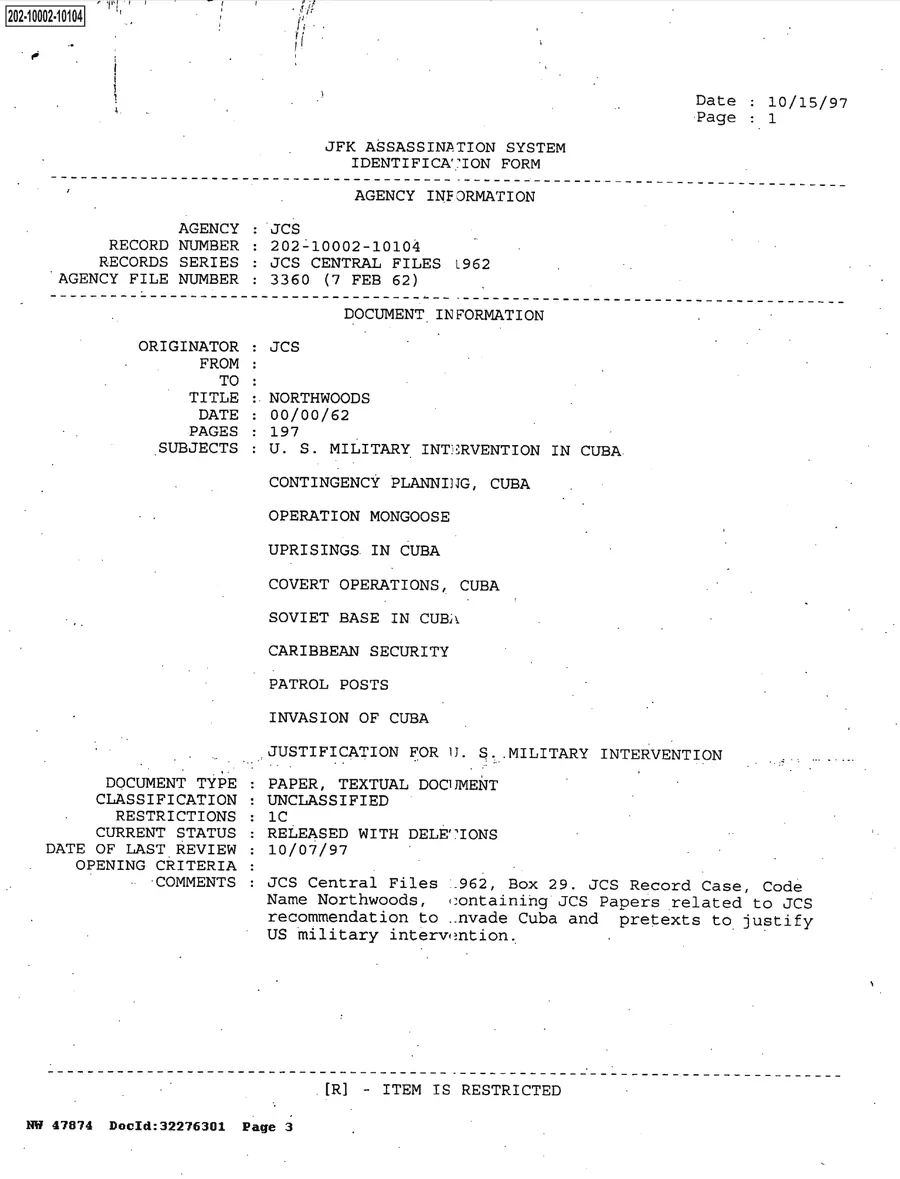
Release paperwork — identification form
Leaf 1 of 65 · source page 1
Release paperwork — review board determination, 1
Leaf 2 of 65 · source page 2
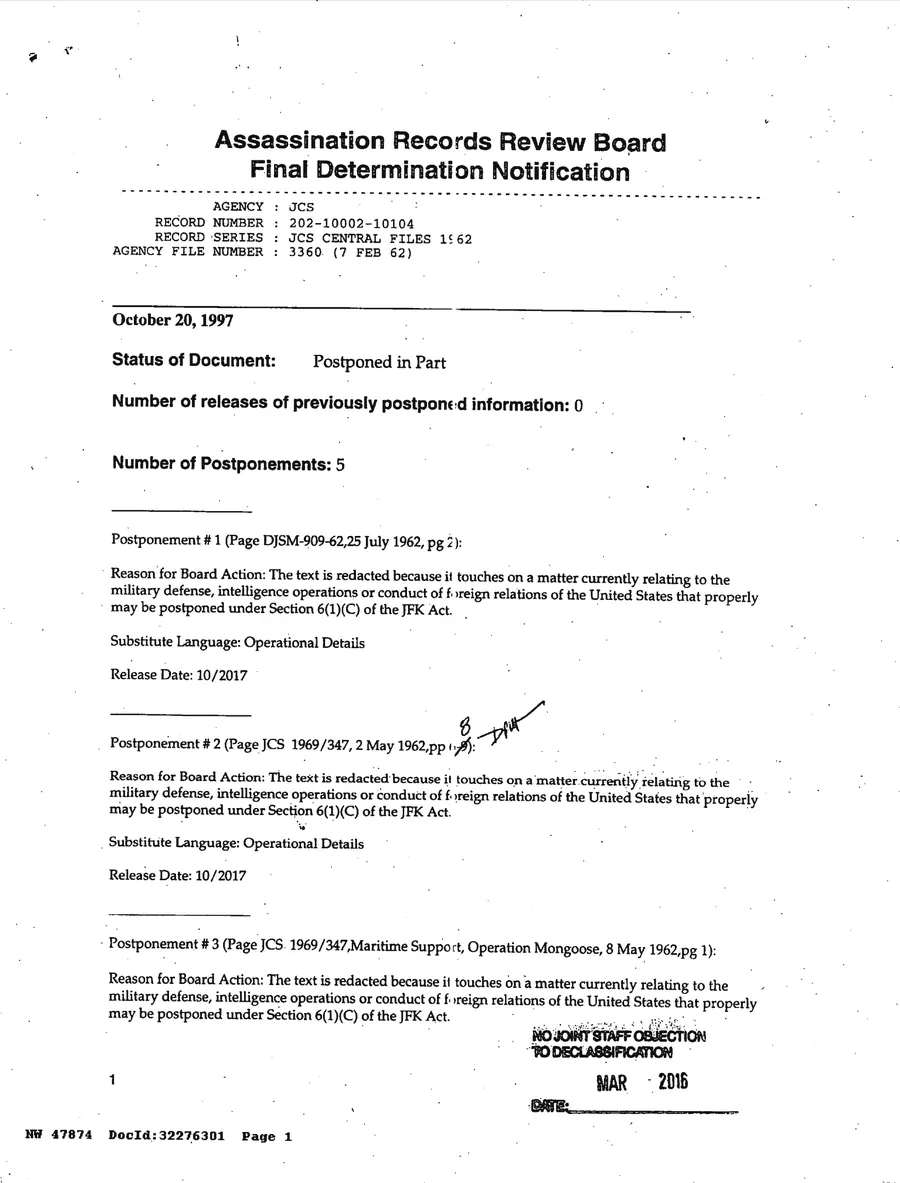
Reproduced in facsimile only — release and index paperwork, printed as it stands rather than transcribed.
Release paperwork — review board determination, 2
Leaf 3 of 65 · source page 3
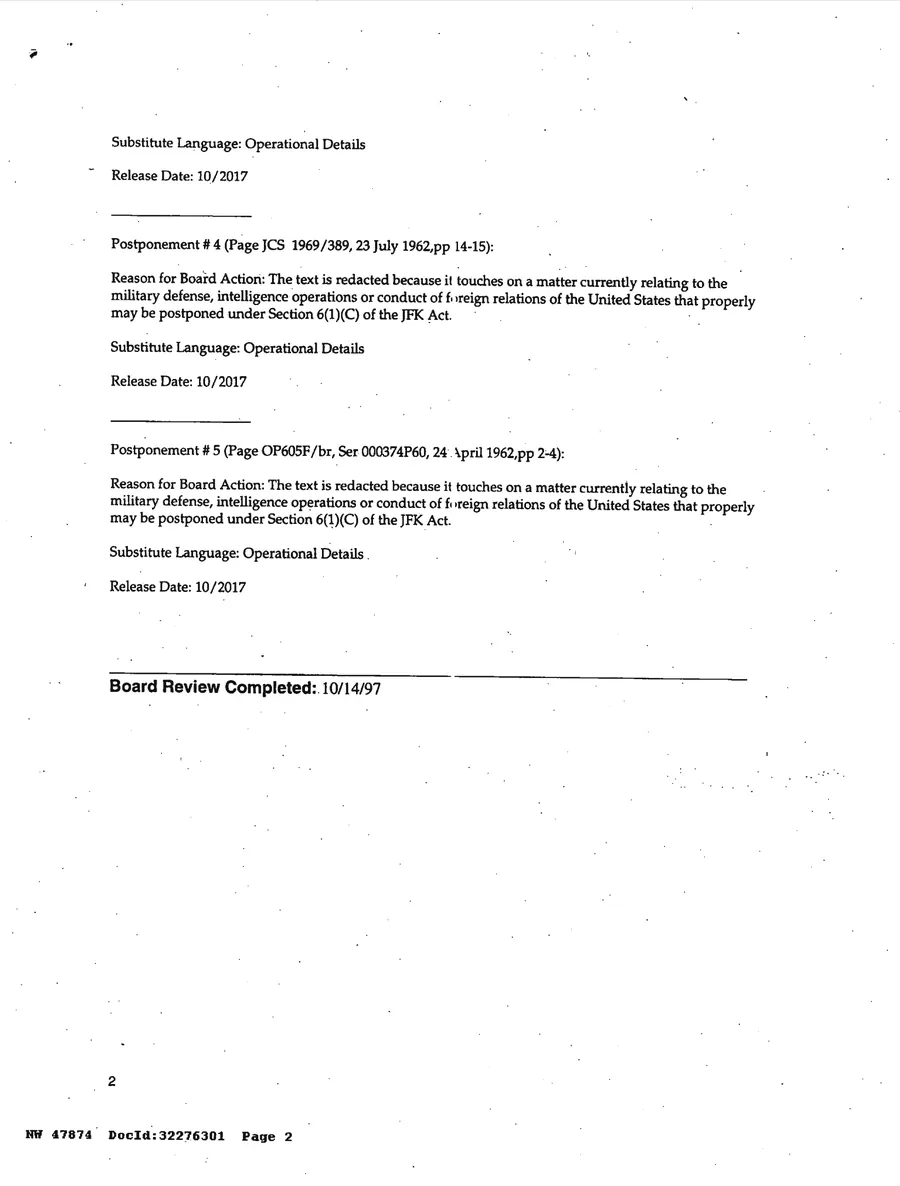
Reproduced in facsimile only — release and index paperwork, printed as it stands rather than transcribed.
Release paperwork — declassification review form
Leaf 4 of 65 · source page 4
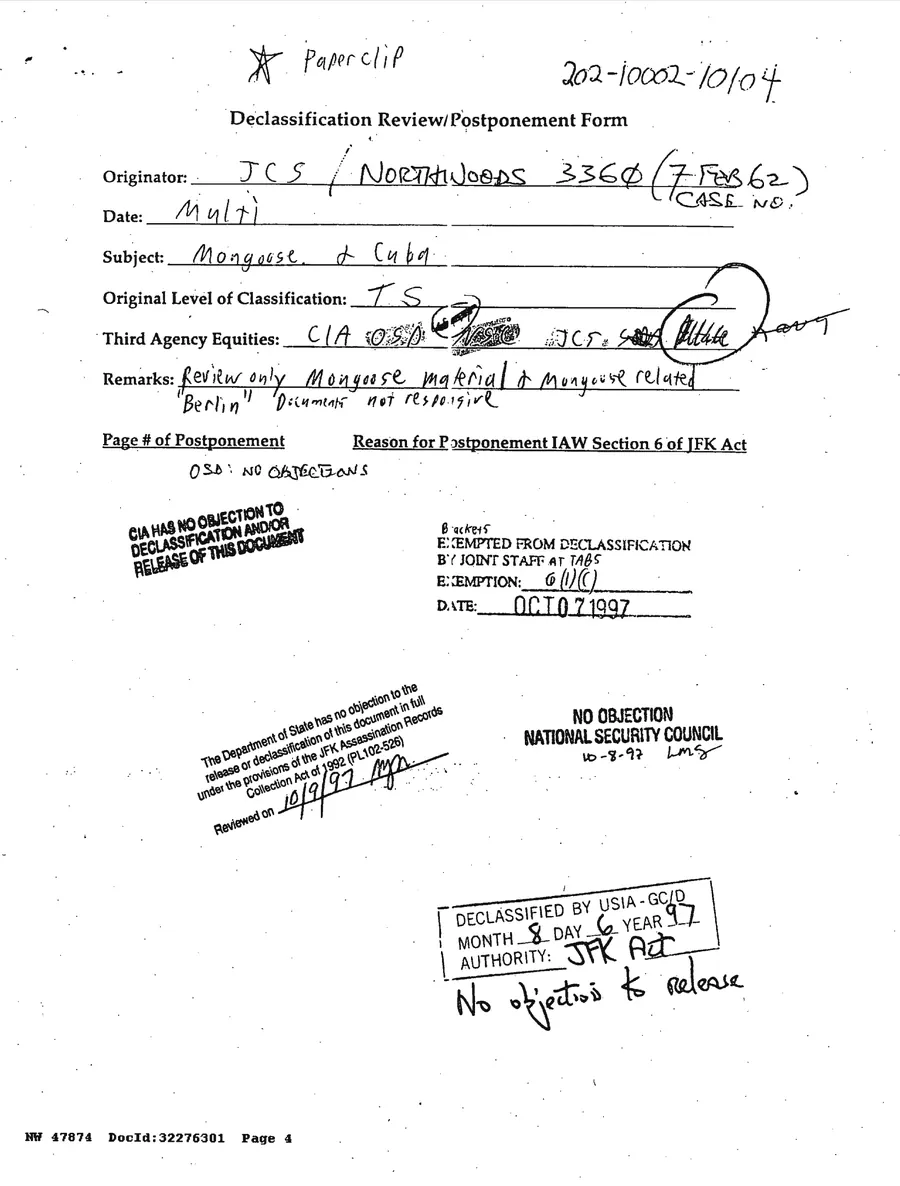
Reproduced in facsimile only — release and index paperwork, printed as it stands rather than transcribed.
Release paperwork — usia clearance
Leaf 5 of 65 · source page 5
Reproduced in facsimile only — release and index paperwork, printed as it stands rather than transcribed.
Jcs record case 3360 — contents
Leaf 6 of 65 · source page 33
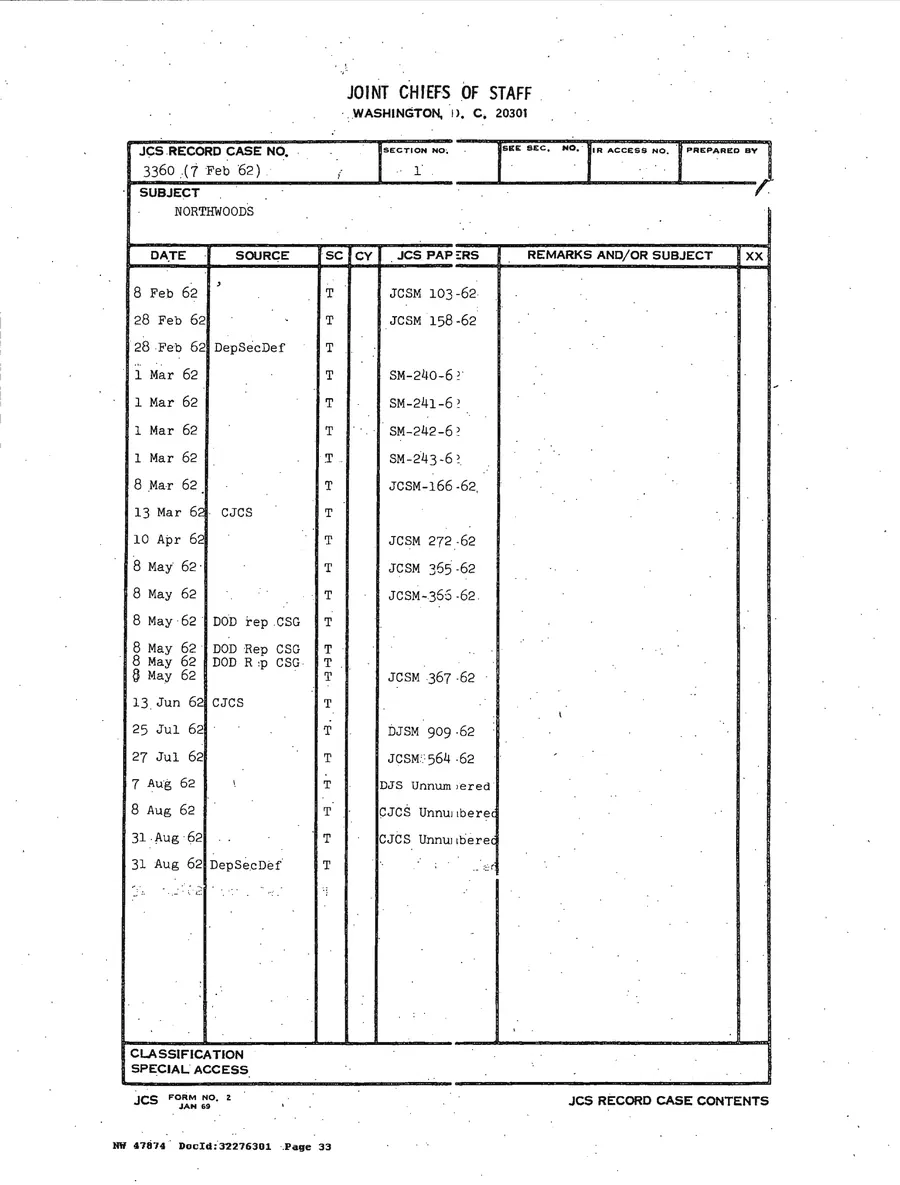
Reproduced in facsimile only — release and index paperwork, printed as it stands rather than transcribed.
Jcs record case 3360 — case file cover sheet, 1
Leaf 7 of 65 · source page 34
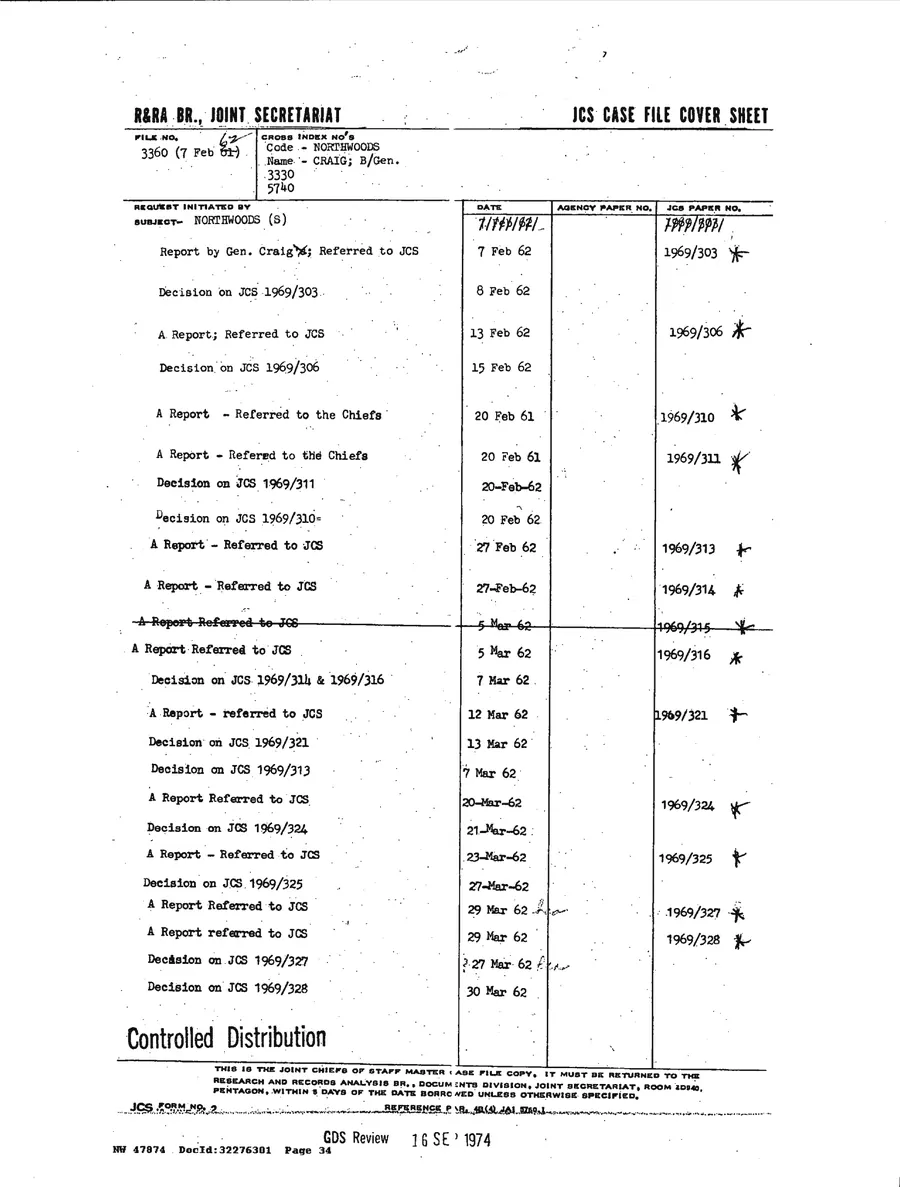
Reproduced in facsimile only — release and index paperwork, printed as it stands rather than transcribed.
Jcs record case 3360 — case file cover sheet, 2
Leaf 8 of 65 · source page 35
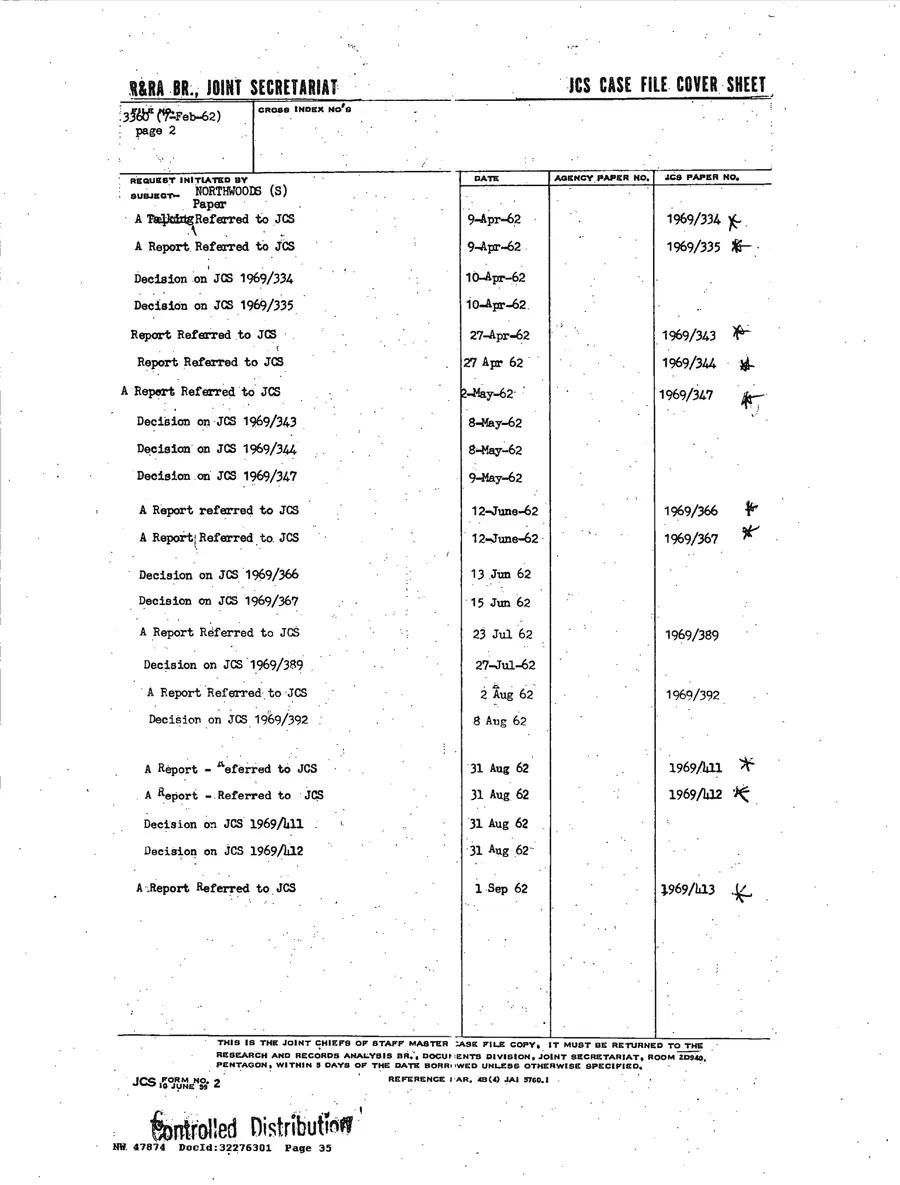
Reproduced in facsimile only — release and index paperwork, printed as it stands rather than transcribed.
Printed page 2152
Leaf 9 of 65 · source page 182
Order restored. JCS 1969/311, the paper that set the rules for every request the Caribbean Survey Group made of the Defense Department. It is pages 182-194 of the 212-page scan, near the end of the file; the case index prints it first. The file copy is incomplete.
TOP SECRET JCS 1969/311 20 February 1962 Page 2152
NOTE BY THE SECRETARIES to the JOINT CHIEFS OF STAFF on NORTHWOODS (S)
A report* on the above subject is submitted for consideration by the Joint Chiefs of Staff.
F. J. BLOUIN M. J. INGELIDO Joint Secretariat
* Not reproduced; on file in Joint Secretariat
TOP SECRET JCS 1969/311
Textual notes on this leaf (6)
- COPY NO. 1
- CONFIRM against a sharper scan. At 1200 dpi the cell above the typed underscore rule carries only a narrow vertical stroke crossing the rule, with a short foot bar printing just below it and a faint mark above - roughly a fifth of the ink of the clean '1' in the same block on PDF 193, which prints flag, stem and full foot bar. The surviving strokes are those of a 1 and no other digit fits them, and the file copy of the same Note at PDF 160 and the Note to Holders at PDF 193 both read COPY NO. 1. Transcribed as 1; the strike is too light for the digit to be read on this leaf alone.
- 2152 (foot, centre)
- The foot repetition of the series folio prints '21', then a third cell carrying only a narrow vertical stroke with a small foot serif and a dot below the baseline, then a clean '2'. The third digit is not resolvable as a digit on its own. The leaf's folio is 2152 by the fully legible 'Page 2152' in the head block of the same leaf, which is what the 'printed' key records.
- * Not reproduced; on file in Joint Secretariat
- This Note's footnote reads 'Not reproduced' where the otherwise identical footnote on the 12 March Note (JCS 1969/321, PDF 160) reads 'Not reproduced herewith'. Verified at 800 dpi: there is no word between 'reproduced' and the semicolon. The Joint Secretariat's own variation. PRESERVED.
- F. J. BLOUIN / M. J. INGELIDO
- Typed names only - this file copy of the Note carries no ink signatures. Recorded as a signature block, transcribed exactly.
- A report* on the above subject
- A vertical fold band runs down the centre of the leaf and drops the b of 'above' and the u of 'subject' to broken fragments; both words read from their surviving letterforms. The same band affects every leaf of the 20 February set (PDF 182-188, 190) and is noted once here.
- small mark below centre of the leaf
- A small hooked ink or pencil mark sits in the blank field about two-thirds down the leaf, and a second short stroke sits below the foot block. Neither is resolvable as a character; recorded here, not transcribed.
Printed page 1
Leaf 10 of 65 · source page 183
TOP SECRET - NOFORN SPECIAL HANDLING
REPORT BY THE DOD/JCS REPRESENTATIVE OF THE CARIBBEAN SURVEY GROUP to the JOINT CHIEFS OF STAFF on PROCEDURES TO BE FOLLOWED IN HANDLING CIA, STATE DEPARTMENT AND US INFORMATION AGENCY REQUESTS FOR DOD SUPPORT IN CONNECTION WITH THE ACTIVITIES OF THE CARIBBEAN SURVEY GROUP (S)
1. The DOD/JCS Representative of the Caribbean Survey Group recommends that the Joint Chiefs of Staff:
a. Note the contents of Enclosure A and Enclosure B.
b. Approve and forward Enclosure C, with Appendices, to the Secretary of Defense.
c. After approval of the proposed procedures (Appendix 1 to Enclosure C) by the Secretary of Defense, transmit Enclosure D to the Chief of Staff, US Army, Chief of Naval Operations, Chief of Staff, US Air Force and the Commandant of the Marine Corps.
TOP SECRET - NOFORN SPECIAL HANDLING
Amended as directed by the Joint Chiefs of Staff - 20 February 1962
Textual notes on this leaf (5)
- line numbers 1 to 10 in the right margin
- The body of the recommendation is line-numbered 1 to 10 down the right margin, in the JCS staff-paper manner, so that the Chiefs could amend by line. The numbers are apparatus of the sheet, not text; they are recorded here and not transcribed. The same numbering runs 1 to 22 on Enclosure C (PDF 188). No other leaf in this batch carries it.
- OF THE CARIBBEAN SURVEY GROUP (S)
- The classification marking '(S)' at the end of the title is a very light strike - the parentheses read, the S is a ghost - and the title underline runs on beneath it. Read as '(S)' on the pattern of the same title on PDF 191, where it prints cleanly. The space before the parenthesis is present here, unlike 'CUBA PROJECT(TS)' on PDF 161.
- cy 1 of 20 copies
- A printed copy-count form at lower right, filled in by hand in a heavy pencil or ink: '1' in the first blank, '20' in the second. Both figures are unambiguous. Recorded in stamps per house rule, not as body text. This is a different apparatus from the typed 'COPY NO.' block on PDF 182 and 193.
- Chief of Staff, US Army, Chief of Naval Operations, Chief of Staff, US Air Force
- The o of the first 'of Staff' and the f of the second fall in the scan's fold band and print broken; both read from their surviving letterforms and from the identical list on PDF 190. The list runs without a serial comma before 'and the Commandant'. PRESERVED as set.
- Amended as directed by the Joint Chiefs of Staff - 20 February 1962
- This leaf's amendment line names 20 February only and is set without parentheses. The amendment lines on the two amended enclosure leaves (PDF 191, 192) open with a parenthesis, name '20 & 23 Feb', and are never closed. The three settings differ; each is transcribed as it appears.
Printed page 2
Leaf 11 of 65 · source page 184
TOP SECRET-NOFORN SPECIAL HANDLING
ENCLOSURE A
DRAFT
1. The attached memorandum for the Secretary of Defense recommends procedures to be followed for DOD support of the operations of the Central Intelligence Agency (CIA), State Department and US Information Agency (USIA) in connection with the activities of the Caribbean Survey Group. Past experience indicates the need for such procedures.
2. The recommended procedures are based upon the results of a conference held with the Deputy Secretary of Defense on 30 January 1962 by the DOD/JCS Representative on the CSG.
3. The procedures recommended to the Secretary of Defense will afford full DOD support to the operations of the CIA, the State Department and USIA in connection with the activities of the CSG. At the same time, from the over-all point of view of the US Government, it will protect the best interests of the DOD.
4. The procedures provide for the submission in writing of requests for DOD support by the CIA, the State Department and USIA to the Secretary of Defense, who will in turn refer the requests to the DOD/JCS Representative on the CSG for evaluation. The DOD/JCS Representative will secure the comments and recommendations of the Services and the Joint Chiefs of Staff and then forward the request with recommendations to the Secretary of Defense for decision.
WILLIAM H. CRAIG Brig General, USA DOD/JCS Representative Caribbean Survey Group
TOP SECRET-NOFORN SPECIAL HANDLING
Textual notes on this leaf (6)
- Subject: Procedure to be Followed in Handling
- The subject line of Enclosure A reads 'Procedure' singular, where the report title on PDF 183, Enclosure C on PDF 188, the amended Enclosure A on PDF 191 and Enclosure D on PDF 190 all read 'Procedures'. Verified at 500 dpi: there is no s, and the following space is a full cell. The draft's own error. PRESERVED; worth an annotation.
- US Information Agency (USIA) in connection
- The closing parenthesis of '(USIA)' falls in the scan's fold band and prints only as a short tick at cap height in the top right of its cell. The opening parenthesis is clean and a full word space follows the mark. Read as '(USIA)' on the pattern of '(CIA)' earlier in the same sentence and of '(CSG)' on PDF 188 and 190.
- The recommended procedures are based upon
- The last five letters of 'procedures' print markedly heavier than the rest of the line - a double strike over the same characters, not a correction to a different word: the underlying and overlying letterforms coincide. Reads 'procedures'. Recorded as ordinary text.
- MEMORANDUM FOR THE CHAIRMAN, JOINT CHIEFS OF STAFF
- The mark after CHAIRMAN was checked at 1200 dpi: it sits on the baseline with a short tail falling below it, at the position and size of this machine's comma, and a separate speck sits in the following word space. Read as a comma.
- TOP SECRET-NOFORN
- The typed classification line on this leaf and on PDF 190 is set 'TOP SECRET-NOFORN' with no spaces around the hyphen; on PDF 183, 185, 186 and 187 the same line is set 'TOP SECRET - NOFORN' with spaces. The document's own inconsistency between leaves. Each recorded as it appears.
- Brig General, USA
- Craig's signature block on this leaf reads 'Brig General, USA' with no full stop after Brig and 'DOD/JCS Representative' with no comma; on PDF 187 the same block reads 'Brig. General, USA' and 'DOD/JCS Representative,'. Both PRESERVED as set.
Printed page 3
Leaf 12 of 65 · source page 185
TOP SECRET - NOFORN SPECIAL HANDLING
ENCLOSURE B
Mr. Gilpatric did not like this paper at all. He indicated the paper was too negative and restricted as though a policy towards an enemy like we are dealing with the Germans or Italians, not a fellow department of our Government. This is a red line operation with the blessing of the President and approved by him as a most important task. This is probably the most important mission we have in the government today. When a request comes in from CIA, you (Craig) will evaluate it and request the Joint Chiefs of Staff for their evaluation and recommendations. The Secretary of Defense will determine, after considering the advice of the Joint Chiefs of Staff, what the decision will be, not the Joint Chiefs of Staff. This decision is the prerogative of the Secretary of Defense.
We do not want to get involved in a case-by-case basis. We do not want individual actions on each case. We do not want masses of individual actions. This is a red line priority problem and must be handled with dispatch and without getting involved in minutia regarding expenses and reimbursement or other details. Department of Defense may have to do it themselves regardless who foots the bill. In some cases, CIA will be required to reimburse if so determined by the Secretary of Defense. This is a matter which must be decided by the Secretary of Defense - not the Joint Chiefs of Staff. The Department of Defense budgets for some CIA support. We have equipment of some types lying around not being used and should not require reimbursement for this type, as a general rule. This must be decided by the Secretary of Defense after considering an evaluation by the Services and the Joint Chiefs of Staff.
TOP SECRET - NOFORN SPECIAL HANDLING
Textual notes on this leaf (7)
- of Caribbean Survey Group (30 January 1962)
- The word space between 'Caribbean' and 'Survey' falls exactly in the scan's fold band and is not visible, giving a 'CaribbeanSurvey' appearance. The cell is present at the correct pitch; the two words are separate. Transcribed with a space. The phrase itself - 'for CIA Support by the Department of Defense of Caribbean Survey Group' - is the drafter's own compressed construction and is PRESERVED.
- masses of individual actions
- An anomalous double space between 'masses' and 'of', mid-sentence, measured at 500 dpi against the single spaces either side of it. PRESERVED as spacing.
- involved in minutia regarding expenses
- Reads 'minutia' where 'minutiae' would be expected, in clean type. The document's own word. PRESERVED.
- regardless who foots the bill
- Reads 'regardless who' without 'of'. The b of 'bill' falls in the fold band and prints broken, but the word is otherwise clean. Both the elliptical construction and the reading PRESERVED.
- as though a policy towards an enemy like we are dealing with the Germans or Italians
- The sentence is ungrammatical as typed - no verb after 'as though a policy'. Nothing is missing from the page: the line is clean type and the fold band falls between 'are' and 'dealing' without dropping a cell. The memorandum for record is a rough note of speech. PRESERVED.
- the Secretary of Defense - not the Joint Chiefs of Staff
- The t of 'not' falls in the fold band and prints as a broken stroke; read from the surviving letterforms and the sense. The dash is a single spaced hyphen, as typed.
- Department of Defense may have to do it themselves
- The final s of 'themselves' sits at the extreme right edge of the type area and prints only partly. Reads 'themselves'; the sentence continues on the next line.
Printed page 4
Leaf 13 of 65 · source page 186
TOP SECRET - NOFORN SPECIAL HANDLING
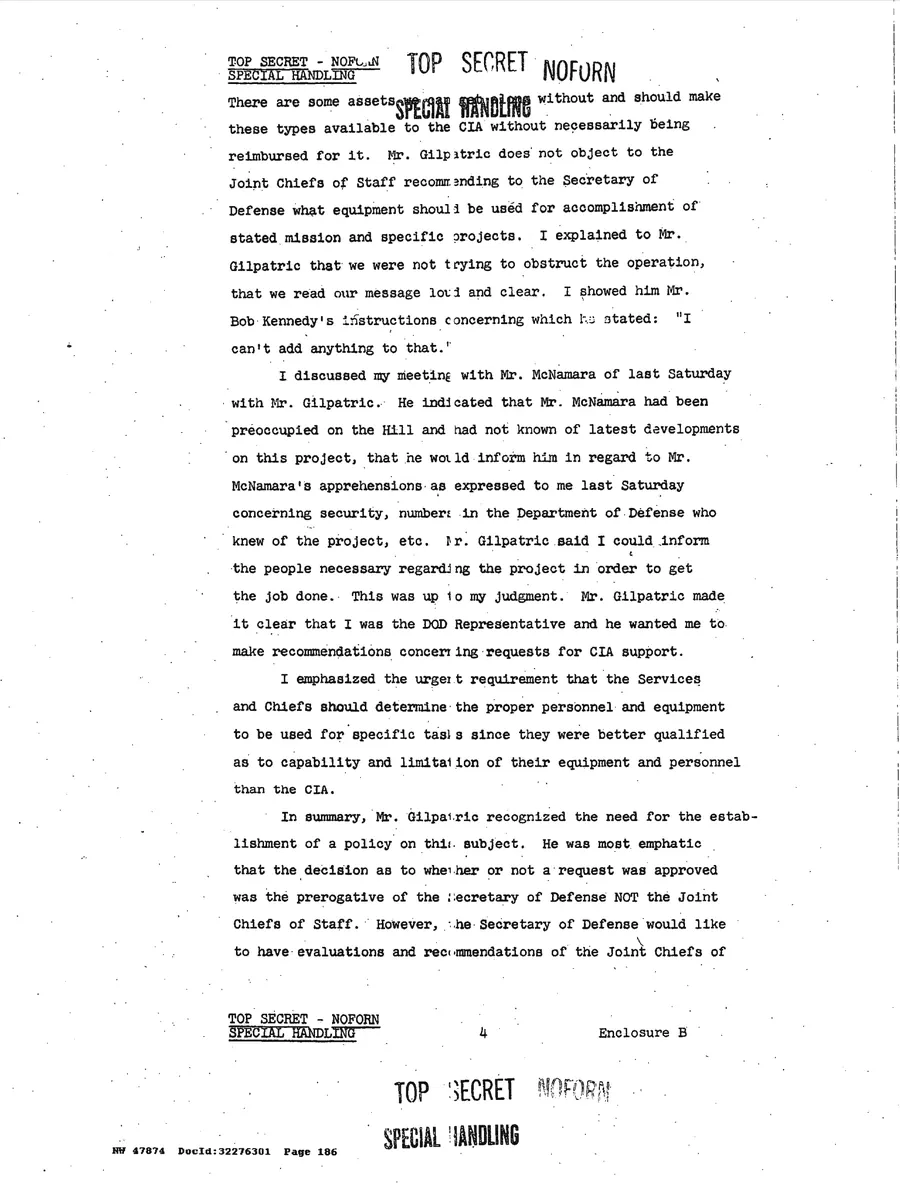
There are some assets we can get along without and should make these types available to the CIA without necessarily being reimbursed for it. Mr. Gilpatric does not object to the Joint Chiefs of Staff recommending to the Secretary of Defense what equipment should be used for accomplishment of stated mission and specific projects. I explained to Mr. Gilpatric that we were not trying to obstruct the operation, that we read our message loud and clear. I showed him Mr. Bob Kennedy's instructions concerning which he stated: "I can't add anything to that."
I discussed my meeting with Mr. McNamara of last Saturday with Mr. Gilpatric. He indicated that Mr. McNamara had been preoccupied on the Hill and had not known of latest developments on this project, that he would inform him in regard to Mr. McNamara's apprehensions as expressed to me last Saturday concerning security, numbers in the Department of Defense who knew of the project, etc. Mr. Gilpatric said I could inform the people necessary regarding the project in order to get the job done. This was up to my judgment. Mr. Gilpatric made it clear that I was the DOD Representative and he wanted me to make recommendations concerning requests for CIA support.
I emphasized the urgent requirement that the Services and Chiefs should determine the proper personnel and equipment to be used for specific tasks since they were better qualified as to capability and limitation of their equipment and personnel than the CIA.
In summary, Mr. Gilpatric recognized the need for the establishment of a policy on this subject. He was most emphatic that the decision as to whether or not a request was approved was the prerogative of the Secretary of Defense NOT the Joint Chiefs of Staff. However, the Secretary of Defense would like to have evaluations and recommendations of the Joint Chiefs of
TOP SECRET - NOFORN SPECIAL HANDLING
Textual notes on this leaf (5)
- There are some assets we can get along without
- CONFIRM against a sharper scan. The SPECIAL HANDLING rubber stamp prints across the middle of the first line of this leaf, over the words between 'assets' and 'without'. At 1400 dpi the typed letterforms are still separable under the stamp's strokes: a two-letter word, a three-letter word opening with a c and closing with an n, then a three-letter word and a five-letter word ending -ong, reading 'we can get along', and the cell count from 'assets' to 'without' matches that reading exactly. Transcribed as 'we can get along'; the stamp is heavy enough that a proofreader should re-read this line on a cleaner impression if one exists.
- he stated: "I can't add anything to that."
- The closing quotation mark after 'that.' prints as a single vertical limb where the opening mark before 'I' prints as a clean double. Its position settles it: the limb sits toward the left of its cell, where the left limb of this machine's double quotation mark falls, not centred as its apostrophe does (compare the clean apostrophes of 'can't' and 'Kennedy's' on the same leaf). Read as a double quotation mark whose right limb did not print. The double space after the colon is as typed.
- concerning security, numbers in the Department of Defense
- The final s of 'numbers' falls in the scan's fold band and prints as a fragment; the plural is read from the surviving letterform and from the sense. Nothing else in the phrase is doubtful.
- This was up to my judgment.
- 'judgment' set without the medial e, as typed. The document's own spelling. PRESERVED.
- the prerogative of the Secretary of Defense NOT the Joint Chiefs of Staff
- The capitalised NOT is the writer's own emphasis, in ordinary type, not underlined - the same habit as the Northwoods report's 'This paper NOT be forwarded' (PDF 163). No punctuation separates it from what follows. PRESERVED.
Printed page 5
Leaf 14 of 65 · source page 187
TOP SECRET - NOFORN SPECIAL HANDLING
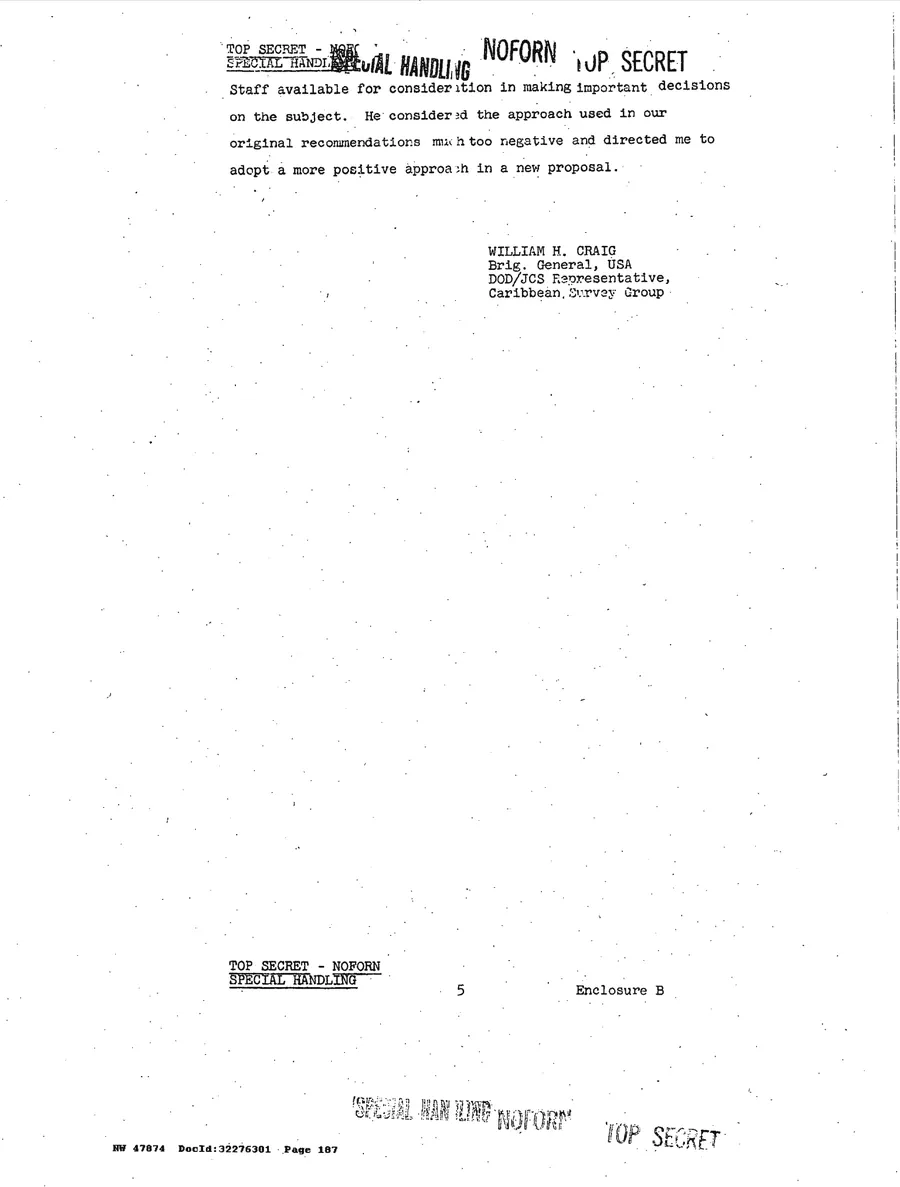
Staff available for consideration in making important decisions on the subject. He considered the approach used in our original recommendations much too negative and directed me to adopt a more positive approach in a new proposal.
WILLIAM H. CRAIG Brig. General, USA DOD/JCS Representative, Caribbean Survey Group
TOP SECRET - NOFORN SPECIAL HANDLING
Textual notes on this leaf (3)
- our original recommendations much too negative
- An anomalous double space between 'recommendations' and 'much', measured at 700 dpi against the single spaces on either side. The c of 'much' is additionally weakened by the scan's fold band. PRESERVED as spacing.
- Brig. General, USA / DOD/JCS Representative,
- Craig's signature block on this leaf carries a full stop after 'Brig' and a comma after 'Representative'; the same block on PDF 184 carries neither. The document's own inconsistency. Both PRESERVED as set.
- lower two-thirds of the leaf is blank
- Enclosure B ends a quarter of the way down and the rest of the sheet is empty apart from the foot block, the folio, the enclosure label and the stamps. The facsimile reproduces the whole leaf.
Printed page 6
Leaf 15 of 65 · source page 188
TOP SECRET - NOFORN SPECIAL HANDLING
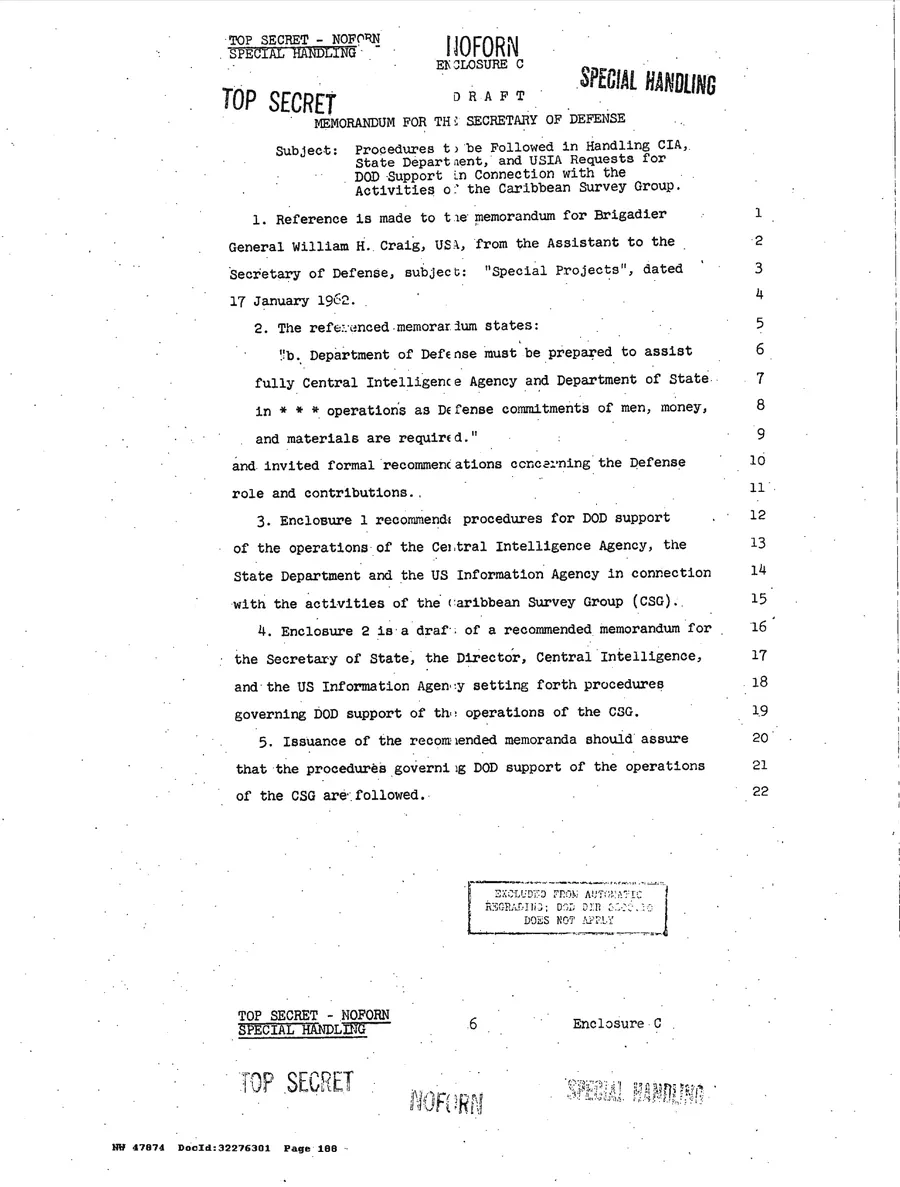
ENCLOSURE C
D R A F T
1. Reference is made to the memorandum for Brigadier General William H. Craig, USA, from the Assistant to the Secretary of Defense, subject: "Special Projects", dated 17 January 1962.
2. The referenced memorandum states:
"b. Department of Defense must be prepared to assist fully Central Intelligence Agency and Department of State in * * * operations as Defense commitments of men, money, and materials are required."
and invited formal recommendations concerning the Defense role and contributions.
3. Enclosure 1 recommends procedures for DOD support of the operations of the Central Intelligence Agency, the State Department and the US Information Agency in connection with the activities of the Caribbean Survey Group (CSG).
4. Enclosure 2 is a draft of a recommended memorandum for the Secretary of State, the Director, Central Intelligence, and the US Information Agency setting forth procedures governing DOD support of the operations of the CSG.
5. Issuance of the recommended memoranda should assure that the procedures governing DOD support of the operations of the CSG are followed.
TOP SECRET - NOFORN SPECIAL HANDLING
Textual notes on this leaf (6)
- line numbers 1 to 22 in the right margin
- The body of Enclosure C is line-numbered 1 to 22 down the right margin, in the same JCS staff-paper manner as the recommendation on PDF 183 - the two amendments recorded on the Decision On sheet (PDF 181) are cited by line and paragraph against this apparatus. The numbers are apparatus of the sheet, not text; recorded here and not transcribed.
- in * * * operations as Defense commitments
- Three spaced asterisks stand for the elided text of the quoted 17 January memorandum - the document's own ellipsis, exactly as the Northwoods package uses three spaced hyphens on PDF 172. Transcribed as typed.
- "b. Department of Defense must be prepared
- The quotation opens on a sub-paragraph letter 'b.' with no 'a.' quoted before it and closes after 'required.' The quotation marks are the document's own. The opening double prints with its left limb weak. PRESERVED as set.
- Enclosure 1 recommends procedures for DOD support
- The terminal s of 'recommends' falls in the scan's fold band and prints as a fragment, so the following word space reads about two cells wide. The cell count from 'Enclosure' to 'procedures' fits 'recommends' plus a single space. Transcribed with a single space; the plural verb is read from the surviving letterform.
- D R A F T
- Letterspaced on this leaf - one blank cell between each letter, measured at 600 dpi - where the DRAFT heading on Enclosure A (PDF 184) is set solid. The document's own setting. PRESERVED as typed; a typeset edition should letterspace rather than insert literal spaces.
- Subject: ... Caribbean Survey Group.
- This subject block ends with a full stop and sets 'State Department, and USIA' with a serial comma; the parallel blocks on PDF 184, 189 and 190 end without a full stop and use no serial comma. The document's own inconsistency. PRESERVED.
Printed page 3
Leaf 16 of 65 · source page 189
Order restored. Out of order in the record. This is the third leaf of a later, amended state of the enclosure; the two that precede it are filed four leaves further on, at pages 191-192 of the scan. Left exactly where the record puts it.
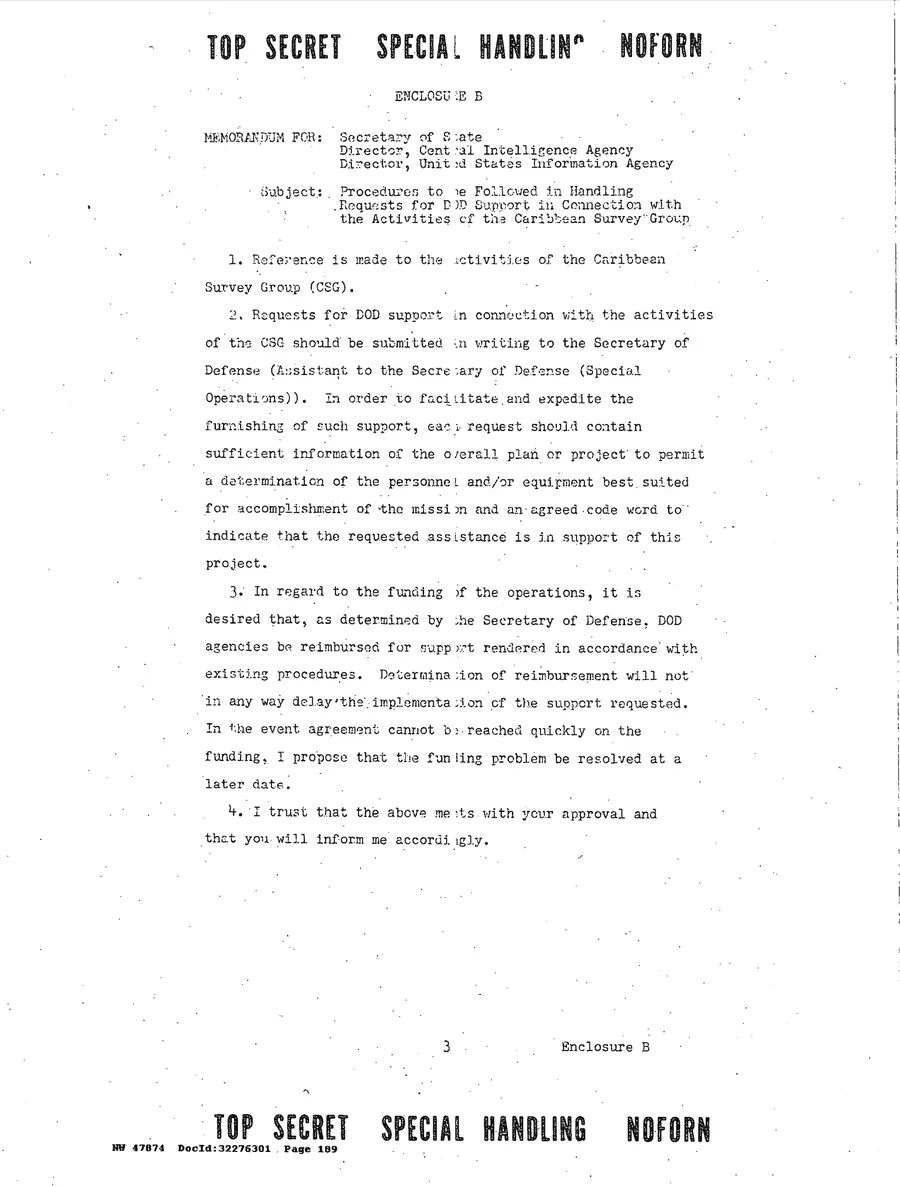
ENCLOSURE B
1. Reference is made to the activities of the Caribbean Survey Group (CSG).
2. Requests for DOD support in connection with the activities of the CSG should be submitted in writing to the Secretary of Defense (Assistant to the Secretary of Defense (Special Operations)). In order to facilitate and expedite the furnishing of such support, each request should contain sufficient information of the overall plan or project to permit a determination of the personnel and/or equipment best suited for accomplishment of the mission and an agreed code word to indicate that the requested assistance is in support of this project.
3. In regard to the funding of the operations, it is desired that, as determined by the Secretary of Defense, DOD agencies be reimbursed for support rendered in accordance with existing procedures. Determination of reimbursement will not in any way delay the implementation of the support requested. In the event agreement cannot be reached quickly on the funding, I propose that the funding problem be resolved at a later date.
4. I trust that the above meets with your approval and that you will inform me accordingly.
Enclosure B
Textual notes on this leaf (5)
- printed folio 3 with the label 'Enclosure B'
- Disclosed source anomaly. This is the second leaf in the batch to carry the folio 3 and the label 'Enclosure B'; the first is PDF 185, four leaves earlier, whose text is wholly different. The two belong to different states of the paper - see the sequence note. The 'printed' key carries the as-shown folio. NOT to be silently renumbered in any edition.
- personnel and/or equipment best suited
- Set 'and/or' with a clean typed solidus, verified at 600 dpi. Worth recording because the parallel sentence in the amended Enclosure A on PDF 192 sets the same construction with a COMMA - 'personnel and, or equipment' - not a solidus. The two leaves of the same amended set disagree; each is transcribed as it appears.
- sufficient information of the overall plan or project
- 'overall' set as one word here, where the same phrase in the amended Enclosure A on PDF 191 also reads 'overall' but Enclosure A of the 20 February set (PDF 184) hyphenates 'over-all'. The document's own inconsistency between machines. PRESERVED.
- MEMORANDUM FOR: Secretary of State
- Set 'MEMORANDUM FOR:' with a colon and a hanging list, where the 20 February enclosures set 'MEMORANDUM FOR THE SECRETARY OF DEFENSE' as a single line in capitals. Enclosure D (PDF 190) uses the same colon-and-list form as this leaf. PRESERVED.
- as determined by the Secretary of Defense, DOD agencies
- The mark after 'Defense' was checked at 600 dpi: it rests on the baseline with a tail falling below it, at comma height and comma width. Read as a comma.
Printed page 10
Leaf 17 of 65 · source page 190
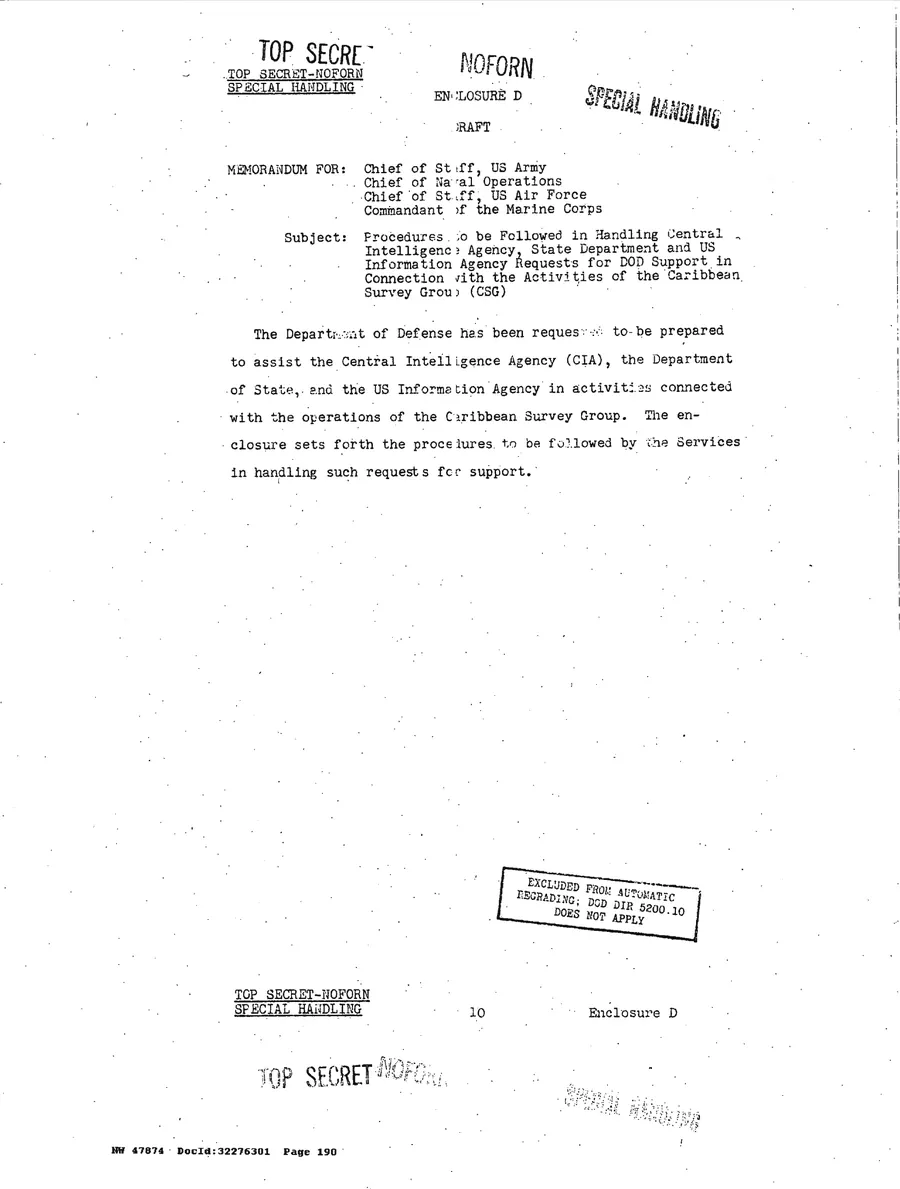
Order restored. The folios of this paper run 1, 2, 3, 4, 5, 6, then 3 again, then 10. Folios 7, 8 and 9 are not in the file copy, and this edition does not supply them.
TOP SECRET-NOFORN SPECIAL HANDLING
ENCLOSURE D
DRAFT
The Department of Defense has been requested to be prepared to assist the Central Intelligence Agency (CIA), the Department of State, and the US Information Agency in activities connected with the operations of the Caribbean Survey Group. The enclosure sets forth the procedures to be followed by the Services in handling such requests for support.
TOP SECRET-NOFORN SPECIAL HANDLING
Textual notes on this leaf (4)
- has been requested to be prepared
- The last three letters of 'requested' fall in the scan's fold band and print as broken fragments; the word is read from its surviving letterforms and from the cell count, which admits no other word. Nothing else in the sentence is doubtful.
- the Department of State, and the US Information Agency
- Set with a serial comma here, where the same list in the subject block of this leaf and in Enclosure C's paragraph 3 (PDF 188) runs without one. The document's own inconsistency. PRESERVED.
- The enclosure sets forth the procedures
- The memorandum refers to an enclosure that is not attached to it in this record; the procedures it means are those of Appendix 1 to Enclosure C - the leaves at PDF 191-192 in their amended form. Recorded here because it bears on the paper's completeness.
- lower half of the leaf is blank
- Enclosure D's single paragraph ends a third of the way down and the rest of the sheet is empty apart from the boxed stamp, the foot block, the folio, the enclosure label and the stamps. The draft carries no signature block. The facsimile reproduces the whole leaf.
Unnumbered leaf
Leaf 18 of 65 · source page 191
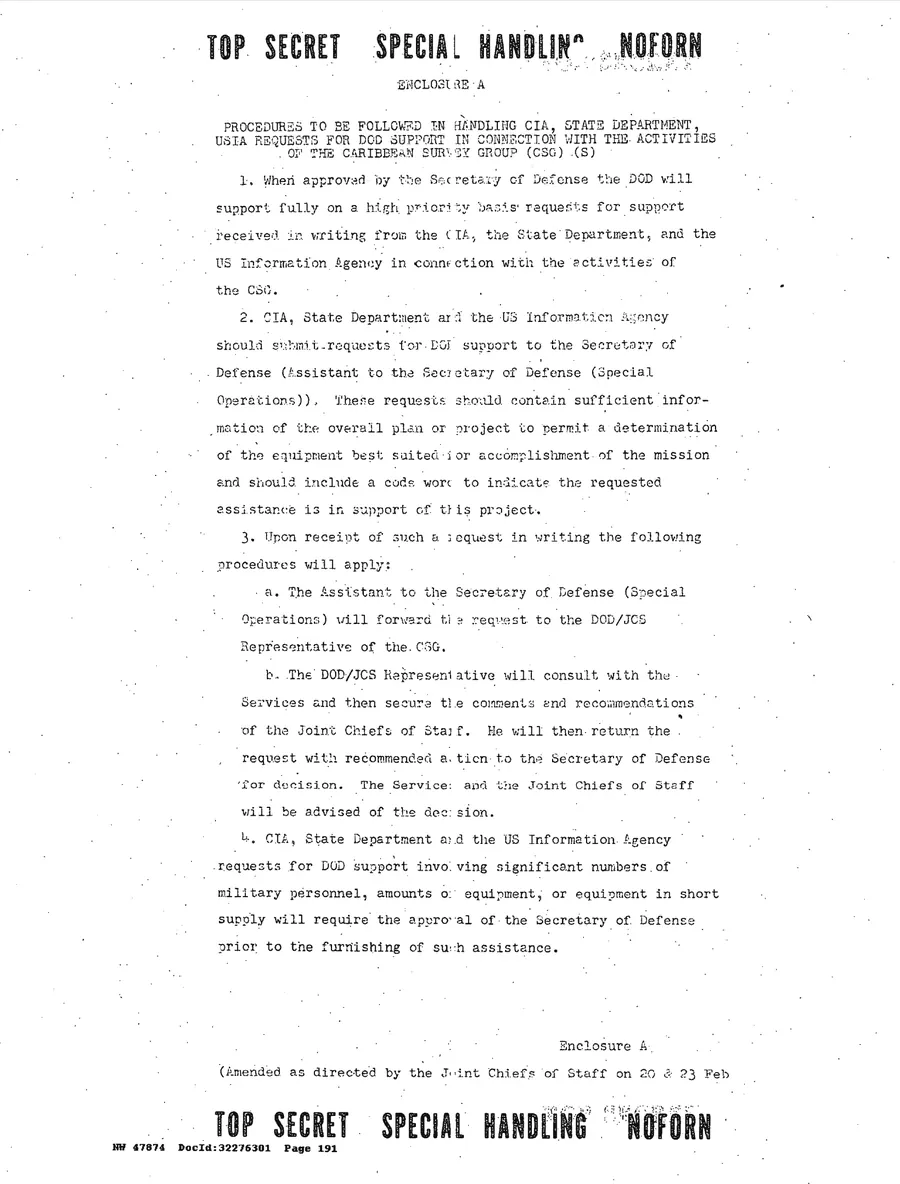
Order restored. The first leaf of the amended state of the enclosure, set on a different machine and footed as amended by direction of the Joint Chiefs of Staff on 20 and 23 February. The record files it after the leaf that belongs at its end.
ENCLOSURE A
PROCEDURES TO BE FOLLOWED IN HANDLING CIA, STATE DEPARTMENT, USIA REQUESTS FOR DOD SUPPORT IN CONNECTION WITH THE ACTIVITIES OF THE CARIBBEAN SURVEY GROUP (CSG) (S)
1. When approved by the Secretary of Defense the DOD will support fully on a high priority basis requests for support received in writing from the CIA, the State Department, and the US Information Agency in connection with the activities of the CSG.
2. CIA, State Department and the US Information Agency should submit requests for DOD support to the Secretary of Defense (Assistant to the Secretary of Defense (Special Operations)). These requests should contain sufficient information of the overall plan or project to permit a determination of the equipment best suited for accomplishment of the mission and should include a code word to indicate the requested assistance is in support of this project.
3. Upon receipt of such a request in writing the following procedures will apply:
a. The Assistant to the Secretary of Defense (Special Operations) will forward the request to the DOD/JCS Representative of the CSG.
b. The DOD/JCS Representative will consult with the Services and then secure the comments and recommendations of the Joint Chiefs of Staff. He will then return the request with recommended action to the Secretary of Defense for decision. The Services and the Joint Chiefs of Staff will be advised of the decision.
4. CIA, State Department and the US Information Agency requests for DOD support involving significant numbers of military personnel, amounts of equipment, or equipment in short supply will require the approval of the Secretary of Defense prior to the furnishing of such assistance.
Enclosure A
(Amended as directed by the Joint Chiefs of Staff on 20 & 23 Feb
Textual notes on this leaf (6)
- (Amended as directed by the Joint Chiefs of Staff on 20 & 23 Feb
- Verified at 800 dpi across the full width of the leaf: the line stops after 'Feb'. There is no year, no closing parenthesis, and no continuation line below it - only the foot stamp. The equivalent line on the next leaf (PDF 192) reads '(Amended as directed by the Joint Chiefs of Staff 20 & 23 Feb 62', without 'on', with the year, and also without a closing parenthesis. Both PRESERVED exactly as typed; neither is to be silently completed.
- no printed folio
- The centre-foot folio position is blank on this leaf at 1200 dpi - not a weak strike, no ink at all. 'printed' is recorded as null. The amended set's folio run is reconstructed in the printed_note and is NOT to be printed as a folio in any edition.
- a determination of the equipment best suited
- This amended text reads 'of the equipment best suited' where the parallel sentence in the amended Enclosure B (PDF 189) reads 'of the personnel and/or equipment best suited'. The omission of the personnel clause is one of the amendments; the page carries no strike, erasure or gap at the point of difference. PRESERVED as typed.
- should include a code word to indicate the requested assistance
- Reads 'to indicate the requested assistance is in support of this project', without 'that'; the parallel sentence on PDF 189 reads 'to indicate that the requested assistance'. The document's own construction on this leaf. PRESERVED.
- the State Department, and the US Information Agency
- Paragraph 1 sets the list with a serial comma; paragraphs 2 and 4 of the same leaf set the same list without one. The document's own inconsistency. PRESERVED.
- OF THE CARIBBEAN SURVEY GROUP (CSG) (S)
- The title's classification marking '(S)' prints cleanly here, which settles the same marking on the report title at PDF 183 where it is a ghost strike.
Unnumbered leaf
Leaf 19 of 65 · source page 192
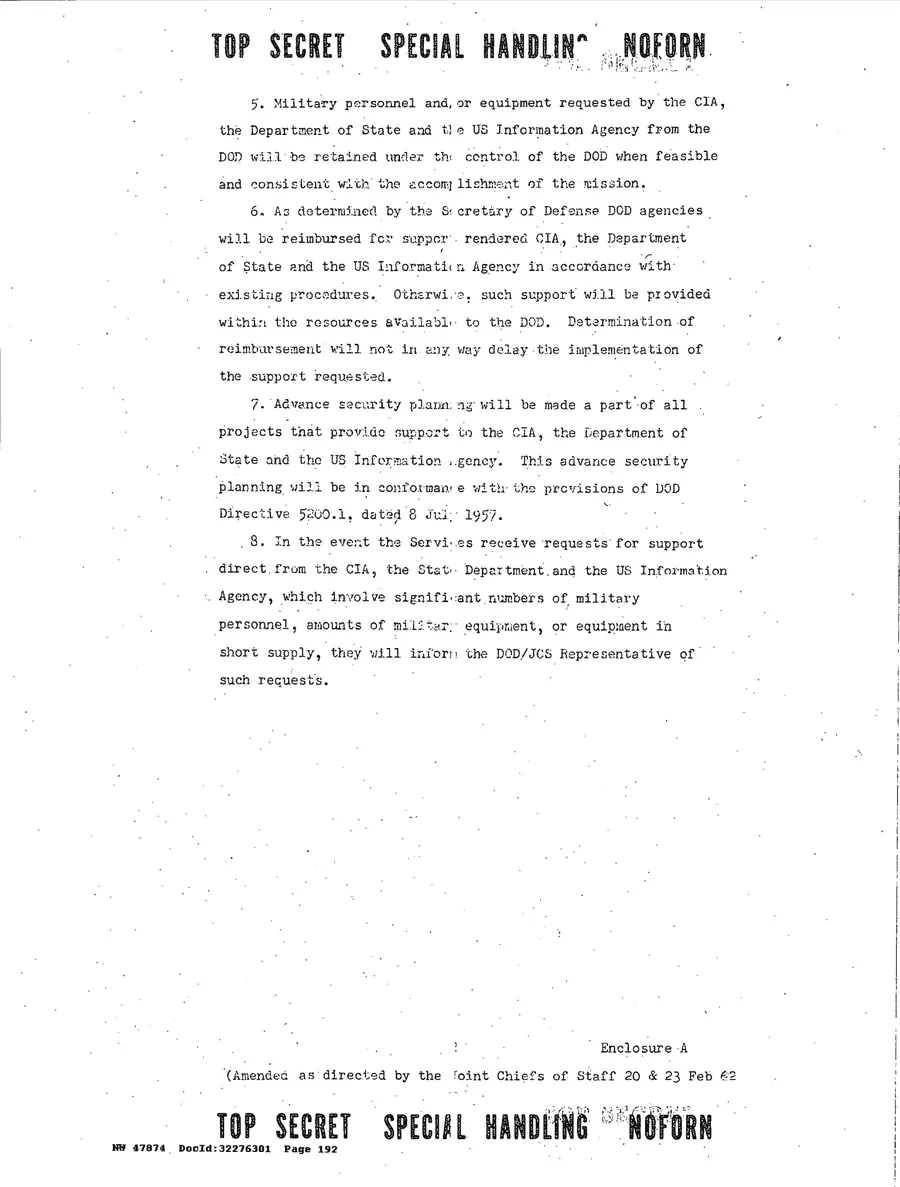
5. Military personnel and, or equipment requested by the CIA, the Department of State and the US Information Agency from the DOD will be retained under the control of the DOD when feasible and consistent with the accomplishment of the mission.
6. As determined by the Secretary of Defense DOD agencies will be reimbursed for support rendered CIA, the Department of State and the US Information Agency in accordance with existing procedures. Otherwise, such support will be provided within the resources available to the DOD. Determination of reimbursement will not in any way delay the implementation of the support requested.
7. Advance security planning will be made a part of all projects that provide support to the CIA, the Department of State and the US Information Agency. This advance security planning will be in conformance with the provisions of DOD Directive 5200.1, dated 8 July 1957.
8. In the event the Services receive requests for support direct from the CIA, the State Department and the US Information Agency, which involve significant numbers of military personnel, amounts of military equipment, or equipment in short supply, they will inform the DOD/JCS Representative of such requests.
Enclosure A
(Amended as directed by the Joint Chiefs of Staff 20 & 23 Feb 62
Textual notes on this leaf (6)
- Military personnel and, or equipment requested by the CIA
- Checked at 1200 dpi. The mark between 'and' and 'or' is a COMMA - it sits on the baseline with a short tail below it, 12 px wide, in a cell of its own with no space either side - and not a solidus: this machine's solidus, in the clean 'and/or' of the same amended set at PDF 189 and in 'DOD/JCS' twice on this leaf, is a long diagonal running from below the baseline to cap height. The document reads 'and, or'. PRESERVED; worth an annotation, since the parallel sentence on PDF 189 reads 'and/or'.
- reimbursed for support rendered CIA, the Department of State
- Reads 'rendered CIA' without 'to'. The line is clean type and no cell is missing. The document's own construction - the same habit as the Northwoods package's 'be assigned the Joint Chiefs of Staff'. PRESERVED; worth an annotation.
- As determined by the Secretary of Defense DOD agencies will be reimbursed
- No comma after 'Defense' here, where the parallel sentence on PDF 189 sets one ('as determined by the Secretary of Defense, DOD agencies'). Verified at 600 dpi: the cell after 'Defense' is empty. PRESERVED.
- dated 8 July 1957
- CONFIRM against a sharper scan. At 1600 dpi the month prints J, u, l clearly and then a fourth character that is almost entirely unprinted, leaving an ascender-height fragment and a mark falling below the baseline in that cell. A descender in that position fits a y and fits nothing else the month admits; the alternative reading, an abbreviated 'Jul.' with a full stop, is excluded because this machine's full stop sits ON the baseline and the mark here is under it. Transcribed 'July'; the strike is too light for the letter to be read outright.
- (Amended as directed by the Joint Chiefs of Staff 20 & 23 Feb 62
- An anomalous double space after '(Amended', measured at 700 dpi. The line carries the year where the equivalent line on PDF 191 does not, and omits the 'on' that PDF 191 carries; neither line closes its parenthesis. PRESERVED exactly as typed.
- no legible printed folio
- At 1200 dpi the centre-foot folio position holds a small curved fragment about 20 px high, opening to the left, with a separate blob below it - not resolvable as a digit, and inconsistent with this machine's 2 (which prints a flat foot bar). Recorded as null with the arithmetic in printed_note. NOT to be silently printed as '2' in any edition.
Unnumbered leaf
Leaf 20 of 65 · source page 193
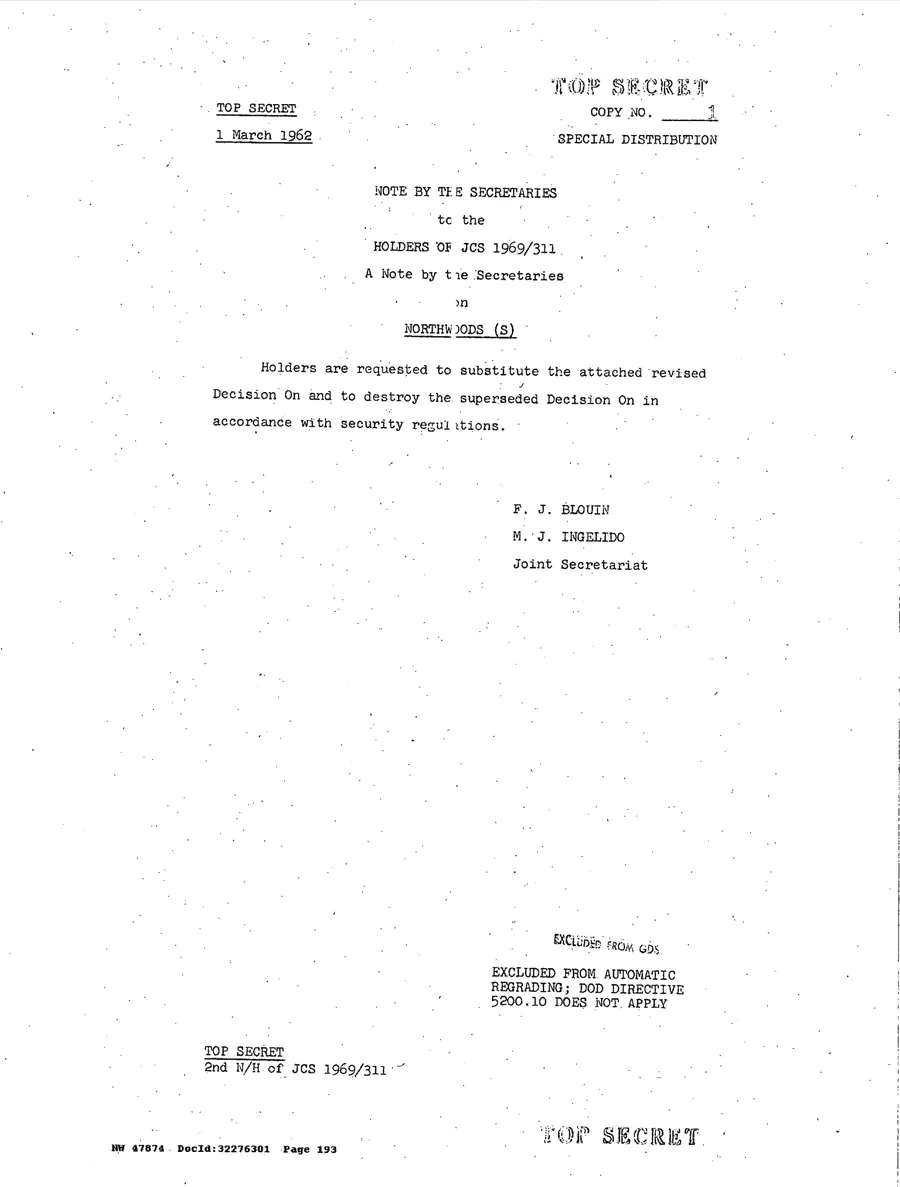
TOP SECRET 1 March 1962
NOTE BY THE SECRETARIES to the HOLDERS OF JCS 1969/311 on NORTHWOODS (S)
Holders are requested to substitute the attached revised Decision On and to destroy the superseded Decision On in accordance with security regulations.
F. J. BLOUIN M. J. INGELIDO Joint Secretariat
EXCLUDED FROM AUTOMATIC REGRADING; DOD DIRECTIVE 5200.10 DOES NOT APPLY
TOP SECRET 2nd N/H of JCS 1969/311
Textual notes on this leaf (5)
- REGRADING; DOD DIRECTIVE 5200.10
- This leaf's typed exclusion note spells out 'DOD DIRECTIVE' and ends without a full stop, matching the typed note on PDF 160; the typed note on PDF 182 abbreviates 'DOD DIR' and ends with a full stop, and the boxed rubber stamp (PDF 183, 188, 190) abbreviates it too. All four wordings coexist in the record; each transcribed as it appears. The semicolon after REGRADING is clean on this impression.
- vertical crease down the centre of the leaf
- A crease runs down the middle of this leaf and drops one character from most lines of the title and text (the H of 'Holders' region, the a of 'regulations', the O of 'JCS 1969/311' in the title). All affected words are read from their surviving letterforms; none is doubtful as a word.
- handwritten tick beside the foot block
- A small ink tick or check mark sits to the right of '2nd N/H of JCS 1969/311' at the foot. A file clerk's mark, not part of the typescript. Recorded here, not transcribed.
- F. J. BLOUIN / M. J. INGELIDO
- Typed names only - no ink signatures on this copy. Recorded as a signature block, transcribed exactly.
- the attached revised Decision On
- 'Decision On' is capitalised as the JCS form-name for the decision sheet, twice in one sentence, and is not followed by a paper number. PRESERVED as set. The revised sheet it refers to is NOT filed behind this leaf - see the sequence note and the flags on PDF 194.
Unnumbered leaf
Leaf 21 of 65 · source page 194
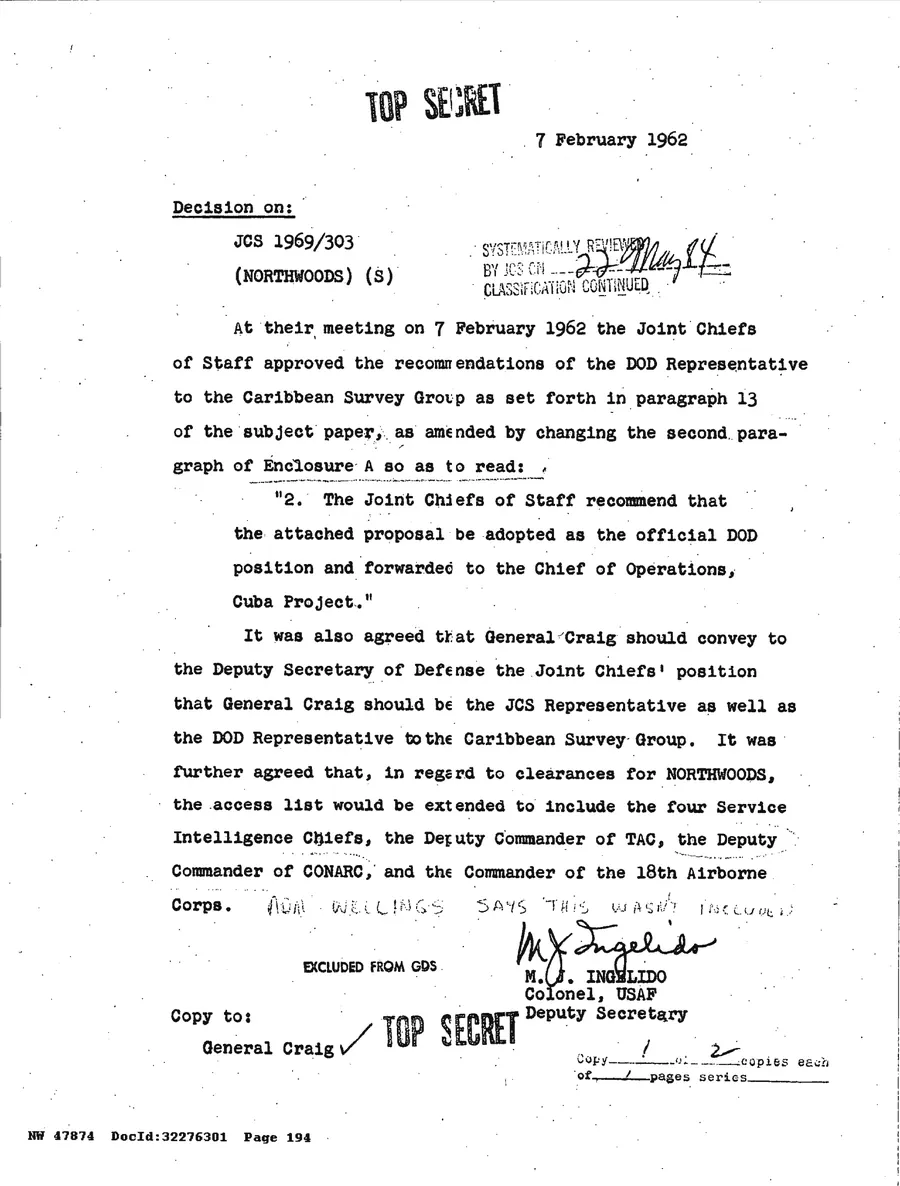
Order restored. Filed behind a note saying a revised decision sheet is attached. It is not that sheet: it decides JCS 1969/303, and a hand has written across it that this was not included.
Decision on:
JCS 1969/303 (NORTHWOODS) (S)
At their meeting on 7 February 1962 the Joint Chiefs of Staff approved the recommendations of the DOD Representative to the Caribbean Survey Group as set forth in paragraph 13 of the subject paper, as amended by changing the second paragraph of Enclosure A so as to read:
"2. The Joint Chiefs of Staff recommend that the attached proposal be adopted as the official DOD position and forwarded to the Chief of Operations, Cuba Project."
It was also agreed that General Craig should convey to the Deputy Secretary of Defense the Joint Chiefs' position that General Craig should be the JCS Representative as well as the DOD Representative tothe Caribbean Survey Group. It was further agreed that, in regard to clearances for NORTHWOODS, the access list would be extended to include the four Service Intelligence Chiefs, the Deputy Commander of TAC, the Deputy Commander of CONARC, and the Commander of the 18th Airborne Corps.
[signed] M. J. Ingelido M. J. INGELIDO Colonel, USAF Deputy Secretary
Copy to: General Craig
Textual notes on this leaf (7)
- ADM WELLINGS SAYS THIS WASN'T INCLUDED
- A manuscript note in block capitals, written in soft pencil or crayon across the leaf on the line beginning 'Corps.', running from the middle of that line to the right margin. Read at 700 dpi; every letter is legible except the M of ADM and the D of INCLUDED, both of which are recoverable from their surviving strokes. It is a filing annotation, not part of the typescript, and it bears directly on this batch's completeness: it records a contemporary statement that the paper this Decision On decides was not in the file. Recorded here, not transcribed as body text.
- the DOD Representative tothe Caribbean Survey Group
- 'to the' set with no word space - 'tothe' - verified at 700 dpi: the cell between the two words is absent, not merely pinched, and the line's cell count confirms it. The document's own error. PRESERVED; worth an annotation.
- SYSTEMATICALLY REVIEWED BY JCS ON 22 May 84
- CONFIRM against the acquisition record. The manuscript date on this impression reads '22 May 84': the two digits before 'May' are the same glyph, a rounded cursive 2 with a flat base, drawn identically twice, and '84' follows 'May'. The earlier pass recorded the same stamp on PDF 159 as '21 May 84'. The two need not disagree - they are different leaves, and the 1984 review ran over several days - but the readings should be reconciled by whoever holds the review-stamp register before either is printed as fact.
- Decision on: JCS 1969/303 (NORTHWOODS) (S)
- The paper number reads 303, not 311, in clean type - the 0 and both 3s are unambiguous at 700 dpi. This leaf therefore decides a different paper from the one it is filed with. Disclosed as a source anomaly; see the sequence note. NOT to be silently corrected to 311 in any edition.
- the Joint Chiefs' position
- Possessive of the plural set with a bare apostrophe, as typed. PRESERVED.
- [signed] M. J. Ingelido
- Ink signature reading 'M. J. Ingelido', struck through the typed name below it - the I of the surname loops down through the J of 'M. J. INGELIDO'. Recorded as a signature block per house rule, transcribed exactly. This is the only ink signature in the batch.
- Copy 1 of 2 copies each of 1 pages series ____
- A printed copy-count form at the foot right, filled in by hand: '1' in the copy blank, '2' in the copies blank, '1' in the pages blank; the series blank is left empty. Recorded in stamps per house rule. The form's own wording reads 'of 1 pages'; the singular is the form's, not a transcription slip.
Unnumbered leaf
Leaf 22 of 65 · source page 158
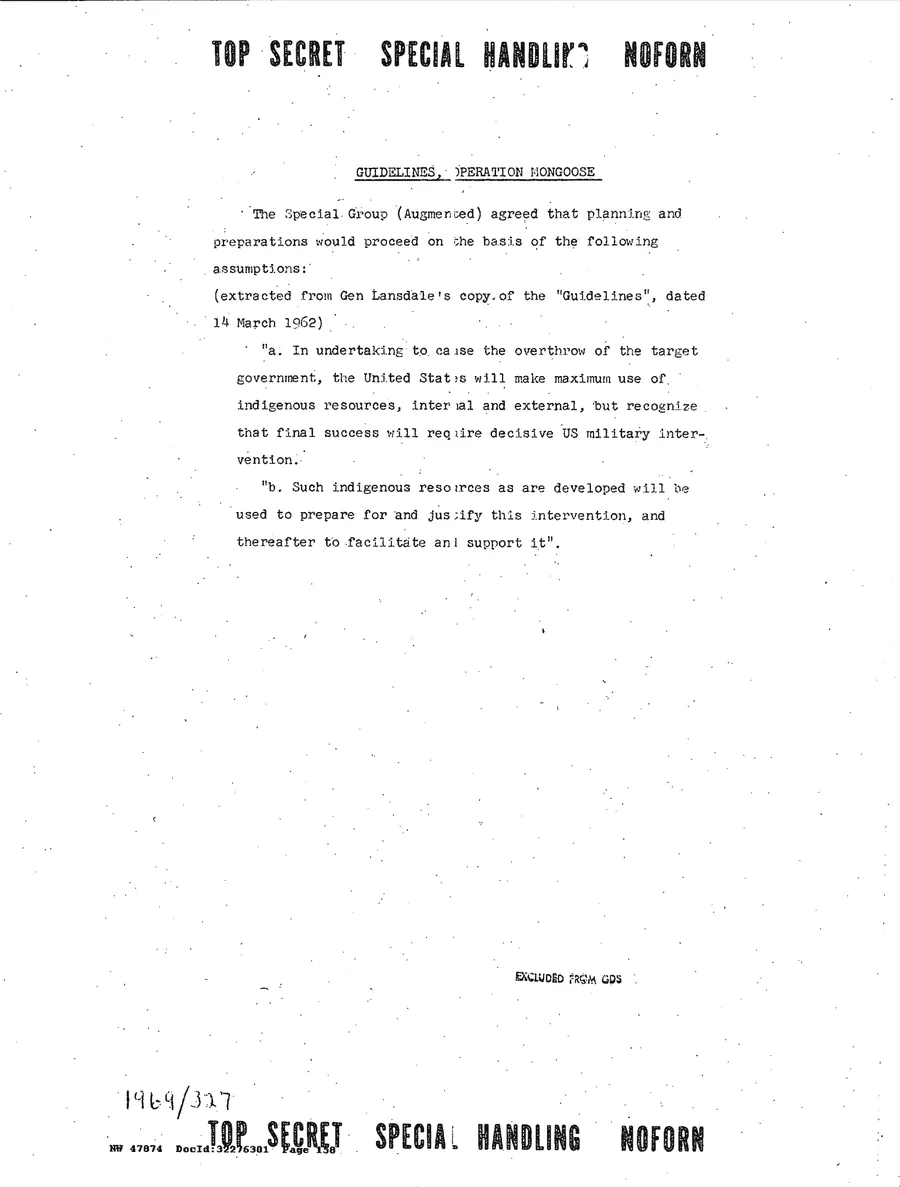
Order restored. A single leaf, the Guidelines for Operation Mongoose, from the copy held by the Chief of Operations. It is page 158 of the scan, the leaf immediately before the memorandum.
GUIDELINES, OPERATION MONGOOSE
The Special Group (Augmented) agreed that planning and preparations would proceed on the basis of the following assumptions:
(extracted from Gen Lansdale's copy of the "Guidelines", dated 14 March 1962)
"a. In undertaking to cause the overthrow of the target government, the United States will make maximum use of indigenous resources, internal and external, but recognize that final success will require decisive US military intervention.
"b. Such indigenous resources as are developed will be used to prepare for and justify this intervention, and thereafter to facilitate and support it".
Textual notes on this leaf (6)
- GUIDELINES, OPERATION MONGOOSE
- Established from the image, not assumed. This leaf is a typed EXTRACT, not a JCS paper: a centred underlined heading, one lead-in sentence, a parenthetical provenance note, and two lettered assumptions quoted from the Special Group (Augmented) 'Guidelines' of 14 March 1962. It carries no letterhead, no date line of its own, no addressee, no signature block and no folio. Its typeface, line spacing (double-spaced, unlike the single-spaced JCS 1969/321 report) and margins are those of a separately prepared extract sheet.
- 1969/327 (pencil, foot left)
- Handwritten in pencil, verified at 900 dpi: the digits read '1 9 6 9 / 3 2 7' unambiguously - note the 7, which has a plain unbarred stem, and the 2 with a flat foot. This is NOT 1969/321 (the Northwoods report on the following leaves) and NOT 1969/392 (the paper transcribed in the rest of this batch). Recorded as a manuscript filing mark, not transcribed as body text.
- (extracted from Gen Lansdale's copy of the "Guidelines", dated 14 March 1962)
- Set BELOW the lead-in sentence and ABOVE the quoted assumptions, not as a footnote and not below a rule. Transcribed in that position. 'Gen' is abbreviated without a full stop, as typed - the same habit as the 'Gen Craig' footnote on PDF 164.
- "a. ... intervention. / "b. ... support it".
- The quotation is opened by a double quotation mark before 'a.' and again before 'b.', and is closed only once, after 'it' at the end of b. Sub-paragraph a therefore opens a quotation it never closes - the document's own setting, a run-on quotation opened afresh at each lettered item. PRESERVED exactly.
- thereafter to facilitate and support it".
- Verified at 700 dpi: the closing double quotation mark precedes the full stop ('it".', not 'it."'). The document's own punctuation, and the British order. PRESERVED.
- In undertaking to cause the overthrow
- The u of 'cause' is a weak strike whose left stem alone prints, giving a 'ca.se' appearance at 200 dpi. Verified at 450 dpi: the right stem and the foot serif are both present, faintly. Reads 'cause'. Stands as transcribed.
Unnumbered leaf
Leaf 23 of 65 · source page 159
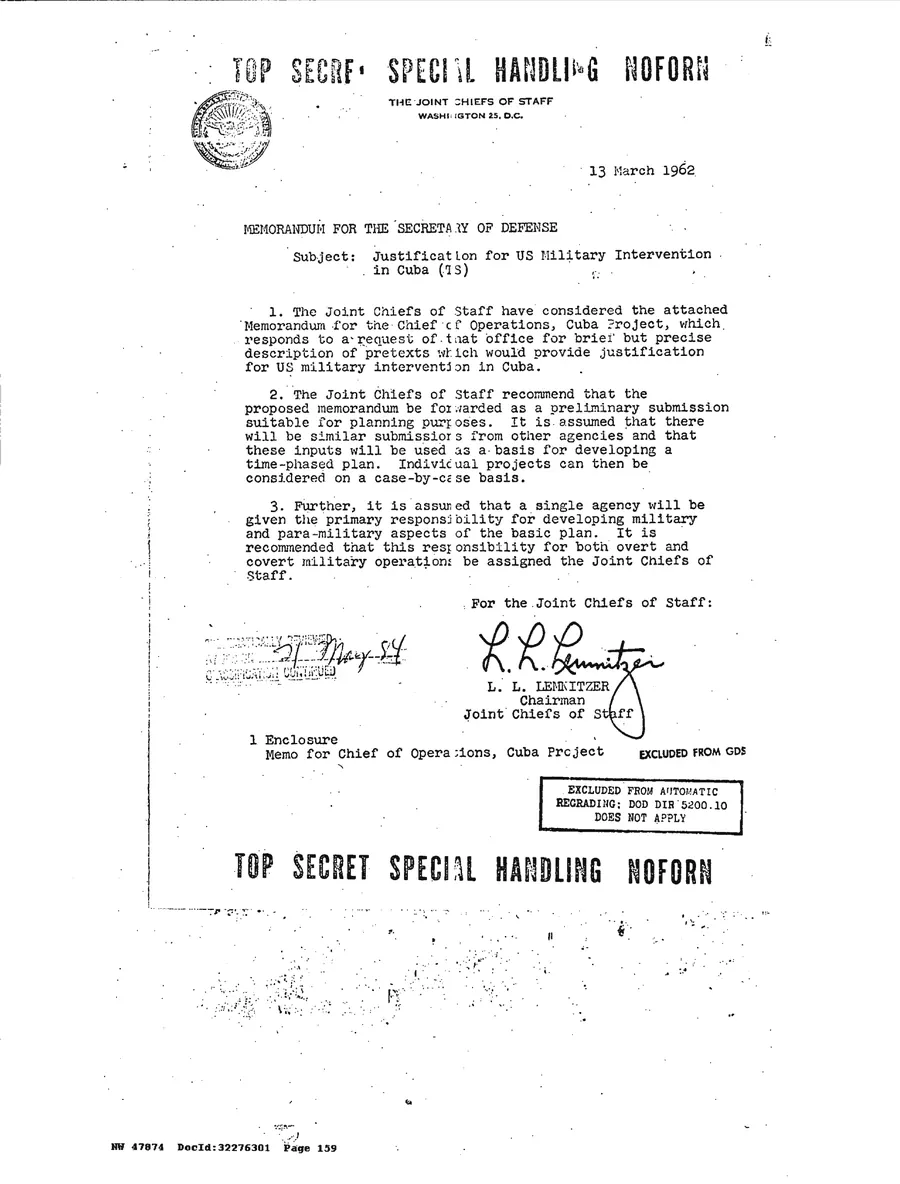
Order restored. The package as it is bound in the record: pages 159-172 of the scan, in that order, nothing added and nothing moved.
THE JOINT CHIEFS OF STAFF WASHINGTON 25, D.C.
1. The Joint Chiefs of Staff have considered the attached Memorandum for the Chief of Operations, Cuba Project, which responds to a request of that office for brief but precise description of pretexts which would provide justification for US military intervention in Cuba.
2. The Joint Chiefs of Staff recommend that the proposed memorandum be forwarded as a preliminary submission suitable for planning purposes. It is assumed that there will be similar submissions from other agencies and that these inputs will be used as a basis for developing a time-phased plan. Individual projects can then be considered on a case-by-case basis.
3. Further, it is assumed that a single agency will be given the primary responsibility for developing military and para-military aspects of the basic plan. It is recommended that this responsibility for both overt and covert military operations be assigned the Joint Chiefs of Staff.
For the Joint Chiefs of Staff: [signed] L. L. Lemnitzer L. L. LEMNITZER Chairman Joint Chiefs of Staff
Textual notes on this leaf (6)
- operations be assigned the Joint Chiefs of Staff
- Reads 'be assigned the Joint Chiefs of Staff' without 'to'. The document's own construction, and it recurs verbatim on printed pages 4 and 6 (PDF 164, 166), so it is the drafter's usage rather than a dropped word in one strike. PRESERVED all three times; worth an annotation.
- SYSTEMATICALLY REVIEWED BY JCS ON 21 May 84 / CLASSIFICATION CONTINUED
- Checked against the scan at 1200 dpi 2026-09-02. The handwritten date reads '21 May 84' on this impression - the 2, the 1 (a long stroke), 'May' and '84' are all legible - and stands. Of the stamp's lettering, '...ATICALLY REVIEWED' and 'CLASSIFICATION CONTINUED' read on this leaf; the middle line is too badly inked to read here and its wording, 'BY JCS ON', is supplied from the fully legible impression of the same stamp on PDF 36 of the same record. PERMANENTLY PROVISIONAL for that one line on this leaf - the ink is not there to read; the date and the other two lines are verified.
- EXCLUDED FROM AUTOMATIC REGRADING; DOD DIR 5200.10 DOES NOT APPLY
- CORRECTED on verification 2026-09-02. The mark after REGRADING in the boxed stamp was read as a colon on first pass; at 1200 dpi it is unmistakably a semicolon - an upper dot over a comma whose tail curves down and to the left. The stamp therefore uses the same punctuation as the TYPED equivalent on PDF 160, which spells out 'DOD DIRECTIVE'; the two remain transcribed independently, each as it appears.
- TOP SECRET SPECIAL HANDLING NOFORN (head)
- The head stamp is over-inked: the T of SECRET prints as a broken blob and the G of HANDLING is fouled, giving a 'TOP SECRE· SPECIAL HANDLI·G' appearance. Read as the standard stamp, which prints cleanly at the foot of the same page.
- top right corner mark
- A small ink or pencil mark sits in the top right corner of the leaf. [illegible] - not resolvable as a character or numeral at 400 dpi; recorded here, not transcribed.
- [signed] L. L. Lemnitzer
- Ink signature reads 'L. L. Lemnitzer'; its final flourish loops down through the typed block, crossing 'Joint Chiefs of Staff'. Recorded as a signature block per house rule, transcribed exactly.
Printed page 2165
Leaf 24 of 65 · source page 160
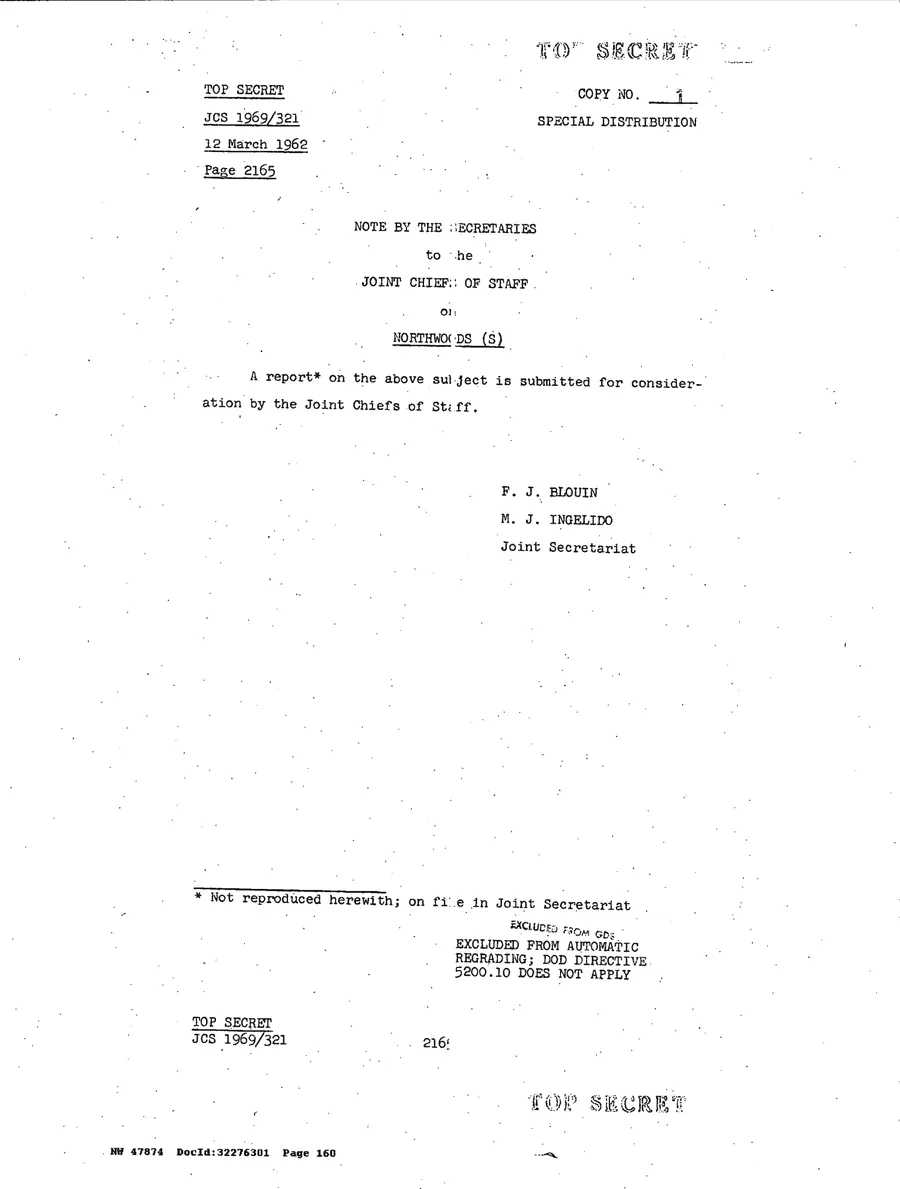
NOTE BY THE SECRETARIES to the JOINT CHIEFS OF STAFF on NORTHWOODS (S)
A report* on the above subject is submitted for consideration by the Joint Chiefs of Staff.
F. J. BLOUIN M. J. INGELIDO Joint Secretariat
* Not reproduced herewith; on file in Joint Secretariat
TOP SECRET JCS 1969/321
Textual notes on this leaf (4)
- COPY NO. 1
- Checked against the scan at 600 dpi 2026-09-02: the digit typed above the underscore rule is a 1 - flag, stem and foot serif all print; only the head is smudged. Stands as transcribed.
- 2165 (foot, centre)
- Checked against the scan at 1200 dpi 2026-09-02. '216' prints cleanly; the fourth digit is a weak strike that leaves only fragments at the top right and lower right of its cell - consistent with a 5, but not resolvable as a digit on their own. The leaf's folio is 2165 by the fully legible 'Page 2165' in the head block of the same leaf, which is what the 'printed' key records. Stands; the foot repetition is recorded as weakly struck.
- REGRADING; DOD DIRECTIVE 5200.10
- The typed exclusion note spells out 'DOD DIRECTIVE' where the boxed stamp on PDF 159 reads 'DOD DIR'; both use a semicolon after REGRADING (the stamp's mark was read as a colon on first pass and corrected to a semicolon on verification 2026-09-02). The document carries both wordings; each transcribed as it appears.
- F. J. BLOUIN / M. J. INGELIDO
- Typed names only - this file copy of the Note carries no ink signatures. Recorded as a signature block, transcribed exactly.
Unnumbered leaf
Leaf 25 of 65 · source page 161
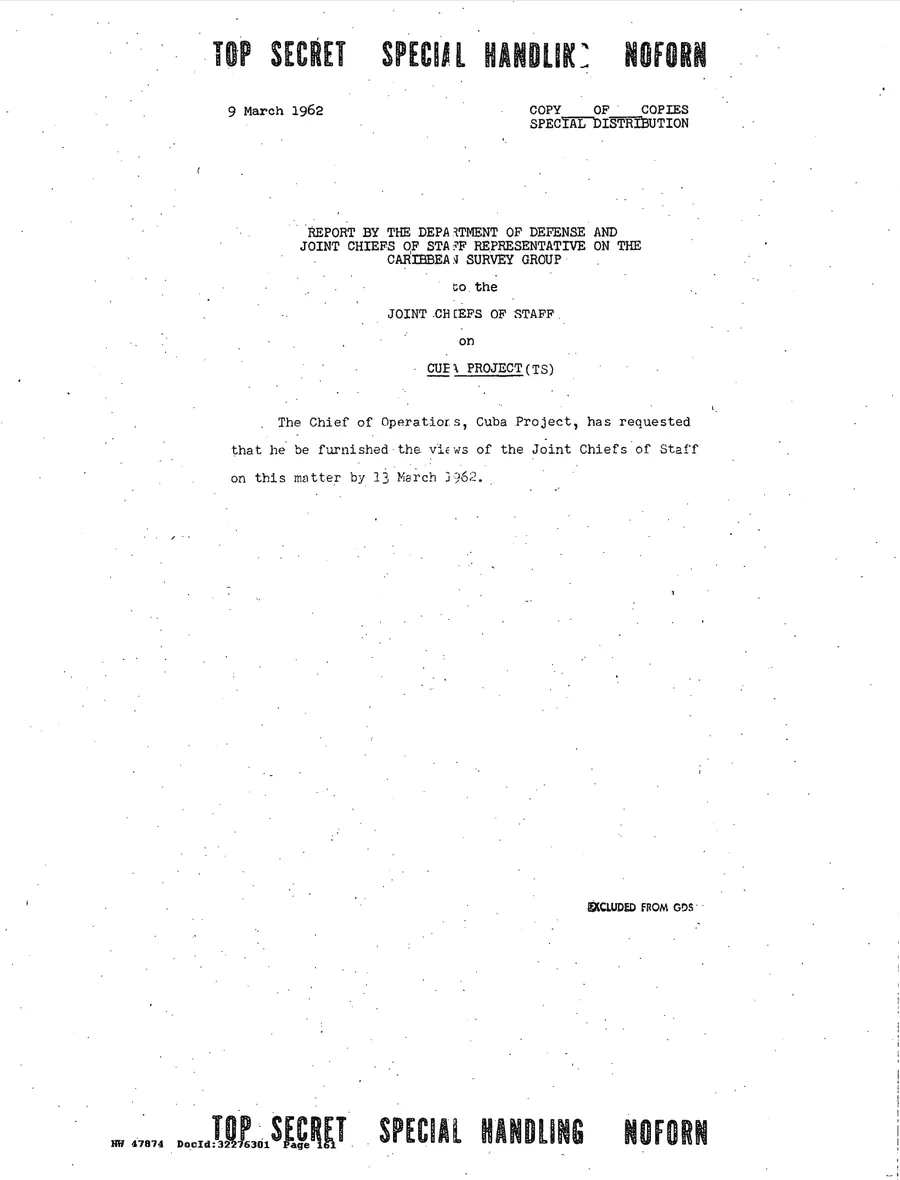
REPORT BY THE DEPARTMENT OF DEFENSE AND JOINT CHIEFS OF STAFF REPRESENTATIVE ON THE CARIBBEAN SURVEY GROUP to the JOINT CHIEFS OF STAFF on CUBA PROJECT(TS)
The Chief of Operations, Cuba Project, has requested that he be furnished the views of the Joint Chiefs of Staff on this matter by 13 March 1962.
Textual notes on this leaf (2)
- CUBA PROJECT(TS)
- No space before the opening parenthesis: the gap between the T of PROJECT and the parenthesis measures well under the typeface's space width (compare the genuine spaces in 'COPY OF COPIES' on the same leaf). The underline stops after PROJECT. PRESERVED as typed. Elsewhere in the package the same subject line prints WITH the space - 'in Cuba (TS)' on PDF 159, 164, 165 and 'IN CUBA (TS)' on PDF 162 - so the two settings coexist in the document.
- TOP SECRET SPECIAL HANDLING NOFORN (head)
- The head stamp's G of HANDLING prints broken ('HANDLIK·' appearance), as on most leaves of the package. Read as the standard stamp throughout; noted once here and not re-flagged on later pages.
Printed page 2
Leaf 26 of 65 · source page 162
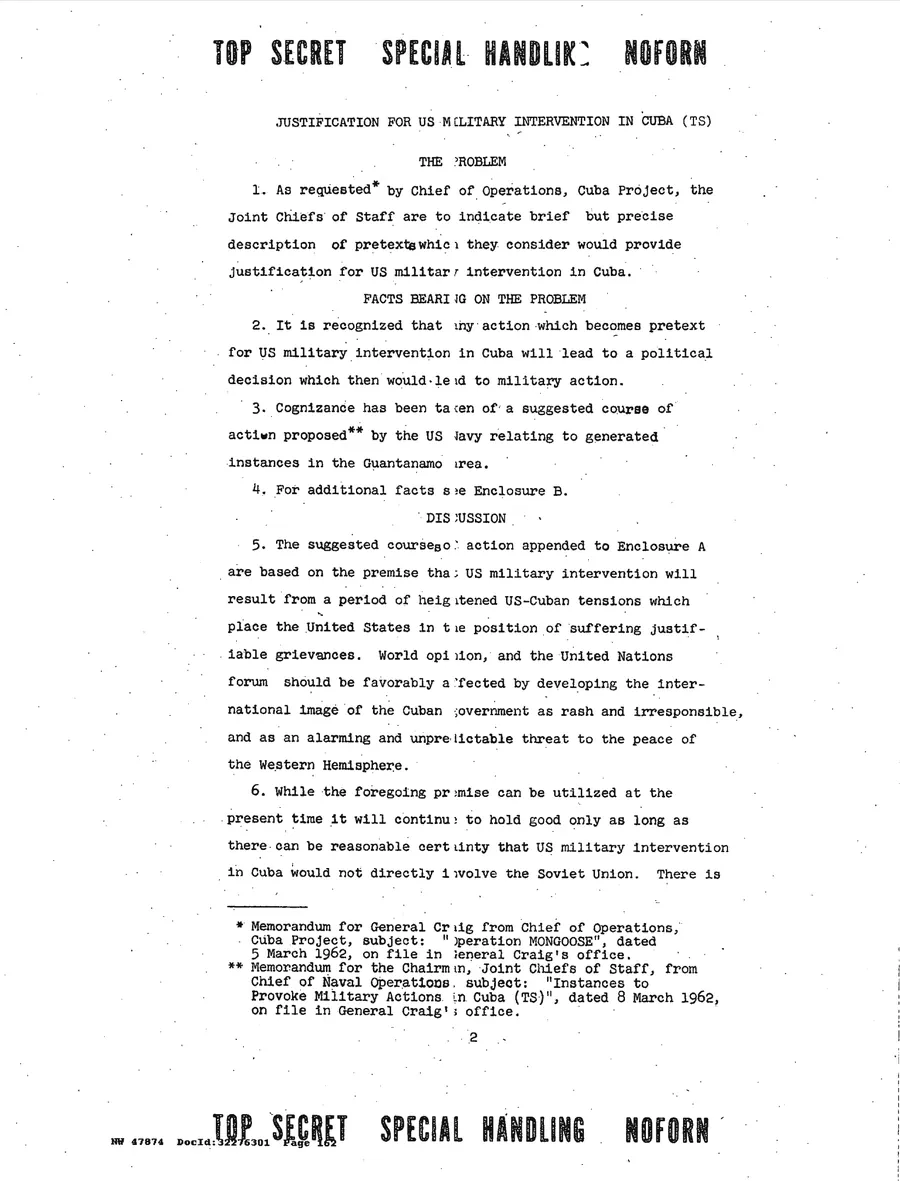
JUSTIFICATION FOR US MILITARY INTERVENTION IN CUBA (TS)
THE PROBLEM
1. As requested* by Chief of Operations, Cuba Project, the Joint Chiefs of Staff are to indicate brief but precise description of pretexts which they consider would provide justification for US military intervention in Cuba.
FACTS BEARING ON THE PROBLEM
2. It is recognized that any action which becomes pretext for US military intervention in Cuba will lead to a political decision which then would lead to military action.
3. Cognizance has been taken of a suggested course of action proposed** by the US Navy relating to generated instances in the Guantanamo area.
4. For additional facts see Enclosure B.
DISCUSSION
5. The suggested courses of action appended to Enclosure A are based on the premise that US military intervention will result from a period of heightened US-Cuban tensions which place the United States in the position of suffering justifiable grievances. World opinion, and the United Nations forum should be favorably affected by developing the international image of the Cuban government as rash and irresponsible, and as an alarming and unpredictable threat to the peace of the Western Hemisphere.
6. While the foregoing premise can be utilized at the present time it will continue to hold good only as long as there can be reasonable certainty that US military intervention in Cuba would not directly involve the Soviet Union. There is
* Memorandum for General Craig from Chief of Operations, Cuba Project, subject: "Operation MONGOOSE", dated 5 March 1962, on file in General Craig's office.
** Memorandum for the Chairman, Joint Chiefs of Staff, from Chief of Naval Operations, subject: "Instances to Provoke Military Actions in Cuba (TS)", dated 8 March 1962, on file in General Craig's office.
Textual notes on this leaf (7)
- brief but / description of
- Two anomalous double spaces mid-sentence in paragraph 1. PRESERVED as spacing.
- description of pretexts which they consider
- Checked against the scan at 600 dpi 2026-09-02: the terminal s of 'pretexts' prints below the baseline (a recurring alignment fault of this typewriter - see also PDF 164) and the word space before 'which' is pinched but present. Reads 'pretexts which'. Stands as transcribed.
- any action which becomes pretext for US military intervention
- Reads 'becomes pretext' without an article. The document's own construction. PRESERVED.
- The suggested courses of action (para 5, first line)
- Checked against the scan at 1200 dpi 2026-09-02: the terminal s of 'courses' prints below the baseline, and the letter after the o of 'of' is a weak strike whose ghost runs from ascender height down to the baseline in the cell where the f belongs - the skeleton of a tall letter, and 'of' is the only word the line admits. Reads 'courses of action', the phrase the document uses cleanly on PDF 163 and 167. Stands as transcribed.
- the United Nations forum should
- Anomalous double space mid-sentence in paragraph 5. PRESERVED as spacing.
- Chief of Naval Operations, subject:
- CONFIRM against a sharper scan - genuinely ambiguous on this one. Checked at 1200 dpi 2026-09-02 with measurements: the mark after 'Operations' is a typed character, not a speck - it sits centred in its own cell, resting on the baseline, 12 px wide by 24 px tall - but it carries roughly a third of the ink of this machine's period (a 24-32 px blob on the baseline) and a fifth of its comma (36-40 px, running 33 px above to 22 px below the baseline), and its shape fits either a partly printed period or a partly printed comma head. Transcribed as a comma on the pattern of 'Cuba Project, subject:' in the footnote above it; a full stop cannot be excluded. The similar-looking dot after 'Actions' in the next line is a different thing: a 12 by 8 px speck hugging the s above the baseline, off the cell centre - not a character, and not transcribed.
- in Cuba (TS)" (footnote **)
- A small speck prints inside the parenthesis after TS, giving a '(TS·)' appearance. Not read as a character; noted for the proofreader.
Printed page 3
Leaf 27 of 65 · source page 163
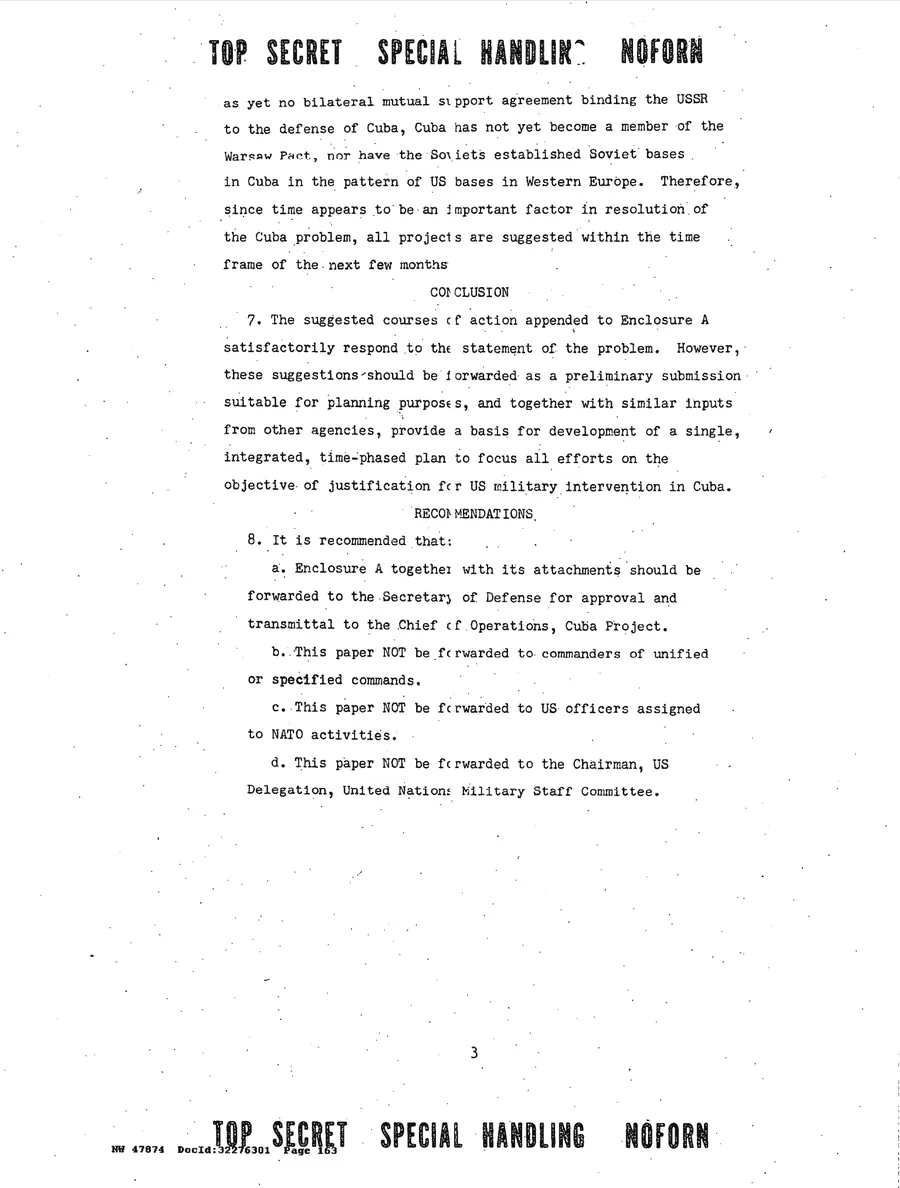
as yet no bilateral mutual support agreement binding the USSR to the defense of Cuba, Cuba has not yet become a member of the Warsaw Pact, nor have the Soviets established Soviet bases in Cuba in the pattern of US bases in Western Europe. Therefore, since time appears to be an important factor in resolution of the Cuba problem, all projects are suggested within the time frame of the next few months
CONCLUSION
7. The suggested courses of action appended to Enclosure A satisfactorily respond to the statement of the problem. However, these suggestions should be forwarded as a preliminary submission suitable for planning purposes, and together with similar inputs from other agencies, provide a basis for development of a single, integrated, time-phased plan to focus all efforts on the objective of justification for US military intervention in Cuba.
RECOMMENDATIONS
8. It is recommended that:
a. Enclosure A together with its attachments should be forwarded to the Secretary of Defense for approval and transmittal to the Chief of Operations, Cuba Project.
b. This paper NOT be forwarded to commanders of unified or specified commands.
c. This paper NOT be forwarded to US officers assigned to NATO activities.
d. This paper NOT be forwarded to the Chairman, US Delegation, United Nations Military Staff Committee.
Textual notes on this leaf (3)
- within the time frame of the next few months
- Checked against the scan at 600 dpi 2026-09-02: no full stop follows 'months', though the sentence and paragraph 6 end here. The only mark to the right of the s is a speck at x-height level, well above where a period would sit on the baseline. Transcribed without one. Stands.
- these suggestions should be forwarded
- A stray diagonal typewriter mark sits above the space between 'suggestions' and 'should'. Not a typed character; not transcribed.
- This paper NOT be forwarded (b, c, d)
- All three restrictive recommendations read 'This paper NOT be forwarded' without 'should' - elliptical drafting carried from 'It is recommended that:'. The capitalised NOT is the document's own emphasis, in ordinary type, not underlined. PRESERVED; worth an annotation.
Printed page 4
Leaf 28 of 65 · source page 164
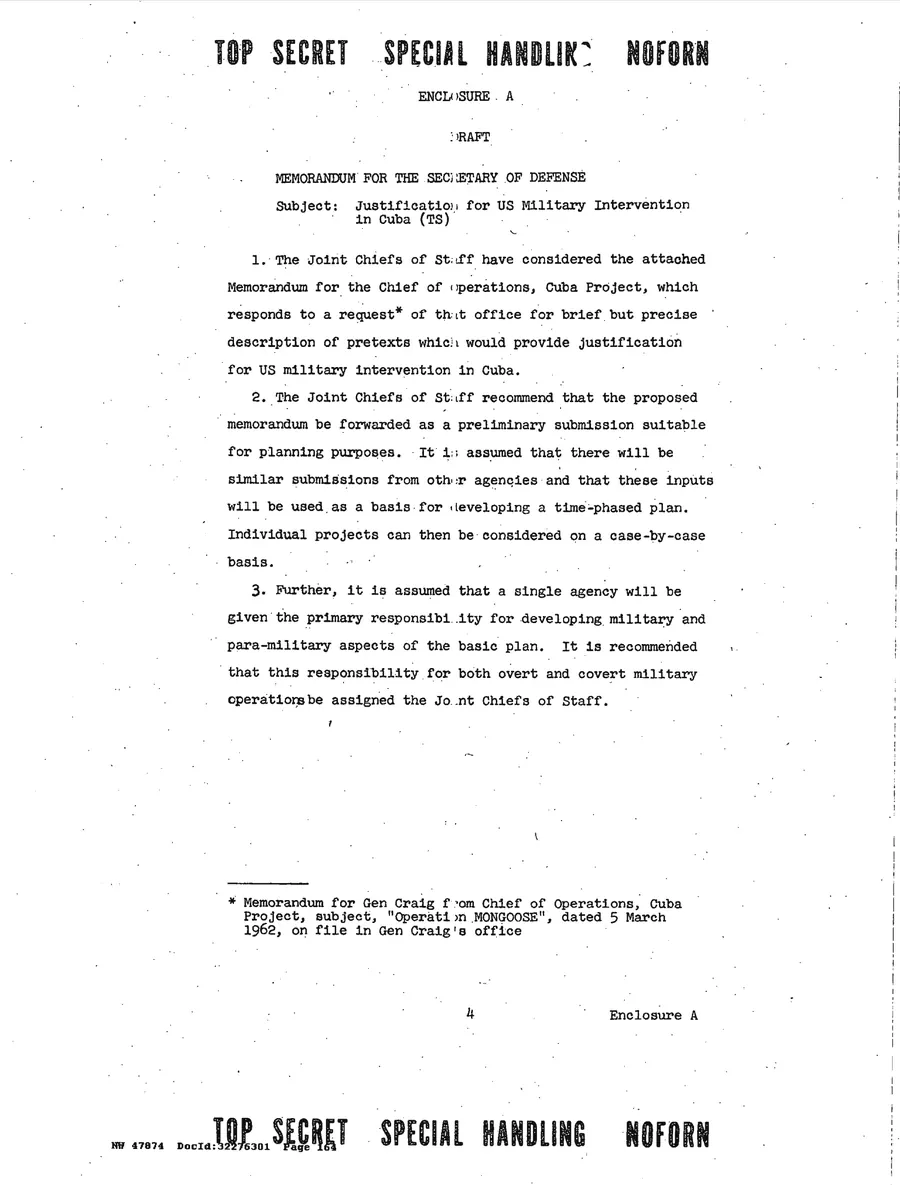
ENCLOSURE A
DRAFT
1. The Joint Chiefs of Staff have considered the attached Memorandum for the Chief of Operations, Cuba Project, which responds to a request* of that office for brief but precise description of pretexts which would provide justification for US military intervention in Cuba.
2. The Joint Chiefs of Staff recommend that the proposed memorandum be forwarded as a preliminary submission suitable for planning purposes. It is assumed that there will be similar submissions from other agencies and that these inputs will be used as a basis for developing a time-phased plan. Individual projects can then be considered on a case-by-case basis.
3. Further, it is assumed that a single agency will be given the primary responsibility for developing military and para-military aspects of the basic plan. It is recommended that this responsibility for both overt and covert military operations be assigned the Joint Chiefs of Staff.
* Memorandum for Gen Craig from Chief of Operations, Cuba Project, subject, "Operation MONGOOSE", dated 5 March 1962, on file in Gen Craig's office
Enclosure A
Textual notes on this leaf (4)
- subject, "Operation MONGOOSE", ... Gen Craig's office
- The footnote reads 'subject,' with a comma where the equivalent footnote on printed page 2 (PDF 162) has 'subject:'; it also abbreviates 'Gen Craig' where page 2 has 'General Craig', and it ends without a full stop. The draft's own inconsistencies. ALL PRESERVED; they matter for citation.
- covert military operations be assigned
- Checked against the scan at 600 dpi 2026-09-02: the terminal s of 'operations' prints below the baseline and the space before 'be' is pinched but present - the same alignment fault as on PDF 162; the i of 'Joint' in the same line is a weak strike with its dot printing ('Jo.nt'). Reads 'operations be assigned the Joint Chiefs of Staff'. Stands as transcribed.
- be assigned the Joint Chiefs of Staff
- Second occurrence of the construction without 'to' (see PDF 159). PRESERVED.
- ENCLOSURE A
- A gap of roughly two character cells between ENCLOSURE and A, with a stray speck in the gap that is not read as a character. Transcribed with a double space. The same wide setting recurs in the APPENDIX and ANNEX headings (PDF 165, 167).
Printed page 5
Leaf 29 of 65 · source page 165
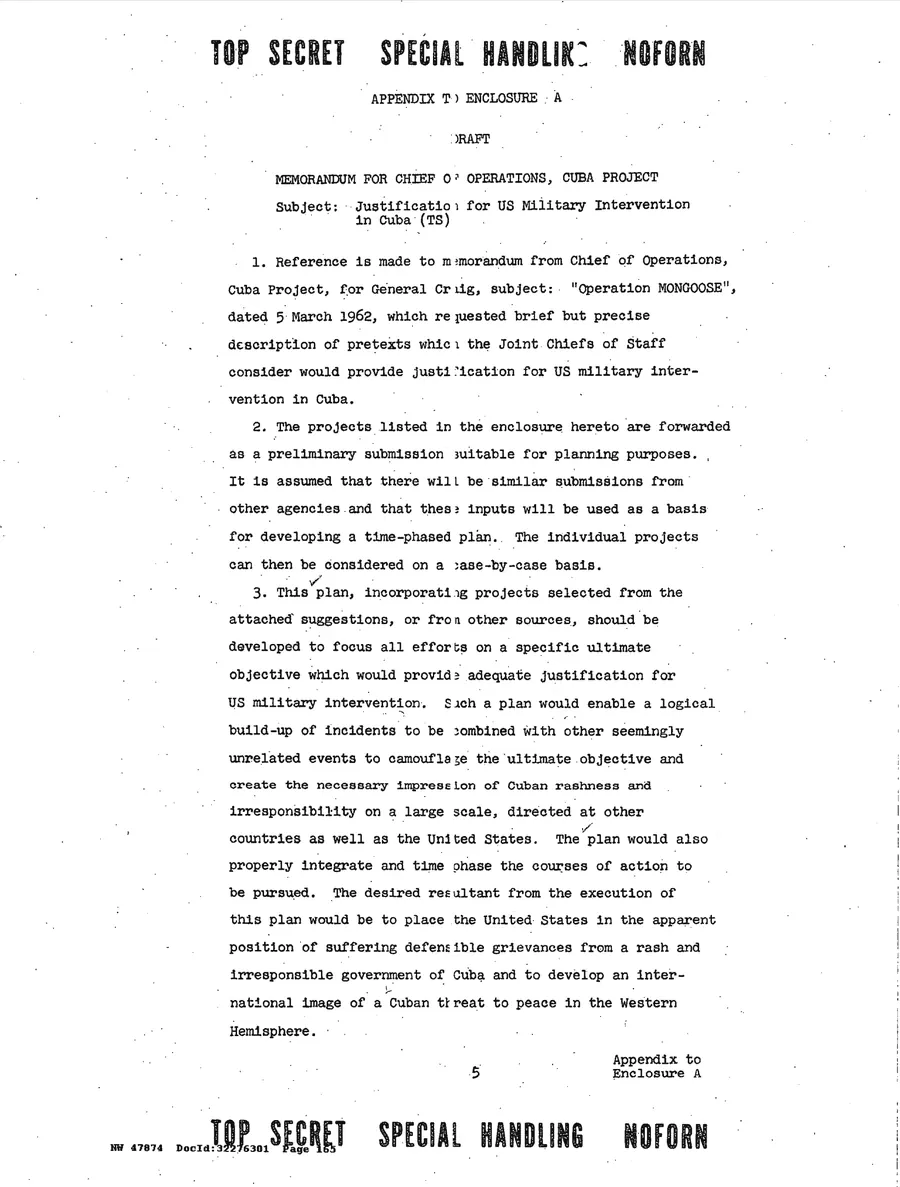
APPENDIX TO ENCLOSURE A
DRAFT
1. Reference is made to memorandum from Chief of Operations, Cuba Project, for General Craig, subject: "Operation MONGOOSE", dated 5 March 1962, which requested brief but precise description of pretexts which the Joint Chiefs of Staff consider would provide justification for US military intervention in Cuba.
2. The projects listed in the enclosure hereto are forwarded as a preliminary submission suitable for planning purposes. It is assumed that there will be similar submissions from other agencies and that these inputs will be used as a basis for developing a time-phased plan. The individual projects can then be considered on a case-by-case basis.
3. This plan, incorporating projects selected from the attached suggestions, or from other sources, should be developed to focus all efforts on a specific ultimate objective which would provide adequate justification for US military intervention. Such a plan would enable a logical build-up of incidents to be combined with other seemingly unrelated events to camouflage the ultimate objective and create the necessary impression of Cuban rashness and irresponsibility on a large scale, directed at other countries as well as the United States. The plan would also properly integrate and time phase the courses of action to be pursued. The desired resultant from the execution of this plan would be to place the United States in the apparent position of suffering defensible grievances from a rash and irresponsible government of Cuba and to develop an international image of a Cuban threat to peace in the Western Hemisphere.
Appendix to Enclosure A
Textual notes on this leaf (3)
- handwritten tick marks
- Two small handwritten tick or check marks sit above the word 'plan' - one over 'This plan' at the start of paragraph 3, one over 'The plan would also' mid-paragraph. A reader's marks, not part of the typescript. Recorded here, not transcribed.
- properly integrate and time phase the courses of action
- 'time phase' set as two words where the document elsewhere hyphenates 'time-phased' (paragraph 2 of this same leaf). The document's own inconsistency. PRESERVED.
- create the necessary impression of Cuban rashness and
- This line prints in a visibly lighter strike than its neighbours - a mimeograph inking variation. Fully legible; no reading affected.
Printed page 6
Leaf 30 of 65 · source page 166
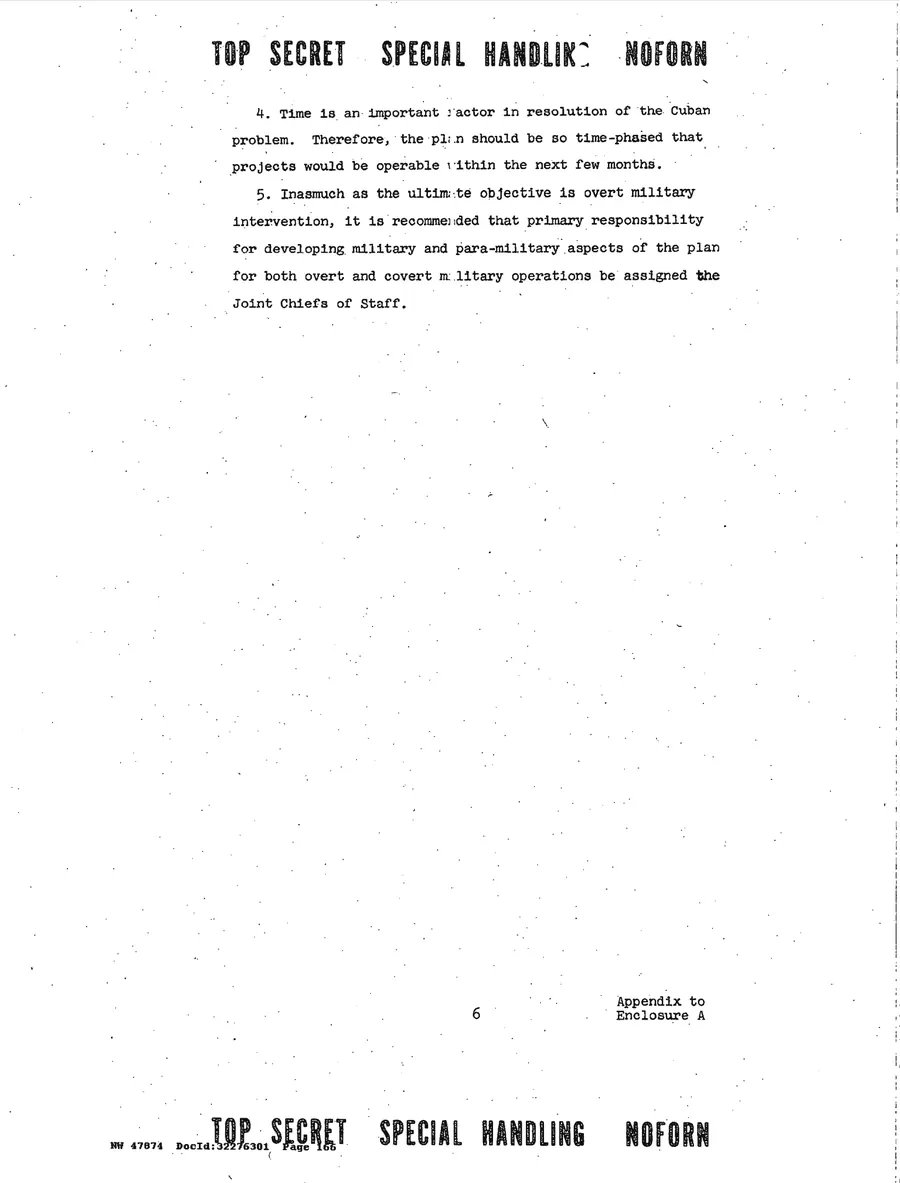
4. Time is an important factor in resolution of the Cuban problem. Therefore, the plan should be so time-phased that projects would be operable within the next few months.
5. Inasmuch as the ultimate objective is overt military intervention, it is recommended that primary responsibility for developing military and para-military aspects of the plan for both overt and covert military operations be assigned the Joint Chiefs of Staff.
Appendix to Enclosure A
Textual notes on this leaf (2)
- operations be assigned the
- Third occurrence of 'be assigned the Joint Chiefs of Staff' without 'to' (see PDF 159, 164). The word 'the' at the line end prints double-struck (heavier than its neighbours). PRESERVED.
- lower two-thirds of the leaf is blank
- The Appendix text ends a third of the way down and the rest of the sheet is empty apart from the folio, the enclosure label and the stamps.
Printed page 7
Leaf 31 of 65 · source page 167
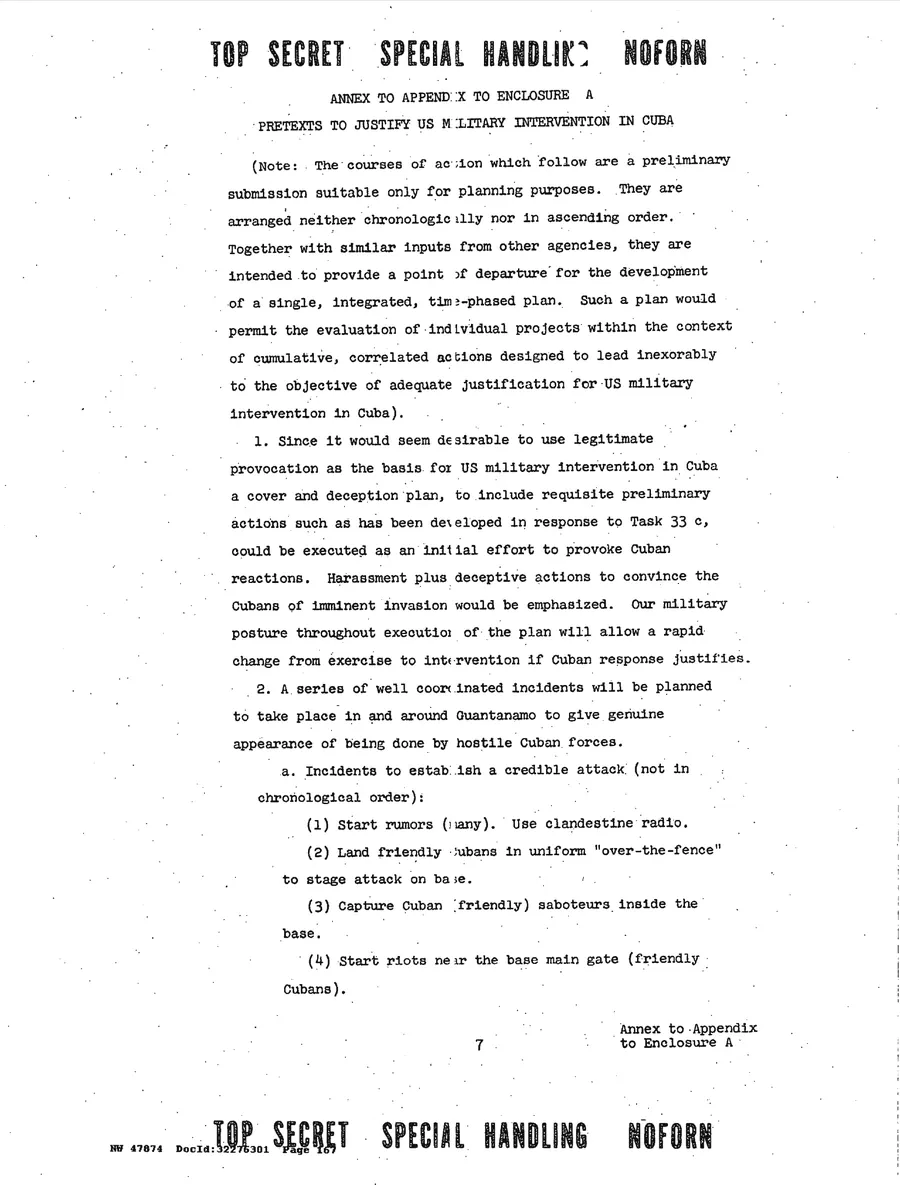
ANNEX TO APPENDIX TO ENCLOSURE A
PRETEXTS TO JUSTIFY US MILITARY INTERVENTION IN CUBA
(Note: The courses of action which follow are a preliminary submission suitable only for planning purposes. They are arranged neither chronologically nor in ascending order. Together with similar inputs from other agencies, they are intended to provide a point of departure for the development of a single, integrated, time-phased plan. Such a plan would permit the evaluation of individual projects within the context of cumulative, correlated actions designed to lead inexorably to the objective of adequate justification for US military intervention in Cuba).
1. Since it would seem desirable to use legitimate provocation as the basis for US military intervention in Cuba a cover and deception plan, to include requisite preliminary actions such as has been developed in response to Task 33 c, could be executed as an initial effort to provoke Cuban reactions. Harassment plus deceptive actions to convince the Cubans of imminent invasion would be emphasized. Our military posture throughout execution of the plan will allow a rapid change from exercise to intervention if Cuban response justifies.
2. A series of well coordinated incidents will be planned to take place in and around Guantanamo to give genuine appearance of being done by hostile Cuban forces.
a. Incidents to establish a credible attack (not in chronological order):
(1) Start rumors (many). Use clandestine radio.
(2) Land friendly Cubans in uniform "over-the-fence" to stage attack on base.
(3) Capture Cuban (friendly) saboteurs inside the base.
(4) Start riots near the base main gate (friendly Cubans).
Annex to Appendix to Enclosure A
Textual notes on this leaf (3)
- Capture Cuban (friendly) saboteurs
- The opening parenthesis of '(friendly)' prints only as a faint broken arc; the closing parenthesis is clean. Read as '(friendly)' on the pattern of '(many)' and '(friendly Cubans)' on the same leaf.
- intervention in Cuba a cover and deception plan
- No punctuation between 'Cuba' and 'a cover and deception plan' - the sentence reads as written, with the comma coming only after 'plan'. The document's own punctuation. PRESERVED.
- in response to Task 33 c,
- '33 c' set with a space before the lower-case letter, as typed. Verified at high zoom; clean type.
Printed page 8
Leaf 32 of 65 · source page 168
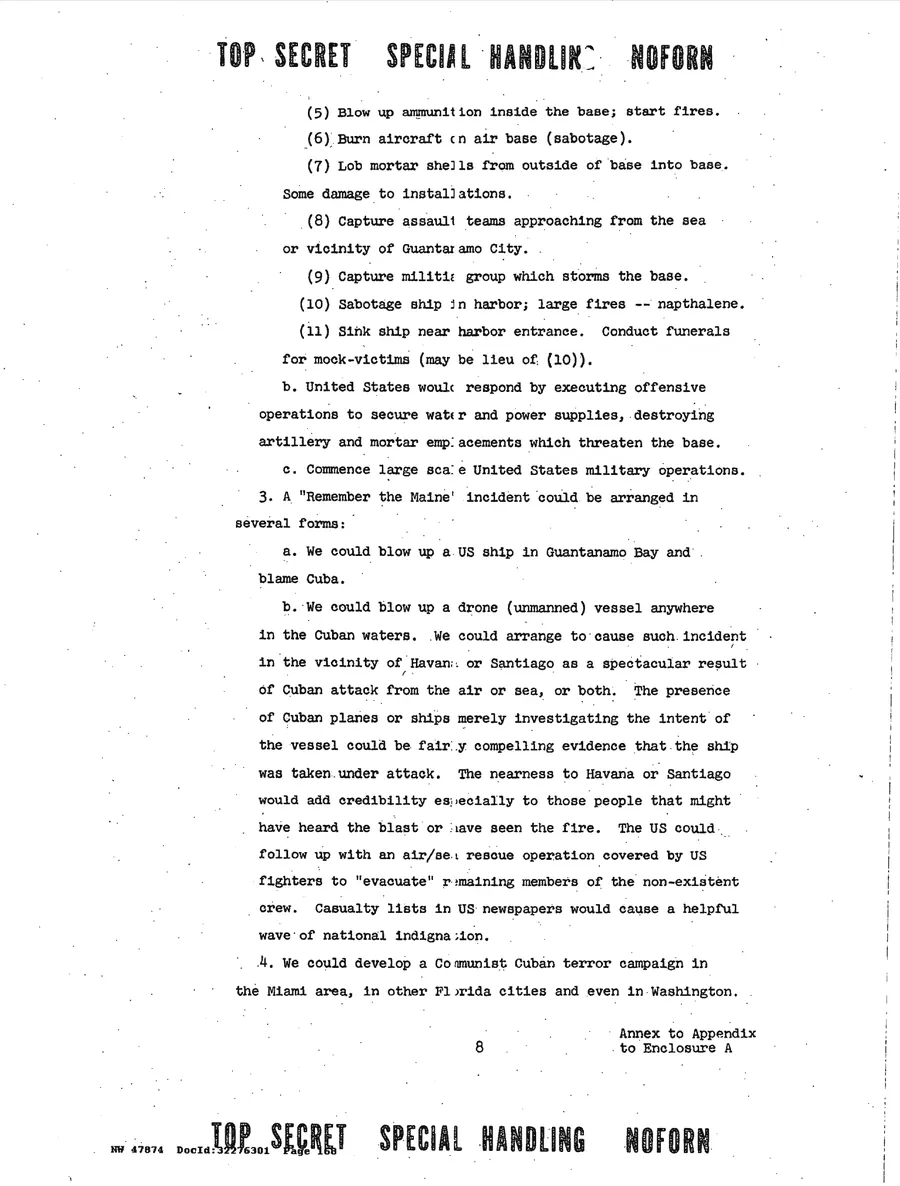
(5) Blow up ammunition inside the base; start fires.
(6) Burn aircraft on air base (sabotage).
(7) Lob mortar shells from outside of base into base. Some damage to installations.
(8) Capture assault teams approaching from the sea or vicinity of Guantanamo City.
(9) Capture militia group which storms the base.
(10) Sabotage ship in harbor; large fires -- napthalene.
(11) Sink ship near harbor entrance. Conduct funerals for mock-victims (may be lieu of (10)).
b. United States would respond by executing offensive operations to secure water and power supplies, destroying artillery and mortar emplacements which threaten the base.
c. Commence large scale United States military operations.
3. A "Remember the Maine" incident could be arranged in several forms:
a. We could blow up a US ship in Guantanamo Bay and blame Cuba.
b. We could blow up a drone (unmanned) vessel anywhere in the Cuban waters. We could arrange to cause such incident in the vicinity of Havana or Santiago as a spectacular result of Cuban attack from the air or sea, or both. The presence of Cuban planes or ships merely investigating the intent of the vessel could be fairly compelling evidence that the ship was taken under attack. The nearness to Havana or Santiago would add credibility especially to those people that might have heard the blast or have seen the fire. The US could follow up with an air/sea rescue operation covered by US fighters to "evacuate" remaining members of the non-existent crew. Casualty lists in US newspapers would cause a helpful wave of national indignation.
4. We could develop a Communist Cuban terror campaign in the Miami area, in other Florida cities and even in Washington.
Annex to Appendix to Enclosure A
Textual notes on this leaf (4)
- napthalene
- Misspelling of 'naphthalene'. The document's own error, in clean type. PRESERVED.
- (may be lieu of (10))
- Reads 'may be lieu of' - 'in' is absent between 'be' and 'lieu' on the page. The document's own omission. PRESERVED; worth an annotation.
- A "Remember the Maine" incident
- Checked against the scan at 1200 dpi 2026-09-02 with measurements. The closing mark after 'Maine' is a single vertical stroke, 16 px wide, of the same height as the limbs of this machine's double quotation mark; the opening mark is a clean double. Its position settles it: it sits about 15 px LEFT of its cell's centre, where the left limb of a double quotation mark prints (the limbs of the doubles around 'evacuate' on the same leaf sit 16 px left and 18 px right of centre), whereas this machine's typed apostrophe prints centred in its cell (both instances of 'Craig's' on PDF 162 are within 6 px of centre). It is a double quotation mark whose right limb did not print. Stands as transcribed.
- large fires -- napthalene
- The dash is typed as two hyphens, transcribed as typed. The typeset edition should render an em dash only with an annotation trail.
Printed page 9
Leaf 33 of 65 · source page 169
The terror campaign could be pointed at Cuban refugees seeking haven in the United States. We could sink a boatload of Cubans enroute to Florida (real or simulated). We could foster attempts on lives of Cuban refugees in the United States even to the extent of wounding in instances to be widely publicized. Exploding a few plastic bombs in carefully chosen spots, the arrest of Cuban agents and the release of prepared documents substantiating Cuban involvement also would be helpful in projecting the idea of an irresponsible government.
5. A "Cuban-based, Castro-supported" filibuster could be simulated against a neighboring Caribbean nation (in the vein of the 14th of June invasion of the Dominican Republic). We know that Castro is backing subversive efforts clandestinely against Haiti, Dominican Republic, Guatemala, and Nicaragua at present and possible others. These efforts can be magnified and additional ones contrived for exposure. For example, advantage can be taken of the sensitivity of the Dominican Air Force to intrusions within their national air space. "Cuban" B-26 or C-46 type aircraft could make cane-burning raids at night. Soviet Bloc incendiaries could be found. This could be coupled with "Cuban" messages to the Communist underground in the Dominican Republic and "Cuban" shipments of arms which would be found, or intercepted, or the beach.
6. Use of MIG type aircraft by US pilots could provide additional provocation. Harassment of civil air, attacks on surface shipping and destruction of US military drone aircraft by MIG type planes would be useful as complementary actions. An F-86 properly painted would convince air passengers that they saw a Cuban MIG, especially if the pilot of the transport were to announce such fact. The primary drawback to this suggestion appears to be the security risk inherent in obtaining or modifying an aircraft. However, reasonable copies of the MIG could be produced from US resources in about three months.
Annex to Appendix to Enclosure A
Textual notes on this leaf (4)
- be found, or intercepted, or the beach
- Checked against the scan at 1200 dpi 2026-09-02: the word before 'the beach' is 'or' - an o followed by an r with its shoulder and a single stem, identical to the two preceding 'or's in the same line and unlike the two-legged n of 'found' at the start of it; nothing on the page suggests a degraded n. The page reads 'be found, or intercepted, or the beach.' 'on' is what sense expects; 'or' is what was typed. The document's own error. PRESERVED; worth an annotation.
- the Communist underground in the
- The word 'underground' prints markedly heavier than its neighbours - a double strike, not an underline. Recorded as ordinary text.
- at present and possible others
- Reads 'possible' where 'possibly' would be expected. The document's own usage. PRESERVED.
- enroute
- Set as one word here ('enroute to Florida') and on PDF 170 ('enroute from the United States'). The document's consistent usage. PRESERVED.
Printed page 10
Leaf 34 of 65 · source page 170
7. Hijacking attempts against civil air and surface craft should appear to continue as harassing measures condoned by the government of Cuba. Concurrently, genuine defections of Cuban civil and military air and surface craft should be encouraged.
8. It is possible to create an incident which will demonstrate convincingly that a Cuban aircraft has attacked and shot down a chartered civil airliner enroute from the United States to Jamaica, Guatemala, Panama or Venezuela. The destination would be chosen only to cause the flight plan route to cross Cuba. The passengers could be a group of college students off on a holiday or any grouping of persons with a common interest to support chartering a non-scheduled flight.
a. An aircraft at Eglin AFB would be painted and numbered as an exact duplicate for a civil registered aircraft belonging to a CIA proprietary organization in the Miami area. At a designated time the duplicate would be substituted for the actual civil aircraft and would be loaded with the selected passengers, all boarded under carefully prepared aliases. The actual registered aircraft would be converted to a drone.
b. Take off times of the drone aircraft and the actual aircraft will be scheduled to allow a rendezvous south of Florida. From the rendezvous point the passenger-carrying aircraft will descend to minimum altitude and go directly into an auxiliary field at Eglin AFB where arrangements will have been made to evacuate the passengers and return the aircraft to its original status. The drone aircraft meanwhile will continue to fly the filed flight plan. When over Cuba the drone will being transmitting on the international distress frequency a "MAY DAY" message stating he is under attack by Cuban MIG aircraft. The transmission will be interrupted by destruction of the aircraft which will be triggered by radio signal. This will allow ICAO radio
Annex to Appendix to Enclosure A
Textual notes on this leaf (3)
- to cause the flight plan route to cross Cuba
- An anomalous gap of about three character cells between 'plan' and 'route', mid-line - wider than any sentence space on the leaf. Possibly a word was skipped or erased in drafting; nothing is visible in the gap at 400 dpi. PRESERVED as spacing; worth an annotation.
- the drone will being transmitting
- Reads 'will being' where 'will begin' (or 'will be') is evidently meant. The document's own error, in clean type. PRESERVED; worth an annotation.
- Take off times
- 'Take off' set as two words, unhyphenated. The document's own usage. PRESERVED.
Printed page 11
Leaf 35 of 65 · source page 171
stations in the Western Hemisphere to tell the US what has happened to the aircraft instead of the US trying to "sell" the incident.
9. It is possible to create an incident which will make it appear that Communist Cuban MIGs have destroyed a USAF aircraft over international waters in an unprovoked attack.
a. Approximately 4 or 5 F-101 aircraft will be dispatched in trail from Homestead AFB, Florida, to the vicinity of Cuba. Their mission will be to reverse course and simulate fakir aircraft for an air defense exercise in southern Florida. These aircraft would conduct variations of these flights at frequent intervals. Crews would be briefed to remain at least 12 miles off the Cuban coast; however, they would be required to carry live ammunition in the event that hostile actions were taken by the Cuban MIGs.
b. On one such flight, a pre-briefed pilot would fly tail-end Charley at considerable interval between aircraft. While near the Cuban Island this pilot would broadcast that he had been jumped by MIGs and was going down. No other calls would be made. The pilot would then fly directly west at extremely low altitude and land at a secure base, an Eglin auxiliary. The aircraft would be met by the proper people, quickly stored and given a new tail number. The pilot who had performed the mission under an alias, would resume his proper identity and return to his normal place of business. The pilot and aircraft would then have disappeared.
c. At precisely the same time that the aircraft was presumably shot down a submarine or small surface craft would disburse F-101 parts, parachute, etc., at approximately 15 to 20 miles off the Cuban coast and depart. The pilots returning to Homestead would have a true story as far as they knew. Search ships and aircraft could be dispatched and parts of aircraft found.
Annex to Appendix to Enclosure A
Textual notes on this leaf (4)
- simulate fakir aircraft
- Reads 'fakir' in clean, unambiguous type (verified at high zoom). Presumably 'faker' (or 'fake') is meant; 'fakir' is what the page says. The document's own word. PRESERVED; worth an annotation - this is one of the document's best-known readings and an OCR pass or hasty editor would silently normalise it.
- On one such flight, a pre-briefed pilot
- CONFIRM against a sharper scan - not settled, but narrowed. Checked at 1200 dpi 2026-09-02 with measurements: the mark after 'flight' is 12 by 16 px and lies wholly BELOW the baseline (9-24 px under it), toward the left of its cell. That excludes a full stop - this machine's period is a 24-32 px blob sitting on the baseline and centred - and it is exactly where the tail of its comma falls (the comma of 'people,' on the same leaf reaches 24 px below the baseline at its lower left). So the reading is a comma with only its tail tip printed, or a stray mark in an otherwise empty cell (which would make the text 'flight a' with a double space). A single space follows the mark, as after a comma. Transcribed as a comma; the full stop is excluded.
- would disburse F-101 parts
- Reads 'disburse' where 'disperse' would be expected. The document's own usage, in clean type. PRESERVED; worth an annotation.
- and parts of aircraft found
- Checked against the scan at 1200 dpi 2026-09-02: the vowel of 'of' is an o with its counter filled by ink and a small notch on its LEFT side. An e on this machine has its bar and opening on the right, so the glyph is an over-inked o, not an e; the o slug is misbehaving along this line - the o of 'found' three words later prints only its left arc. Reads 'of'. Stands as transcribed.
Printed page 2
Leaf 36 of 65 · source page 172
ENCLOSURE B
FACTS BEARING ON THE PROBLEM
1. The Joint Chiefs of Staff have previously stated* that US unilateral military intervention in Cuba can be undertaken in the event that the Cuban regime commits hostile acts against US forces or property which would serve as an incident upon which to base overt intervention.
2. The need for positive action in the event that current covert efforts to foster an internal Cuban rebellion are unsuccessful was indicated** by the Joint Chiefs of Staff on 7 March 1962, as follows:
" - - - determination that a credible internal revolt is impossible of attainment during the next 9-10 months will require a decision by the United States to develop a Cuban "provocation" as justification for positive US military action."
3. It is understood that the Department of State also is preparing suggested courses of action to develop justification for US military intervention in Cuba.
* JCS 1969/303 ** JCS 1969/313
Enclosure B
Textual notes on this leaf (3)
- printed folio reads '2'
- Disclosed source anomaly, verified at 1200 dpi 2026-09-02. The centred folio prints as '2'. To its left, in the cell where a leading digit would sit, there is a faint horizontal fragment 28 px wide lying just above the baseline toward the right of that cell - consistent with the right end of the foot serif of a weakly struck 1 (this machine's 1 carries a full-width foot bar; compare the '1.' of paragraph 1 above and the folio '11' on PDF 171), but not resolvable as any digit. The folio run makes the intended number 12 (the Annex ends at 11 on the facing leaf). Recorded as the page shows it; the 'printed' key carries the as-shown reading and printed_note carries the arithmetic. Matches the acquisition inventory's 'enclosure-b-folio-weak-strike' discrepancy record. NOT to be silently printed as '12' in any edition.
- " - - - determination
- The quotation opens with a double quotation mark followed by three spaced hyphens - the document's own ellipsis-by-dashes for the elided opening of the quoted JCS 1969/303 passage. Transcribed exactly as typed.
- a Cuban "provocation" as justification
- Double quotation marks nested inside the double-quoted blockquote, as the document sets them (the same habit as Archive 001's source). PRESERVED.
Unnumbered leaf
Leaf 37 of 65 · source page 195
Order restored. JCS 1969/303, the paper that opened the case on 7 February 1962 and the paper the March report answers. It is pages 195-212 of the scan — the last leaves of the file, where it ends, complete, at the fourth page of its Enclosure C.
Decision on:
JCS 1969/303 (NORTHWOODS) (S)
At their meeting on 7 February 1962 the Joint Chiefs of Staff approved BGEN Craig's recommendations as set forth in paragraph 13 of the subject paper, as amended by changes in the second paragraph of Enclosure A.
[signed] M. J. Ingelido M. J. INGELIDO Colonel, USAF Deputy Secretary
Copy to: General Craig
Textual notes on this leaf (7)
- SYSTEMATICALLY REVIEWED BY JCS ON 22 May 84
- CONFIRM against a sharper scan. The handwritten date was read from 1600- and 3000-dpi crops. The month and year are unambiguous ('May' and '84'). The two day digits are written large, in a free looping hand quite unlike the small cramped hand of the same stamp on PDF 159 (which the edition reads as '21 May 84'), and both glyphs carry the identical form - an open curl at the upper left, an arc over to the right and down, a bottom loop and a flat foot - which is this hand's 2. Transcribed '22'. A second reading of '21' is excluded on this impression because the second glyph carries the same bottom loop as the first, where a 1 in this hand is a plain stroke. The same date, in the same hand, prints on PDF 196. NOT reconciled with the PDF 159 reading; two different impressions, two different hands, and the edition should say so rather than harmonise them.
- SECRET (head and foot stencils)
- The classification stencils on this leaf read SECRET, not TOP SECRET, and carry neither SPECIAL HANDLING nor NOFORN - although the paper they cover is stencilled TOP SECRET SPECIAL HANDLING NOFORN throughout (PDF 196-203) and the head block of PDF 196 also reads SECRET. The Decision sheet's own classification. PRESERVED; worth an annotation, because it is the one leaf of the paper that is not TOP SECRET on its face.
- approved BGEN Craig's recommendations
- Set as 'BGEN', capitals, no full stops, no space - not 'Brig Gen' or 'Brigadier General' as the report's own footnotes have it (PDF 198, 202, 203). The Decision sheet's own abbreviation, in clean type. PRESERVED.
- General Craig (routing block)
- A small ink caret or comma-shaped manuscript mark sits above the space between 'General' and 'Craig', about x-height above the line. Not a typed character and not part of either word; a reader's or clerk's mark. Recorded here, not transcribed.
- top left corner mark
- A smudged horizontal streak about 45 pt long runs across the top left corner of the leaf, with a short vertical tick below its left end. [illegible] - it resolves into no characters at 1000 dpi and is consistent with the edge of a stamp struck off the sheet or with a photocopy artefact. Recorded here, not transcribed.
- [signed] M. J. Ingelido
- Ink signature reads 'M. J. Ingelido', struck above the typed name; its initial M is a large open loop and the terminal o carries a long horizontal flourish that runs out to the right past the typed block. Recorded as a signature block per house rule, transcribed exactly. Compare PDF 196, where the same officer's name is typed only, unsigned.
- as amended by changes in the second paragraph of Enclosure A
- Enclosure A, the leaf this sentence amends, is at PDF 202, and it carries the amendment already incorporated: it is set in clean even lines, is not headed DRAFT (unlike its own Appendix 1 on PDF 203), and closes with the unsigned line 'As amended by JCS at meeting on 7 Febraary 1962'. The physical trace of a JCS-meeting amendment survives instead on PDF 201, where two lines of paragraph 11 d and the whole of paragraph 12 are typed at a visibly tighter leading than their neighbours. Recorded here because the leaves have to be read together.
Unnumbered leaf
Leaf 38 of 65 · source page 196
JOINT CHIEFS OF STAFF DECISION ON JCS 1969/303 A Note by the Secretaries on NORTHWOODS (S) Note by the Secretaries
1. At their meeting on 7 February 1962 the Joint Chiefs of Staff approved the recommendations in paragraph 13 of JCS 1969/303 as amended by changes in the second paragraph of Enclosure A.
2. This decision now becomes a part of and shall be attached as the top sheet of JCS 1969/303.
F. J. BLOUIN M. J. INGELIDO Joint Secretariat
Textual notes on this leaf (7)
- A Note by the Secretaries / Note by the Secretaries
- The centred title block carries the line 'A Note by the Secretaries' as its third line AND the line 'Note by the Secretaries' as its sixth. Both were re-read at 1200 dpi and both are clean, unambiguous type. On the JCS decision-sheet form the third line names the form of the paper being decided and the sixth attributes the decision sheet itself, so the third line ought to describe JCS 1969/303 - which the leaf at PDF 197 titles a REPORT, not a Note. The duplication is the form-filling error of this sheet. PRESERVED; worth an annotation.
- two solid black rectangles, lower quarter of the leaf
- Two black rectangles, side by side, occupy the lower quarter of the leaf. The scan is 1-bit: inside them every pixel is black apart from scattered white speckle, so there is no recoverable detail at any resolution and nothing to distinguish a physical black area on the original, a paste-over, or a scanning or photocopy defect. They are NOT described as a redaction, and no redaction notation appears near them. What they cover matters: on a JCS decision sheet this is the zone that carries the foot classification block and, where there is one, the series folio. Disclosed source anomaly.
- SECRET (head block)
- The typed head block classifies the sheet SECRET, matching the SECRET stencils on PDF 195, while the stencils struck on this same leaf at head and foot read TOP SECRET NOFORN SPECIAL HANDLING. The leaf carries both classifications. PRESERVED as it stands, each in its own place.
- NORTHWOODS (S)
- Set without parentheses round NORTHWOODS here and with them - '(NORTHWOODS) (S)' - on PDF 195. Both settings are clean type. The document's own inconsistency. PRESERVED.
- the top sheet of JCS 1969/303
- The middle digit of the '303' in paragraph 2 is a weak strike, giving a '1969/3)3.' appearance. Re-read at 1500 dpi: only the RIGHT arc of the 0 printed, from its top shoulder round to its foot, and the left arc did not - the ink left is a closing-parenthesis shape sitting in the digit's own cell, at digit height and on the baseline, and nothing of a parenthesis's slimmer, taller form. The group reads 1969/303, as it does cleanly three times elsewhere on the same leaf. Stands as transcribed.
- COPY NO. 1
- The digit above the underscore rule prints in a heavier, larger face than the typescript, as on PDF 160 - struck with a different machine or hand-stamped. Read as 1: flag, stem and foot serif all print cleanly at 700 dpi.
- F. J. BLOUIN / M. J. INGELIDO
- Typed names only; this file copy carries no ink signatures, where the Decision sheet at PDF 195 carries Ingelido's ink signature. Recorded as a signature block, transcribed exactly.
Unnumbered leaf
Leaf 39 of 65 · source page 197
REPORT BY THE DEPARTMENT OF DEFENSE AND THE JOINT CHIEFS OF STAFF REPRESENTATIVE OF THE CARIBBEAN SURVEY GROUP TO THE CHAIRMAN, JOINT CHIEFS OF STAFF on CUBAN PROJECT
TOP SECRET
Textual notes on this leaf (7)
- REPRESENTATIVE OF THE CARIBBEAN SURVEY GROUP
- Reads 'REPRESENTATIVE OF THE' where the equivalent title page of JCS 1969/321 (PDF 161) reads 'REPRESENTATIVE ON THE'. Clean type here; the F of OF is complete. The two papers set the same office two ways. PRESERVED; it matters for citation.
- CUBAN PROJECT
- The title page names the subject 'CUBAN PROJECT'; the report's own running title on the next leaf (PDF 198) names it 'CUBA PROJECT', as do Enclosure A (PDF 202) and Appendix 1 (PDF 203, 'Subject: Cuba Project'). Clean type in every instance. The document's own inconsistency. PRESERVED. Note also that the subject line carries no classification marking here, where PDF 161 sets 'CUBA PROJECT(TS)'.
- TO THE CHAIRMAN, JOINT CHIEFS OF STAFF
- The report is addressed TO THE CHAIRMAN, Joint Chiefs of Staff - not 'to the Joint Chiefs of Staff' as JCS 1969/321 is (PDF 161). Recorded because it fixes what kind of paper this is: a Representative's report to the Chairman, referred by him to the Chiefs.
- TOP SECRET-NOFORN (typed right head block)
- The typed head block hyphenates 'TOP SECRET-NOFORN' on one line with 'SPECIAL HANDLING' beneath. Every other typed classification block in the paper (PDF 198-203) sets three lines, 'SPECIAL HANDLING REQUIRED / NOFORN / LIMITED DISTRIBUTION'. This leaf's own setting. PRESERVED.
- CSGWG C#31
- Handwritten in ink at the lower right, in a small upright hand: 'CSGWG' in capitals, then a space, then a capital C, then a hash and the digits 3 and 1. A small dot sits between the C and the hash - it is a pen rest or a full stop, not a character of the number. Read as 'CSGWG C#31'; the final character is a plain vertical stroke with a small entry serif at the top left, which is this hand's 1 rather than a lower-case l. CSGWG is the Caribbean Survey Group Working Group. Recorded as a marking, not transcribed as body text.
- the lower two-thirds of the leaf is blank
- The title block ends about a third of the way down and the rest of the sheet is empty apart from the stamps, the foot classification blocks and the handwritten control number. The facsimile reproduces the whole leaf.
- on (title block)
- The 'on' between the title and the subject prints as a clean o followed by a weak n whose right stem is thin. Read as 'on', the word this form always uses in this position (compare PDF 160, 161, 196). Stands as transcribed.
Unnumbered leaf
Leaf 40 of 65 · source page 198
POSITION OF DEPARTMENT OF DEFENSE, CUBA PROJECT
THE PROBLEM
1. As requested by the Chief of Operations, Cuba Project* to determine a firm US position regarding the stake and role of the Department of Defense in the event US assistance is requested in support of Cuban insurgent efforts to overthrow the Castro government.
ASSUMPTIONS
2. National Security Policy concerning overthrow of the Castro regime is as agreed at the 9 May 1961 meeting of the National Security Council.**
3. The situation in Cuba will be as reflected in current National Intelligence Estimates.***
4. Operations against the Castro government will be covert in the initial stages.
5. Time favors the Castro government.
FACTS BEARING ON THE PROBLEM
6. At the 5 May 1961 meeting** of the National Security Council it was agreed that US policy toward Cuba should aim at the downfall of Castro. Other significant elements of policy determined at that meeting were:
a. The United States should not undertake military intervention in Cuba at that time but should do nothing to foreclose the possibility of military intervention in the future.
b. The United States should not impose a naval blockade or attempt an air war against Cuba.
* Memorandum from Brigadier General E. G. Lansdale, USAF, for Brigadier General W. H. Craig, USA, subject: "Special Project" dated 17 Jan 1962, not on file in Joint Secretariat
** Enclosure to JCS 2304/[illegible]6
*** SNIE 85-61, dated 28 Nov 61, also NIE 85-62 to be published 7 Feb 1962, both documents will be available through Joint Secretariat
TOP SECRET
Textual notes on this leaf (9)
- the left third of the leaf
- This leaf and the three that follow it are a mimeograph washout down the left edge: the first three to six characters of most lines print as ghosts, some of them as nothing but the tops of the letters. Every affected line was re-read from 600- and 1000-dpi crops of the left column before being transcribed, and the readings below are what survives on the page, not what the sense wants. Where the ink is genuinely gone the reading is flagged individually.
- the 9 May 1961 meeting of the National Security Council.** / At the 5 May 1961 meeting**
- The paper gives two different dates for what its own footnote treats as one meeting: paragraph 2 has 'the 9 May 1961 meeting of the National Security Council' and paragraph 6 has 'the 5 May 1961 meeting of the National Security Council', and BOTH carry the same double-asterisk pointing to the same source, 'Enclosure to JCS 2304/[illegible]6'. Both digits were re-read at 600 dpi and both are clean: the 9 in paragraph 2 has a closed bowl and a straight descending stem, the 5 in paragraph 6 has a flat top bar and an open bowl. Appendix 1 to Enclosure A (PDF 203) follows paragraph 2 and dates it 9 May 1961. The document's own contradiction. PRESERVED; worth an annotation.
- Enclosure to JCS 2304/[illegible]6
- CONFIRM against a sharper scan. The digit between the solidus and the 6 did not print. All that survives in its cell is two short strokes: one roughly horizontal at about two-thirds of digit height toward the right of the cell, and one roughly horizontal on the baseline toward the centre, with clean white paper between them and no stem. The cell is fully occupied - the ink spans 2.6 pt of a 5.6 pt cell - so a character was struck, and it is not a space. The pattern fits a 5, a 2 or a 3 about equally, and does not fit a 1 (this machine's 1 prints a heavy full-height stem, which would not drop out while the flag and foot survived). The scan is 1-bit, so no further resolution is available. Recorded as [illegible] rather than guessed. The reference matters: it is the paper's authority for the National Security Council decision of May 1961.
- NORORN (foot classification block)
- The foot classification block's second line reads NORORN - N-O-R-O-R-N - where the head block on the same leaf reads NOFORN. Verified at 900 dpi: the third character is a clean R with a full bowl and a splayed leg, not an F. The document's own typing error, and it recurs in a different form on PDF 203, where the foot block reads NORFORN. PRESERVED; worth an annotation.
- Operations against the Castro government will be covert in the initial stages.
- The washed-out words are 'Operations' (the O and the p-e-r print as ghosts) and 'initial stages' (the i-n-i-t of 'initial' and the t-a-g of 'stages' are ghosts). Re-read at 1000 dpi: the letter skeletons and the word lengths both fit, the descender of the p of 'Operations' and the double t of 'initial' print, and the parallel clause at PDF 203 paragraph 1 c reads 'Operations against the Castro regime will be covert, at least initially.' Note that this leaf says 'government' where PDF 203 says 'regime', and that this leaf has no comma before 'in the initial stages'. Stands as transcribed.
- Cuba Project* to determine a firm US position
- No punctuation between the asterisk and 'to determine': the sentence runs 'As requested by the Chief of Operations, Cuba Project* to determine a firm US position...' and has no main verb. The document's own construction. PRESERVED.
- subject: "Special Project" dated 17 Jan 1962, not on file
- The first footnote sets no comma before 'dated' and a comma before 'not on file', and ends without a full stop. The same citation on PDF 202 sets it the other way round - 'subject: "Special Project", dated 17 Jan 1962; not on file' - and abbreviates 'BrigGeneral' where this leaf spells out 'Brigadier General'. The paper's own inconsistencies. ALL PRESERVED; they matter for citation.
- POSITION OF DEPARTMENT OF DEFENSE, CUBA PROJECT
- Reads 'CUBA PROJECT' where the title page on the facing leaf (PDF 197) reads 'CUBAN PROJECT'. Clean type in both. PRESERVED.
- 28 Nov 61
- The third footnote dates SNIE 85-61 '28 Nov 61' with a two-digit year and dates NIE 85-62's publication '7 Feb 1962' with four, in the same sentence. The document's own inconsistency. PRESERVED.
Printed page 2
Leaf 41 of 65 · source page 199
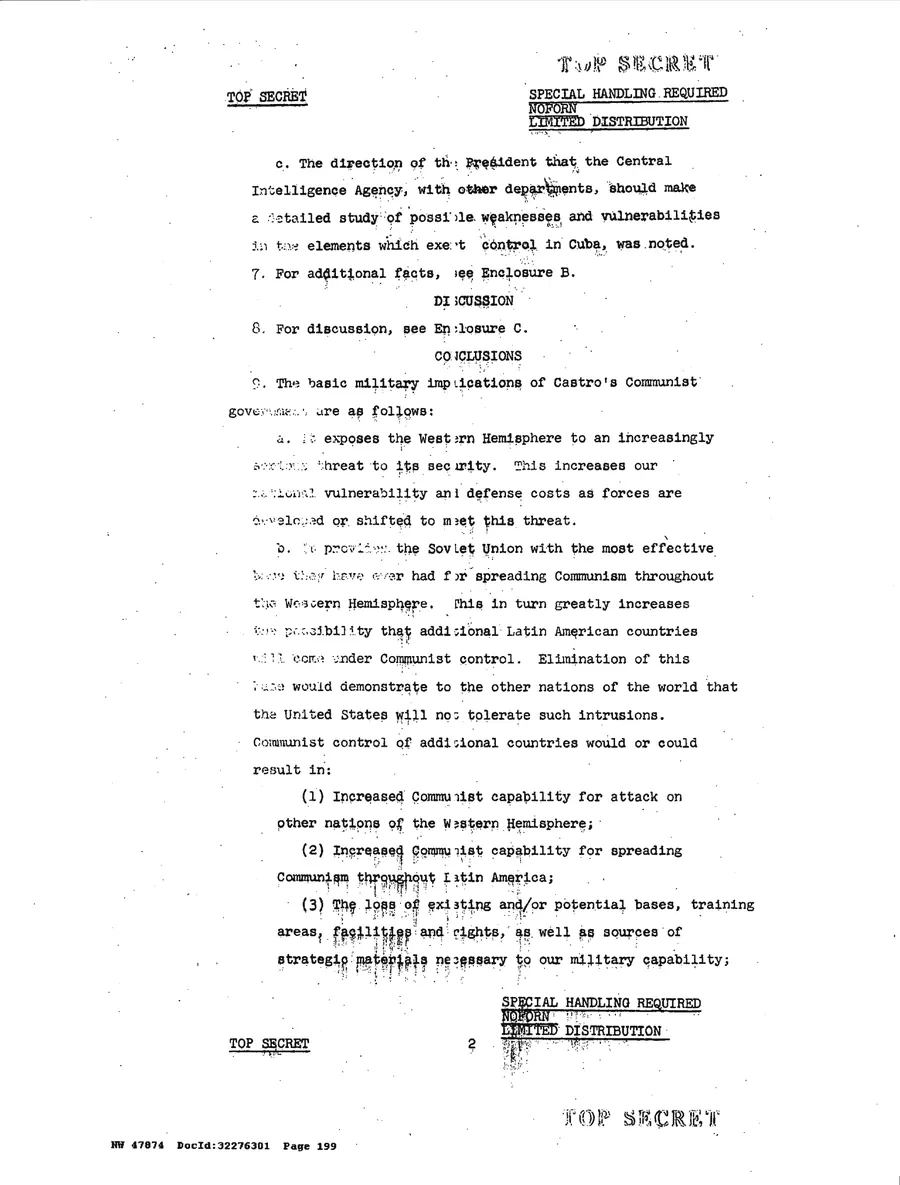
c. The direction of the President that the Central Intelligence Agency, with other departments, should make a detailed study of possible weaknesses and vulnerabilities in the elements which exert control in Cuba, was noted.
7. For additional facts, see Enclosure B.
DISCUSSION
8. For discussion, see Enclosure C.
CONCLUSIONS
9. The basic military implications of Castro's Communist government are as follows:
a. It exposes the Western Hemisphere to an increasingly serious threat to its security. This increases our national vulnerability and defense costs as forces are developed or shifted to meet this threat.
b. It provides the Soviet Union with the most effective base they have ever had for spreading Communism throughout the Western Hemisphere. This in turn greatly increases the possibility that additional Latin American countries will come under Communist control. Elimination of this base would demonstrate to the other nations of the world that the United States will not tolerate such intrusions. Communist control of additional countries would or could result in:
(1) Increased Communist capability for attack on other nations of the Western Hemisphere;
(2) Increased Communist capability for spreading Communism throughout Latin America;
(3) The loss of existing and/or potential bases, training areas, facilities and rights, as well as sources of strategic materials necessary to our military capability;
TOP SECRET
Textual notes on this leaf (6)
- vertical ink stain, lower right quadrant
- A band of heavy vertical streaking, about 55 pt wide, runs from the '(2)' paragraph down through the foot classification block, printing as a curtain of dark drips. It is a mimeograph or photocopy fault, not writing: it carries no letterforms at 700 dpi and it crosses the type without displacing it. It does not obscure any reading - every character under it is legible - but it is conspicuous in facsimile and should not be mistaken for a redaction or for manuscript.
- the left third of the leaf
- The mimeograph washout described on PDF 198 continues on this leaf: the openings of most lines print as ghosts. All of them were re-read from 800-dpi crops. The worst are 'serious threat' in paragraph a, where 'serious' survives only as the tops of its letters, and 'national' in the next line, and 'It provides' and 'base they have ever had' in paragraph b. Each is legible in outline at 800 dpi and each is confirmed word for word by the parallel passage in Appendix 1 to Enclosure A (PDF 203), which repeats this conclusion almost verbatim. Transcribed from the page; the parallel is corroboration, not the source.
- For additional facts, see Enclosure B. / For discussion, see Enclosure C.
- These two sentences and paragraph 13 a ('the memorandum at Enclosure A hereto') are the paper's only statement of its own enclosure structure. There is no References list, no table of contents and no enclosure list on either the Decision sheet (PDF 195) or the Note by the Secretaries (PDF 196). The paper therefore declares exactly three enclosures - A, B and C - and nothing more. Recorded here because the edition needs it for the completeness ruling.
- Castro's Communist government
- 'government' is set here and 'regime' at the parallel place in Appendix 1 (PDF 203 paragraph 2), while paragraph 11 on PDF 200 has 'the Communist regime in Cuba' and PDF 198 paragraph 4 has 'the Castro government'. The document uses both words throughout, apparently interchangeably. PRESERVED in each place as it stands.
- in the elements which exert control in Cuba, was noted
- Reads 'was noted' as the main verb of a sentence whose subject is 'The direction of the President' - the item records that the President's direction was noted, not that anything was decided. Elliptical drafting carried from paragraph 6's 'Other significant elements of policy determined at that meeting were:'. PRESERVED.
- and/or
- Set with a solidus and no spaces, as typed, in '(3) The loss of existing and/or potential bases'. Clean type. Recurs on PDF 200 ('land, sea and/or air bases').
Printed page 3
Leaf 42 of 65 · source page 200
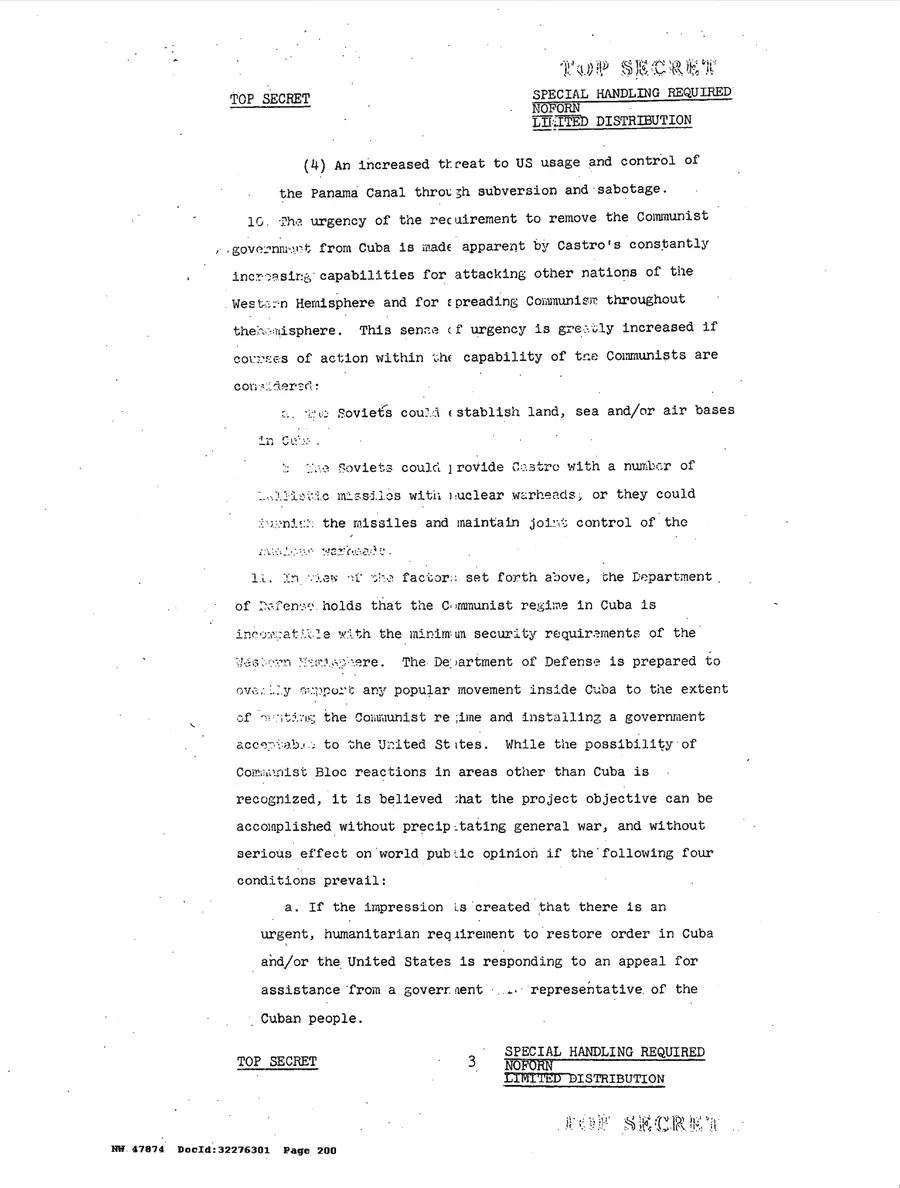
(4) An increased threat to US usage and control of the Panama Canal through subversion and sabotage.
10. The urgency of the requirement to remove the Communist government from Cuba is made apparent by Castro's constantly increasing capabilities for attacking other nations of the Western Hemisphere and for spreading Communism throughout thehemisphere. This sense of urgency is greatly increased if courses of action within the capability of the Communists are considered:
a. The Soviets could establish land, sea and/or air bases in Cuba.
b. The Soviets could provide Castro with a number of ballistic missiles with nuclear warheads; or they could furnish the missiles and maintain joint control of the nuclear warheads.
11. In view of the factors set forth above, the Department of Defense holds that the Communist regime in Cuba is incompatible with the minimum security requirements of the Western Hemisphere. The Department of Defense is prepared to overtly support any popular movement inside Cuba to the extent of ousting the Communist regime and installing a government acceptable to the United States. While the possibility of Communist Bloc reactions in areas other than Cuba is recognized, it is believed that the project objective can be accomplished without precipitating general war, and without serious effect on world public opinion if the following four conditions prevail:
a. If the impression is created that there is an urgent, humanitarian requirement to restore order in Cuba and/or the United States is responding to an appeal for assistance from a government representative of the Cuban people.
TOP SECRET
Textual notes on this leaf (8)
- throughout thehemisphere.
- 'the' and 'hemisphere' are typed with no space between them: 'thehemisphere'. Verified at 1500 dpi - the h of 'hemisphere' begins in the cell immediately after the e of 'the', and the two words share one unbroken run of type. (The h, e and m print faintly, being in the washout, but they print.) Note also that the sentence has already said 'the Western Hemisphere' eight words earlier, with a capital H, so the paper says 'Western Hemisphere ... the hemisphere' in one breath. The document's own error. PRESERVED; worth an annotation.
- assistance from a government representative of the Cuban people
- An anomalous gap of about five and a half character cells (32.9 pt of white between the last glyph of 'government' and the first glyph of 'representative', where a single space on this line measures 5 to 7 pt) sits mid-sentence. Inside the gap there are four or five small specks lying on and just below the baseline, at the size and spacing of the feet of erased characters, but nothing resolves into a letter at 1500 dpi. A word was probably typed and rubbed out. Transcribed as five spaces; the count is from the measurement, not from the sense. PRESERVED as spacing; worth an annotation. Compare the same fault at PDF 170, 'the flight plan route'.
- nuclear warheads; or they could furnish
- A semicolon before 'or', verified at 1500 dpi: an upper dot at x-height and a lower comma-tail descending below the baseline, both centred in one cell. Not a comma and not a colon. PRESERVED.
- are considered:
- A colon, not a semicolon: verified at 1500 dpi, two round dots one above the other, the lower resting on the baseline, neither carrying a tail. Stands as transcribed.
- prepared to overtly support any popular movement
- 'overtly' and 'support' are both in the washout and print as ghosts. Each was settled by measuring its ink span against the line's character pitch: both occupy exactly seven character cells (36.7 pt and 37.2 pt at a 5.56 pt pitch), which fits 'overtly' and 'support' and excludes the shorter alternatives. The surviving letter tops agree. Note the split infinitive is the document's own. Stands as transcribed.
- to the extent of ousting the Communist regime
- 'ousting' is a ghost - only the s, the t and the top of the g print at 200 dpi. Measured at 1200 dpi it occupies seven character cells (38.2 pt at a 5.56 pt pitch), which fits 'ousting' and excludes 'unseating' (9) and 'toppling' (8); the surviving letterforms are consistent. Stands as transcribed.
- the Communist government from Cuba / the Communist regime in Cuba
- Paragraph 10 says 'government' and paragraph 11 says 'regime' of the same thing, on the same leaf. The document's own variation, as on PDF 199. PRESERVED in each place.
- the left third of the leaf
- The mimeograph washout continues on this leaf, worst in paragraphs 10 b and 11: 'ballistic missiles with nuclear', 'furnish', 'nuclear warheads.', 'In view of the factors', 'of Defense', 'incompatible with', 'Western Hemisphere', 'overtly support', 'of ousting', 'acceptable', 'Communist Bloc'. Every one was re-read from 800-dpi crops of the left column and, where shape alone did not settle it, from a character-pitch measurement of the word's ink span. None is transcribed from sense alone.
Printed page 4
Leaf 43 of 65 · source page 201
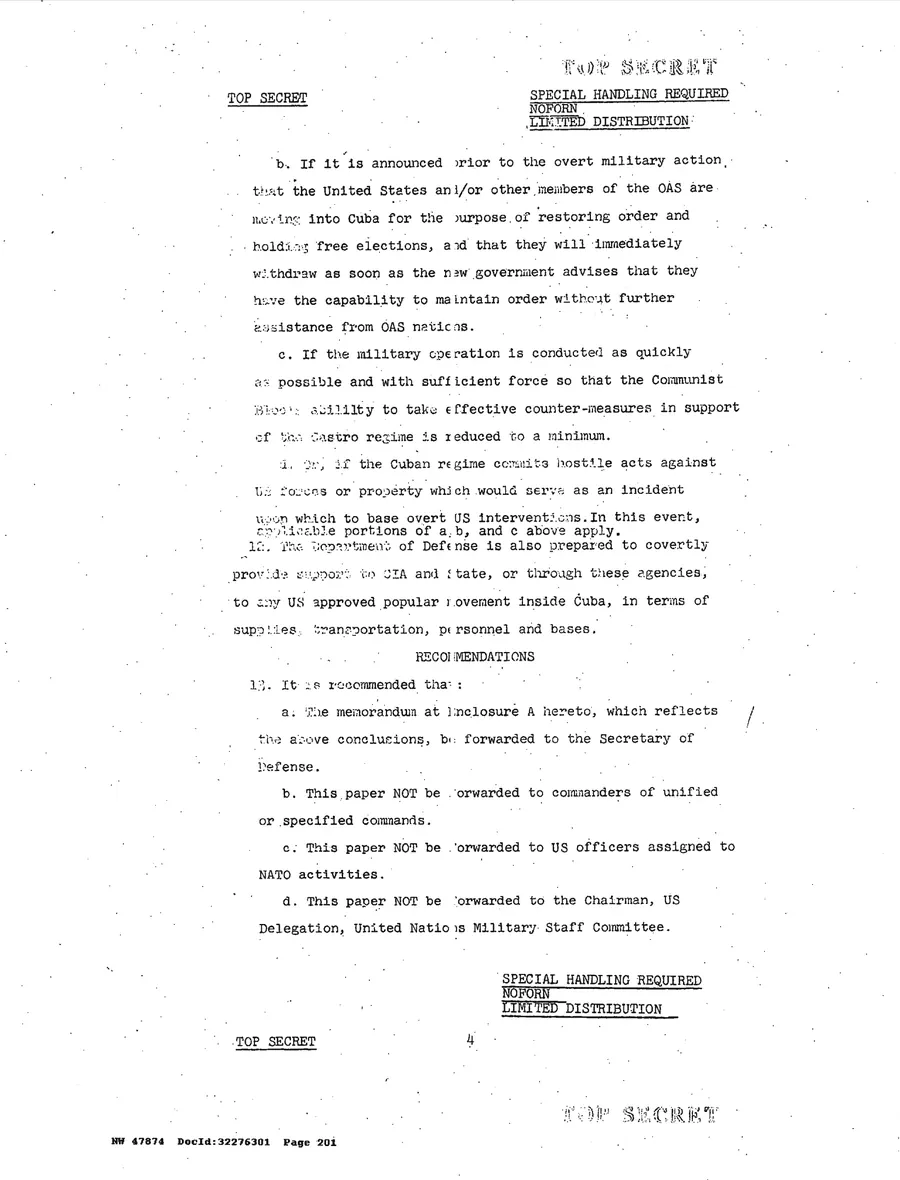
b. If it is announced prior to the overt military action that the United States and/or other members of the OAS are moving into Cuba for the purpose of restoring order and holding free elections, and that they will immediately withdraw as soon as the new government advises that they have the capability to maintain order without further assistance from OAS nations.
c. If the military operation is conducted as quickly as possible and with sufficient force so that the Communist Bloc's abililty to take effective counter-measures in support of the Castro regime is reduced to a minimum.
d. Or, if the Cuban regime commits hostile acts against US forces or property which would serve as an incident upon which to base overt US interventions.In this event, applicable portions of a,b, and c above apply.
12. The Department of Defense is also prepared to covertly provide support to CIA and State, or through these agencies, to any US approved popular movement inside Cuba, in terms of supplies, transportation, personnel and bases.
RECOMMENDATIONS
13. It is recommended that:
a. The memorandum at Enclosure A hereto, which reflects the above conclusions, be forwarded to the Secretary of Defense.
b. This paper NOT be forwarded to commanders of unified or specified commands.
c. This paper NOT be forwarded to US officers assigned to NATO activities.
d. This paper NOT be forwarded to the Chairman, US Delegation, United Nations Military Staff Committee.
TOP SECRET
Textual notes on this leaf (9)
- the Communist Bloc's abililty to take effective counter-measures
- Reads 'abililty' - a-b-i-l-i-l-t-y, with an extra l. The word is in the washout, so it was settled by measurement rather than by shape: at 600 dpi its ink spans 42.5 pt, and on the same line 'to' spans 9.6 pt and 'counter-measures' 87.4 pt, which fixes the character pitch at 5.56 pt. Eight characters predict 42.9 pt and seven ('ability') predict 37.4 pt; the measured 42.5 pt is eight, and the difference is nine times the measurement's uncertainty. The surviving letter tops show two dotted i's with a full-height stroke after each. The document's own typing error. PRESERVED; worth an annotation - an OCR pass or a hasty editor would silently normalise it.
- overt US interventions.In this event, applicable portions of a,b, and c above apply.
- Two faults preserved in one sentence, both verified at 1500-3000 dpi. FIRST: no space after the full stop - 'interventions.In this event' - the I of 'In' begins in the character cell immediately after the stop. SECOND: no space after the first comma of the series - 'of a,b, and c' - the comma occupies the cell between the a and the b with no blank cell after it, while the comma after the b is followed by a normal space. The mark after the a is a lightly struck comma, not a full stop: it descends 24 px below the baseline at 1200 dpi, exactly as the comma after the b does, where this machine's period sits on the baseline and does not descend. BOTH PRESERVED.
- the tighter leading of the last two lines of 13 d and of paragraph 12
- The line 'applicable portions of a,b, and c above apply.' and the whole of paragraph 12 are typed at roughly half the leading of the rest of the leaf, crowded up under the line above and running slightly left of the paragraph indent. This is the physical trace of retyping in a fixed space: matter was fitted in after the leaf was set. The Decision sheet at PDF 195 and the Note at PDF 196 both record that the Chiefs approved paragraph 13 'as amended by changes in the second paragraph of Enclosure A'. Recorded as an editorial observation, not as body text.
- Or, if the Cuban regime commits hostile acts
- Recommendation-style item d opens with 'Or,' - a sentence-initial conjunction with a comma after it, breaking the parallel of a, b and c, each of which opens 'If'. The 'Or,' is in the washout and reads as a ghost; at 1400 dpi the two characters and the following comma are legible, the O as a full oval and the r as a stem with a shoulder. PRESERVED; worth an annotation, since it changes what the four conditions are - d is an alternative to a, b and c, not a fourth requirement alongside them.
- This paper NOT be forwarded (b, c, d)
- All three restrictive recommendations read 'This paper NOT be forwarded' without 'should' - the same elliptical drafting, and the same capitalised NOT in ordinary type without underlining, as JCS 1969/321 at PDF 163. The two papers were drafted a month apart on the same form of words. PRESERVED.
- counter-measures
- Hyphenated by the document, mid-line, not at a line break. Kept as the document's own hyphen.
- in terms of supplies, transportation, personnel and bases.
- The mark after 'supplies' is in the washout and prints faintly; at 1500 dpi it rests on the baseline with a short tail below it, which is this machine's comma and not its period. Reads 'supplies,'. Stands as transcribed.
- manuscript diagonal stroke in the right margin
- A single firm ink stroke, about 12 pt long and leaning to the right, sits in the right margin exactly level with recommendation 13 a - the recommendation that Enclosure A be forwarded to the Secretary of Defense, and the one the Chiefs amended. A reader's mark. Recorded in stamps, not transcribed.
- the left third of the leaf
- The mimeograph washout continues: 'that the United States', 'moving into Cuba', 'holding free elections', 'withdraw', 'have the capability', 'assistance from OAS nations', 'as possible', 'Bloc's abililty', 'of the Castro regime', 'Or,', 'US forces', 'upon which', 'applicable portions', '12. The Department', 'provide support to CIA and State', 'to any US approved', 'supplies, transportation', '13. It is recommended that:', 'The memorandum at Enclosure A', 'the above conclusions', 'Defense.' All re-read from 800-dpi crops of the left column; the two readings that shape alone could not settle ('abililty' and the comma in 'a,b,') were settled by measurement and are flagged separately above.
Unnumbered leaf
Leaf 44 of 65 · source page 202
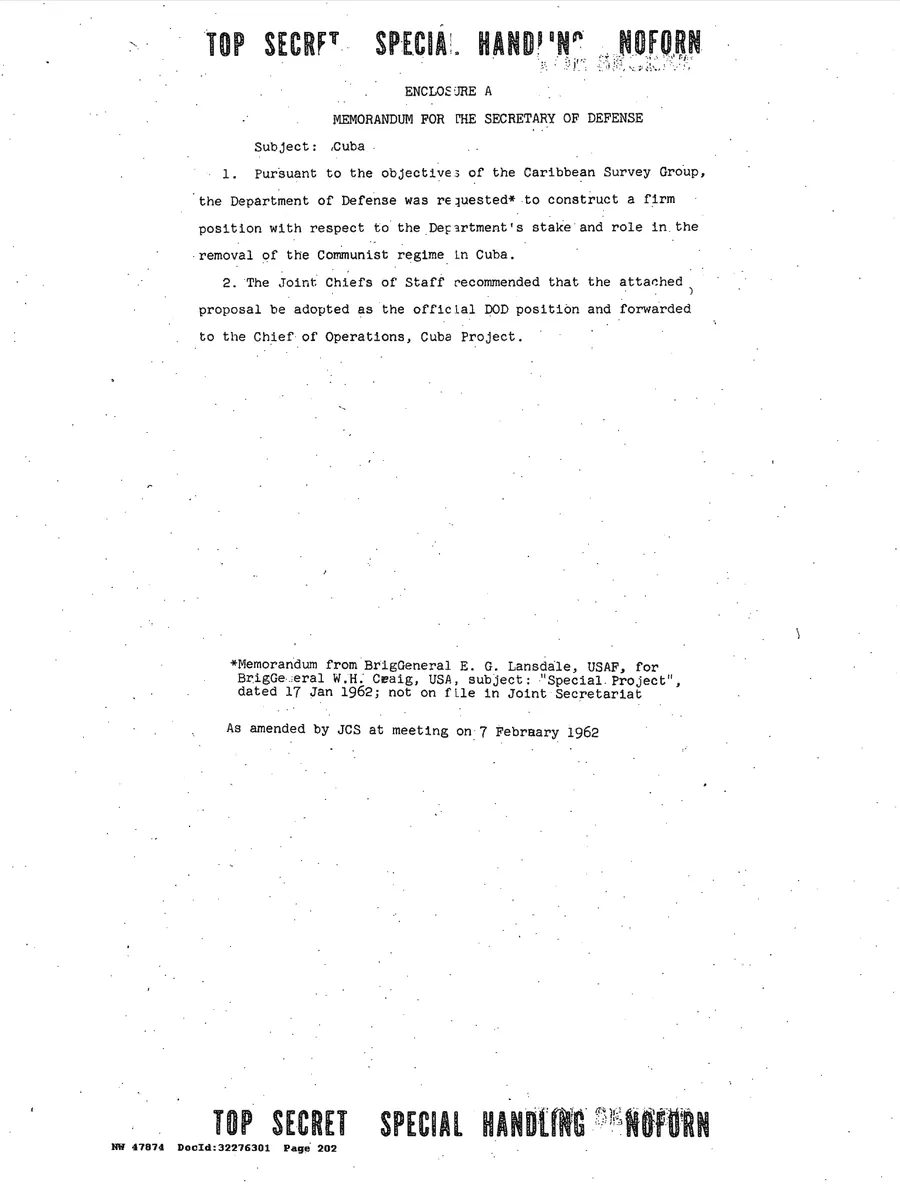
ENCLOSURE A
1. Pursuant to the objectives of the Caribbean Survey Group, the Department of Defense was requested* to construct a firm position with respect to the Department's stake and role in the removal of the Communist regime in Cuba.
2. The Joint Chiefs of Staff recommended that the attached proposal be adopted as the official DOD position and forwarded to the Chief of Operations, Cuba Project.
*Memorandum from BrigGeneral E. G. Lansdale, USAF, for BrigGeneral W.H. Craig, USA, subject: "Special Project", dated 17 Jan 1962; not on file in Joint Secretariat
As amended by JCS at meeting on 7 Febraary 1962
Textual notes on this leaf (7)
- As amended by JCS at meeting on 7 Febraary 1962
- Reads 'Febraary' - F-e-b-r-a-a-r-y - in clean, unambiguous type at 1200 dpi: the fifth character is a full a with a closed bowl and a right stem, not a u. The document's own error. PRESERVED; worth an annotation. The line itself is the evidence that this leaf is the amended Enclosure A, not the version circulated before the meeting of 7 February 1962.
- *Memorandum from BrigGeneral E. G. Lansdale, USAF, for BrigGeneral W.H. Craig, USA
- Three preserved settings, all against the practice of the same citation on PDF 198. 'BrigGeneral' is set as ONE word, twice, with no space and no full stop - a compression of 'Brig' and 'General' that appears nowhere else in the paper (PDF 198 spells 'Brigadier General'; PDF 203 has 'BrigGen'). 'W.H.' is set without a space between the initials where PDF 198 has 'W. H.'. And this version punctuates 'subject: "Special Project", dated 17 Jan 1962; not on file' where PDF 198 has 'subject: "Special Project" dated 17 Jan 1962, not on file'. ALL PRESERVED; they matter for citation.
- Craig (footnote)
- The r of 'Craig' is double-struck or over-inked, its bowl filled and its shoulder run into the a, giving a 'Ceaig' appearance at 200 dpi. Re-read at 900 dpi: the glyph carries an r's single stem and shoulder with the ink of a second, slightly offset strike over it, and the surname reads Craig, as it does cleanly on PDF 198, 201 and 203. Stands as transcribed.
- Subject: Cuba
- The subject of the memorandum for the Secretary of Defense is the single word 'Cuba' - not 'Cuba Project' as on Appendix 1 (PDF 203), and not the long subject line 'Justification for US Military Intervention in Cuba (TS)' that the equivalent enclosure of JCS 1969/321 carries (PDF 164). Double space after the colon, as set. A small ink speck sits immediately before the C of Cuba; it is not a character and is not transcribed.
- the leaf carries no typed classification blocks
- Unlike PDF 198-201 and PDF 203, this leaf carries NO typed 'TOP SECRET' head or foot block and NO typed 'SPECIAL HANDLING REQUIRED / NOFORN / LIMITED DISTRIBUTION' block. Its only classification is the large single-line stencil struck across the head and the foot. Recorded because it marks Enclosure A as a separately typed sheet, prepared apart from the report body.
- manuscript marks in the right margin
- Two small ink strokes shaped like closing parentheses sit in the right margin, one level with 'the attached' at the end of the first line of paragraph 2 and one about two-thirds of the way down the blank lower half of the leaf. Neither touches the type; neither is a character. Reader's marks, recorded here and not transcribed.
- the lower half of the leaf is blank
- The two paragraphs end about a quarter of the way down; below them the sheet is empty apart from the footnote, the amendment note and the foot stencil. The facsimile reproduces the whole leaf.
Unnumbered leaf
Leaf 45 of 65 · source page 203
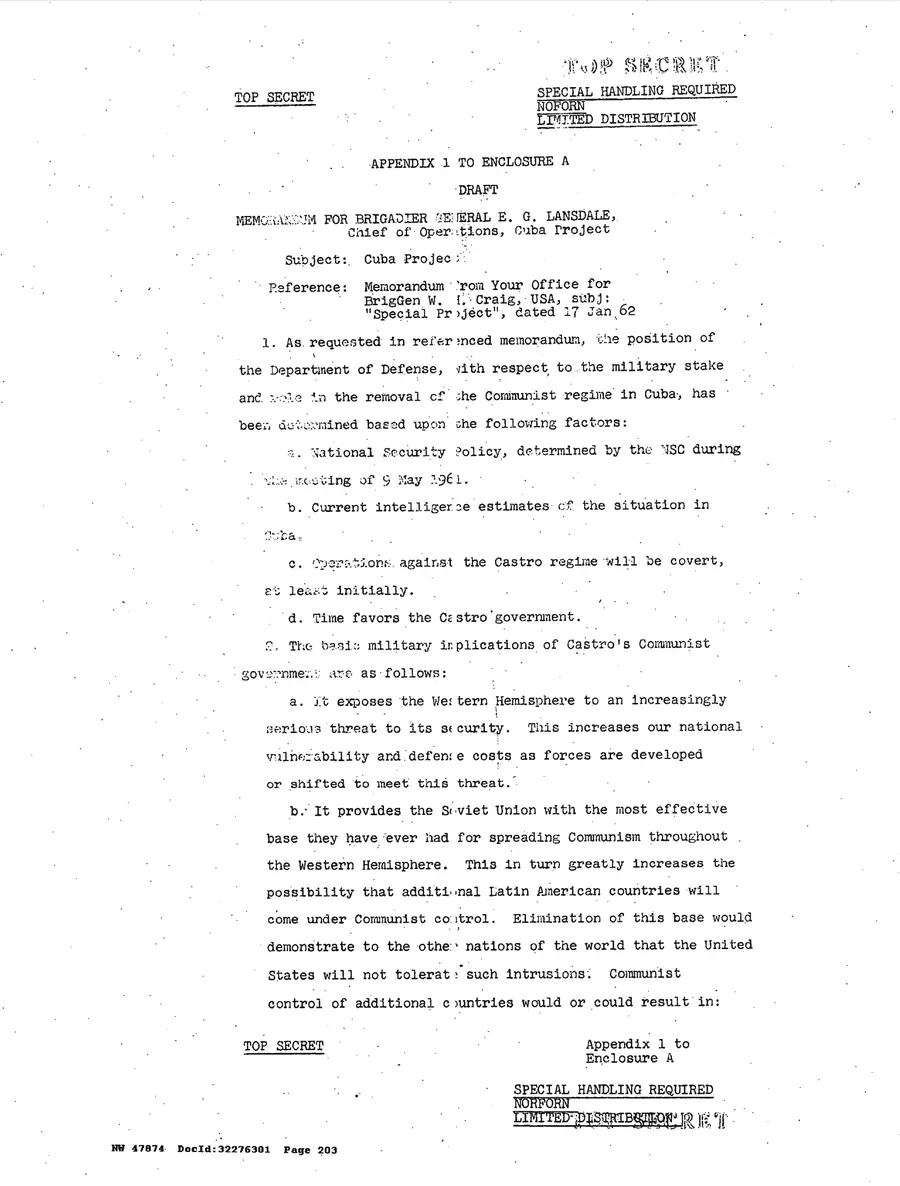
APPENDIX 1 TO ENCLOSURE A
DRAFT
Reference: Memorandum from Your Office for BrigGen W. H. Craig, USA, subj: "Special Project", dated 17 Jan 62
1. As requested in referenced memorandum, the position of the Department of Defense, with respect to the military stake and role in the removal of the Communist regime in Cuba, has been determined based upon the following factors:
a. National Security Policy, determined by the NSC during the meeting of 9 May 1961.
b. Current intelligence estimates of the situation in Cuba.
c. Operations against the Castro regime will be covert, at least initially.
d. Time favors the Castro government.
2. The basic military implications of Castro's Communist government are as follows:
a. It exposes the Western Hemisphere to an increasingly serious threat to its security. This increases our national vulnerability and defense costs as forces are developed or shifted to meet this threat.
b. It provides the Soviet Union with the most effective base they have ever had for spreading Communism throughout the Western Hemisphere. This in turn greatly increases the possibility that additional Latin American countries will come under Communist control. Elimination of this base would demonstrate to the other nations of the world that the United States will not tolerate such intrusions. Communist control of additional countries would or could result in:
Appendix 1 to Enclosure A
TOP SECRET
Textual notes on this leaf (8)
- NORFORN (foot classification block)
- The foot classification block's second line reads NORFORN - N-O-R-F-O-R-N, seven characters - where the head block on the same leaf reads NOFORN. Verified at 900 dpi: an R with a full bowl and splayed leg stands between the O and the F, and the word occupies one character cell more than the head block's NOFORN. A different misspelling from the NORORN of PDF 198's foot block; the two foot blocks were typed independently and each went wrong its own way. PRESERVED; worth an annotation.
- the meeting of 9 May 1961
- Appendix 1 dates the National Security Policy decision 9 May 1961, agreeing with paragraph 2 of the report body (PDF 198) and disagreeing with paragraph 6 of the same body, which has 5 May 1961. Verified at 1500 dpi: the digit has a closed bowl at x-height with a straight stem descending to the baseline on its right, which is this machine's 9; its 5 has a flat top bar and an open lower bowl. So within one paper the same meeting is 9 May twice and 5 May once. PRESERVED; the edition should not harmonise them.
- Reference: Memorandum from Your Office for
- The R of 'Reference' prints with its bowl unclosed and its leg thin, giving a 'Peference' appearance at 200 dpi. Re-read at 1500 dpi: the stroke that closes the bowl is present but starved of ink, and the leg springs from the bowl's foot as an R's does and not from the stem as a P has none. Reads 'Reference:'. Stands as transcribed.
- BrigGen W. H. Craig, USA, subj:
- A third form of the same citation: 'BrigGen' here, 'BrigGeneral' on PDF 202, 'Brigadier General' on PDF 198; 'subj:' here where both the others have 'subject:'; 'dated 17 Jan 62' here with a two-digit year where both the others have '17 Jan 1962'; and the reference is described as 'Memorandum from Your Office' rather than by Lansdale's name. Four settings of one citation across three leaves of one paper. ALL PRESERVED.
- Subject: Cuba Project
- The final t of 'Project' is a weak strike whose crossbar prints and whose stem is thin, with a small speck to its right. Read as 'Project' - the word the same line uses cleanly in the addressee block two lines above. Note the subject differs from Enclosure A's, which is the single word 'Cuba' (PDF 202). Double space after the colon, as set.
- Operations against the Castro regime will be covert, at least initially.
- The corresponding assumption in the report body (PDF 198, paragraph 4) reads 'Operations against the Castro government will be covert in the initial stages.' - 'government' for 'regime', no comma, and a different ending. The draft memorandum restates the report's assumptions rather than quoting them. PRESERVED; the two wordings are the document's own.
- the left third of the leaf
- The mimeograph washout thins on this leaf but does not stop: 'and role in', 'been determined', 'the meeting of 9 May 1961', 'Cuba.' (after 1 b), 'Operations', 'at least', '2. The basic', 'government are as follows', 'serious threat', 'vulnerability and defense' all print as ghosts. Re-read from 800- and 1500-dpi crops of the left column. The remainder of the leaf, from the middle of paragraph 2 b down, prints clean and dark - the strongest impression of the four report leaves.
- the text breaks off at 'would or could result in:'
- The leaf ends mid-structure: paragraph 2 b introduces an enumeration that does not begin until the next leaf. This is a normal page turn, not a defect - PDF 204 continues the paper - but it is recorded so that no one reading this batch alone takes Appendix 1 to end here.
Printed page 2
Leaf 46 of 65 · source page 204
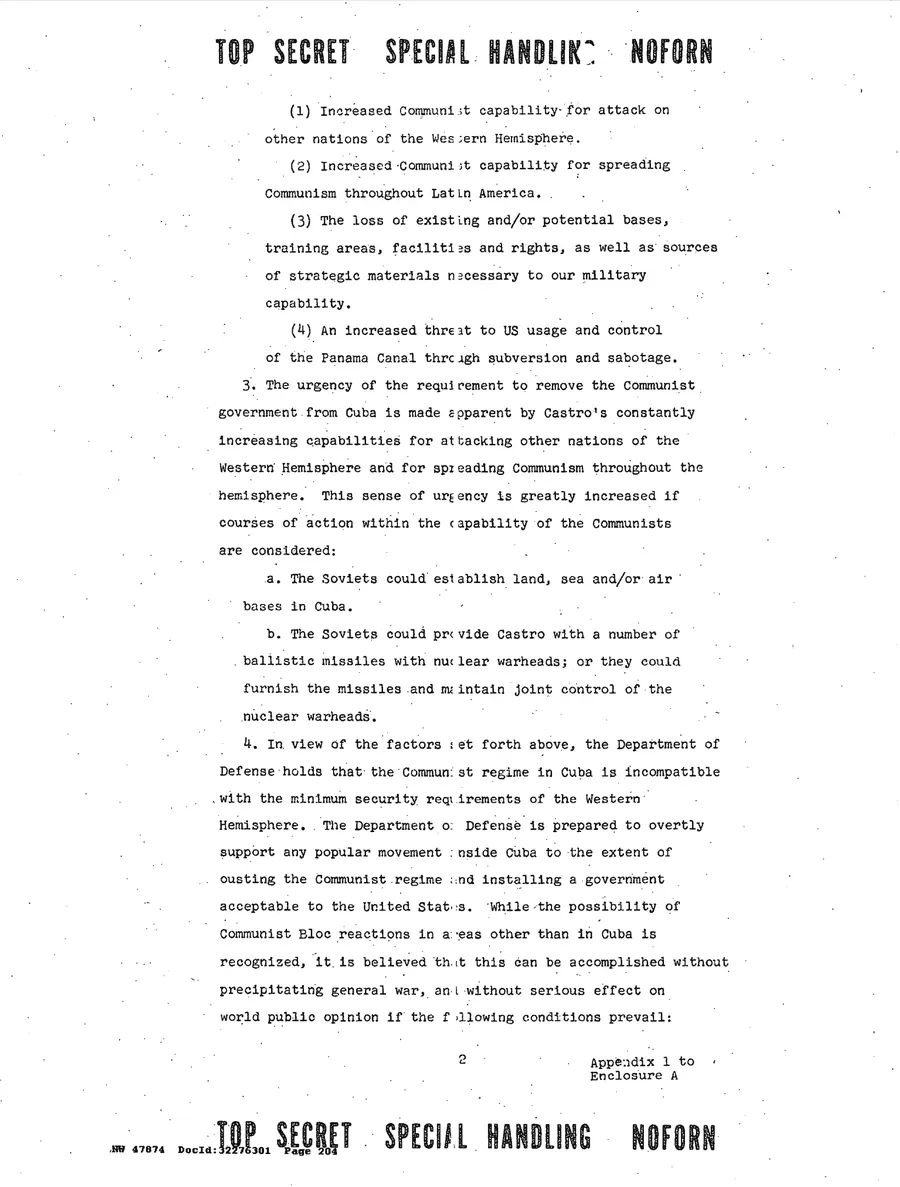
(1) Increased Communist capability for attack on other nations of the Western Hemisphere.
(2) Increased Communist capability for spreading Communism throughout Latin America.
(3) The loss of existing and/or potential bases, training areas, facilities and rights, as well as sources of strategic materials necessary to our military capability.
(4) An increased threat to US usage and control of the Panama Canal through subversion and sabotage.
3. The urgency of the requirement to remove the Communist government from Cuba is made apparent by Castro's constantly increasing capabilities for attacking other nations of the Western Hemisphere and for spreading Communism throughout the hemisphere. This sense of urgency is greatly increased if courses of action within the capability of the Communists are considered:
a. The Soviets could establish land, sea and/or air bases in Cuba.
b. The Soviets could provide Castro with a number of ballistic missiles with nuclear warheads; or they could furnish the missiles and maintain joint control of the nuclear warheads.
4. In view of the factors set forth above, the Department of Defense holds that the Communist regime in Cuba is incompatible with the minimum security requirements of the Western Hemisphere. The Department of Defense is prepared to overtly support any popular movement inside Cuba to the extent of ousting the Communist regime and installing a government acceptable to the United States. While the possibility of Communist Bloc reactions in areas other than in Cuba is recognized, it is believed that this can be accomplished without precipitating general war, and without serious effect on world public opinion if the following conditions prevail:
Appendix 1 to Enclosure A
Textual notes on this leaf (5)
- TOP SECRET SPECIAL HANDLING NOFORN (head and foot, stencil)
- PHYSICAL ANOMALY OF THE FILE COPY - disclose. This leaf carries the stencil classification stamps and NOTHING ELSE. Every other leaf of JCS 1969/303 in this range (PDF 203, 205-212) carries, in addition, a TYPED classification block: 'TOP SECRET' underlined at the head left, and 'SPECIAL HANDLING REQUIRED / NOFORN / LIMITED DISTRIBUTION' underlined line by line at the head right, with the same pair repeated at the foot. PDF 204 has none of that typed apparatus at either head or foot; the head is the stencil alone across the full measure, and the foot is the stencil, the folio and the enclosure label. Verified at 400 dpi across the full width of both zones, so it is not a crop or a failure of the scan. The setting is that of the JCS 1969/321 leaves (PDF 161-172), not of its own neighbours. The text runs on correctly from PDF 203 and into PDF 205, so nothing is missing; the leaf is simply set differently. Recorded as the leaf shows it. This is the only real disclosure the edition owes on this paper - it is a leaf anomaly, NOT a gap in the record.
- sources of strategic materials necessary to our military capability
- Reads 'materials'. The same sub-paragraph in Enclosure C (PDF 211, paragraph 7 a (3)) reads 'materiels'. Both readings verified in clean type at 460 dpi. The two settings of the same list differ; each is transcribed as it appears. PRESERVED; the pair matters for collation.
- nuclear warheads; or they could furnish the missiles
- A semicolon before 'or'. The same sub-paragraph in Enclosure C (PDF 211, paragraph 7 b) prints a comma in that position. PRESERVED; the difference matters for collation.
- Communist Bloc reactions in areas other than in Cuba
- Reads 'in areas other than in Cuba', with the preposition repeated. The document's own construction, in clean type; it recurs verbatim in Enclosure C (PDF 211). PRESERVED.
- The Department of Defense is prepared to overtly support
- A split infinitive of the document's own ('to overtly support'), matched by 'to covertly provide support' in paragraph 5 on PDF 205 and paragraph 10 on PDF 212. PRESERVED, noted once here and not re-flagged.
Printed page 3
Leaf 47 of 65 · source page 205
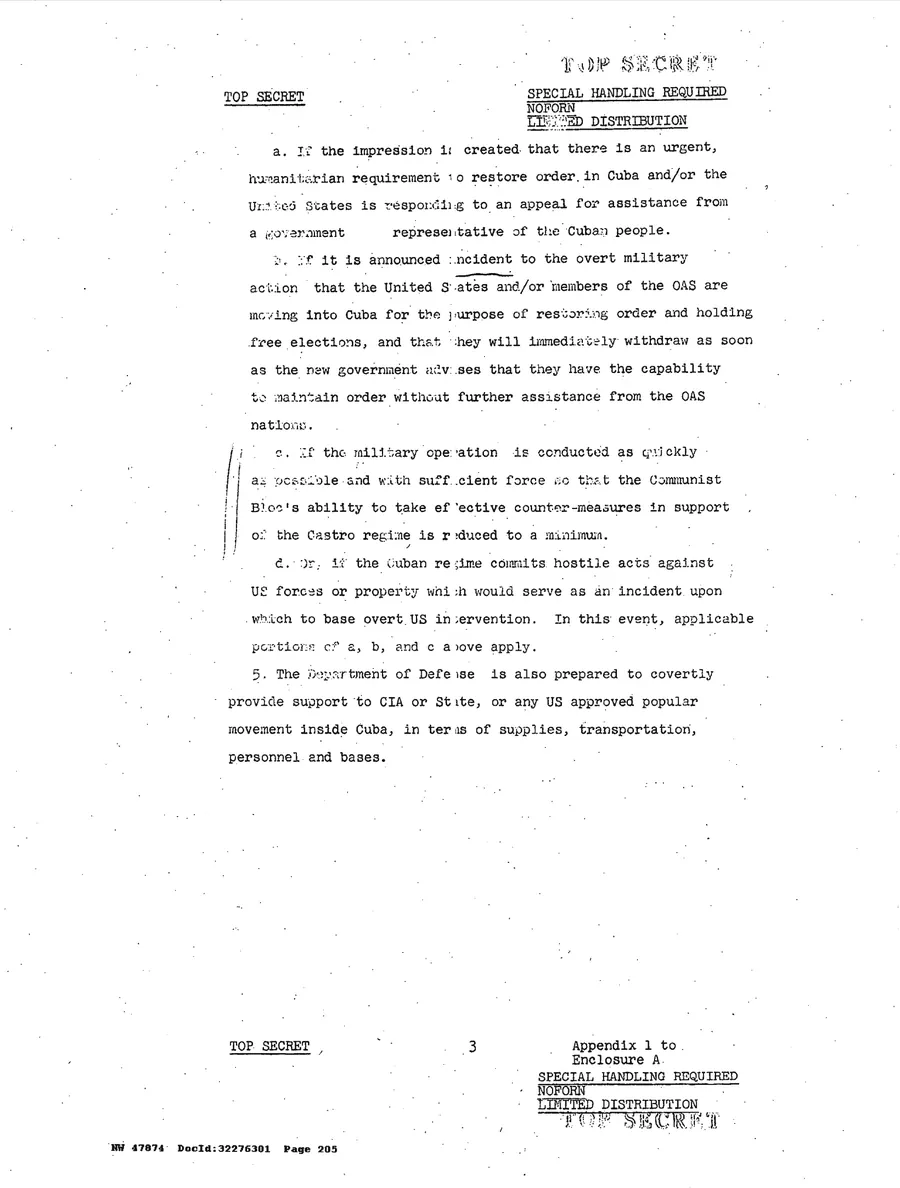
a. If the impression is created that there is an urgent, humanitarian requirement to restore order in Cuba and/or the United States is responding to an appeal for assistance from a government representative of the Cuban people.
b. If it is announced incident to the overt military action that the United States and/or members of the OAS are moving into Cuba for the purpose of restoring order and holding free elections, and that they will immediately withdraw as soon as the new government advises that they have the capability to maintain order without further assistance from the OAS nations.
c. If the military operation is conducted as quickly as possible and with sufficient force so that the Communist Bloc's ability to take effective counter-measures in support of the Castro regime is reduced to a minimum.
d. Or, if the Cuban regime commits hostile acts against US forces or property which would serve as an incident upon which to base overt US intervention. In this event, applicable portions of a, b, and c above apply.
5. The Department of Defense is also prepared to covertly provide support to CIA or State, or any US approved popular movement inside Cuba, in terms of supplies, transportation, personnel and bases.
Appendix 1 to Enclosure A
Textual notes on this leaf (9)
- from a government representative of the Cuban people
- SIX blank character cells between 'government' and 'representative', measured, not estimated. At 600 dpi the ink-column starts of the line fit a character grid of pitch 44.9 px with a residual under 0.02 cell over 24 glyph positions: 'government' occupies cells 0-9 and the r of 'representative' starts at cell 16, leaving cells 10-15 empty. Nothing is printed in the gap and there is no erasure shadow. The parallel sentence in Enclosure C (PDF 212, paragraph 9 a) sets the same words with an ordinary single space, so a word may have been dropped or lifted in this setting. PRESERVED as six spaces; worth an annotation.
- If it is announced incident to the overt military action
- A manuscript ink underline - a single wavy stroke, not a typed rule - runs under 'incident' and a little way under the following 'to'. It sits on its own baseline below the line of type and is in the same ink as the marginal strokes beside paragraph c. A reader's emphasis mark, not part of the typescript. Recorded here, not transcribed. The word underlined, 'incident', is the reading that differs from the body of the paper.
- the overt military action that the United States
- Anomalous double space after 'action', mid-sentence. Verified at 1100 dpi: the gap is visibly twice the width of every other word space on the same line ('that the', 'the United'). PRESERVED as spacing. The same sentence on PDF 212 sets a single space here.
- If the military operation is conducted
- Anomalous double space after 'operation', mid-sentence, verified at 1100 dpi against the neighbouring word spaces on the same line. PRESERVED as spacing. The same sentence on PDF 212 sets a single space here.
- The Department of Defense is also prepared
- Anomalous double space after 'Defense', mid-sentence, verified at 1100 dpi against 'of Defense' on the same line. PRESERVED as spacing. The parallel paragraph 10 on PDF 212 sets a single space here.
- marginal ink strokes beside paragraph c
- Two long curved ink strokes, drawn freehand as a double vertical rule, run down the left margin from the head of paragraph c to its last line. A reader's marginal emphasis, in the same ink as the underline beneath 'incident'. Recorded here, not transcribed.
- and/or members of the OAS / assistance from the OAS nations
- Collation note, not a doubt. This paragraph b differs from its counterpart in Enclosure C (PDF 212, paragraph 9 b) at two points: PDF 205 reads 'and/or members of the OAS' where PDF 212 reads 'and/or other members of the OAS', and PDF 205 reads 'from the OAS nations' where PDF 212 reads 'from OAS nations'. Both leaves verified at 460 dpi. Each transcribed as it appears.
- provide support to CIA or State, or any US approved popular movement
- Collation note. This paragraph 5 reads 'to CIA or State, or any US approved popular movement'; the counterpart paragraph 10 in Enclosure C (PDF 212) reads 'to CIA, or through these agencies, to any US approved popular movement' - naming one agency but then saying 'these agencies'. Both verified in clean type at 460 dpi and both transcribed as they appear; the PDF 212 form is the defective one and is flagged there.
- commits hostile acts against US forces
- Single space between 'hostile' and 'acts' on this leaf, verified at 1100 dpi. The counterpart on PDF 212 sets a double space there. Recorded so the two are not silently harmonised.
Unnumbered leaf
Leaf 48 of 65 · source page 206
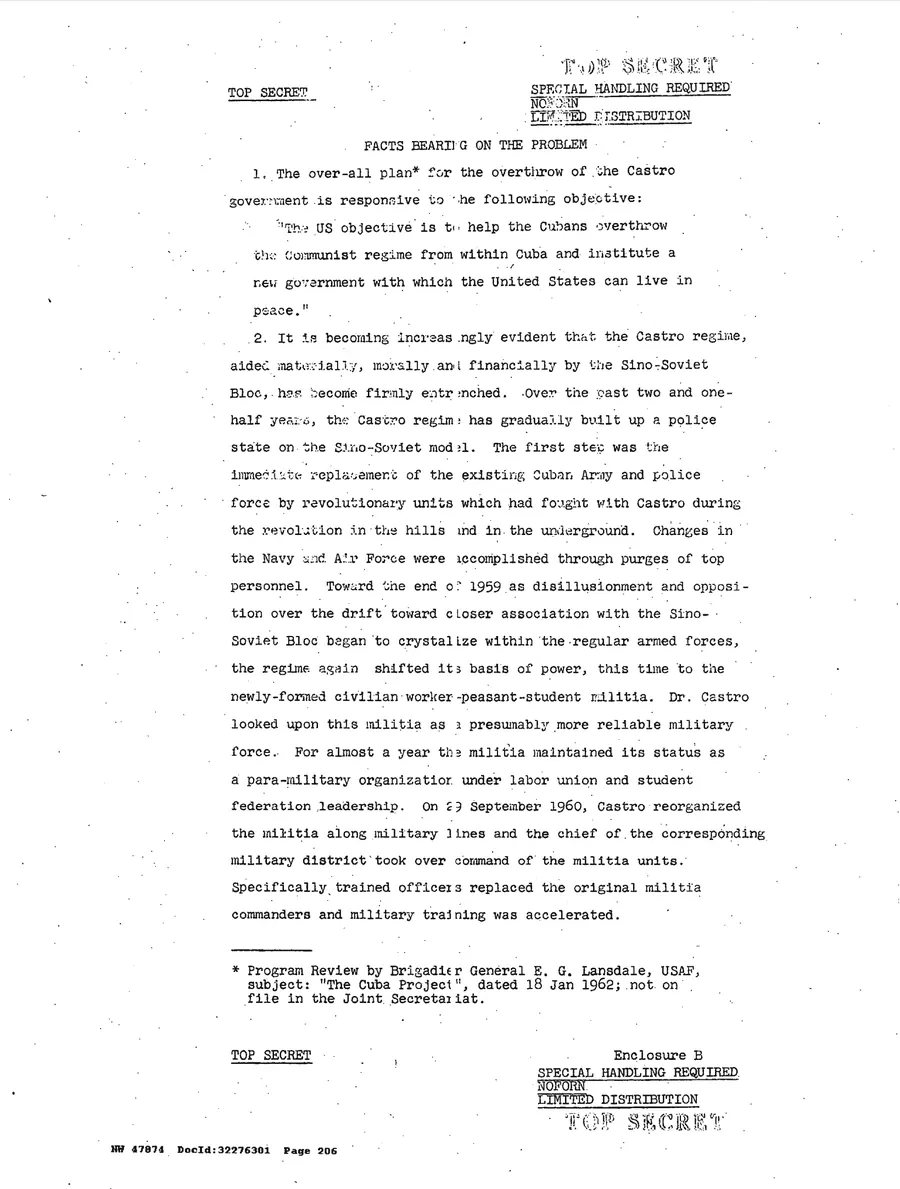
FACTS BEARING ON THE PROBLEM
1. The over-all plan* for the overthrow of the Castro government is responsive to the following objective:
"The US objective is to help the Cubans overthrow the Communist regime from within Cuba and institute a new government with which the United States can live in peace."
2. It is becoming increasingly evident that the Castro regime, aided materially, morally and financially by the Sino-Soviet Bloc, has become firmly entrenched. Over the past two and one-half years, the Castro regime has gradually built up a police state on the Sino-Soviet model. The first step was the immediate replacement of the existing Cuban Army and police force by revolutionary units which had fought with Castro during the revolution in the hills and in the underground. Changes in the Navy and Air Force were accomplished through purges of top personnel. Toward the end of 1959 as disillusionment and opposition over the drift toward closer association with the Sino-Soviet Bloc began to crystalize within the regular armed forces, the regime again shifted its basis of power, this time to the newly-formed civilian worker -peasant-student militia. Dr. Castro looked upon this militia as a presumably more reliable military force. For almost a year the militia maintained its status as a para-military organization under labor union and student federation leadership. On 29 September 1960, Castro reorganized the militia along military lines and the chief of the corresponding military district took over command of the militia units. Specifically trained officers replaced the original militia commanders and military training was accelerated.
* Program Review by Brigadier General E. G. Lansdale, USAF, subject: "The Cuba Project", dated 18 Jan 1962; not on file in the Joint Secretariat.
Enclosure B
Textual notes on this leaf (7)
- FACTS BEARING ON THE PROBLEM (no ENCLOSURE B heading above it)
- Enclosure B opens straight on its subject heading. There is no 'ENCLOSURE B' line above it, where Enclosure C on PDF 209 does carry 'ENCLOSURE C' above 'DISCUSSION'. Checked at 460 dpi across the whole head of the leaf: the space between the typed classification block and 'FACTS BEARING ON THE PROBLEM' is blank paper. The enclosure is identified only by the foot label. The document's own inconsistency; recorded, nothing supplied.
- crystalize
- Set with a single l, for 'crystallize'. Clean, unambiguous type at 900 dpi. The document's own spelling. PRESERVED.
- the regime again shifted its basis of power
- Anomalous double space after 'again', mid-sentence. PRESERVED as spacing.
- the newly-formed civilian worker -peasant-student militia
- A space stands before the hyphen in 'worker -peasant', so the compound reads 'worker -peasant-student' with the first hyphen detached from the word in front of it. Verified at 900 dpi: the gap between the r of 'worker' and the hyphen is a full character cell, and the hyphen abuts 'peasant' with no gap. The document's own setting. PRESERVED; worth an annotation, since a typesetter will want to close it up.
- On 29 September 1960, Castro reorganized
- The two digits are weakly struck: the 2 prints with its upper bowl broken (an epsilon-like appearance) and the 9 has lost part of its bowl. Read at 900 dpi as '29' - the 2 keeps its flat foot bar and the 9 its descender and closed head, and no other pair of digits fits the ink. Stands as transcribed.
- Over the past two and one-half years
- 'one-half' hyphenated as the document sets it, and 'two and one-half' left as written rather than normalised. PRESERVED.
- not on file in the Joint Secretariat.
- This footnote ends with a full stop and says 'in the Joint Secretariat'. The footnote on the next leaf (PDF 207) ends with NO full stop and says 'in Joint Secretariat', and the footnotes on PDF 208 and PDF 209 also end without a full stop. The paper is inconsistent leaf to leaf; each transcribed as it appears.
Printed page 2
Leaf 49 of 65 · source page 207
3. Simultaneously, the Castro regime was also building its security network*. In June 1961, the process culminated with the establishment of a Ministry of Interior with responsibility for maintaining "public order". The decree centralizes the various police and investigation units under the new ministry. It also gave the Ministry authority to supervise the activities of "Committees for the Defense of the Revolution". These committees are responsible for informing authorities of "counter-revolutionary" activities or attitudes. A campaign is under way to establish 100,000 of such committees with 50,000 "volunteer" members in offices, factories, schools, churches, cooperatives, residential areas, etc. By centralizing the police function and combining it with a vast network of informers, the Castro regime has established a security system on the Communist Bloc model.
4. In support of this military and security build-up, Castro forces have been equipped with arms and materiel from the Sino-Soviet Bloc countries, i.e., Czechoslovakia and Russia. Information indicates the Cuban force is well equipped with modern weapons and that there is in Cuba an actual surplus of military equipment for the force in being. Some accounts indicate that certain materiel is rather sophisticated, and includes EW radar, fire control systems, advanced fighters, short and possibly medium range rockets. It becomes obvious that the Castro forces are being trained and equipped for operations far beyond that required to maintain law and order and internal security. This represents a continuous threat to the Western Hemisphere, and is a Communist stronghold for the
* Department of State White Paper, subject: "The Castro Regime in Cuba", recently published but undated; not on file in Joint Secretariat
Enclosure B
Textual notes on this leaf (6)
- the Cuban force is well equipped with modern weapons
- Anomalous double space after 'force', mid-sentence, verified at 1000 dpi against the word spaces on either side of it on the same line. PRESERVED as spacing.
- security network*. In June 1961
- The footnote asterisk is set BEFORE the full stop ('network*.'), where the asterisk on PDF 206 follows a word with no adjacent punctuation and the asterisks on PDF 208-209 follow the word directly. Transcribed in the position the page prints it.
- not on file in Joint Secretariat
- The footnote ends without a terminal full stop, and reads 'in Joint Secretariat' where the equivalent footnote on PDF 206 reads 'in the Joint Secretariat.' with the article and a stop. Verified at 460 dpi: the space to the right of the final t is clean paper. The document's own inconsistency. PRESERVED.
- arms and materiel from the Sino-Soviet Bloc / certain materiel is rather sophisticated
- 'materiel' twice on this leaf, correctly spelled and unaccented, in clean type. Recorded because the same paper sets 'materials' on PDF 204 and 'materiels' on PDF 211 in the parallel sub-paragraph; the three settings are not to be harmonised.
- vertical rule down the right of the leaf
- A thin vertical line runs from the head of the leaf down through the typed classification block and into the first paragraphs, to the right of the type. It is a crease or scanner artefact, not ink of the document: it crosses letterforms without displacing them and does not repeat on the neighbouring leaves. Not transcribed.
- 100,000 of such committees with 50,000 "volunteer" members
- Both figures verified digit by digit at 460 dpi. The construction 'to establish 100,000 of such committees' is the document's own. PRESERVED.
Printed page 3
Leaf 50 of 65 · source page 208
continued spread of Communism to other countries of the inter-American System.
5. In response to a request* by the President in April 1961 the Defense Department has already planned for the overthrow of the Castro government by use of military force. In the event formal, overt commitment of US forces in Cuba should become necessary there are now two US military plans** in being either of which could be implemented. Both plans provide for the deployment of sizeable US forces and are designed, among other things, toward the over-throw of the Castro-government as rapidly as possible.
a. CINCLANT OPLAN 314-61,** approved*** by the Joint Chiefs of Staff, provides for a simultaneous amphibious and airborne assault within 18 days after the execution order, assuming no prior alert or prepositioning of forces. After the intial assault, it is estimated that overthrow of the Castro government and the gain of essential control of Cuba would be assured in 10 days.
b. CINCLANT OPLAN 316-61,** designed for a faster commitment of US forces, provides for an airborne assault within 5 days of the execution order. However, since this plan deploys fewer forces initially, no estimate is made concerning the length of time required for overthrow of the government or control of Cuba. This latter plan, not yet approved by the Joint Chiefs of Staff, is in process of minor revision by CINCLANT.
* JCS 2304/29 ** CINCLANT Contingency Operations Plan 314-61 (Cuba), and CINCLANT Contingency Operations Plan 316-61 (Cuba), both plans on file in Joint Secretariat *** JCS 2018/306
Enclosure B
Textual notes on this leaf (7)
- After the intial assault
- Reads 'intial' - the second i of 'initial' is absent. Verified at 1200 dpi: five letter cells, i-n-t-i-a-l is six; the ink is 'i n t i a l'. Clean type, not a broken strike. The document's own error. PRESERVED; worth an annotation.
- toward the over-throw of the Castro-government as rapidly as possible
- Two of the document's own hyphens in one clause: 'over-throw' broken across the hyphen mid-line (not at a line end), and 'Castro-government' hyphenated. The same leaf sets 'overthrow' unhyphenated twice - in paragraph 5's own second sentence and in sub-paragraph a - so this is not the drafter's settled usage. Verified at 460 dpi. PRESERVED; worth an annotation, since a hyphen at a line end would normally be closed up under the house rule and these must not be.
- there are now two US military plans** in being either of which could be implemented
- The words 'either of which' print in the washed-out band down the left of this leaf and are barely inked. Read at 1200 dpi by fitting the character grid: 'either' occupies six cells and 'of' begins seven cells after the e, exactly as a following space requires, and the surviving ink is an e, a t stem, and the shoulder of an r. No other word fits the measure or the sense. Stands as transcribed. The same washed band affects 'of Staff,' in sub-paragraph a, 'no prior alert', 'assault' twice and 'government' - all read the same way and all confirmed by measure.
- After the intial assault, it is estimated
- CONFIRM against a sharper scan. The mark after 'assault' is a weak strike in the washed-out left band: at 1600 dpi it leaves a small blob low in its cell, at or just below the baseline, but too little ink to separate a comma from a full stop by shape. It is read as a comma because the next word, 'it', is lower case and begins no new sentence. Transcribed as a comma; the reading of the surrounding words is not in doubt, only this mark.
- CINCLANT OPLAN 314-61,** / OPLAN 316-61,**
- In both body references the hyphen between the digits prints low and light, sitting near the baseline rather than at mid height, giving a '314 61' appearance at low magnification. Read as hyphens: the footnote on the same leaf sets 'Plan 314-61 (Cuba)' and 'Plan 316-61 (Cuba)' with clean mid-height hyphens, and the body marks occupy the same single cell between the digit groups. Stands as transcribed.
- both plans on file in Joint Secretariat
- None of the three footnotes on this leaf ends with a full stop, and the second reads 'in Joint Secretariat' without the article. Consistent with PDF 207 and inconsistent with PDF 206. PRESERVED.
- the deployment of sizeable US forces
- 'sizeable' with the e, as the document sets it, in clean type. PRESERVED.
Unnumbered leaf
Leaf 51 of 65 · source page 209
ENCLOSURE C
DISCUSSION
1. Although it is possible that a Cuban counter-revolutionary leader could emerge with sufficient appeal to enable the anti-Castro elements to unite in an attempt to seize power, such eventuality does not seem likely unless fostered and supported by the United States. To date, exiled Cubans have failed to produce such a leader.* Even the loss of Castro by assassination or by natural casues, while unsettling on the government, would almost certainly not prove fatal to the regime.** It is therefore expected that no Cuban leader or insurgent group can independently undertake a significant subversion effort against the government with any reasonable chance of success.
2. Even a cursory look at Castro's military preparations to defend Cuba indicates that a purely overt attempt to overthrow the Castro government can only be accomplished by a well conceived military plan in significant force, requiring military intervention by the United States.
3. As long as Cuba does not become a member and an accepted military partner of the Warsaw Pact the threat of general war as a result of US military intervention in Cuba does not appear to exist.
4. It is expected that the Castro government will avoid giving the United States sufficient provocation for armed intervention. For this reason Cuban forces are not expected to be committed to an attack on the US Naval Base at Guantanamo Bay. Neither is it
* J-2 DM-400-61, "After the Assassination of Castro ' What?" dated 27 October 1961; on file in J-2 ** SNIE 85-61, "The Situation and Prospects in Cuba", dated 28 Nov 61; on file in Joint Secretariat
Enclosure C
Textual notes on this leaf (7)
- or by natural casues, while unsettling
- Reads 'casues' - the u and the s transposed in 'causes'. Verified at 460 dpi: six clean letter cells, c-a-s-u-e-s, no broken strike. The document's own error. PRESERVED; worth an annotation, since any OCR pass or hasty editor will silently correct it.
- "After the Assassination of Castro ' What?"
- CONFIRM against a sharper scan - genuinely ambiguous. The mark standing between 'Castro' and 'What?' in the footnote title was measured at 1200 dpi. It is a single vertical limb 20 px wide occupying rows 69-124 of the line - the same vertical band as the limbs of this machine's double quotation mark on the same line (the opening mark before 'After' prints two limbs at rows 61-120, the closing mark after 'What?' two limbs at rows 49-100), and far above where a hyphen prints. Its cell is flanked by exactly one space on each side, the way a typed dash is set. Its horizontal position is what leaves the question open: its centre lies 12 px LEFT of its cell centre, which is where the LEFT limb of a double quotation mark falls, not where this machine's centred apostrophe falls (see the PDF 168 'Maine' determination in transcription.json). So it is either an apostrophe struck as a dash substitute, or a double quotation mark with its right limb unprinted - and neither makes sense of the title, which plainly wants a dash. Transcribed as a single apostrophe, the more probable single character. A hyphen is excluded by height. NOT to be silently printed as a dash.
- ENCLOSURE C
- A gap of about two character cells between ENCLOSURE and C, verified at 1200 dpi. The same wide setting as ENCLOSURE A, APPENDIX A and ANNEX ... ENCLOSURE A on PDF 164, 165 and 167. Transcribed with a double space, following the precedent already set in transcription.json.
- a well conceived military plan in significant force
- The t of 'significant' is a weak strike, leaving a stem with the crossbar unprinted. Read as 'significant' at 460 dpi: the cell count is right for it and the same word prints cleanly two lines later ('a significant subversion effort'). The phrase 'in significant force' is the document's own; it is not a misreading of 'in sufficient force'. Stands as transcribed.
- a purely overt attempt to overthrow the Castro government
- 'overthrow' unhyphenated here, against 'over-throw' and 'Castro-government' on PDF 208. The paper is inconsistent between its enclosures; each transcribed as it appears.
- such eventuality does not seem likely
- Reads 'such eventuality' without an article. The document's own construction, in clean type. PRESERVED.
- on file in J-2 / on file in Joint Secretariat
- Neither footnote ends with a full stop. The second dates SNIE 85-61 '28 Nov 61' in the abbreviated form where the first spells out '27 October 1961'. The document's own inconsistency. PRESERVED.
Printed page 2
Leaf 52 of 65 · source page 210
expected that Castro will allow a definite relationship to become known or apparent between his government and communist attempts at infilitration and subversion of other Latin American states.
5. It is postulated therefore, that to progress in following the established national policy of aiming at the downfall of Castro, it will be necessary for the United States to support a selected Cuban insurgent attempt from the outset and to be prepared to sustain such insurgent program to a successful conclusion, including overt military intervention as the final and decisive step.
6. It is clear that the United States cannot afford repetition of the unfortunate miscalculation of the political aspirations of Fidel Castro in the desire to see an end to the Batista regime. It would appear that a significant lesson of this costly mistake is the requirement for emphasis and improvement in US intelligence efforts to evaluate the true colors of potentially capable personalities and groups which eventually may have to be recognized and supported by the United States in future counter-revolutionary undertakings.
7. The basic military implications of Castro's Communist government are as follows:
a. It exposes the Western Hemisphere to an increasingly serious threat to its security. This increases our national vulnerability and defense costs as forces are developed or shifted to meet this threat.
b. It provides the Soviet Union with the most effective base they have ever had for spreading Communism throughout the Western Hemisphere. This in turn greatly increases the possibility that additional Latin American countries will come under Communist control. Elimination of this base in Cuba would demonstrate to the other nations of the world that the US will not tolerate such intrusions. Communist control of additional countries would or could result in:
Enclosure C
Textual notes on this leaf (6)
- at infilitration and subversion of other Latin American states
- Reads 'infilitration' - an extra i between the l and the t of 'infiltration'. Verified at 460 dpi in clean type, thirteen letter cells where 'infiltration' takes twelve. The document's own error. PRESERVED; worth an annotation.
- communist attempts at infilitration
- 'communist' in lower case here, where this leaf capitalises 'Communist' four times in sub-paragraph b and 'Castro's Communist government' in paragraph 7. Verified at 460 dpi: the initial letter is a lower-case c, no taller than the o that follows it. The document's own inconsistency. PRESERVED.
- at the downfall of Castro, it will be necessary
- Anomalous double space after the comma following 'Castro', mid-sentence. PRESERVED as spacing.
- It is postulated therefore, that to progress
- The comma falls after 'therefore' with none before it, so the parenthesis is left open. The document's own punctuation. PRESERVED.
- to sustain such insurgent program to a successful conclusion
- Reads 'such insurgent program' without an article. The document's own construction, in clean type. PRESERVED.
- the true colors of potentially capable personalities
- 'colors' in the US spelling, as the document sets it; the same leaf sets 'defense' and 'defence' does not occur. Recorded for the typesetter; nothing changed.
Printed page 3
Leaf 53 of 65 · source page 211
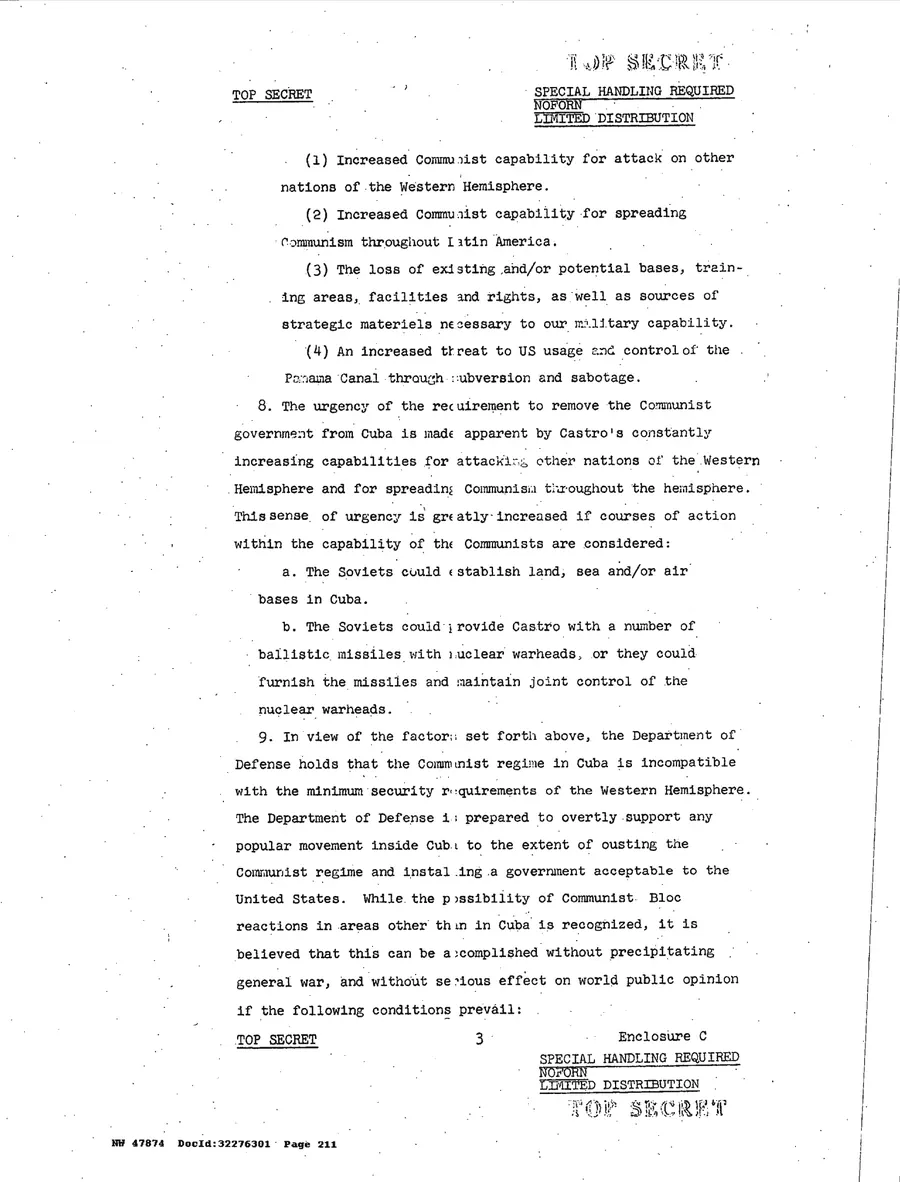
(1) Increased Communist capability for attack on other nations of the Western Hemisphere.
(2) Increased Communist capability for spreading Communism throughout Latin America.
(3) The loss of existing and/or potential bases, training areas, facilities and rights, as well as sources of strategic materiels necessary to our military capability.
(4) An increased threat to US usage and control of the Panama Canal through subversion and sabotage.
8. The urgency of the requirement to remove the Communist government from Cuba is made apparent by Castro's constantly increasing capabilities for attacking other nations of the Western Hemisphere and for spreading Communism throughout the hemisphere. This sense of urgency is greatly increased if courses of action within the capability of the Communists are considered:
a. The Soviets could establish land, sea and/or air bases in Cuba.
b. The Soviets could provide Castro with a number of ballistic missiles with nuclear warheads, or they could furnish the missiles and maintain joint control of the nuclear warheads.
9. In view of the factors set forth above, the Department of Defense holds that the Communist regime in Cuba is incompatible with the minimum security requirements of the Western Hemisphere. The Department of Defense is prepared to overtly support any popular movement inside Cuba to the extent of ousting the Communist regime and installing a government acceptable to the United States. While the possibility of Communist Bloc reactions in areas other than in Cuba is recognized, it is believed that this can be accomplished without precipitating general war, and without serious effect on world public opinion if the following conditions prevail:
Enclosure C
Textual notes on this leaf (4)
- sources of strategic materiels necessary to our military capability
- Reads 'materiels'. The identical sub-paragraph in Appendix 1 to Enclosure A (PDF 204, item (3)) reads 'materials', and PDF 207 twice reads the singular 'materiel'. All three verified in clean type at 460 dpi. The paper carries all three forms; each transcribed as it appears. PRESERVED; worth an annotation, and the three must not be harmonised.
- nuclear warheads, or they could furnish the missiles
- A comma before 'or'. The identical sub-paragraph on PDF 204 sets a semicolon there. Verified at 460 dpi: the mark on this leaf has a tail running below the baseline and no upper dot. PRESERVED; the pair matters for collation.
- paragraphs 8 and 9 duplicating PDF 204
- Structural note, not a doubt. Paragraphs 8 and 9 of Enclosure C and their sub-paragraphs (1)-(4), a and b reproduce paragraphs 3 and 4 of Appendix 1 to Enclosure A (PDF 204) almost word for word, under different numbers. The two settings differ at three points only - 'materials'/'materiels', the semicolon/comma after 'warheads', and the line breaks - all of them flagged. This duplication is what makes Enclosure C's paragraph 10 the natural end of the paper: it is the counterpart of Appendix 1's closing paragraph 5.
- Communist Bloc reactions in areas other than in Cuba
- The repeated preposition, as on PDF 204. PRESERVED.
Printed page 4
Leaf 54 of 65 · source page 212
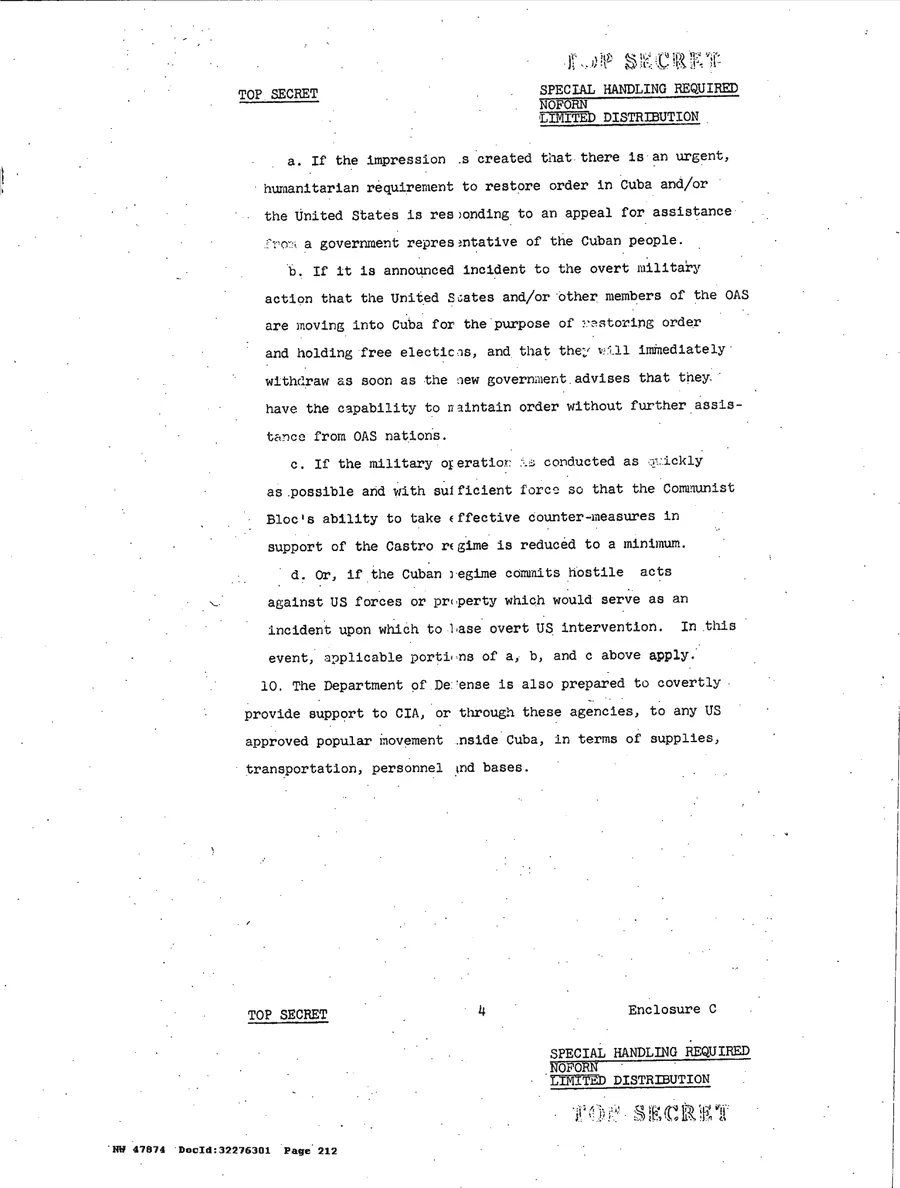
a. If the impression is created that there is an urgent, humanitarian requirement to restore order in Cuba and/or the United States is responding to an appeal for assistance from a government representative of the Cuban people.
b. If it is announced incident to the overt military action that the United States and/or other members of the OAS are moving into Cuba for the purpose of restoring order and holding free elections, and that they will immediately withdraw as soon as the new government advises that they have the capability to maintain order without further assistance from OAS nations.
c. If the military operation is conducted as quickly as possible and with sufficient force so that the Communist Bloc's ability to take effective counter-measures in support of the Castro regime is reduced to a minimum.
d. Or, if the Cuban regime commits hostile acts against US forces or property which would serve as an incident upon which to base overt US intervention. In this event, applicable portions of a, b, and c above apply.
10. The Department of Defense is also prepared to covertly provide support to CIA, or through these agencies, to any US approved popular movement inside Cuba, in terms of supplies, transportation, personnel and bases.
Enclosure C
Textual notes on this leaf (6)
- provide support to CIA, or through these agencies, to any US approved popular movement
- The sentence names ONE agency and then refers to 'these agencies' in the plural, so the phrase does not parse. The counterpart paragraph 5 in Appendix 1 to Enclosure A (PDF 205) reads 'to CIA or State, or any US approved popular movement', naming two. Verified at 460 dpi: after 'CIA' this leaf prints a comma and then 'or through these agencies,' - there is no 'and State' on the page and no erasure shadow where it would sit. The document's own defective sentence. PRESERVED; worth an annotation, and it must not be repaired from the Appendix reading.
- commits hostile acts against US forces
- Anomalous double space between 'hostile' and 'acts', mid-sentence, verified at 1000 dpi against the neighbouring word spaces on the same line. The counterpart sub-paragraph d on PDF 205 sets a single space there. PRESERVED as spacing.
- and holding free elections
- The o of 'elections' prints as an open c - its right arc did not ink - and the n prints as an arch with its stems light, giving an 'electicns' appearance at low magnification. Read at 2000 dpi: the word occupies nine letter cells, which only 'elections' fits, and this machine's o slug misbehaves elsewhere in the record (see the PDF 171 'of' determination in transcription.json). The same word prints cleanly on PDF 205. Reads 'elections'. Stands as transcribed.
- and/or other members of the OAS / assistance from OAS nations / a government representative
- Collation note, not a doubt. This sub-paragraph b differs from its counterpart on PDF 205 at three points: 'other members of the OAS' where PDF 205 has 'members of the OAS'; 'from OAS nations' where PDF 205 has 'from the OAS nations'; and, in sub-paragraph a, an ordinary single space in 'a government representative' where PDF 205 leaves a six-cell gap. This leaf also sets single spaces at the three points where PDF 205 doubles them ('action that', 'operation is', 'Defense is') and doubles the one point where PDF 205 is single ('hostile acts'). All verified at 460-1000 dpi on both leaves. Each transcribed as it appears.
- If it is announced incident to the overt military action
- 'incident to' here as on PDF 205, and this leaf carries no manuscript underline beneath it - the reader who marked PDF 205 did not mark the same words here. Recorded so the absence is not read as an oversight.
- end of the record
- This is the last leaf of the release. The text stops at the full stop after 'personnel and bases.', a complete sentence closing a complete paragraph, with about half the leaf blank below it and the ordinary foot block in place. There is no catchword, no 'continued' marking, no further enclosure label, and the folio 4 completes Enclosure C's run (unnumbered, 2, 3, 4). The paper is not truncated here. See completeness_note.
Unnumbered leaf
Leaf 55 of 65 · source page 36
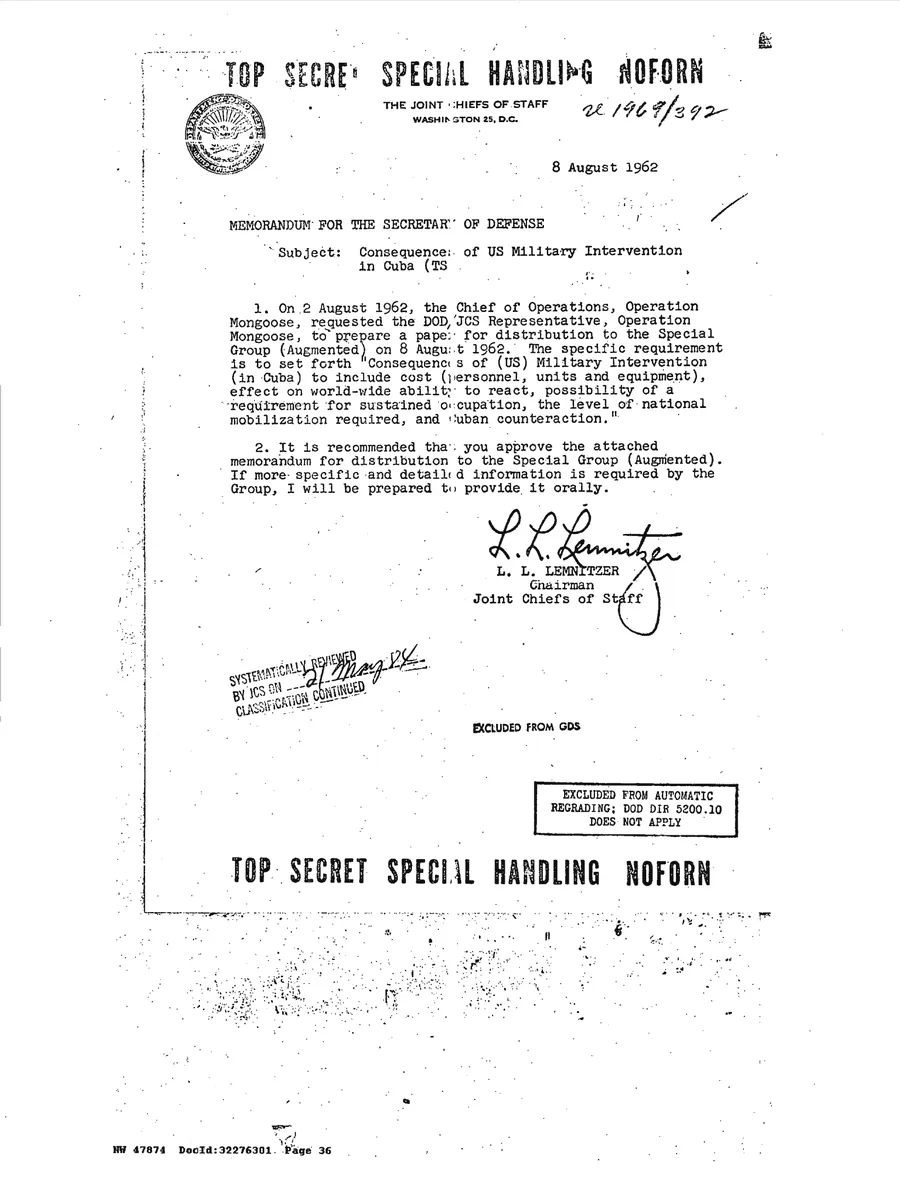
Order restored. JCS 1969/392 of August 1962, five months later, the last substantial paper in the case. It is pages 36-46 of the scan, near the front of the file.
THE JOINT CHIEFS OF STAFF WASHINGTON 25, D.C.
1. On 2 August 1962, the Chief of Operations, Operation Mongoose, requested the DOD/JCS Representative, Operation Mongoose, to prepare a paper for distribution to the Special Group (Augmented) on 8 August 1962. The specific requirement is to set forth "Consequences of (US) Military Intervention (in Cuba) to include cost (personnel, units and equipment), effect on world-wide ability to react, possibility of a requirement for sustained occupation, the level of national mobilization required, and Cuban counteraction."
2. It is recommended that you approve the attached memorandum for distribution to the Special Group (Augmented). If more specific and detailed information is required by the Group, I will be prepared to provide it orally.
[signed] L. L. Lemnitzer L. L. LEMNITZER Chairman Joint Chiefs of Staff
Textual notes on this leaf (8)
- in Cuba (TS
- PRESERVED document error. Verified at 900 dpi: the subject line turns after 'Intervention' and the second line ends 'in Cuba (TS' with NO closing parenthesis. The cell to the right of the S is clean white - there is no weak strike, no fragment and no speck where a parenthesis would sit, and the type ends well short of the right margin, so nothing has been lost off the edge. Every other appearance of this subject line in the record closes the parenthesis ('in Cuba (TS)' on PDF 37, 159, 164, 165). The drafter's own omission on this leaf. NOT to be silently completed in any edition.
- SYSTEMATICALLY REVIEWED BY JCS ON 21 May 84 / CLASSIFICATION CONTINUED
- CONFIRMED at 600 and 900 dpi, as the reference impression for the whole record. All three printed lines read cleanly on this leaf: 'SYSTEMATICALLY REVIEWED' / 'BY JCS ON ____' / 'CLASSIFICATION CONTINUED'. The middle line is 'BY JCS ON' - B-Y, space, J-C-S, space, O-N, followed by a dashed rule for the date - which is the wording supplied to the badly inked impression on PDF 159. The handwritten date over the rule reads '21 May 84': the 2 and the 1 run together in a single cursive movement, 'May' is written out in full, and the last pair is 8-4 with the 4 closed at the top and its stem carried below the rule. Stands as transcribed on this leaf and vindicates the supplied reading on PDF 159.
- 1969/392 (ink, top right)
- CONFIRM - the digits are certain, the prefix is not. At 900 dpi '1969/392' reads unambiguously in a cursive ink hand. Immediately to its left is a short two-letter cursive mark about the width of two characters, made in the same ink and the same stroke weight: an opening loop rising to the right and a second short stroke ending in a terminal dot. It fits 're' and it fits a doubled 'cc'; it is too short for 'JCS'. Transcribed as an unread prefix rather than guessed. The same annotation, in the same hand, recurs at the top right of PDF 37.
- requested the DOD/JCS Representative
- The solidus in 'DOD/JCS' prints as a faint hairline at 200 dpi and reads clearly at 450 dpi. The form 'DOD/JCS Representative' recurs cleanly on PDF 40 and 45. Stands as transcribed.
- "Consequences of (US) Military Intervention (in Cuba) to include cost
- The quoted requirement parenthesises '(US)' and '(in Cuba)' where the memorandum's own subject line does not. The document's own setting, quoting the Chief of Operations' wording. PRESERVED.
- [signed] L. L. Lemnitzer
- Ink signature reads 'L. L. Lemnitzer', the same hand as on PDF 159. Recorded as a signature block per house rule, transcribed exactly.
- TOP SECRET SPECIAL HANDLING NOFORN (head)
- The head stamp is over-inked and the T of SECRET prints as a broken blob, as on PDF 159. Read as the standard stamp, which prints cleanly at the foot of the same leaf.
- no enclosure block on this leaf
- Checked at 700 dpi over the whole lower third. Unlike the 13 March 1962 letterhead memorandum on PDF 159, which carries '1 Enclosure / Memo for Chief of Operations, Cuba Project' at the lower left, this leaf carries NO enclosure block. Below the signature block there is only the JCS review stamp (left) and EXCLUDED FROM GDS (right); the rest of the sheet is blank apart from the boxed regrading stamp and the foot stencil. Recorded so that no editor supplies one by analogy.
Unnumbered leaf
Leaf 56 of 65 · source page 37
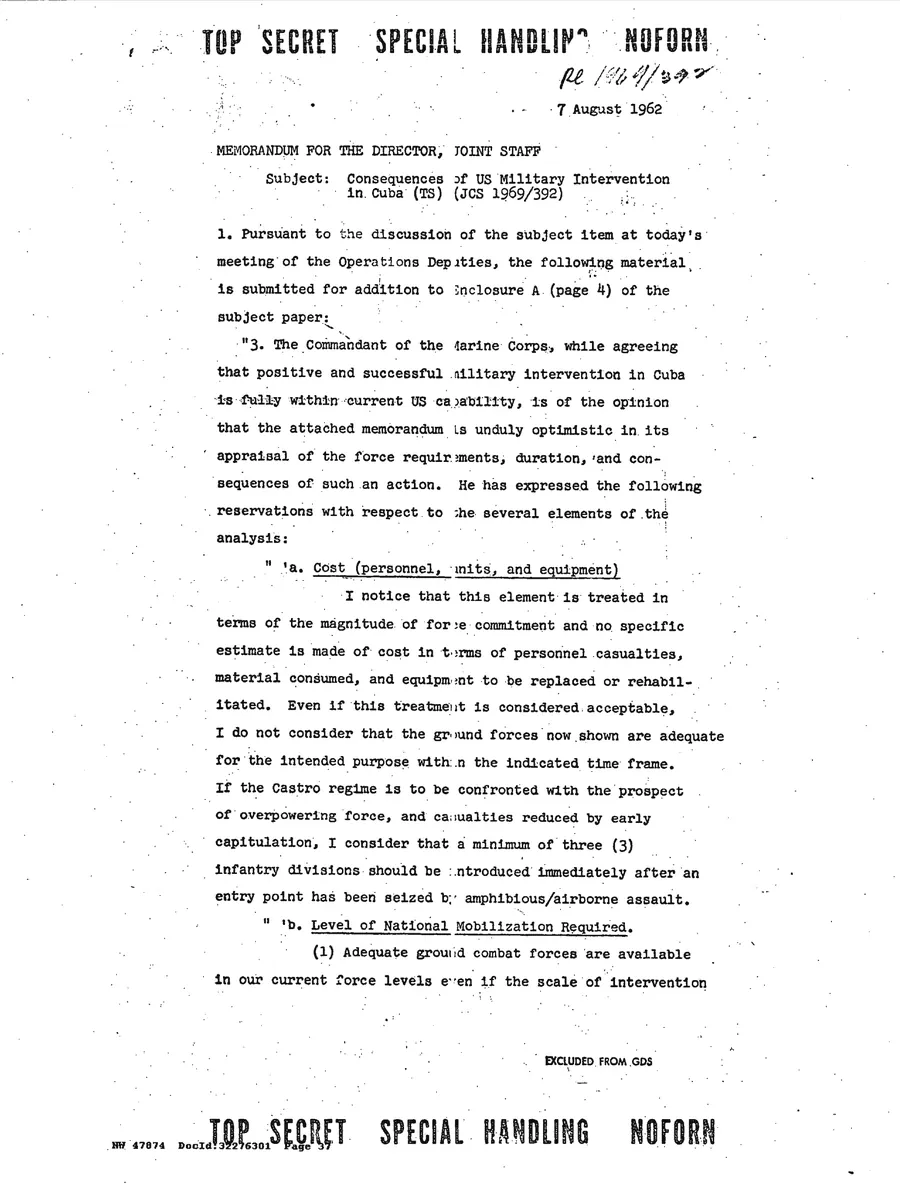
1. Pursuant to the discussion of the subject item at today's meeting of the Operations Deputies, the following material is submitted for addition to Enclosure A (page 4) of the subject paper:
"3. The Commandant of the Marine Corps, while agreeing that positive and successful military intervention in Cuba is fully within current US capability, is of the opinion that the attached memorandum is unduly optimistic in its appraisal of the force requirements, duration, and consequences of such an action. He has expressed the following reservations with respect to the several elements of the analysis:
" 'a. Cost (personnel, units, and equipment)
I notice that this element is treated in terms of the magnitude of force commitment and no specific estimate is made of cost in terms of personnel casualties, material consumed, and equipment to be replaced or rehabilitated. Even if this treatment is considered acceptable, I do not consider that the ground forces now shown are adequate for the intended purpose within the indicated time frame. If the Castro regime is to be confronted with the prospect of overpowering force, and casualties reduced by early capitulation, I consider that a minimum of three (3) infantry divisions should be introduced immediately after an entry point has been seized by amphibious/airborne assault.
" 'b. Level of National Mobilization Required.
(1) Adequate ground combat forces are available in our current force levels even if the scale of intervention
Textual notes on this leaf (6)
- " 'a. Cost (personnel, units, and equipment)
- The lettered reservations are set with TWO opening marks: a double quotation mark, a space, then an apostrophe, then the letter and full stop - the typist's way of opening a quotation inside the already-quoted paragraph 3. The same setting recurs at 'b (this leaf), 'c and 'd (PDF 38) and 'e (PDF 39), and both levels are closed together at the end of PDF 39. Transcribed exactly as typed, spacing included.
- material consumed
- PRESERVED document inconsistency. This leaf sets 'material consumed' with an -al ending, where PDF 39 of the same memorandum sets 'materiel casualties' with an -iel ending. Both are in clean type at 450 dpi. The drafter's own inconsistency within one paper; neither is normalised.
- is fully within current US capability
- A faint broken horizontal mark runs at x-height across this line, from 'is fully' through about the middle of 'current US ca'. NOT read as a strike-through and NOT transcribed as one. At 1400 dpi it resolves into disconnected specks rather than a continuous stroke: there is no drawn line, the letterforms beneath it are undamaged, and every word on the line is fully legible. A comparable mark sits at the same relative height on PDF 38 ('approaching the scale of'). Recorded as a reproduction artefact of this mimeographed copy. Contrast the genuine, unmistakable over-strike on PDF 43, which is typed.
- cost (personnel, units, and equipment)
- The heading sets a serial comma before 'and equipment' where the covering memorandum on PDF 36 quotes the requirement as '(personnel, units and equipment)' without one. Two different hands quoting the same phrase. Both PRESERVED as they stand.
- 1969/392 (ink, top right)
- The same ink annotation as on PDF 36, in the same hand, with the same short unread cursive prefix. See the PDF 36 flag; not re-argued here.
- no printed folio
- The foot of the leaf carries only the EXCLUDED FROM GDS stamp, the TOP SECRET stencil and the NARA footer - no folio. The paper's folios begin at 2 on the next leaf. Recorded so the run 2, 3 is not mistaken for a missing first leaf.
Printed page 2
Leaf 57 of 65 · source page 38
is increased as indicated above. The same situation does not appear to apply with respect to tactical airlift and military government/civil affairs units. If all elements of the intervention force are to have the same degree of readiness and preparation, it would appear necessary to resort to partial prior mobilization in these areas.
(2) The foregoing consideration is addressed only to direct commitment in Cuba. Restoration of our capability to respond quickly to heightened tensions in other areas might well require additional mobilization approaching the scale of that undertaken during the Berlin crisis.
" 'c. Effect on World-Wide Ability to React.
A critical point here is the duration of involvement of major elements of our strategic reserve in Cuba. From examination of time and distance factors, and assessment of the probable level of opposition, I cannot agree that the indicated time frame is adequate to introduce and deploy forces of this magnitude, establish effective control, install an effective new government, turn over control to that government, withdraw and rehabilitate our forces, and place those forces in a renewed readiness posture in CONUS. In my opinion a much longer time would be involved and during this period our ability to respond to other crisis would be seriously reduced.
" 'd. Castro-Cuban Counteraction. The statement is made that Cuban defensive plans are believed to contemplate a strong initial resistance, followed by a determined defense of preselected keypoints, and finally by protracted guerrilla warfare. This statement is from the current National Intelligence Estimate which also states that the present military establishment as a whole is politically reliable.
Textual notes on this leaf (5)
- our ability to respond to other crisis would be seriously reduced
- PRESERVED document error. Reads 'other crisis' where 'other crises' is evidently meant. Clean type at 450 dpi - the word ends in -sis, with no terminal e and no plural s. The drafter's own usage. Worth an annotation.
- approaching the scale of that undertaken during the Berlin
- A faint broken horizontal mark runs at x-height across 'approaching the scale of', at the same relative height on the leaf as the comparable mark on PDF 37. NOT read as a strike-through. At 1200 dpi it resolves into disconnected specks, not a drawn stroke; the letterforms are undamaged and the line is fully legible. Recorded as a reproduction artefact, as on PDF 37.
- preselected keypoints
- 'preselected' unhyphenated and 'keypoints' set as one word, both in clean type. The document's own compounding. PRESERVED.
- military government/civil affairs units
- Set with a solidus and no spaces, here and again on PDF 39 ('a military government/ civil affairs establishment', where the solidus falls at the line end). The document's own form. PRESERVED.
- no EXCLUDED FROM GDS on this leaf
- Only the first leaf of this memorandum (PDF 37) carries an EXCLUDED FROM GDS impression; neither this leaf nor PDF 39 does. Checked over the whole of both sheets at 400 dpi - the lower two-fifths of each carries nothing but the printed folio, the foot stencil and the NARA footer. Recorded so the absence is not read as a difference in handling; the stamp was simply applied to the top leaf only.
Printed page 3
Leaf 58 of 65 · source page 39
If Castro's Cuba is only partially successful in the execution of its defensive plans, combat operations could be of considerably longer duration than anticipated with personnel and materiel casualties increasing proportionally.
" 'e. Possibility of a Requirement for a Sustained Occupation. The present wording makes no mention of the very real probability that a US provisional military government would be required for an extended period of time. Considering the size (44,206 sq. mi.) and population (6,743,000) of Cuba, its long history of political unrest, and its tradition of sustained and extensive guerrilla and terrorist resistance to constituted authority, the estimate that only a division-size force will be required subsequent to the assault phase appears modest. I consider it more probable that a clean-up and occupation force of three infantry divisions and associated support units would be required for a considerable period. This is in addition to the need for a military government/civil affairs establishment capable of directing the civil and economic affairs of Cuba until we can organize and install a successor regime capable of responsible self-government. This period of transition, re-organization, and economic rehabilitation might well continue for several years.' "
[signed] C. H. Hayes C. H. HAYES Major General, U.S. Marine Corps Deputy Chief of Staff (Plans)
Textual notes on this leaf (6)
- might well continue for several years.' "
- The paper closes with THREE marks in sequence: a full stop, an apostrophe, a space, and a double quotation mark. Verified at 450 dpi - the apostrophe sits high and centred in its own cell, then a clear word space, then the double mark with both limbs printing. This closes both levels of quotation in the order they were opened on PDF 37 (double, then apostrophe), with the space between them as typed. PRESERVED exactly, spacing included.
- materiel casualties
- PRESERVED document inconsistency, the counterpart of the PDF 37 flag. This leaf spells 'materiel'; PDF 37 of the same memorandum spells 'material consumed'. Both in clean type. Neither normalised.
- the size (44,206 sq. mi.) and population (6,743,000) of Cuba
- Both figures verified digit by digit at 450 dpi: 44,206 and 6,743,000, with 'sq. mi.' abbreviated with two full stops and a space. No digit is a weak strike. Recorded because a mis-set figure here would be quoted onward.
- a military government/civil affairs establishment
- The solidus falls at the end of a line ('government/' / 'civil affairs'), so the compound is closed up in transcription per the house rule on line-break hyphenation. The document's own unspaced solidus form, as on PDF 38.
- re-organization
- Hyphenated mid-line, not at a line break - the document's own hyphen. PRESERVED.
- [signed] C. H. Hayes
- Ink signature reads 'C H Hayes' in a single connected stroke with no full stops; the typed block below it sets 'C. H. HAYES'. Transcribed as a signature block per house rule.
Printed page 1
Leaf 59 of 65 · source page 40
Decision on:
JCS 1969/392 (NORTHWOODS) (S)
At their meeting on 8 August 1962 the Joint Chiefs of Staff approved the recommendations of the DOD/JCS Representative for Operation Mongoose as set forth in paragraph 7 of the subject paper, as amended in the Appendix to Enclosure A by:
a. Substitution, in the heading of paragraph 2 on page 5, of the word "Requirements" for the word "Cost".
b. Insertion, in subparagraph 2 a on page 5, of the words "key strategic areas in" after the words "seize control of".
c. Substitution, in the first sentence of subparagraph 3 c on page 6, of the words "were originally" for the word "are" as well as the addition of the words "prior to D-day" at the end of that sentence. Additionally, deletion of the last sentence of that subparagraph.
d. Changing the end of the first sentence of paragraph 4 on page 6 so as to read:- "....achieving control of key strategic areas of Cuba within 10-15 days. Further, in the second sentence of the same paragraph, the word "such" is substituted for the word "essential".
Textual notes on this leaf (7)
- so as to read:- "....achieving control of key strategic areas of Cuba within 10-15 days.
- PRESERVED document error. The amendment opens a quotation with a double quotation mark and four full stops ('"....achieving') and NEVER closes it. Verified at 1400 dpi: after 'days' there is a single full stop sitting on the baseline, centred in its cell, and the cell to its right is clean - no closing quotation mark, no fragment. The sentence that follows ('Further, in the second sentence...') is the Decision Sheet's own prose, not part of the quotation, which makes the omission unmistakable. The identical construction 'read:- "' recurs on PDF 41 and 45, where the quotation IS closed. NOT to be silently closed in any edition.
- the word "such" is substituted for the word "essential".
- Double quotation marks nested inside the unclosed outer quotation opened at '"....achieving'. The document sets them as ordinary doubles, not singles. PRESERVED. The full stop after the closing mark of 'essential' prints faintly and low; verified at 1400 dpi as a full stop, not a stray speck.
- read:- "....achieving
- The colon-and-hyphen introducer ':-' and the four-stop ellipsis '....' are both the document's own. The house style of this Decision Sheet: ':-' recurs before every quoted amendment on PDF 41 and 45. PRESERVED exactly, including the four stops rather than three.
- Copy ___1___ of ___2___ copies each of ___3___ pages series ___A___
- The copy-count block is a typed form with four underscore rules, filled in by hand in ink: a 1 over the first rule, a 2 over the second, a 3 over the third and a capital A over the fourth, all in the same broad-nibbed hand. Verified at 900 dpi. The '3 pages' is the internal check that this Decision Sheet is complete at PDF 40-42. The word 'Copy' itself prints only its capital C clearly on this impression - the o, p and y are ghosts - and is read from the clean impression of the same form on PDF 45.
- Copy to: General Harris
- Typed at the foot centre with a double space after the colon, followed by a large handwritten tick in ink whose stroke rises to the right and ends above the S of Harris. A routing mark; recorded in stamps, not transcribed as body text. The same typed line recurs on PDF 42 and 46.
- subparagraph 2 a / subparagraph 3 c
- Sub-paragraph references are set with a space before the lower-case letter throughout this sheet ('2 a', '3 c', '4 b', '4 c', '4 d', '5 c', '5 d', '6 b'), never '2a'. The document's own style, matching 'Task 33 c' on PDF 167. PRESERVED.
- SYSTEMATICALLY REVIEWED BY JCS ON 21 May 84
- The review stamp is struck at a slight angle low on the left of the leaf and runs off the sheet edge, so the leading S of SYSTEMATICALLY and the leading B of BY do not print. The remaining letters, the dashed date rule and the handwritten '21 May 84' all read. Supplied from the clean impression on PDF 36 of the same record.
Printed page 2
Leaf 60 of 65 · source page 41
(Dec on JCS 1969/392 - Contd)
e. Changing subparagraph 4 b on page 7 by:
(1) Deletion, in the first sentence, of the word "only".
(2) Insertion of a new second sentence to read as follows:- "There may be a requirement for amphibious lift for rapid redeployment and counter-guerrilla activities until order has been restored."
(3) Substitution, in the present second sentence, of the words "30 to 45" for the words "approximately 20".
f. Insertion, at the beginning of the first sentence of subparagraph 4 c on page 7 of the words "It is estimated that the".
g. Deletion, in subparagraph 4 d on page 7, of all after the words "would be fully committed".
h. Deletion, in the second sentence of subparagraph 5 c on page 8, of all after the words "targets in Florida".
i. Deletion, in the last sentence of subparagraph 5 d on page 8, of all after the words "constantly increasing capabilities".
Textual notes on this leaf (5)
- (Dec on JCS 1969/392 - Contd)
- The continuation head is abbreviated 'Dec' for 'Decision' and 'Contd' for 'Continued', neither with a full stop, and the dash is a single hyphen with a space either side. Verified at 700 dpi. PRESERVED exactly; the same line recurs on PDF 42.
- of subparagraph 4 c on page 7 of the words
- PRESERVED document error. Item f reads 'of subparagraph 4 c on page 7 of the words' with no comma after 'page 7', where every parallel item on this sheet sets one (compare g: 'on page 7, of all after'; h: 'on page 8, of all after'). Clean type at 500 dpi. The drafter's own omission.
- counter-guerrilla activities until order has been restored."
- The quoted insertion in item e (2) IS closed, with the closing double quotation mark following the full stop ('restored."') - the opposite order from PDF 158's 'support it".'. Both orders occur in this record; each transcribed as it stands. Note also that item d on PDF 40 opens the same construction and never closes it.
- subparagraph 5 d
- The lower-case d of '5 d' in item i is a weak strike whose bowl prints only as a left arc, giving a partly open letterform. Verified at 500 dpi: the ascender is full height and joins the bowl at the right, which excludes a and o; the run of items on this sheet (5 c in h, then 5 d in i) settles it. Reads '5 d'. Stands as transcribed.
- "30 to 45" for the words "approximately 20"
- Both figures verified in clean type at 500 dpi and again at 2000 dpi on the neighbouring leaf. Recorded because these numbers are quoted onward in the literature.
Printed page 3
Leaf 61 of 65 · source page 42
(Dec on JCS 1969/392 - Contd)
j. Changing the end of the first sentence of subparagraph 6 c on page 9 so as to read:- "....will consist of substantial Army follow-on forces with such other sea and air support as may be required."
[signed] M. J. Ingelido M. J. INGELIDO Colonel, USAF Secretary
Textual notes on this leaf (5)
- SPECIAL HANDLING REQUIRED; NOT RELEASABLE TO FOREIGN NATIONAL (foot stamp)
- STAMP IMPRESSION, NOT A DOCUMENT ERROR - recorded here so that no proofreader 'corrects' it and no editor annotates it as a mistake in the paper. Verified at 450 dpi: the foot impression of the standard two-line stamp is set so far right that the final S of NATIONALS falls off the edge of the inked die and does not print, leaving 'NOT RELEASABLE TO FOREIGN NATIONAL'. The same stamp on the same leaf's HEAD prints the S normally, as do both impressions on PDF 40 and 41. The stamps entry records the foot impression exactly as it prints; the wording of the stamp itself is NATIONALS.
- read:- "....will consist of substantial Army follow-on forces
- Item j uses the same ':- "....' introducer as items d (PDF 40) and e (2) (PDF 41), with four full stops. Here the quotation IS closed, after 'required.'. PRESERVED as set; the point of note is that item d on PDF 40 is the one that is left open.
- Copy to: / General Harris
- Typed at the lower left on two lines - 'Copy to:' flush, 'General Harris' indented beneath it - not on one line as on PDF 40 and 46, and with no handwritten tick on this leaf. A routing mark; recorded in stamps, not transcribed as body text.
- [signed] M. J. Ingelido
- Ink signature reads 'M J Ingelido' with the initials run together; the typed block below sets 'M. J. INGELIDO'. The same name appears typed and unsigned in the Joint Secretariat block on PDF 160. Transcribed as a signature block per house rule.
- lower half of the leaf is blank
- Item j and the signature end a little below the midpoint of the sheet; below them there is only the routing line, the folio and the stamps. The facsimile reproduces the whole leaf.
Unnumbered leaf
Leaf 62 of 65 · source page 43
THE JOINT CHIEFS OF STAFF WASHINGTON 25, D. C.
1. I have reviewed the subject paper and recommend the following changes be made in order to amplify selected paragraphs therein as requested by Mr. Gilpatric on 6 August 1962:
a. Page 7, paragraph 4 d - add new last sentence as follows:
"To replace the airborne troop drop capability represented by 14 Air Reserve squadrons, it will be necessary to degrade theater airlift capabilities to the following extent for approximately 15 days:
"(1) Loss of 93% of PACAF total airlift and 15% of USAFE airlift; or
"(2) Loss of 100% of USAFE airlift and 50% of PACAF airlift; or
"(3) Loss of 70% of PACAF airlift and 50% of USAFE airlift."
b. Page 15, paragraph 4 - change to read as follows:
"4. Effect on World-Wide Ability to React - The strength of the Cuban opposition and the resultant length of the operation will determine the total effect upon the US capability to react elsewhere. When the assault forces have been committed to the Cuban operation, the strategic Army forces in CONUS would be short the supporting forces such as engineer, medical, military police, signal and helicopter units for the remaining five divisions. Presuming achievement of . . . It is recognized, however, that certain combat and support elements will have to be retained in Cuba for counter-guerrilla and military government operations,. and that engineer, medical, military police, signal and civil affairs units will be required to support these and military government operations, These support units . . ."
Textual notes on this leaf (12)
- and that engineer, medical, military police, signal and civil affairs units will be required to support these and military government operations,
- STRUCK OUT - and the strike is TYPED, not manuscript. Verified at 1400 and 1800 dpi. The strike consists of hyphen glyphs typed over the words: in the inter-word spaces they stand as separate, fully formed hyphens with square ends and clear white gaps either side ('military-police,-signal-and', 'be-required-to-support-thes'), and over the letters the consecutive hyphens merge into a continuous bar at hyphen height, because the machine is monospaced and the hyphen fills its cell. A drawn pen line would run unbroken through the spaces at a constant height and would not resolve into discrete glyphs. The typist backspaced and over-typed. The struck run begins with 'and' immediately after the first 'operations' and ends with the mark after the second 'operations'; the typed text beneath is fully legible and is transcribed in full, per the fidelity rule. With the strike honoured, the amended paragraph reads '...retained in Cuba for counter-guerrilla and military government operations. These support units . . .'.
- military government operations,. and that engineer
- Two marks stand after the first 'operations', and this is how the strike was made good. Verified at 1800 dpi: the first mark is a COMMA carrying a short horizontal bar across it - the same typed hyphen over-strike as the run that follows - and the second is a clean, unstruck FULL STOP typed in the next cell. So the sentence originally ran on with a comma; the comma was struck and a full stop added to close the sentence where the deletion begins. Both marks are transcribed, in the order typed. An edition that prints the amended reading should print 'operations.' and drop the struck comma with the struck run.
- manuscript underlining on this leaf
- UNDERLINING, DRAWN BY HAND with a straightedge - distinct from the machine's typed underscore. Verified at 1200-1600 dpi: the hand rules are thin, uniform hairlines about half the weight of this typewriter's underscore, dead straight, with abrupt square ends that do not respect character-cell boundaries; the typed underscores in the same block (under 'Page 7, paragraph', '4 d', 'Page 15, paragraph' and '4') are visibly heavier and cell-aligned. The hand rules underline, in order: 'Effect on World-Wide Ability to React' in the quoted paragraph 4 heading; 'When the' at the end of the 'react elsewhere' line; the whole of 'assault forces have been committed to the Cuban operation,'; the whole of 'the strategic Army forces in CONUS would be short the'; the whole of 'supporting forces such as engineer, medical, military'; the whole of 'police, signal and helicopter units for the remaining'; 'five divisions.'; 'and support' at the end of the 'certain combat and support' line; and 'and military government' in the 'guerrilla and military government operations' line. Recorded here; the underlining is not carried into the body text, which is transcribed as unemphasised.
- Effect on World-Wide Ability to React (underline)
- CONFIRM against a sharper scan. The rule under this heading is thinner still than the other hand rules on the leaf - four scan rows at 1200 dpi against eight for the rule under 'assault forces have been committed to the Cuban operation,' - and much thinner than the typed underscore under 'Page 15, paragraph' two lines above it. It is therefore probably a hand rule like the rest, but the possibility that it is a lightly struck machine underscore reproducing the source paper's own heading emphasis cannot be excluded on this impression. Listed with the hand underlining above, with this reservation noted.
- Loss of 93% of PACAF total airlift
- SETTLED FROM PDF 44, and the batch note is corrected here: it is the SECOND digit that is damaged, not the first. Verified at 2000 dpi. The 9 prints cleanly - closed bowl, descender curving left. The second digit is over-inked into a solid upper bar and a solid lower bar with the bowls filled and the right-hand curves lost, giving a colon-like or E-like blot roughly the width of one digit; on its own it is not resolvable. PDF 44 repeats the identical three-option list, re-lettered a, b, c instead of (1), (2), (3), and its first option prints '93%' in clean, unambiguous type at 2000 dpi, with the same 15% of USAFE airlift and the same 'or'. The two other options match figure for figure (100%/50%, 70%/50%). Reads 93%. Recorded as settled by the parallel list on PDF 44, not by inference from the blot.
- Subject: JCS 1969/392 - The Consequences of US Military Intervention in Cuba (TS)
- This memorandum's subject line inserts a definite article - 'The Consequences' - where the covering memorandum on PDF 36 and the Marine Corps memorandum on PDF 37 both set 'Consequences' without one. It also prefixes the JCS paper number and closes the parenthesis after TS, which PDF 36 does not. All three settings PRESERVED as they stand.
- WASHINGTON 25, D. C.
- This letterhead sets the city abbreviation with a space between the initials, 'D. C.', where the letterhead on PDF 36 and PDF 159 sets 'D.C.' closed up. Verified at 1200 dpi: the gap between the first full stop and the C measures a full space width, wider than the letterspacing anywhere else in the line. Two different letterhead plates in the same record. PRESERVED as each prints.
- EXCLUDED FROM AUTOMATIC REGRADING; DOD DIR 5200.10 DOES NOT APPLY.
- TYPED in three lines at the lower right, in the body typeface - not the boxed rubber stamp of PDF 159 and not the wording of the typed note on PDF 160. This one abbreviates 'DOD DIR' (like the PDF 159 stamp) but, unlike either, ends with a full stop after APPLY. Semicolon after REGRADING, as everywhere in this record. A third variant of the same formula; transcribed exactly and recorded in stamps.
- 7 AUG 62 (ink, top right)
- Handwritten in a broad bold hand, all capitals, unpunctuated: '7 AUG 62'. Immediately to its left is a small cluster of ink strokes about one character wide, [illegible] - not resolvable as a letter, digit or initial at 600 dpi, and not transcribed. The date agrees with the 7 August 1962 Tentative Decision on PDF 45 and with the 6 August 1962 Gilpatric request cited in paragraph 1.
- Presuming achievement of . . . It is recognized
- The elision is typed as three full stops separated by spaces, with a space before the first and after the last, and no fourth stop to close the sentence - the memorandum's own way of eliding the middle of the quoted paragraph. The same three-spaced-stops form recurs at 'These support units . . .' at the end of the block, and again on PDF 44 ('The readiness posture of SAC, . . .'). PRESERVED exactly, spacing included. Note that the Decision Sheet on PDF 40-42 uses a different form for the same purpose, four unspaced stops after an opening quotation mark.
- squadrons, it will be necessary
- The comma after 'squadrons' prints cleanly on this leaf. On PDF 44, which quotes the same sentence in the parallel amendment, the same comma is a very weak strike - checked at 1800 dpi, a faint mark occupying its own cell at the baseline with a normal word space after it, so the character is present but barely inked. The two leaves agree; the PDF 44 mark is an inking fault, not a variant reading. Recorded so it is not reported as a difference between the two.
- Page 7, paragraph 4 d - add new last sentence as follows:
- The typed underscore under the citation breaks before the numeral, so the leaf shows two underscored runs with an unmarked space between them ('Page 7, paragraph' and '4 d'). The same break occurs in item b. Recorded as a feature of the typing, not as two separate emphases.
Printed page 2
Leaf 63 of 65 · source page 44
c. Page 15, paragraph 4, last line - add new sentence as follows:
"committed to a Cuban operation. To replace the airborne troop drop capability represented by 14 Air Reserve squadrons, it will be necessary to degrade theater airlift capabilities to the following extent for approximately 15 days:
"a. Loss of 93% of PACAF total airlift and 15% of USAFE airlift; or
"b. Loss of 100% of USAFE airlift and 50% of PACAF airlift; or
"c. Loss of 70% of PACAF airlift and 50% of USAFE airlift."
The readiness posture of SAC, . . .
HERBERT D. RILEY Vice Admiral, USN Director
Textual notes on this leaf (7)
- Loss of 93% of PACAF total airlift and 15% of USAFE airlift; or
- THIS IS THE LEAF THAT SETTLES PDF 43. The identical three-option airlift-loss list is repeated here, re-lettered a, b, c where PDF 43 has (1), (2), (3), and every figure prints in clean type at 2000 dpi: 93% / 15%, 100% / 50%, 70% / 50%. On PDF 43 the second digit of the first percentage is an over-inked blot; it is read as 3 from this list, not inferred from the blot. The two lists agree in wording, order, punctuation and the trailing '; or'.
- "committed to a Cuban operation. To replace the airborne troop drop capability
- The quoted insertion here begins with the tail of the sentence it attaches to ('committed to a Cuban operation.') and then repeats, word for word, the sentence already quoted in item a on PDF 43. The two amendments propose the same new sentence for two different places in the subject paper. Both transcribed in full; the repetition is the document's, not the transcription's.
- Air Reserve squadrons, it will be necessary
- The comma after 'squadrons' is a very weak strike on this leaf. Verified at 1800 dpi: a faint mark occupies its own character cell at the baseline, with a full word space following it, so the character is present but barely inked. Read as the comma that prints cleanly in the same sentence on PDF 43. Stands as transcribed.
- The readiness posture of SAC, . . .
- The memorandum's last line of text breaks off in an elision - a comma, then three spaced full stops - and stops there, with no closing quotation mark and no further sentence. This is the paper's own way of eliding what follows in the amended paragraph, the same form used twice on PDF 43. It is NOT a page break or a missing leaf: the Director's typed block follows immediately below on the same leaf, and PDF 45 begins a different paper. PRESERVED; worth an annotation so the abrupt ending is not read as damage.
- HERBERT D. RILEY / Vice Admiral, USN / Director
- Typed names and titles only - this file copy carries NO ink signature above the block, unlike PDF 36, 39 and 42. Checked at 500 dpi over the whole area above the block. Recorded as a signature block per house rule, transcribed exactly, with the absence of the signature noted.
- TOP SECRET-NOFORN (head stamp)
- The boxed head stamp is badly inked on this leaf: the first line prints 'TOP SECRET-I' then a gap then fragments reading '.OK..', so NOFORN is not legible here. The second line, SPECIAL HANDLING, prints cleanly, and the same stamp prints in full at the head of PDF 43 and at the foot of both leaves. Read as the standard stamp; recorded as it prints.
- no printed folio anomaly
- The folio '2' prints cleanly at the foot centre. With PDF 43 unnumbered, the memorandum is complete at two leaves; no folio is missing from the run.
Printed page 1
Leaf 64 of 65 · source page 45
Tentative Decision on:
JCS 1969/392 (NORTHWOODS) (S)
On 7 August 1962 the Joint Chiefs of Staff tentatively approved the recommendations of the DOD/JCS Representative, Operation Mongoose, as set forth in paragraph 7 of the subject paper itself amended in the Appendix to Enclosure A by:
a. Substitution, in the first sentence of subparagraph 3 a, of the words "in lieu of" for the words "to obviate the necessity for".
b. The addition, to the end of the first sentence of subparagraph 3 c, of the words, ", however, CINCLANT and Headquarters USAF have been requested to prepare alternative plans not involving any mobilization." Further, in the second sentence of subparagraph 3 c, the word "other" is substituted for the word "additional".
c. The insertion, as a new first sentence to subparagraph 4 a, of the following:- "When the assault forces have been committed to the Cuban operation the strategic Army forces in the CONUS would be short the supporting forces for the remaining five divisions."
d. The insertion, in subparagraph 4 d, of the word "CONUS" before the words "MATS airlift" and the words ", if mobilized, would be" before the words "about 30 per cent
Textual notes on this leaf (8)
- before the words "about 30 per cent
- The last line of text on the leaf runs straight into the foot stencil: the final t of 'cent' abuts the T of the TOP SECRET impression with no gap, and everything beyond it is under solid stencil ink. Any closing quotation mark and full stop that followed are LOST UNDER THE STAMP and cannot be recovered from this scan at any magnification. Item d is not continued on PDF 46, which opens at item e, so the sentence ends here on the page. Transcribed to the last legible character; the loss is disclosed rather than made good. NOT to be silently completed in any edition.
- as set forth in paragraph 7 of the subject paper itself amended in the Appendix to Enclosure A by:
- PRESERVED. This leaf reads 'the subject paper itself amended', where the Decision Sheet of the following day (PDF 40) reads 'the subject paper, as amended'. Verified at 450 dpi in clean type: there is no comma after 'paper' and the words are 'itself amended', not 'as amended'. The Tentative Decision's own wording; worth an annotation, since the two sheets are otherwise closely parallel.
- of the words, ", however, CINCLANT and Headquarters USAF
- PRESERVED as typed, and deliberately so. Item b sets a comma after 'words', then an opening quotation mark, then a SECOND comma inside the quotation - because the words being inserted themselves begin with a comma. The result, ', ", however,', looks like a typing fault and is not: it is the correct way to quote an insertion that opens with punctuation. Verified at 450 dpi. Recorded so no editor tidies it.
- the following:- "When the assault forces have been committed to the Cuban operation the strategic Army forces in the CONUS
- Item c quotes the same new sentence that Admiral Riley's memorandum quotes on PDF 43, and the two differ in three places: this leaf has no comma after 'Cuban operation', sets 'in the CONUS' with the article, and stops at 'supporting forces for the remaining five divisions' where PDF 43 continues 'such as engineer, medical, military police, signal and helicopter units for the remaining five divisions'. Three separate variants of one sentence within one file. All PRESERVED as each leaf sets them.
- (NORTHWOODS) (S)
- The '(S)' following (NORTHWOODS) is overprinted by the N of NOT in the head stencil. Verified at 800 dpi: the parenthesis pair and the S read through the stencil ink - the S's spine is distinct from the N's diagonal, and both parentheses print clear of the stamp. Reads '(S)', as on PDF 40 where the same title block prints unobstructed. Stands as transcribed.
- Copy ___1___ of ___2___ copies each of ___2___ pages series ___A___
- Hand-filled in ink over the typed rules: 1, 2, 2 and A. Verified at 700 dpi. The '2 pages' is the internal check that this Tentative Decision is complete at PDF 45-46 - note that it differs from the '3 pages' declared on the Decision Sheet of the following day (PDF 40), which is a longer paper. Recorded in stamps per the house rule for copy-count blocks.
- SPECIAL HANDLING REQUIRED; NOT RELEASABLE TO FOREIGN NATIONALS (foot)
- The foot impression is very badly inked and set far to the left: only 'NOT R' and scattered letter fragments of the second line print, and the first line is largely lost. Read as the standard two-line stamp, which prints legibly at the head of this leaf and cleanly on PDF 40 and 41. Recorded as the stamp it is, with its condition described.
- "in lieu of" / "to obviate the necessity for"
- Both quoted phrases verified in clean type at 450 dpi. Recorded because the substitution reverses the sense of the sentence being amended and will be quoted onward.
Printed page 2
Leaf 65 of 65 · source page 46
e. The substitution, in subparagraph 6 b of the word "may" for the word "will" in the first sentence and the deletion of all of the last two sentences.
The Marine Corps requested a "hold" on implementation and indicated that it would phone-vote either (a) its final approval, or (b) its desire to add to the Enclosure a paragraph delineating the Commandant, Marine Corps' reservations concerning the draft memorandum contained in the Appendix to Enclosure A (in this event, these reservations will be submitted in writing by the Marine Corps). It was also agreed that the Joint Staff should dispatch an appropriate message implementing the action called for by the revision to the first sentence of subparagraph 3 c of the Appendix to Enclosure A. (NOTE: Subject message was subsequently dispatched as JCS 5602).
Should the Marine Corps confirm that it desires to include the Commandant's reservations as cited above, please reschedule this item as Agenda Item 1 for the Wednesday, 8 August meeting.
[signed] M. J. Ingelido M. J. INGELIDO Colonel, USAF Secretary
Textual notes on this leaf (9)
- date line reads '7 August'
- Disclosed loss. The head stencil is struck squarely over the date line: '7 August' reads through the stamp's lettering, but the cells to the right of 'August', where '1962' would stand, are under solid stencil ink and nothing can be recovered from them at 900 dpi. The year is NOT supplied in the transcription. The paper's date is 7 August 1962 on the internal evidence of PDF 45, its own first leaf, which prints the date line clear; but this leaf is recorded as it shows.
- no continuation head on this leaf
- Checked at 900 dpi across the whole head band. Unlike the Decision Sheet of 8 August, whose continuation leaves (PDF 41, 42) each carry '(Dec on JCS 1969/392 - Contd)' beneath the date, this leaf carries no such line: below the date and the stencils the text begins directly at item e. Recorded so the absence is not read as a loss under the stamp.
- in subparagraph 6 b of the word "may"
- PRESERVED document error. Item e reads 'in subparagraph 6 b of the word' with no comma after '6 b', where the parallel items on PDF 45 and on the Decision Sheet all set one ('in subparagraph 4 d, of the word'; 'in subparagraph 2 a on page 5, of the'). Clean type at 450 dpi. The drafter's own omission.
- the Commandant, Marine Corps' reservations
- PRESERVED as typed. The possessive apostrophe falls after 'Corps' with no following s, and the appositive 'Marine Corps' is set off by a single opening comma with no closing one - so the phrase reads as a title in apposition, punctuated on one side only. Verified at 450 dpi: the apostrophe prints high and centred in its own cell after the s of Corps. The document's own punctuation.
- the first sentence of subparagraph 3 c
- The space between 'sentence' and 'of' is pinched almost shut, giving a 'sentenceof' appearance at 450 dpi. Verified at high zoom: a narrow but real word space, the machine's carriage crowding at the line end, not a run-together word. Reads 'sentence of'. Stands as transcribed.
- dispatched as JCS 5602)
- CONFIRM - the message number is certain, the prefix is nearly so. The digits 5602 print cleanly at 450 dpi. Of the prefix, the C and S print in full; the J is a weak strike showing its stem and the start of its lower hook but not the hook's full curve. No other three-letter prefix fits the record or the sense (the Joint Staff is the dispatching authority named in the same sentence), and 'JCS' appears in clean type six times elsewhere on these two leaves. Transcribed 'JCS'; the weak J is recorded rather than passed over.
- (NOTE: Subject message was subsequently dispatched as JCS 5602).
- The double space after 'NOTE:' is the document's own, matching the house convention after 'Subject:' elsewhere in the record, and is retained as set. The parenthetical closes before the full stop ('5602).'), which is this sheet's own habit.
- printed folio 2 under the foot stencil
- The TOP SECRET foot stencil is struck directly over the centred folio. Verified at 450 dpi: a typewritten 2 reads clearly through the stencil ink, standing between the P of TOP and the S of SECRET, in the position and at the size of the folios on the neighbouring leaves. Unlike the folio anomaly on PDF 172, nothing here is doubtful - the digit is present and legible, merely overprinted. Recorded as 2.
- phone-vote
- Hyphenated as a verb, in clean type. The document's own compound. PRESERVED.