The Declassified Collection

Archive 005 · Free to read

FRANK R. OLSON

Central Intelligence Agency · 9 December 1953

Every leaf of the released record, free to read here in full, with a word-for-word transcription facing each leaf and no sign-up. Of the edition's 129 annotations, 10 are shown here; the other 119 are in the printed book.

Reproduced from the copy published free by the CIA Reading Room. The transcription and the 129 notes are ours.

Unnumbered leaf Leaf 1 of 64 · source page 1
FRANK R. OLSON — leaf 1, facsimile of the released scan

Order restored. The earliest narrative of the death in the Agency's file, and the only one written before the claim was made. It is a separately numbered Reading Room record, not part of the 9 December compilation that follows.

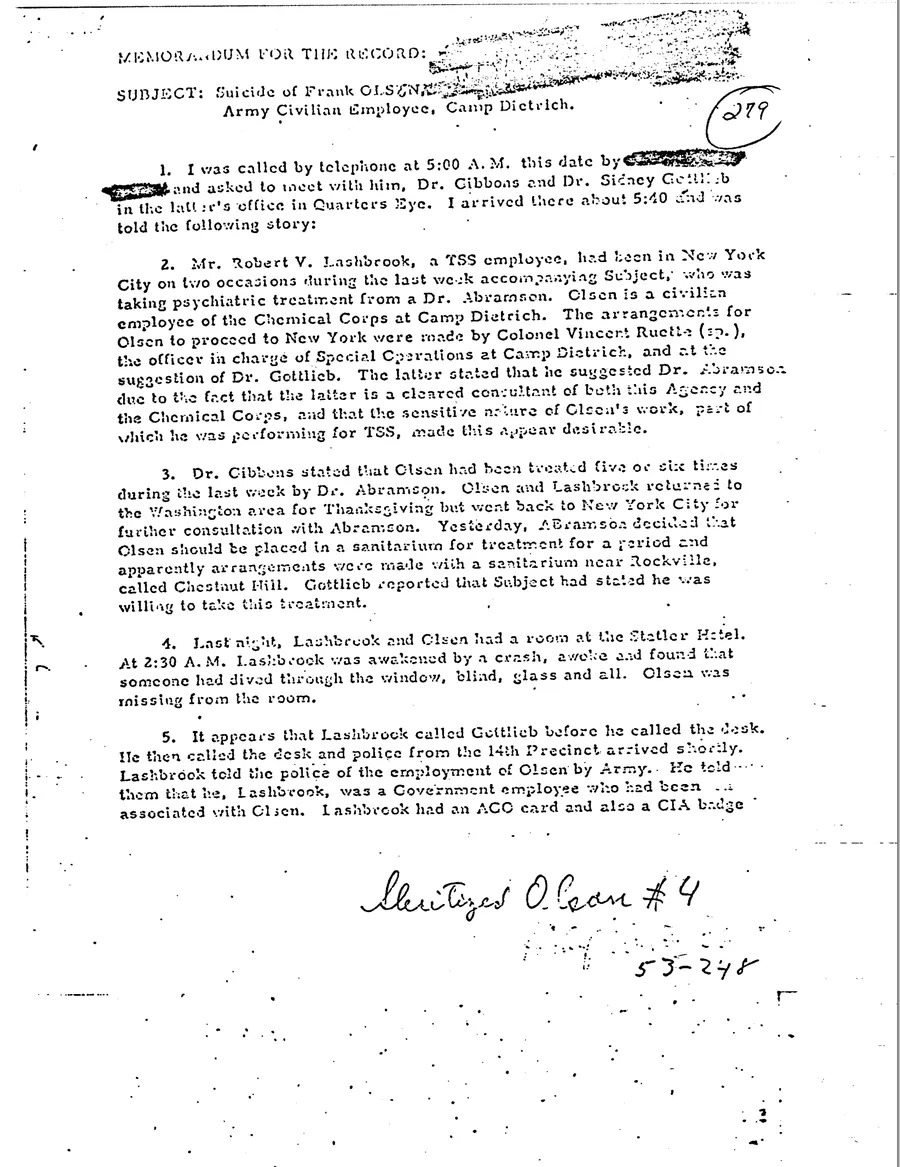
MEMORANDUM FOR THE RECORD:

SUBJECT: Suicide of Frank OLSON [redacted], Army Civilian Employee, Camp Dietrich.

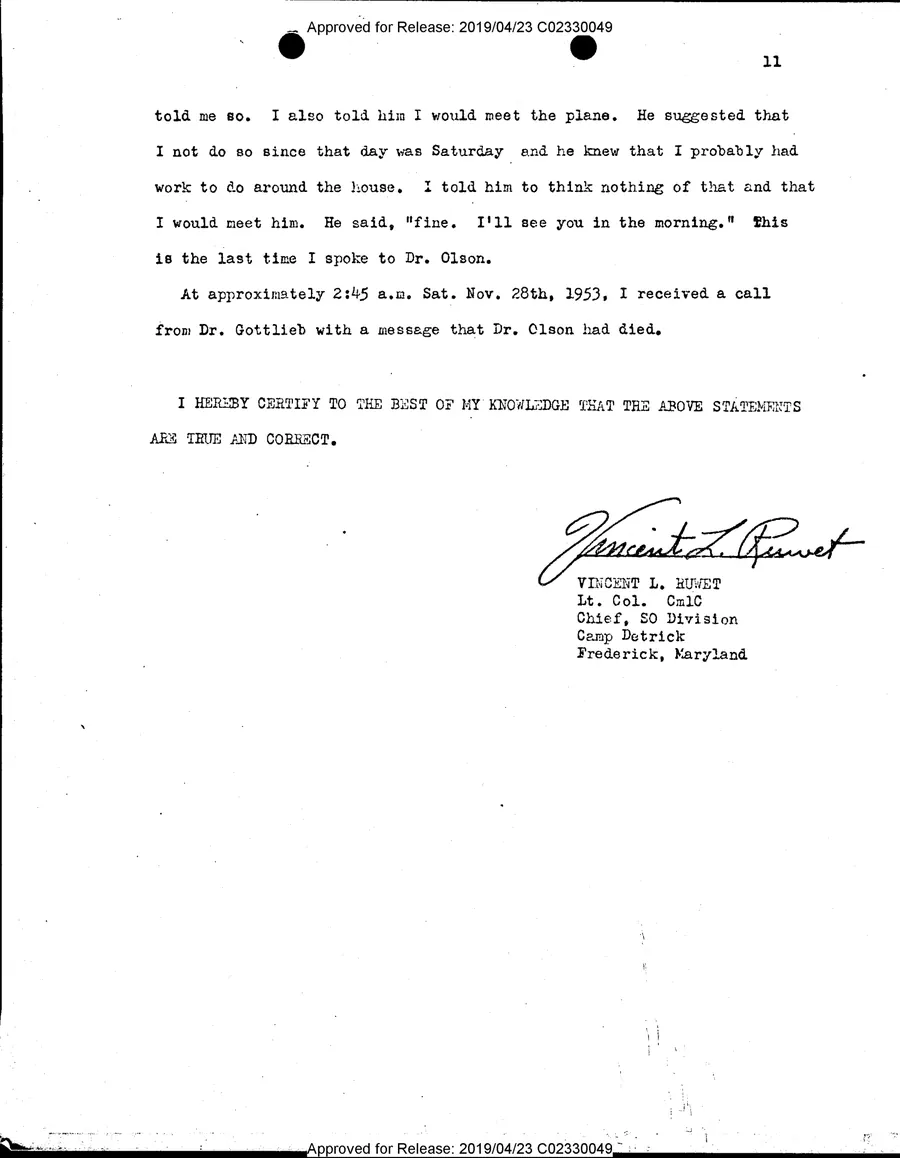
1. I was called by telephone at 5:00 A. M. this date by [redacted] and asked to meet with him, Dr. Gibbons and Dr. Sidney Gottlieb in the latter's office in Quarters Eye. I arrived there about 5:40 and was told the following story:

2. Mr. Robert V. Lashbrook, a TSS employee, had been in New York City on two occasions during the last week accompanying Subject, who was taking psychiatric treatment from a Dr. Abramson. Olsen is a civilian employee of the Chemical Corps at Camp Dietrich. The arrangements for Olsen to proceed to New York were made by Colonel Vincent Ruette (sp.), the officer in charge of Special Operations at Camp Dietrich, and at the suggestion of Dr. Gottlieb. The latter stated that he suggested Dr. Abramson due to the fact that the latter is a cleared consultant of both this Agency and the Chemical Corps, and that the sensitive nature of Olsen's work, part of which he was performing for TSS, made this appear desirable.

3. Dr. Gibbons stated that Olsen had been treated five or six times during the last week by Dr. Abramson. Olsen and Lashbrook returned to the Washington area for Thanksgiving but went back to New York City for further consultation with Abramson. Yesterday, ABramson decided that Olsen should be placed in a sanitarium for treatment for a period and apparently arrangements were made with a sanitarium near Rockville, called Chestnut Hill. Gottlieb reported that Subject had stated he was willing to take this treatment.

4. Last night, Lashbrook and Olsen had a room at the Statler Hotel. At 2:30 A. M. Lashbrook was awakened by a crash, awoke and found that someone had dived through the window, blind, glass and all. Olsen was missing from the room.

5. It appears that Lashbrook called Gottlieb before he called the desk. He then called the desk and police from the 14th Precinct arrived shortly. Lashbrook told the police of the employment of Olsen by Army. He told them that he, Lashbrook, was a Government employee who had been associated with Olsen. Lashbrook had an AGO card and also a CIA badge

Textual notes on this leaf (7)
Camp Dietrich
The installation is Camp Detrick. The document's own spelling throughout. PRESERVED.
Suicide of Frank OLSON
Capitalised in the subject line; the body spells the name 'Olsen' throughout. PRESERVED.
Colonel Vincent Ruette (sp.)
The parenthetical is the typist's own note that the spelling is uncertain; the officer signs elsewhere as Ruwet. Faint on this copy. CONFIRM.
Yesterday, ABramson decided
Capital B in mid-word, as struck. PRESERVED.
an AGO card
Middle letter degraded; read as G, but C is possible. CONFIRM.
Sanitized Olson #4
Ink annotation in the lower half; first word read as 'Sanitized'. CONFIRM.
a CIA badge
The page breaks off here without a full stop; the sentence continues on the next leaf. PRESERVED.
Unnumbered leaf Leaf 2 of 64 · source page 2
FRANK R. OLSON — leaf 2, facsimile of the released scan

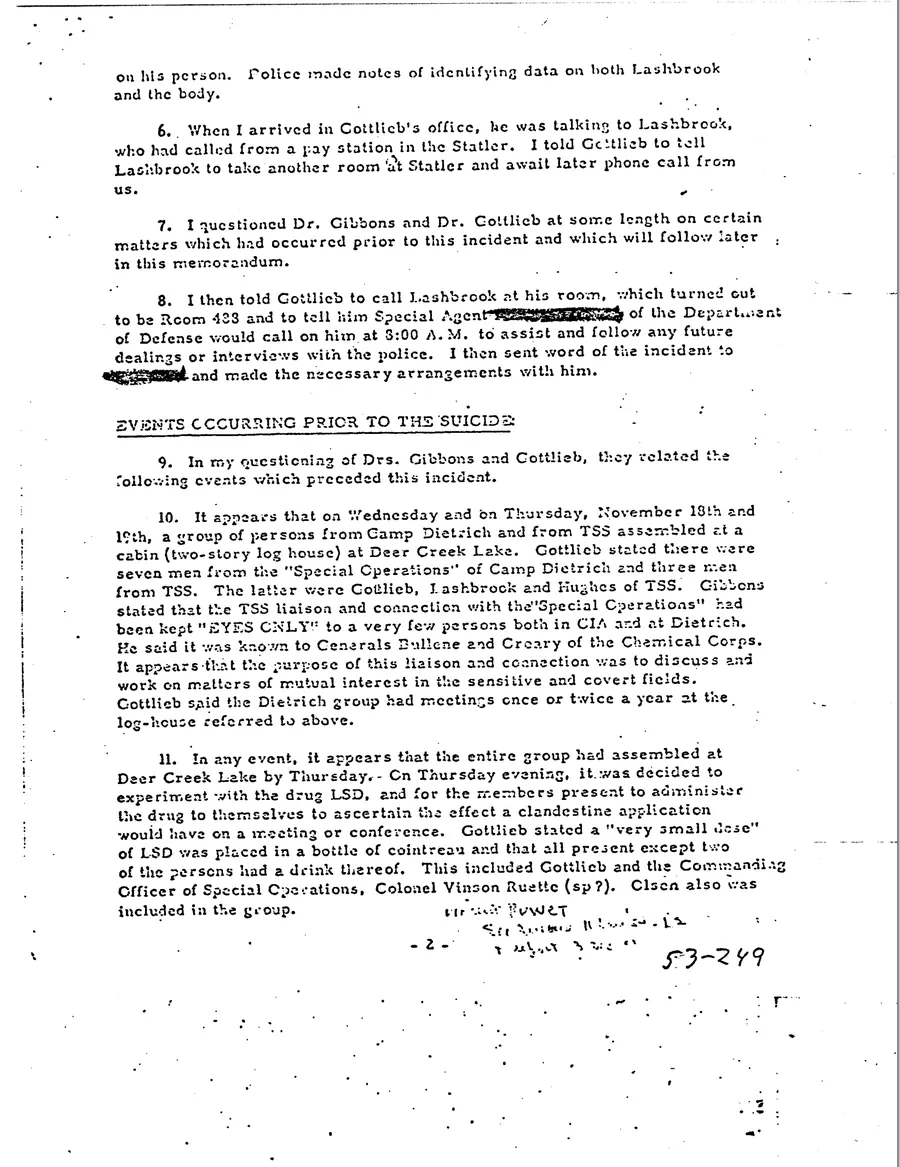
on his person. Police made notes of identifying data on both Lashbrook and the body.

6. When I arrived in Gottlieb's office, he was talking to Lashbrook, who had called from a pay station in the Statler. I told Gottlieb to tell Lashbrook to take another room at Statler and await later phone call from us.

7. I questioned Dr. Gibbons and Dr. Gottlieb at some length on certain matters which had occurred prior to this incident and which will follow later in this memorandum.

8. I then told Gottlieb to call Lashbrook at his room, which turned out to be Room 438 and to tell him Special Agent [redacted] of the Department of Defense would call on him at 8:00 A. M. to assist and follow any future dealings or interviews with the police. I then sent word of the incident to [redacted] and made the necessary arrangements with him.

EVENTS OCCURRING PRIOR TO THE SUICIDE:

9. In my questioning of Drs. Gibbons and Gottlieb, they related the following events which preceded this incident.

10. It appears that on Wednesday and on Thursday, November 18th and 19th, a group of persons from Camp Dietrich and from TSS assembled at a cabin (two-story log house) at Deer Creek Lake. Gottlieb stated there were seven men from the "Special Operations" of Camp Dietrich and three men from TSS. The latter were Gottlieb, Lashbrook and Hughes of TSS. Gibbons stated that the TSS liaison and connection with the"Special Operations" had been kept "EYES ONLY" to a very few persons both in CIA and at Dietrich. He said it was known to Generals Bullene and Creary of the Chemical Corps. It appears that the purpose of this liaison and connection was to discuss and work on matters of mutual interest in the sensitive and covert fields. Gottlieb said the Dietrich group had meetings once or twice a year at the log-house referred to above.

11. In any event, it appears that the entire group had assembled at Deer Creek Lake by Thursday.- On Thursday evening, it was decided to experiment with the drug LSD, and for the members present to administer the drug to themselves to ascertain the effect a clandestine application would have on a meeting or conference. Gottlieb stated a "very small dose" of LSD was placed in a bottle of cointreau and that all present except two of the persons had a drink thereof. This included Gottlieb and the Commanding Officer of Special Operations, Colonel Vinson Ruette (sp?). Olsen also was included in the group.

- 2 -

Textual notes on this leaf (7)
to be Room 438
Second and third digits broken on this copy; read 4-3-8, but '488' is possible. CONFIRM.
Colonel Vinson Ruette (sp?)
Given as 'Vincent Ruette (sp.)' on the first leaf and 'Vinson' here; the parenthetical is the typist's own doubt about the spelling. PRESERVED.
with the"Special Operations"
No space typed between 'the' and the opening quotation mark. PRESERVED.
Deer Creek Lake by Thursday.- On
A hyphen stands between the full stop and 'On'; it may be a stray mark rather than a typed character. CONFIRM.
Vincent RUWET
Pencil annotation at the foot, read in capitals. CONFIRM.
Generals Bullene and Creary
Surnames as typed. CONFIRM.
Camp Dietrich
The installation is Camp Detrick. The document's own spelling, which it shortens to 'Dietrich' further down. PRESERVED.
Unnumbered leaf Leaf 3 of 64 · source page 3
FRANK R. OLSON — leaf 3, facsimile of the released scan

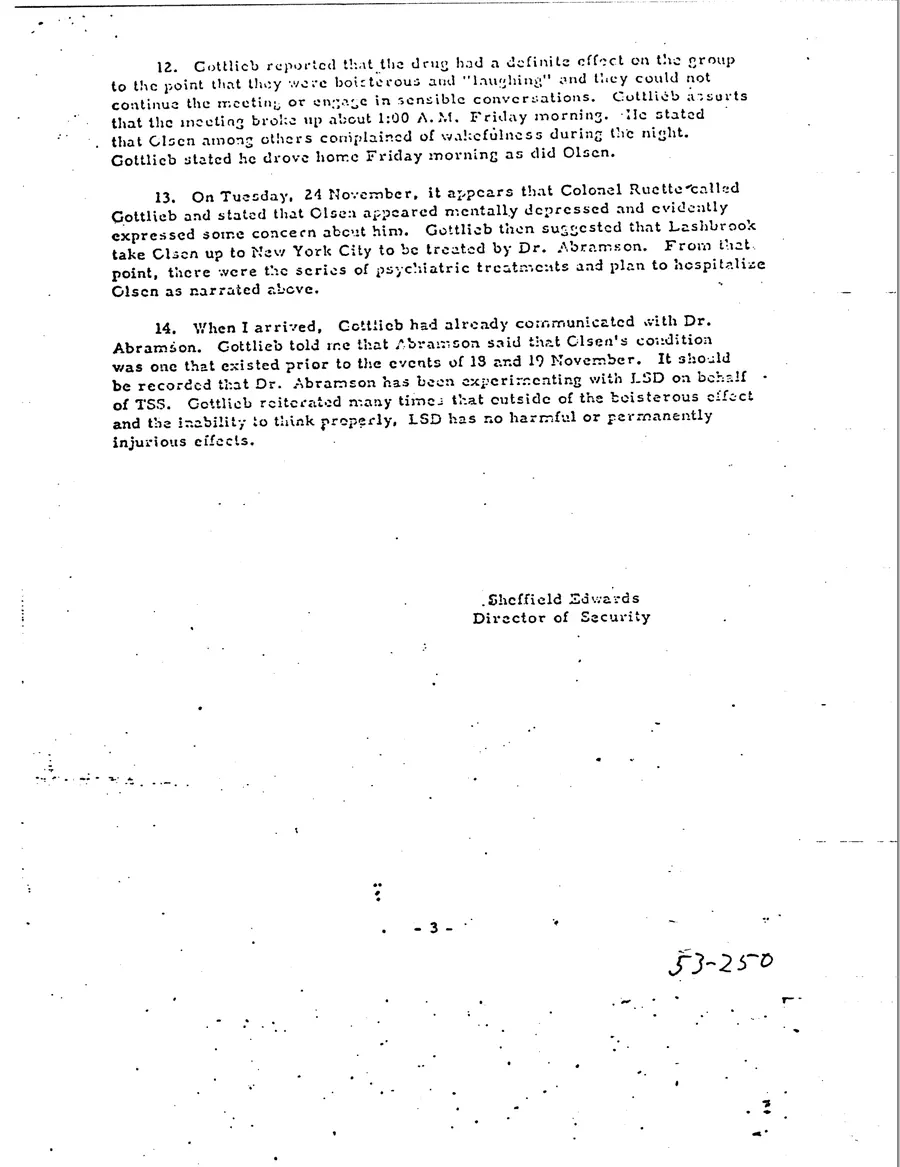
12. Gottlieb reported that the drug had a definite effect on the group to the point that they were boisterous and "laughing" and they could not continue the meeting or engage in sensible conversations. Gottlieb asserts that the meeting broke up about 1:00 A. M. Friday morning. He stated that Olsen among others complained of wakefulness during the night. Gottlieb stated he drove home Friday morning as did Olsen.

13. On Tuesday, 24 November, it appears that Colonel Ruette called Gottlieb and stated that Olsen appeared mentally depressed and evidently expressed some concern about him. Gottlieb then suggested that Lashbrook take Olsen up to New York City to be treated by Dr. Abramson. From that point, there were the series of psychiatric treatments and plan to hospitalize Olsen as narrated above.

14. When I arrived, Gottlieb had already communicated with Dr. Abramson. Gottlieb told me that Abramson said that Olsen's condition was one that existed prior to the events of 18 and 19 November. It should be recorded that Dr. Abramson has been experimenting with LSD on behalf of TSS. Gottlieb reiterated many times that outside of the boisterous effect and the inability to think properly, LSD has no harmful or permanently injurious effects.

Sheffield Edwards Director of Security

- 3 -

Textual notes on this leaf (2)
Colonel Ruette called
A small stray mark stands between 'Ruette' and 'called'; read as page dirt, not a typed character. CONFIRM.
Sheffield Edwards
Typed signature block only; there is no ink signature on this copy. PRESERVED.
Unnumbered leaf Leaf 4 of 64 · source page 4
FRANK R. OLSON — leaf 4, facsimile of the released scan

Order restored. Undated; placed by the date of the report it covers. This is the only leaf printed here from Reading Room record 00144975; the eleven leaves that follow it in that record are the same typing as leaves 16 to 26 of the compilation opposite, in a poorer copy. See the Textual Notes.

(Date) [blank]

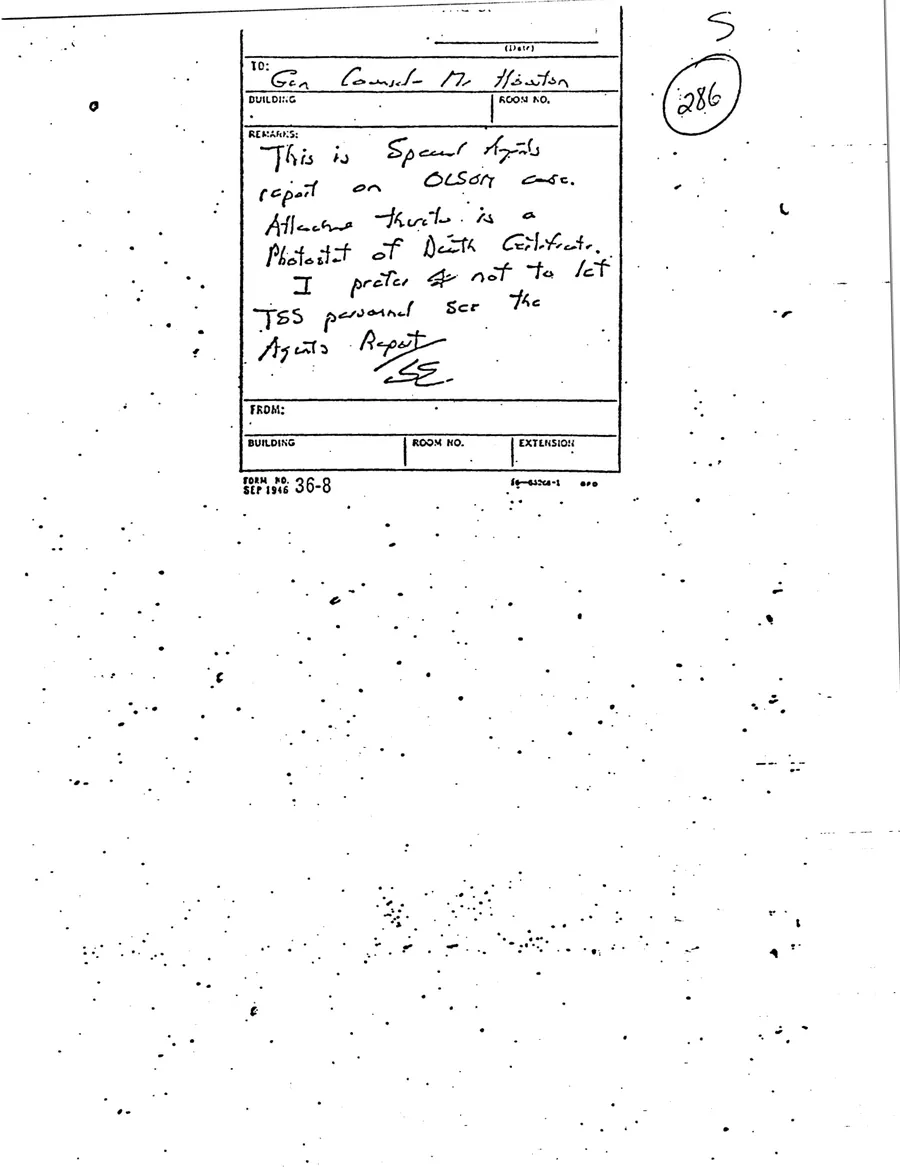
TO: Gen Counsel - Mr. Houston BUILDING [blank] ROOM NO. [blank]

REMARKS: This is Special Agents report on OLSON case. Attached thereto is a Photostat of Death Certificate.

I prefer [struck out] not to let TSS personnel see the Agents Report

SE

FROM: [blank] BUILDING [blank] ROOM NO. [blank] EXTENSION [blank]

FORM NO. 36-8 SEP 1946

Textual notes on this leaf (6)
Gen Counsel - Mr. Houston
Manuscript; 'Gen' and 'Mr' are written without clear full stops. CONFIRM.
This is Special Agents report
No apostrophe written. PRESERVED.
see the Agents Report
No apostrophe written, and no full stop at the end of the note. PRESERVED.
I prefer [struck out] not to let
One short word of two or three letters is struck through between 'prefer' and 'not'; it cannot be read. CONFIRM.
SE
Initials only, not a full signature; read as 'SE'. CONFIRM.
FORM NO. 36-8 SEP 1946
Printed at the foot of the slip on two lines, 'FORM NO. / SEP 1946' at the left and '36-8' set larger beside it. A printer's code and 'GPO' stand at the right of the same line but are illegible on this copy. PRESERVED.
Unnumbered leaf Leaf 5 of 64 · source page 5
FRANK R. OLSON — leaf 5, facsimile of the released scan
Approved for Release: 2019/04/23 C02330049 (head and foot)

Order restored. Reading Room record 02330049, "FRANK R. OLSON", is printed here entire and in its own order: forty-two leaves as the Agency re-released them on 23 April 2019. Nothing is added to it and nothing is taken out.

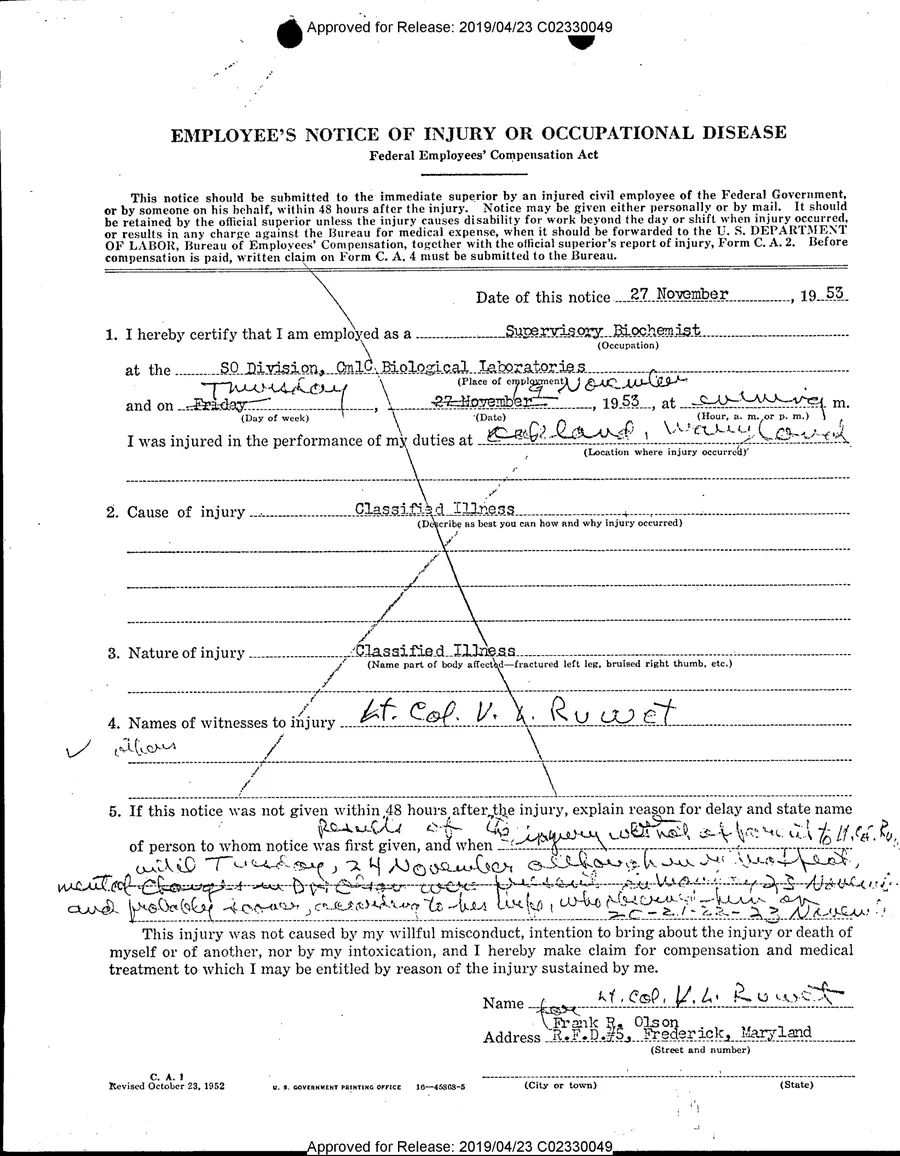
EMPLOYEE'S NOTICE OF INJURY OR OCCUPATIONAL DISEASE

Federal Employees' Compensation Act

This notice should be submitted to the immediate superior by an injured civil employee of the Federal Government, or by someone on his behalf, within 48 hours after the injury. Notice may be given either personally or by mail. It should be retained by the official superior unless the injury causes disability for work beyond the day or shift when injury occurred, or results in any charge against the Bureau for medical expense, when it should be forwarded to the U. S. DEPARTMENT OF LABOR, Bureau of Employees' Compensation, together with the official superior's report of injury, Form C. A. 2. Before compensation is paid, written claim on Form C. A. 4 must be submitted to the Bureau.

Date of this notice 27 November, 19 53

1. I hereby certify that I am employed as a Supervisory Biochemist (Occupation) at the SO Division, CmlC Biological Laboratories (Place of employment)

and on Friday [struck through; 'Thursday' written above], 27 November [struck through; '19 November' written above], 1953, at evening m. (Day of week) (Date) (Hour, a. m. or p. m.) I was injured in the performance of my duties at Oakland, Western Maryland (Location where injury occurred)

2. Cause of injury Classified Illness (Describe as best you can how and why injury occurred)

3. Nature of injury Classified Illness (Name part of body affected-fractured left leg, bruised right thumb, etc.)

4. Names of witnesses to injury Lt. Col. V. L. Ruwet others

5. If this notice was not given within 48 hours after the injury, explain reason for delay and state name of person to whom notice was first given, and when Results of the injury were not evident to Lt. Col. Ruwet until Tuesday, 24 November although mental effect, [struck through: 'mental changes in Dr. Olson were present on Monday 23 November'] and probably sooner, according to his wife, who noticed him on 20-21-22-23 November.

This injury was not caused by my willful misconduct, intention to bring about the injury or death of myself or of another, nor by my intoxication, and I hereby make claim for compensation and medical treatment to which I may be entitled by reason of the injury sustained by me.

Name for Lt. Col. V. L. Ruwet Frank R. Olson Address R.F.D.#5, Frederick, Maryland (Street and number) (City or town) (State)

C. A. 1 Revised October 23, 1952 U. S. GOVERNMENT PRINTING OFFICE 16-45868-5

Textual notes on this leaf (8)
Oakland, Western Maryland
Manuscript place of injury; the two words after 'Oakland' are the least legible on the leaf. CONFIRM.
at evening m.
The hour is written as a word in a field printed for a clock time, leaving the printed 'm.' standing after it. PRESERVED.
Cause of injury Classified Illness
Both item 2 and item 3 are answered with the same two typed words. PRESERVED.
others
One word in ink in the left margin beneath item 4, after a tick; read as 'others', though 'civilians' is possible. CONFIRM.
Results of the injury were not evident to Lt. Col. Ruwet
Manuscript answer to item 5; read as far as the hand allows. CONFIRM.
mental changes in Dr. Olson were present on Monday 23 November
The struck-through line in the item 5 answer, read under the ruled stroke. CONFIRM.
who noticed him on 20-21-22-23 November
The verb is read as 'noticed'; 'observed' is possible. CONFIRM.
for Lt. Col. V. L. Ruwet
The form is an employee's own notice, but it is signed by another officer on the employee's behalf; the employee was dead when it was signed. PRESERVED.
Unnumbered leaf Leaf 6 of 64 · source page 6
FRANK R. OLSON — leaf 6, facsimile of the released scan
Approved for Release: 2019/04/23 C02330049 (head and foot)

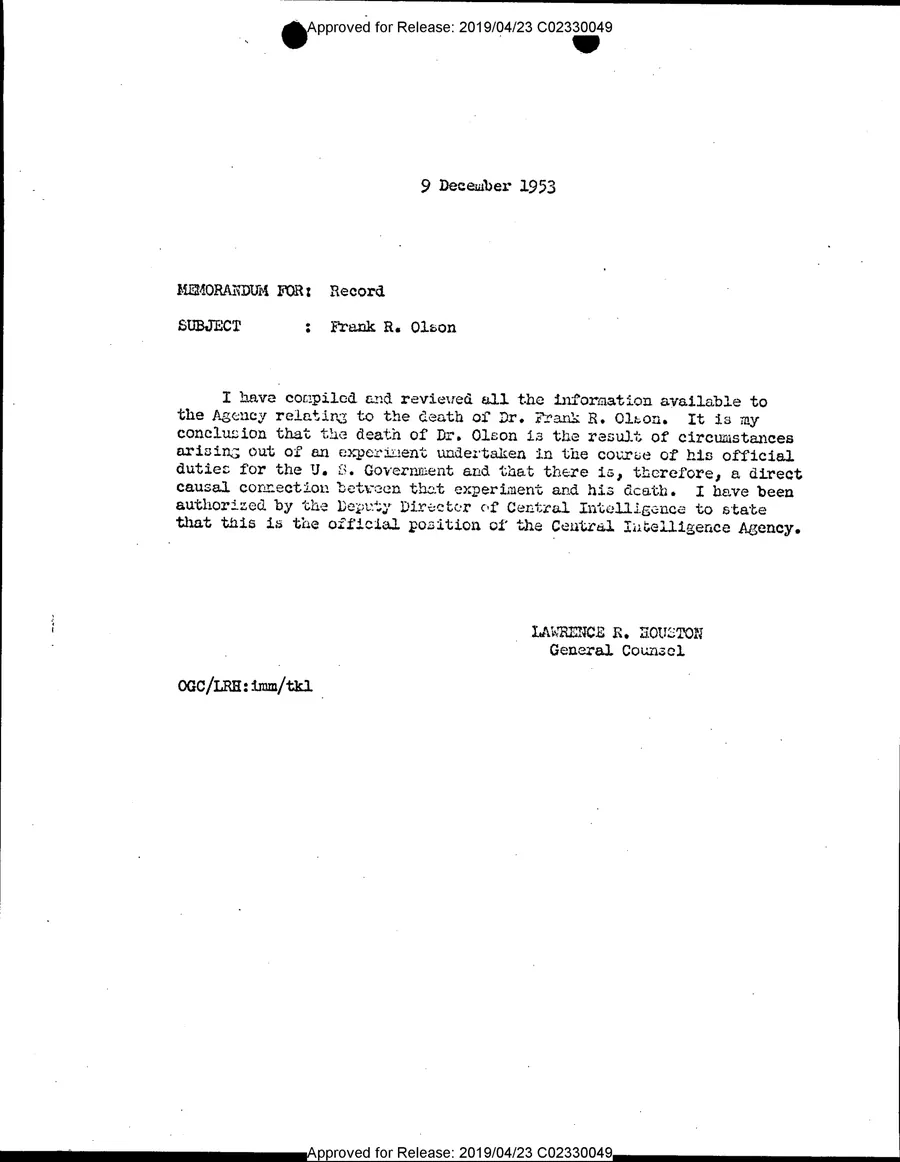
9 December 1953

MEMORANDUM FOR: Record

SUBJECT : Frank R. Olson

I have compiled and reviewed all the information available to the Agency relating to the death of Dr. Frank R. Olson. It is my conclusion that the death of Dr. Olson is the result of circumstances arising out of an experiment undertaken in the course of his official duties for the U. S. Government and that there is, therefore, a direct causal connection between that experiment and his death. I have been authorized by the Deputy Director of Central Intelligence to state that this is the official position of the Central Intelligence Agency.

LAWRENCE R. HOUSTON General Counsel

OGC/LRH:imm/tkl

Textual notes on this leaf (1)
OGC/LRH:imm/tkl
Typist's identification line; the lower-case letters after the colon are read as 'imm' and 'tkl'. CONFIRM.
Unnumbered leaf Leaf 7 of 64 · source page 7
FRANK R. OLSON — leaf 7, facsimile of the released scan
Approved for Release: 2019/04/23 C02330049 (head and foot)

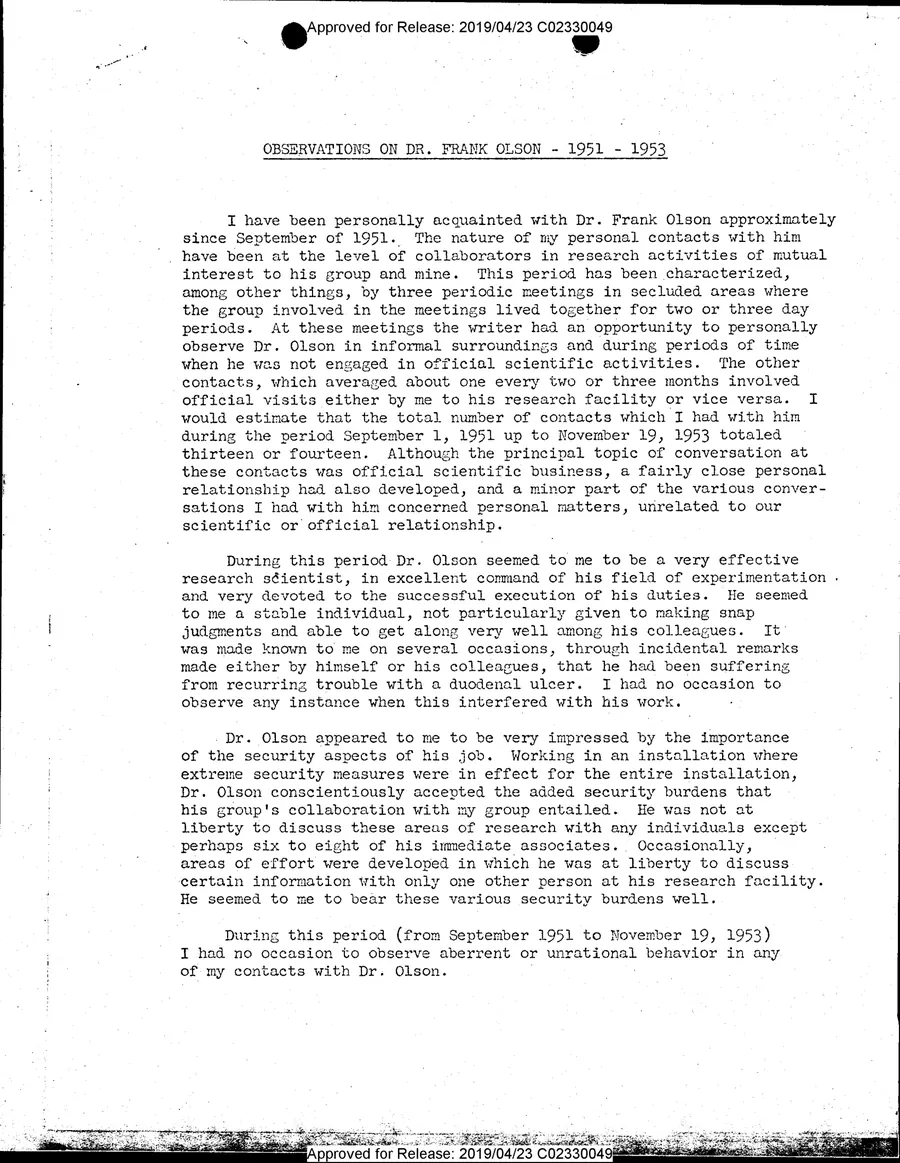
OBSERVATIONS ON DR. FRANK OLSON - 1951 - 1953

I have been personally acquainted with Dr. Frank Olson approximately since September of 1951. The nature of my personal contacts with him have been at the level of collaborators in research activities of mutual interest to his group and mine. This period has been characterized, among other things, by three periodic meetings in secluded areas where the group involved in the meetings lived together for two or three day periods. At these meetings the writer had an opportunity to personally observe Dr. Olson in informal surroundings and during periods of time when he was not engaged in official scientific activities. The other contacts, which averaged about one every two or three months involved official visits either by me to his research facility or vice versa. I would estimate that the total number of contacts which I had with him during the period September 1, 1951 up to November 19, 1953 totaled thirteen or fourteen. Although the principal topic of conversation at these contacts was official scientific business, a fairly close personal relationship had also developed, and a minor part of the various conversations I had with him concerned personal matters, unrelated to our scientific or official relationship.

During this period Dr. Olson seemed to me to be a very effective research scientist, in excellent command of his field of experimentation and very devoted to the successful execution of his duties. He seemed to me a stable individual, not particularly given to making snap judgments and able to get along very well among his colleagues. It was made known to me on several occasions, through incidental remarks made either by himself or his colleagues, that he had been suffering from recurring trouble with a duodenal ulcer. I had no occasion to observe any instance when this interfered with his work.

Dr. Olson appeared to me to be very impressed by the importance of the security aspects of his job. Working in an installation where extreme security measures were in effect for the entire installation, Dr. Olson conscientiously accepted the added security burdens that his group's collaboration with my group entailed. He was not at liberty to discuss these areas of research with any individuals except perhaps six to eight of his immediate associates. Occasionally, areas of effort were developed in which he was at liberty to discuss certain information with only one other person at his research facility. He seemed to me to bear these various security burdens well.

During this period (from September 1951 to November 19, 1953) I had no occasion to observe aberrent or unrational behavior in any of my contacts with Dr. Olson.

Textual notes on this leaf (2)
The nature of my personal contacts with him have been
Plural verb with a singular subject, as typed. PRESERVED.
aberrent or unrational
'aberrent' for aberrant and 'unrational' for irrational. The document's own spellings. PRESERVED.
Printed page 2 Leaf 8 of 64 · source page 8
FRANK R. OLSON — leaf 8, printed page 2, facsimile of the released scan
Approved for Release: 2019/04/23 C02330049 (head and foot)

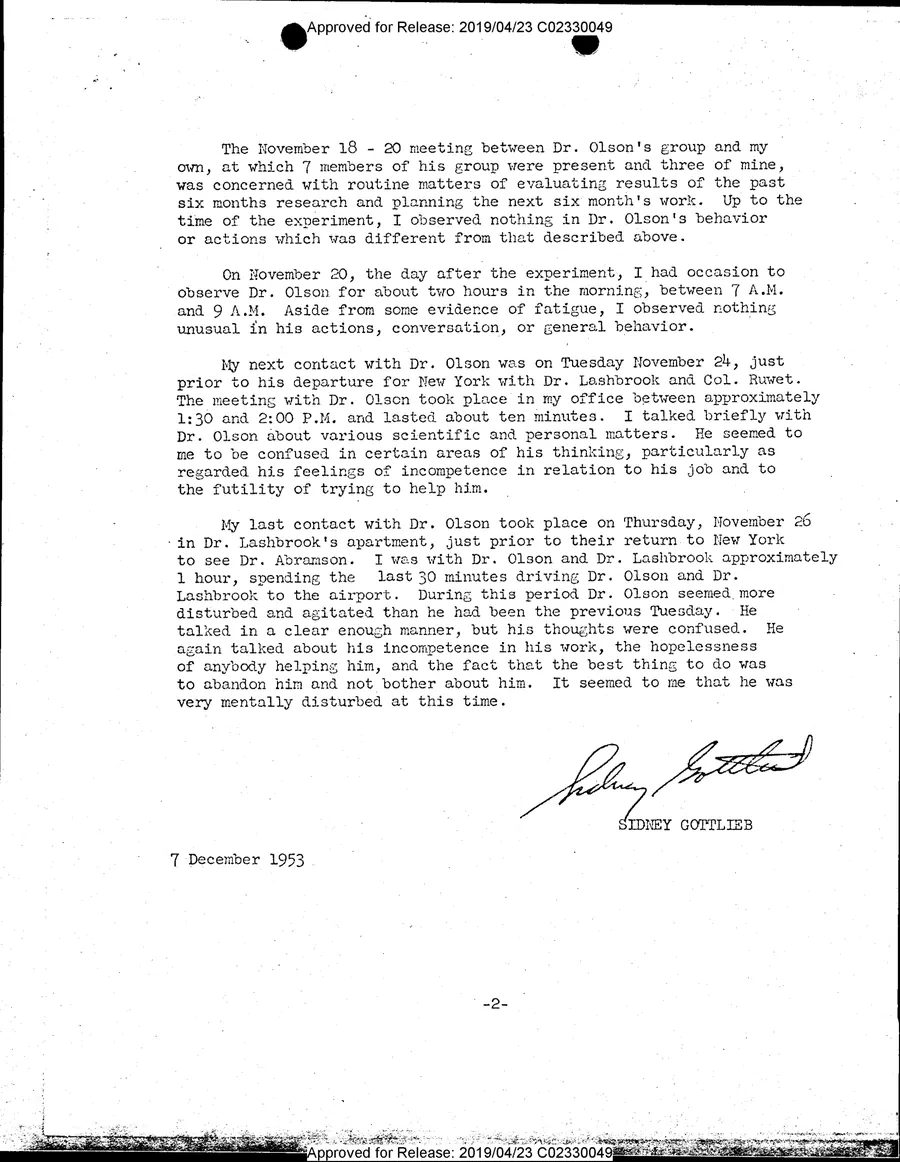
The November 18 - 20 meeting between Dr. Olson's group and my own, at which 7 members of his group were present and three of mine, was concerned with routine matters of evaluating results of the past six months research and planning the next six month's work. Up to the time of the experiment, I observed nothing in Dr. Olson's behavior or actions which was different from that described above.

On November 20, the day after the experiment, I had occasion to observe Dr. Olson for about two hours in the morning, between 7 A.M. and 9 A.M. Aside from some evidence of fatigue, I observed nothing unusual in his actions, conversation, or general behavior.

My next contact with Dr. Olson was on Tuesday November 24, just prior to his departure for New York with Dr. Lashbrook and Col. Ruwet. The meeting with Dr. Olson took place in my office between approximately 1:30 and 2:00 P.M. and lasted about ten minutes. I talked briefly with Dr. Olson about various scientific and personal matters. He seemed to me to be confused in certain areas of his thinking, particularly as regarded his feelings of incompetence in relation to his job and to the futility of trying to help him.

My last contact with Dr. Olson took place on Thursday, November 26 in Dr. Lashbrook's apartment, just prior to their return to New York to see Dr. Abramson. I was with Dr. Olson and Dr. Lashbrook approximately 1 hour, spending the last 30 minutes driving Dr. Olson and Dr. Lashbrook to the airport. During this period Dr. Olson seemed more disturbed and agitated than he had been the previous Tuesday. He talked in a clear enough manner, but his thoughts were confused. He again talked about his incompetence in his work, the hopelessness of anybody helping him, and the fact that the best thing to do was to abandon him and not bother about him. It seemed to me that he was very mentally disturbed at this time.

[signed] SIDNEY GOTTLIEB

7 December 1953

-2-

Textual notes on this leaf (1)
the next six month's work
Apostrophe placed as typed. PRESERVED.
Unnumbered leaf Leaf 9 of 64 · source page 9
FRANK R. OLSON — leaf 9, facsimile of the released scan
Approved for Release: 2019/04/23 C02330049 (head and foot)

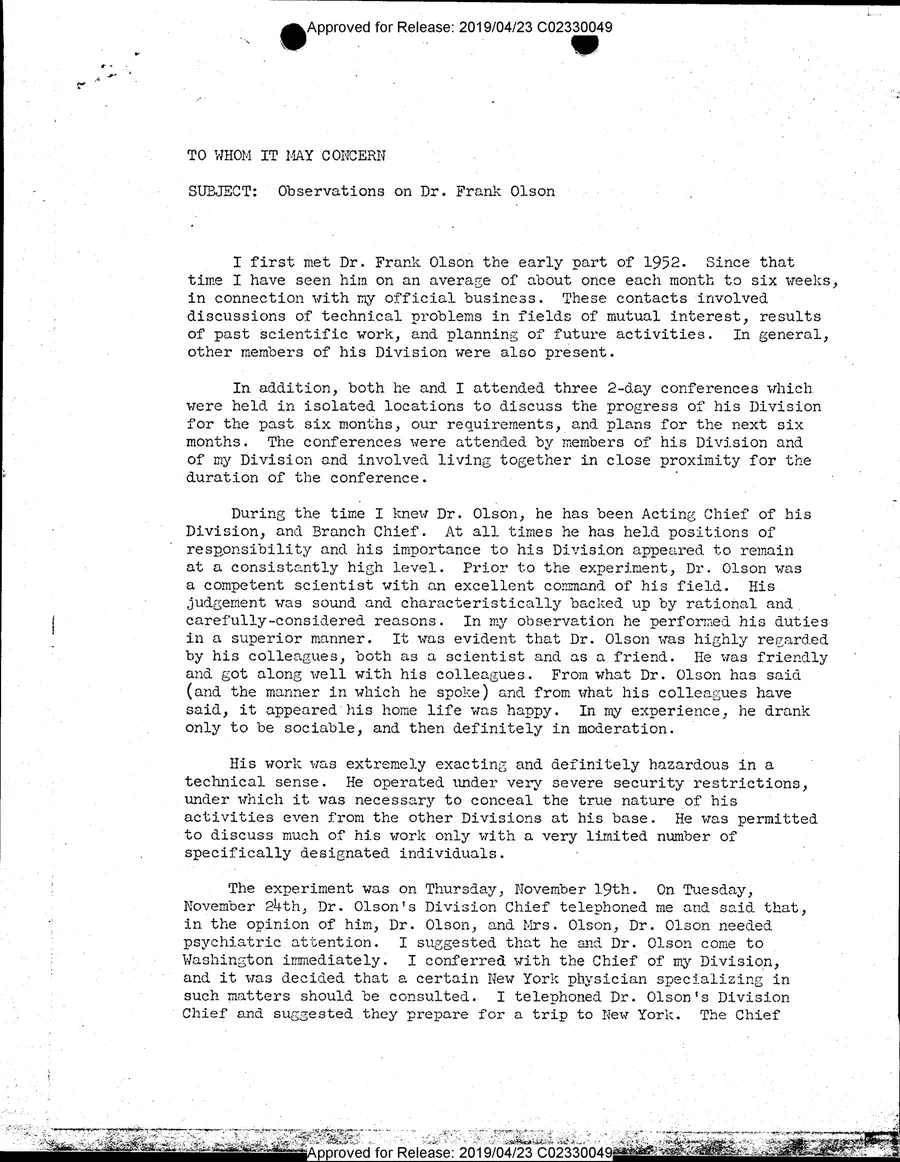
TO WHOM IT MAY CONCERN

SUBJECT: Observations on Dr. Frank Olson

I first met Dr. Frank Olson the early part of 1952. Since that time I have seen him on an average of about once each month to six weeks, in connection with my official business. These contacts involved discussions of technical problems in fields of mutual interest, results of past scientific work, and planning of future activities. In general, other members of his Division were also present.

In addition, both he and I attended three 2-day conferences which were held in isolated locations to discuss the progress of his Division for the past six months, our requirements, and plans for the next six months. The conferences were attended by members of his Division and of my Division and involved living together in close proximity for the duration of the conference.

During the time I knew Dr. Olson, he has been Acting Chief of his Division, and Branch Chief. At all times he has held positions of responsibility and his importance to his Division appeared to remain at a consistantly high level. Prior to the experiment, Dr. Olson was a competent scientist with an excellent command of his field. His judgement was sound and characteristically backed up by rational and carefully-considered reasons. In my observation he performed his duties in a superior manner. It was evident that Dr. Olson was highly regarded by his colleagues, both as a scientist and as a friend. He was friendly and got along well with his colleagues. From what Dr. Olson has said (and the manner in which he spoke) and from what his colleagues have said, it appeared his home life was happy. In my experience, he drank only to be sociable, and then definitely in moderation.

His work was extremely exacting and definitely hazardous in a technical sense. He operated under very severe security restrictions, under which it was necessary to conceal the true nature of his activities even from the other Divisions at his base. He was permitted to discuss much of his work only with a very limited number of specifically designated individuals.

The experiment was on Thursday, November 19th. On Tuesday, November 24th, Dr. Olson's Division Chief telephoned me and said that, in the opinion of him, Dr. Olson, and Mrs. Olson, Dr. Olson needed psychiatric attention. I suggested that he and Dr. Olson come to Washington immediately. I conferred with the Chief of my Division, and it was decided that a certain New York physician specializing in such matters should be consulted. I telephoned Dr. Olson's Division Chief and suggested they prepare for a trip to New York. The Chief

Textual notes on this leaf (2)
consistantly
Misspelling of 'consistently'. The document's own error. PRESERVED.
judgement
Spelled with the medial 'e'. PRESERVED.
Printed page 2 Leaf 10 of 64 · source page 10
FRANK R. OLSON — leaf 10, printed page 2, facsimile of the released scan
Approved for Release: 2019/04/23 C02330049 (head and foot)

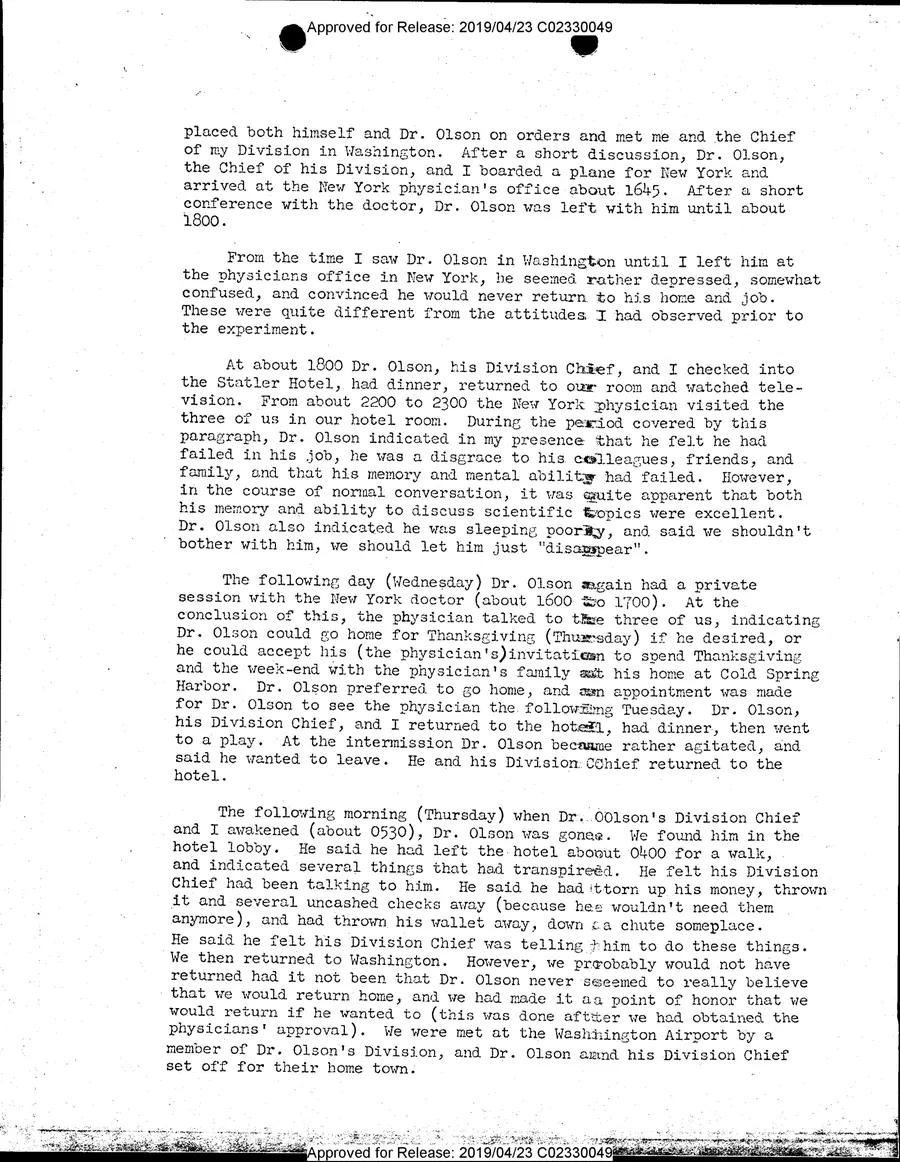
placed both himself and Dr. Olson on orders and met me and the Chief of my Division in Washington. After a short discussion, Dr. Olson, the Chief of his Division, and I boarded a plane for New York and arrived at the New York physician's office about 1645. After a short conference with the doctor, Dr. Olson was left with him until about 1800.

From the time I saw Dr. Olson in Washington until I left him at the physicians office in New York, he seemed rather depressed, somewhat confused, and convinced he would never return to his home and job. These were quite different from the attitudes I had observed prior to the experiment.

At about 1800 Dr. Olson, his Division Chief, and I checked into the Statler Hotel, had dinner, returned to our room and watched television. From about 2200 to 2300 the New York physician visited the three of us in our hotel room. During the period covered by this paragraph, Dr. Olson indicated in my presence that he felt he had failed in his job, he was a disgrace to his colleagues, friends, and family, and that his memory and mental ability had failed. However, in the course of normal conversation, it was quite apparent that both his memory and ability to discuss scientific topics were excellent. Dr. Olson also indicated he was sleeping poorly, and said we shouldn't bother with him, we should let him just "disappear".

The following day (Wednesday) Dr. Olson again had a private session with the New York doctor (about 1600 to 1700). At the conclusion of this, the physician talked to the three of us, indicating Dr. Olson could go home for Thanksgiving (Thursday) if he desired, or he could accept his (the physician's) invitation to spend Thanksgiving and the week-end with the physician's family at his home at Cold Spring Harbor. Dr. Olson preferred to go home, and an appointment was made for Dr. Olson to see the physician the following Tuesday. Dr. Olson, his Division Chief, and I returned to the hotel, had dinner, then went to a play. At the intermission Dr. Olson became rather agitated, and said he wanted to leave. He and his Division Chief returned to the hotel.

The following morning (Thursday) when Dr. Olson's Division Chief and I awakened (about 0530), Dr. Olson was gone. We found him in the hotel lobby. He said he had left the hotel about 0400 for a walk, and indicated several things that had transpired. He felt his Division Chief had been talking to him. He said he had torn up his money, thrown it and several uncashed checks away (because he wouldn't need them anymore), and had thrown his wallet away, down a chute someplace. He said he felt his Division Chief was telling him to do these things. We then returned to Washington. However, we probably would not have returned had it not been that Dr. Olson never seemed to really believe that we would return home, and we had made it a point of honor that we would return if he wanted to (this was done after we had obtained the physicians' approval). We were met at the Washington Airport by a member of Dr. Olson's Division, and Dr. Olson and his Division Chief set off for their home town.

Textual notes on this leaf (2)
vertical streak of doubled characters
A vertical band of smeared toner about two thirds of the way across the leaf doubles or thickens one character on most lines (the OCR layer renders 'our' as 'oum', 'ability' as 'abilitg', 'disappear' as 'disasgpear'). Read through the streak to the intended characters; this is a scan defect, not the typist's. Not a textual reading.
the physicians office
No apostrophe, as typed. PRESERVED. Later on the same leaf the typist writes 'the physicians' approval' with the apostrophe after the s. Both kept.
Printed page 3 Leaf 11 of 64 · source page 11
FRANK R. OLSON — leaf 11, printed page 3, facsimile of the released scan
Approved for Release: 2019/04/23 C02330049 (head and foot)

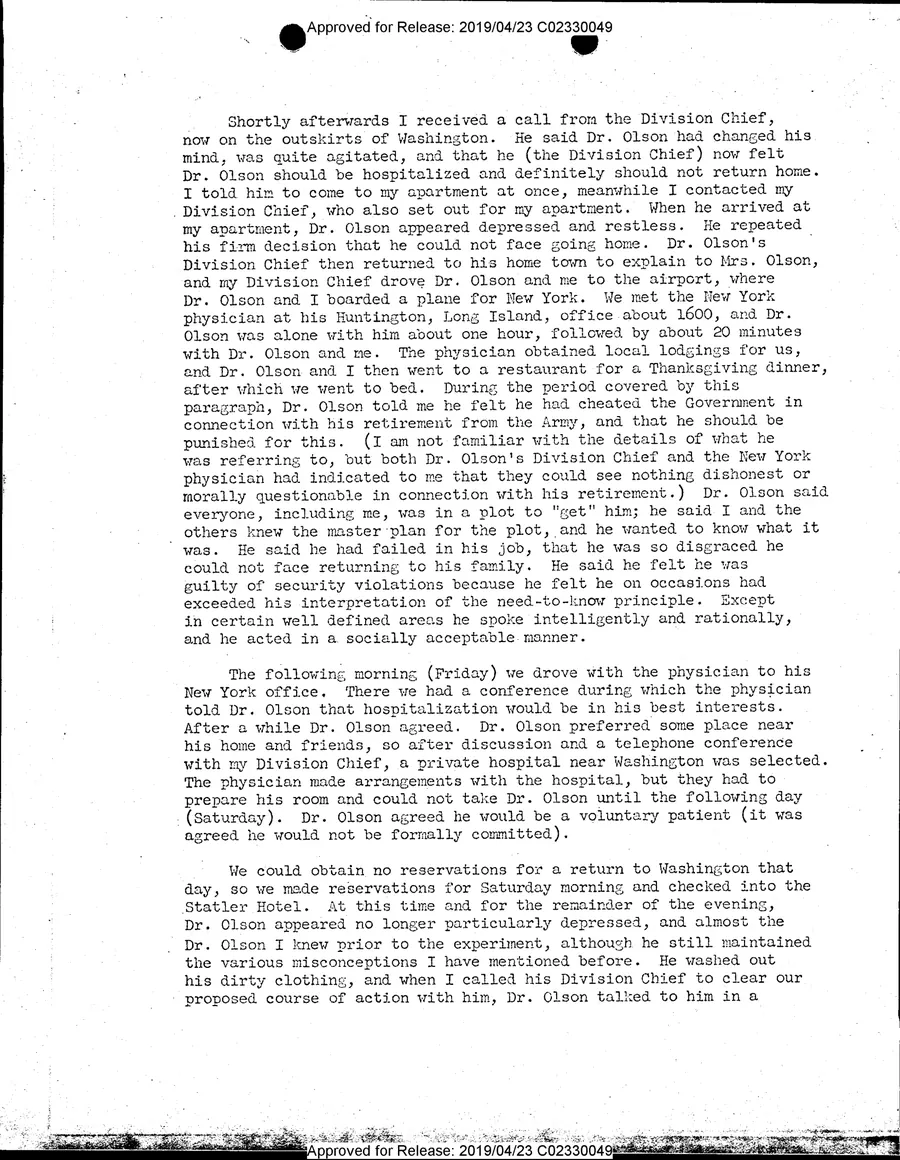
Shortly afterwards I received a call from the Division Chief, now on the outskirts of Washington. He said Dr. Olson had changed his mind, was quite agitated, and that he (the Division Chief) now felt Dr. Olson should be hospitalized and definitely should not return home. I told him to come to my apartment at once, meanwhile I contacted my Division Chief, who also set out for my apartment. When he arrived at my apartment, Dr. Olson appeared depressed and restless. He repeated his firm decision that he could not face going home. Dr. Olson's Division Chief then returned to his home town to explain to Mrs. Olson, and my Division Chief drove Dr. Olson and me to the airport, where Dr. Olson and I boarded a plane for New York. We met the New York physician at his Huntington, Long Island, office about 1600, and Dr. Olson was alone with him about one hour, followed by about 20 minutes with Dr. Olson and me. The physician obtained local lodgings for us, and Dr. Olson and I then went to a restaurant for a Thanksgiving dinner, after which we went to bed. During the period covered by this paragraph, Dr. Olson told me he felt he had cheated the Government in connection with his retirement from the Army, and that he should be punished for this. (I am not familiar with the details of what he was referring to, but both Dr. Olson's Division Chief and the New York physician had indicated to me that they could see nothing dishonest or morally questionable in connection with his retirement.) Dr. Olson said everyone, including me, was in a plot to "get" him; he said I and the others knew the master plan for the plot, and he wanted to know what it was. He said he had failed in his job, that he was so disgraced he could not face returning to his family. He said he felt he was guilty of security violations because he felt he on occasions had exceeded his interpretation of the need-to-know principle. Except in certain well defined areas he spoke intelligently and rationally, and he acted in a socially acceptable manner.

The following morning (Friday) we drove with the physician to his New York office. There we had a conference during which the physician told Dr. Olson that hospitalization would be in his best interests. After a while Dr. Olson agreed. Dr. Olson preferred some place near his home and friends, so after discussion and a telephone conference with my Division Chief, a private hospital near Washington was selected. The physician made arrangements with the hospital, but they had to prepare his room and could not take Dr. Olson until the following day (Saturday). Dr. Olson agreed he would be a voluntary patient (it was agreed he would not be formally committed).

We could obtain no reservations for a return to Washington that day, so we made reservations for Saturday morning and checked into the Statler Hotel. At this time and for the remainder of the evening, Dr. Olson appeared no longer particularly depressed, and almost the Dr. Olson I knew prior to the experiment, although he still maintained the various misconceptions I have mentioned before. He washed out his dirty clothing, and when I called his Division Chief to clear our proposed course of action with him, Dr. Olson talked to him in a

Printed page 4 Leaf 12 of 64 · source page 12
FRANK R. OLSON — leaf 12, printed page 4, facsimile of the released scan
Approved for Release: 2019/04/23 C02330049 (head and foot)

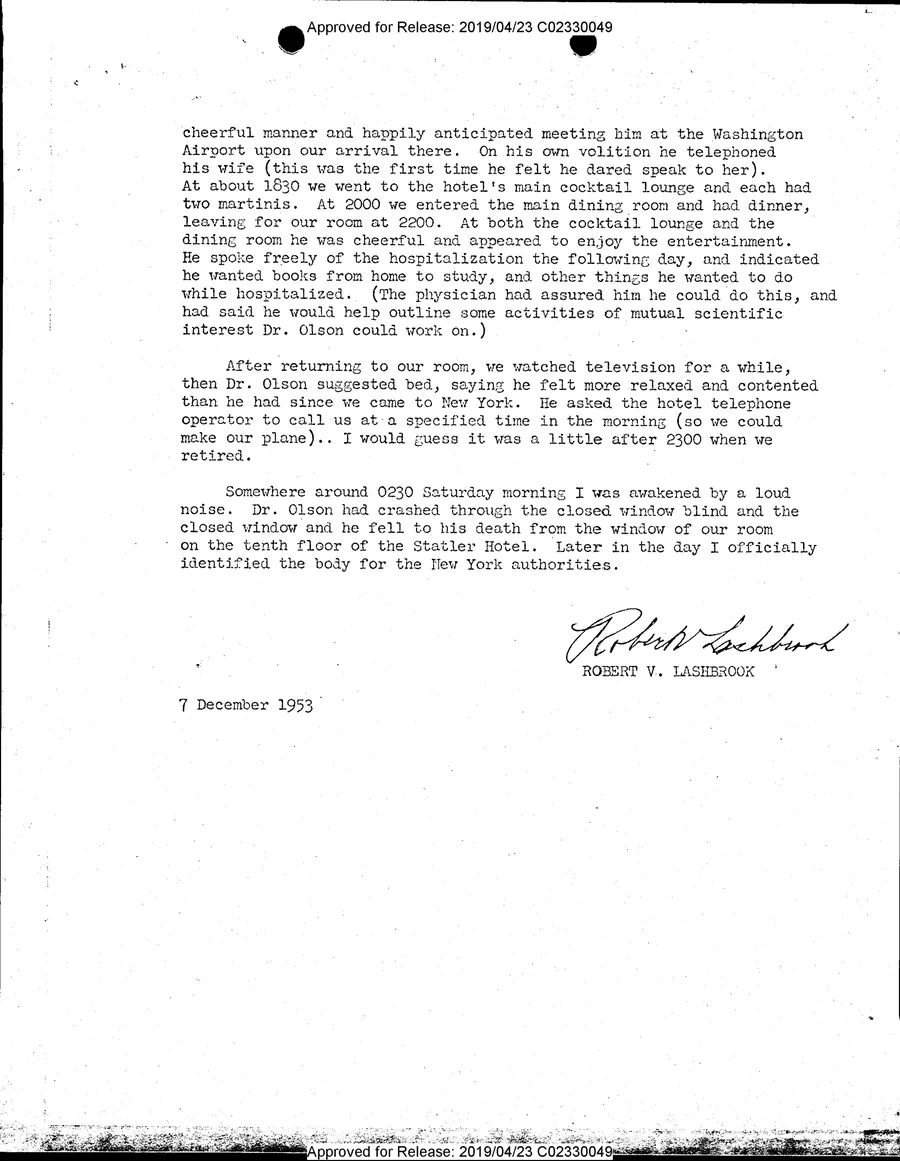
cheerful manner and happily anticipated meeting him at the Washington Airport upon our arrival there. On his own volition he telephoned his wife (this was the first time he felt he dared speak to her). At about 1830 we went to the hotel's main cocktail lounge and each had two martinis. At 2000 we entered the main dining room and had dinner, leaving for our room at 2200. At both the cocktail lounge and the dining room he was cheerful and appeared to enjoy the entertainment. He spoke freely of the hospitalization the following day, and indicated he wanted books from home to study, and other things he wanted to do while hospitalized. (The physician had assured him he could do this, and had said he would help outline some activities of mutual scientific interest Dr. Olson could work on.)

After returning to our room, we watched television for a while, then Dr. Olson suggested bed, saying he felt more relaxed and contented than he had since we came to New York. He asked the hotel telephone operator to call us at a specified time in the morning (so we could make our plane).. I would guess it was a little after 2300 when we retired.

Somewhere around 0230 Saturday morning I was awakened by a loud noise. Dr. Olson had crashed through the closed window blind and the closed window and he fell to his death from the window of our room on the tenth floor of the Statler Hotel. Later in the day I officially identified the body for the New York authorities.

[signed] ROBERT V. LASHBROOK

7 December 1953

Textual notes on this leaf (1)
make our plane)..
Two full stops after the closing parenthesis, as typed. PRESERVED.
Unnumbered leaf Leaf 13 of 64 · source page 13
FRANK R. OLSON — leaf 13, facsimile of the released scan
Approved for Release: 2019/04/23 C02330049 (head and foot) · SECRET / SECURITY INFORMATION, stamped at head and foot

Order restored. Four leaves are missing here. Leaves 9 to 12 of the compilation are a memorandum for the General Counsel signed by Dr Harold A. Abramson, the private physician who saw Dr Olson in New York. His writing is not a work of the United States Government and is not reproduced in this edition. Nothing else in the compilation is left out.

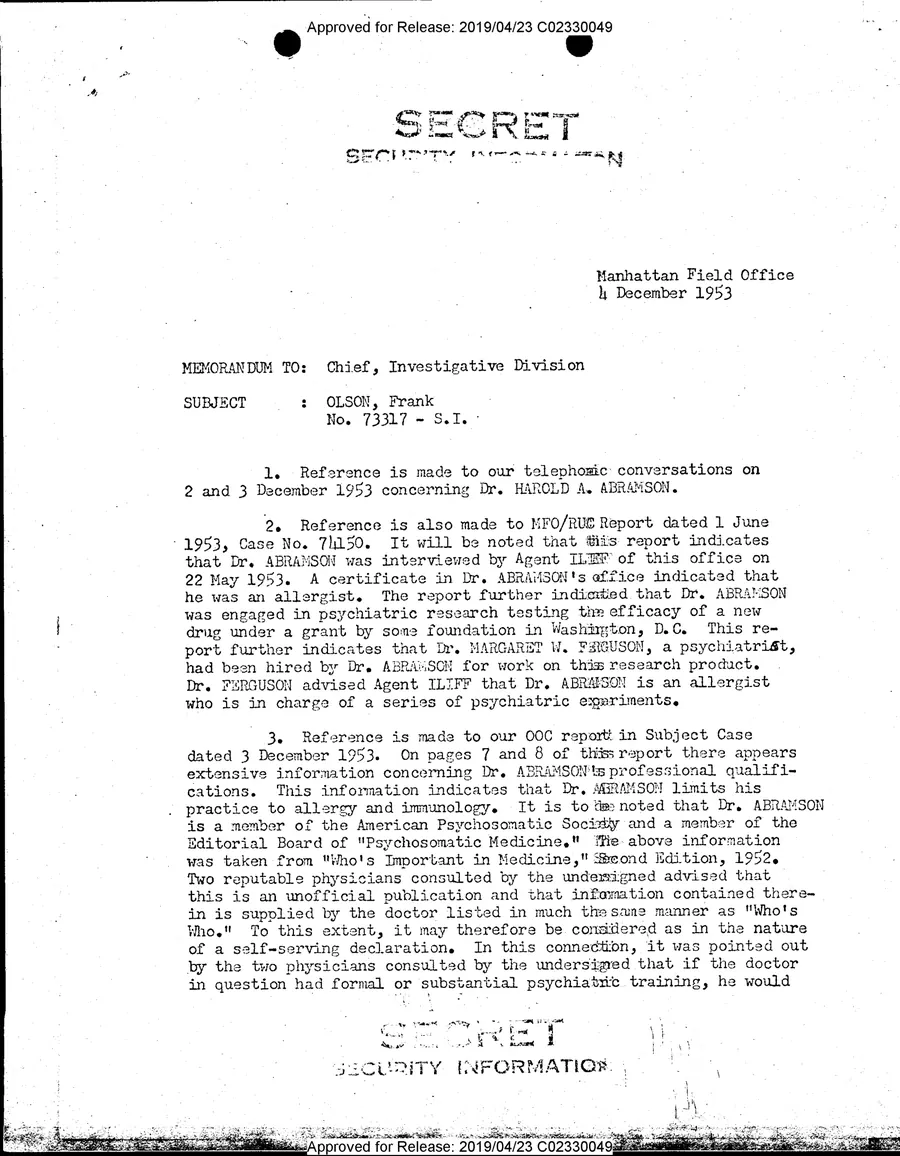
Manhattan Field Office 4 December 1953

MEMORANDUM TO: Chief, Investigative Division

SUBJECT : OLSON, Frank No. 73317 - S.I.

1. Reference is made to our telephonic conversations on 2 and 3 December 1953 concerning Dr. HAROLD A. ABRAMSON.

2. Reference is also made to MFO/RUC Report dated 1 June 1953, Case No. 74150. It will be noted that this report indicates that Dr. ABRAMSON was interviewed by Agent ILIFF of this office on 22 May 1953. A certificate in Dr. ABRAMSON's office indicated that he was an allergist. The report further indicated that Dr. ABRAMSON was engaged in psychiatric research testing the efficacy of a new drug under a grant by some foundation in Washington, D. C. This report further indicates that Dr. MARGARET W. FERGUSON, a psychiatrist, had been hired by Dr. ABRAMSON for work on this research product. Dr. FERGUSON advised Agent ILIFF that Dr. ABRAMSON is an allergist who is in charge of a series of psychiatric experiments.

3. Reference is made to our OOC report in Subject Case dated 3 December 1953. On pages 7 and 8 of this report there appears extensive information concerning Dr. ABRAMSON's professional qualifications. This information indicates that Dr. ABRAMSON limits his practice to allergy and immunology. It is to be noted that Dr. ABRAMSON is a member of the American Psychosomatic Society and a member of the Editorial Board of "Psychosomatic Medicine." The above information was taken from "Who's Important in Medicine," Second Edition, 1952. Two reputable physicians consulted by the undersigned advised that this is an unofficial publication and that information contained therein is supplied by the doctor listed in much the same manner as "Who's Who." To this extent, it may therefore be considered as in the nature of a self-serving declaration. In this connection, it was pointed out by the two physicians consulted by the undersigned that if the doctor in question had formal or substantial psychiatric training, he would

Textual notes on this leaf (4)
our OOC report
Office symbol read as three letters, O-O-C. CONFIRM.
SUBJECT : OLSON, Frank
A space stands before the colon, as typed. PRESERVED.
Agent ILIFF
Surname in capitals, as typed; the type is worn. CONFIRM.
Case No. 74150
The referenced case number, distinct from the subject case number 73317. PRESERVED.
Printed page 2 Leaf 14 of 64 · source page 14
FRANK R. OLSON — leaf 14, printed page 2, facsimile of the released scan
Approved for Release: 2019/04/23 C02330049 (head and foot) · SECRET / SECURITY INFORMATION, stamped at head and foot

Case No. 73317

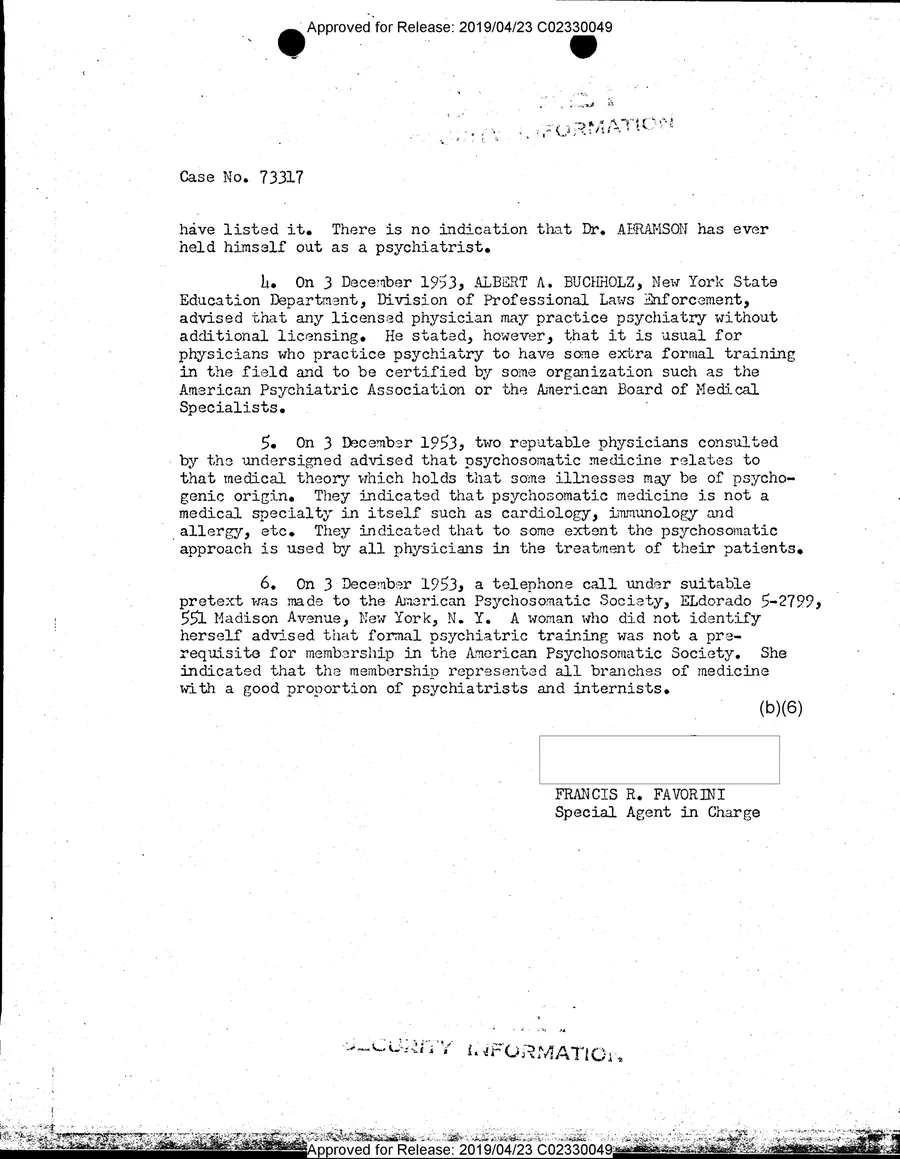
have listed it. There is no indication that Dr. ABRAMSON has ever held himself out as a psychiatrist.

4. On 3 December 1953, ALBERT A. BUCHHOLZ, New York State Education Department, Division of Professional Laws Enforcement, advised that any licensed physician may practice psychiatry without additional licensing. He stated, however, that it is usual for physicians who practice psychiatry to have some extra formal training in the field and to be certified by some organization such as the American Psychiatric Association or the American Board of Medical Specialists.

5. On 3 December 1953, two reputable physicians consulted by the undersigned advised that psychosomatic medicine relates to that medical theory which holds that some illnesses may be of psychogenic origin. They indicated that psychosomatic medicine is not a medical specialty in itself such as cardiology, immunology and allergy, etc. They indicated that to some extent the psychosomatic approach is used by all physicians in the treatment of their patients.

6. On 3 December 1953, a telephone call under suitable pretext was made to the American Psychosomatic Society, ELdorado 5-2799, 551 Madison Avenue, New York, N. Y. A woman who did not identify herself advised that formal psychiatric training was not a prerequisite for membership in the American Psychosomatic Society. She indicated that the membership represented all branches of medicine with a good proportion of psychiatrists and internists.

[redacted] FRANCIS R. FAVORINI Special Agent in Charge

Textual notes on this leaf (3)
ELdorado 5-2799
Telephone exchange name typed with a capital L, as was then usual. PRESERVED.
ALBERT A. BUCHHOLZ
Surname in capitals, as typed. CONFIRM.
have listed it.
The leaf opens mid-sentence; the sentence begins on the preceding leaf. PRESERVED.
Unnumbered leaf Leaf 15 of 64 · source page 15
FRANK R. OLSON — leaf 15, facsimile of the released scan
Approved for Release: 2019/04/23 C02330049 (head and foot) · SECRET / SECURITY INFORMATION, stamped over the printed CLASS: line at head and foot · FINAL, stamped diagonally across the CHARACTER OF CASE and REPORT MADE BY panels

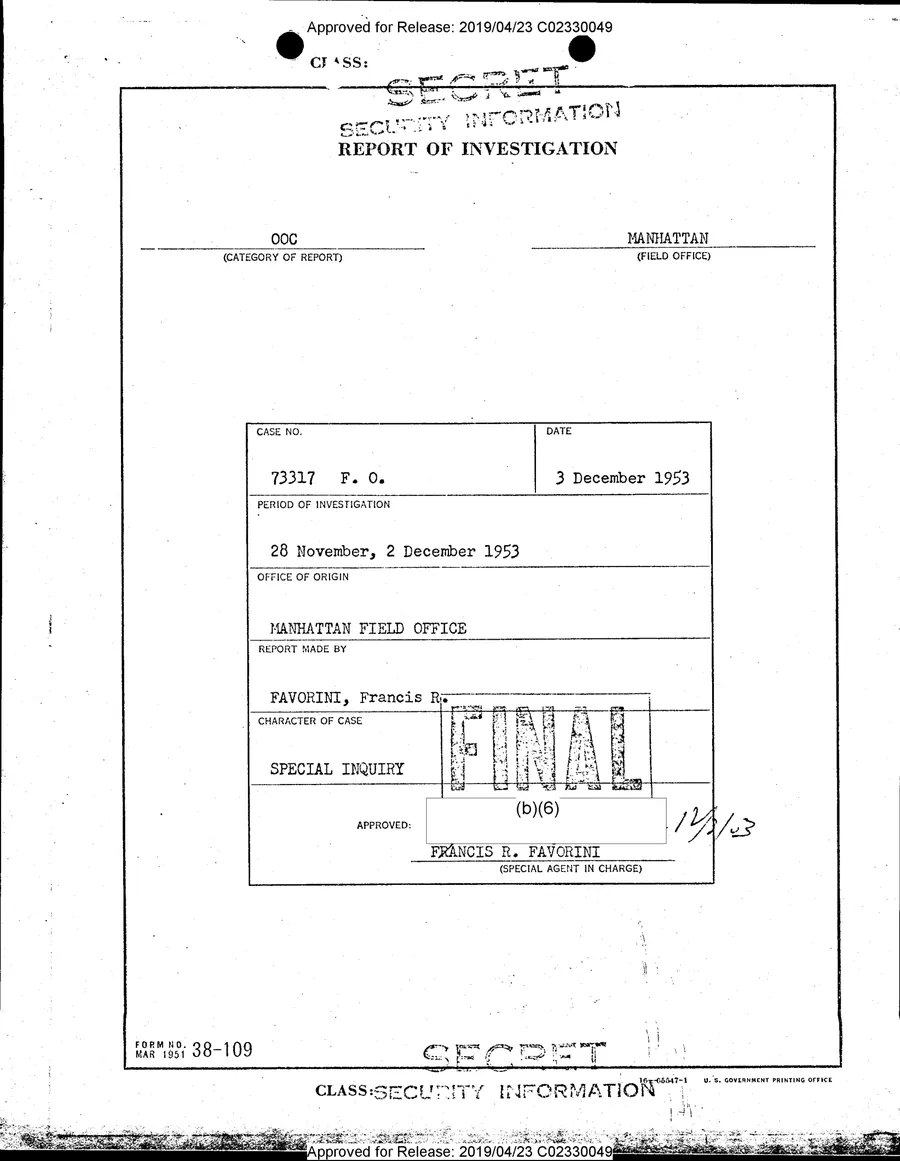
CLASS:

REPORT OF INVESTIGATION

OOC (CATEGORY OF REPORT) MANHATTAN (FIELD OFFICE)

CASE NO. 73317 F. O. DATE 3 December 1953 PERIOD OF INVESTIGATION 28 November, 2 December 1953 OFFICE OF ORIGIN MANHATTAN FIELD OFFICE REPORT MADE BY FAVORINI, Francis R. CHARACTER OF CASE SPECIAL INQUIRY

APPROVED: [redacted] FRANCIS R. FAVORINI (SPECIAL AGENT IN CHARGE)

FORM NO. 38-109 MAR 1951 16-65547-1 U. S. GOVERNMENT PRINTING OFFICE

CLASS:

Textual notes on this leaf (4)
12/4/53
Manuscript date beside the approval; the middle figure is read as 4, but 3 is possible. CONFIRM.
OOC
Category of report given as three letters, O-O-C, matching the office symbol used in the covering memorandum. CONFIRM.
CASE NO. 73317 F. O.
The case number is followed by 'F. O.' in the same field. PRESERVED.
PERIOD OF INVESTIGATION 28 November, 2 December 1953
Two dates separated by a comma, with no year on the first, as typed. PRESERVED.
Printed page 1 Leaf 16 of 64 · source page 16
FRANK R. OLSON — leaf 16, printed page 1, facsimile of the released scan
Approved for Release: 2019/04/23 C02330049 (head and foot) · SECRET / SECURITY INFORMATION (head and foot) · Security Office property stamp, lower right: data to be returned when it has served its purpose; existence or contents not to be disclosed except to CIA Staff Officers directly concerned.

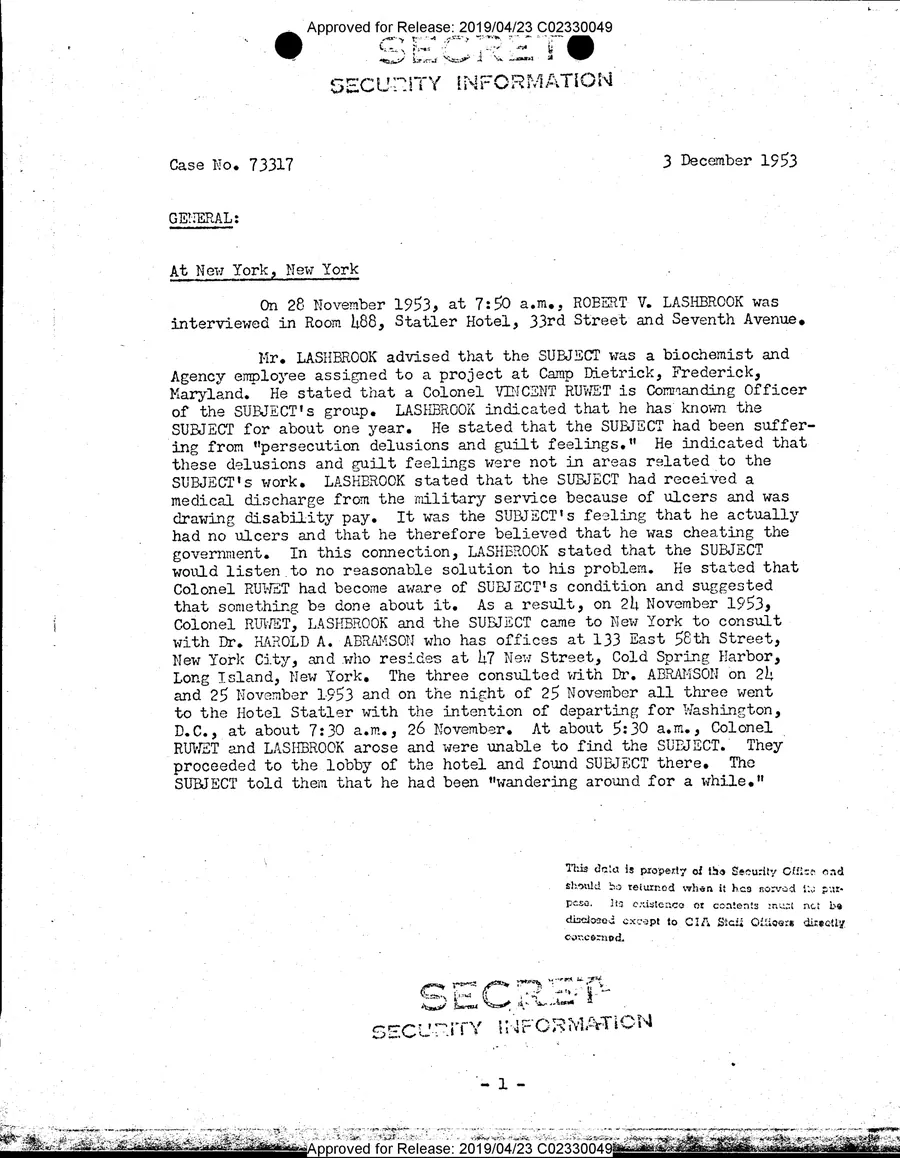
Case No. 73317 3 December 1953

GENERAL:

At New York, New York

On 28 November 1953, at 7:50 a.m., ROBERT V. LASHBROOK was interviewed in Room 488, Statler Hotel, 33rd Street and Seventh Avenue.

Mr. LASHBROOK advised that the SUBJECT was a biochemist and Agency employee assigned to a project at Camp Dietrick, Frederick, Maryland. He stated that a Colonel VINCENT RUWET is Commanding Officer of the SUBJECT's group. LASHBROOK indicated that he has known the SUBJECT for about one year. He stated that the SUBJECT had been suffering from "persecution delusions and guilt feelings." He indicated that these delusions and guilt feelings were not in areas related to the SUBJECT's work. LASHBROOK stated that the SUBJECT had received a medical discharge from the military service because of ulcers and was drawing disability pay. It was the SUBJECT's feeling that he actually had no ulcers and that he therefore believed that he was cheating the government. In this connection, LASHBROOK stated that the SUBJECT would listen to no reasonable solution to his problem. He stated that Colonel RUWET had become aware of SUBJECT's condition and suggested that something be done about it. As a result, on 24 November 1953, Colonel RUWET, LASHBROOK and the SUBJECT came to New York to consult with Dr. HAROLD A. ABRAMSON who has offices at 133 East 58th Street, New York City, and who resides at 47 New Street, Cold Spring Harbor, Long Island, New York. The three consulted with Dr. ABRAMSON on 24 and 25 November 1953 and on the night of 25 November all three went to the Hotel Statler with the intention of departing for Washington, D.C., at about 7:30 a.m., 26 November. At about 5:30 a.m., Colonel RUWET and LASHBROOK arose and were unable to find the SUBJECT. They proceeded to the lobby of the hotel and found SUBJECT there. The SUBJECT told them that he had been "wandering around for a while."

Textual notes on this leaf (1)
Camp Dietrick
The installation is Camp Detrick. The document's own spelling. PRESERVED.
Printed page 2 Leaf 17 of 64 · source page 17
FRANK R. OLSON — leaf 17, printed page 2, facsimile of the released scan
Approved for Release: 2019/04/23 C02330049 (head and foot) · SECRET / SECURITY INFORMATION (head and foot)

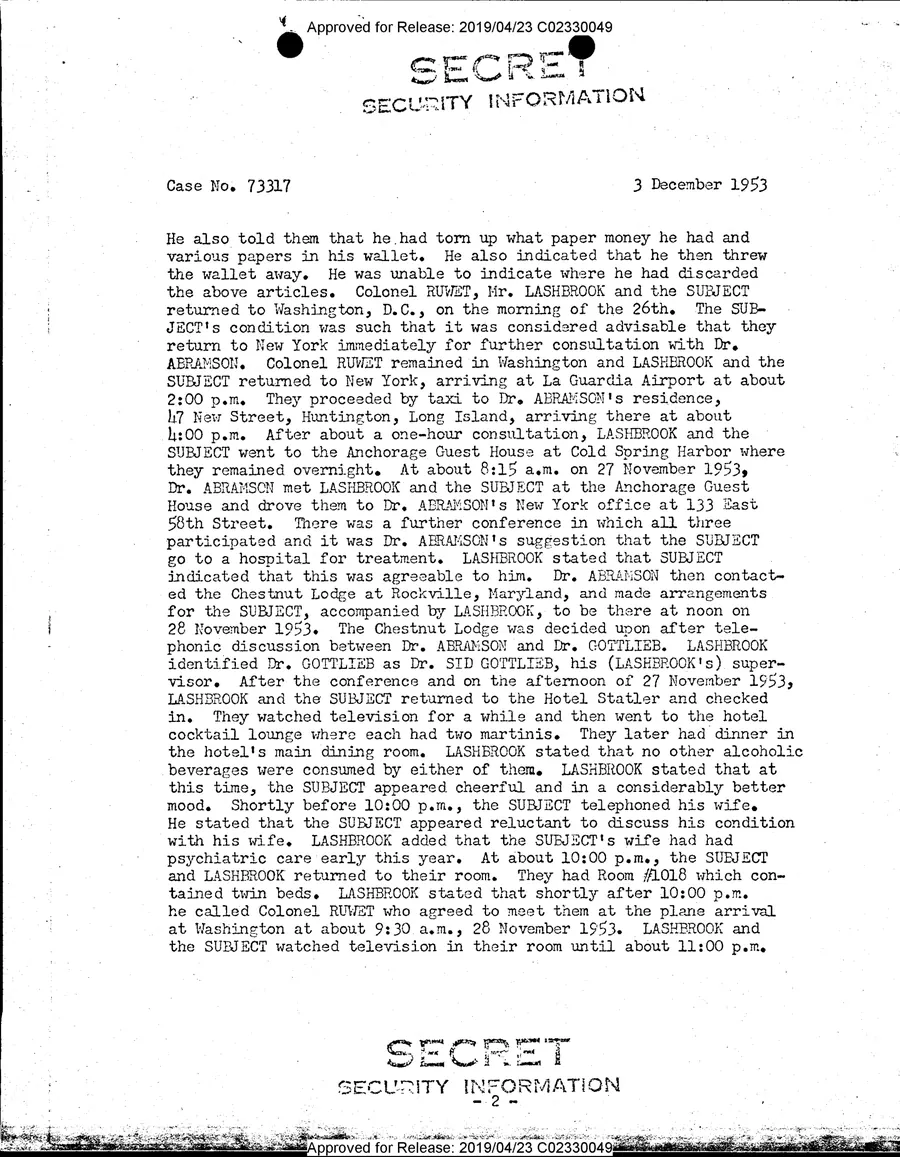
Case No. 73317 3 December 1953

He also told them that he had torn up what paper money he had and various papers in his wallet. He also indicated that he then threw the wallet away. He was unable to indicate where he had discarded the above articles. Colonel RUWET, Mr. LASHBROOK and the SUBJECT returned to Washington, D.C., on the morning of the 26th. The SUBJECT's condition was such that it was considered advisable that they return to New York immediately for further consultation with Dr. ABRAMSON. Colonel RUWET remained in Washington and LASHBROOK and the SUBJECT returned to New York, arriving at La Guardia Airport at about 2:00 p.m. They proceeded by taxi to Dr. ABRAMSON's residence, 47 New Street, Huntington, Long Island, arriving there at about 4:00 p.m. After about a one-hour consultation, LASHBROOK and the SUBJECT went to the Anchorage Guest House at Cold Spring Harbor where they remained overnight. At about 8:15 a.m. on 27 November 1953, Dr. ABRAMSON met LASHBROOK and the SUBJECT at the Anchorage Guest House and drove them to Dr. ABRAMSON's New York office at 133 East 58th Street. There was a further conference in which all three participated and it was Dr. ABRAMSON's suggestion that the SUBJECT go to a hospital for treatment. LASHBROOK stated that SUBJECT indicated that this was agreeable to him. Dr. ABRAMSON then contacted the Chestnut Lodge at Rockville, Maryland, and made arrangements for the SUBJECT, accompanied by LASHBROOK, to be there at noon on 28 November 1953. The Chestnut Lodge was decided upon after telephonic discussion between Dr. ABRAMSON and Dr. GOTTLIEB. LASHBROOK identified Dr. GOTTLIEB as Dr. SID GOTTLIEB, his (LASHBROOK's) supervisor. After the conference and on the afternoon of 27 November 1953, LASHBROOK and the SUBJECT returned to the Hotel Statler and checked in. They watched television for a while and then went to the hotel cocktail lounge where each had two martinis. They later had dinner in the hotel's main dining room. LASHBROOK stated that no other alcoholic beverages were consumed by either of them. LASHBROOK stated that at this time, the SUBJECT appeared cheerful and in a considerably better mood. Shortly before 10:00 p.m., the SUBJECT telephoned his wife. He stated that the SUBJECT appeared reluctant to discuss his condition with his wife. LASHBROOK added that the SUBJECT's wife had had psychiatric care early this year. At about 10:00 p.m., the SUBJECT and LASHBROOK returned to their room. They had Room #1018 which contained twin beds. LASHBROOK stated that shortly after 10:00 p.m. he called Colonel RUWET who agreed to meet them at the plane arrival at Washington at about 9:30 a.m., 28 November 1953. LASHBROOK and the SUBJECT watched television in their room until about 11:00 p.m.

Textual notes on this leaf (2)
47 New Street, Huntington, Long Island
Folio 1 of this report gives the same address as Cold Spring Harbor. The document's own inconsistency. PRESERVED.
Room #1018
The room number is preceded by a number sign, as typed. PRESERVED.
Printed page 3 Leaf 18 of 64 · source page 18
FRANK R. OLSON — leaf 18, printed page 3, facsimile of the released scan
Approved for Release: 2019/04/23 C02330049 (head and foot) · SECRET / SECURITY INFORMATION (head and foot)

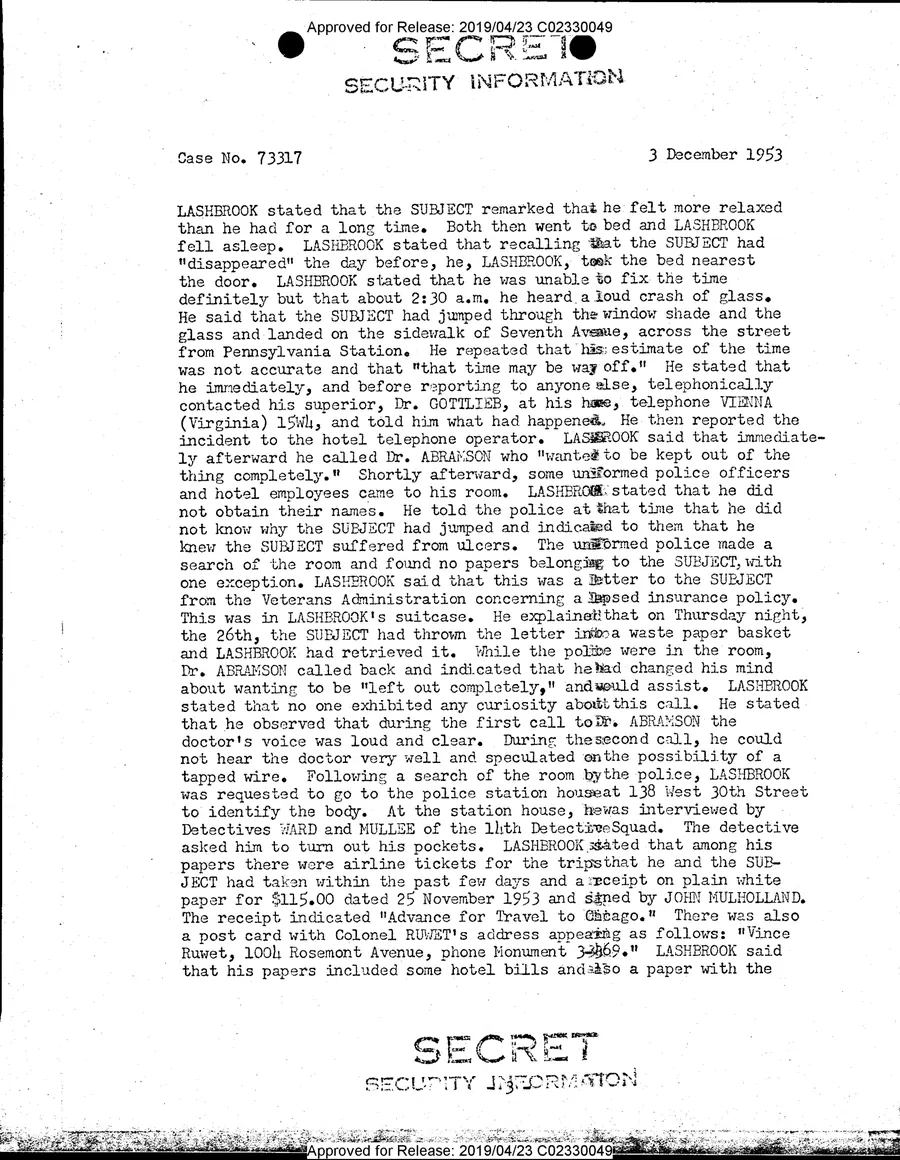
Case No. 73317 3 December 1953

LASHBROOK stated that the SUBJECT remarked that he felt more relaxed than he had for a long time. Both then went to bed and LASHBROOK fell asleep. LASHBROOK stated that recalling that the SUBJECT had "disappeared" the day before, he, LASHBROOK, took the bed nearest the door. LASHBROOK stated that he was unable to fix the time definitely but that about 2:30 a.m. he heard a loud crash of glass. He said that the SUBJECT had jumped through the window shade and the glass and landed on the sidewalk of Seventh Avenue, across the street from Pennsylvania Station. He repeated that his estimate of the time was not accurate and that "that time may be way off." He stated that he immediately, and before reporting to anyone else, telephonically contacted his superior, Dr. GOTTLIEB, at his home, telephone VIENNA (Virginia) 15W4, and told him what had happened. He then reported the incident to the hotel telephone operator. LASHBROOK said that immediately afterward he called Dr. ABRAMSON who "wanted to be kept out of the thing completely." Shortly afterward, some uniformed police officers and hotel employees came to his room. LASHBROOK stated that he did not obtain their names. He told the police at that time that he did not know why the SUBJECT had jumped and indicated to them that he knew the SUBJECT suffered from ulcers. The uniformed police made a search of the room and found no papers belonging to the SUBJECT, with one exception. LASHBROOK said that this was a letter to the SUBJECT from the Veterans Administration concerning a lapsed insurance policy. This was in LASHBROOK's suitcase. He explained that on Thursday night, the 26th, the SUBJECT had thrown the letter into a waste paper basket and LASHBROOK had retrieved it. While the police were in the room, Dr. ABRAMSON called back and indicated that he had changed his mind about wanting to be "left out completely," and would assist. LASHBROOK stated that no one exhibited any curiosity about this call. He stated that he observed that during the first call to Dr. ABRAMSON the doctor's voice was loud and clear. During the second call, he could not hear the doctor very well and speculated on the possibility of a tapped wire. Following a search of the room by the police, LASHBROOK was requested to go to the police station house at 138 West 30th Street to identify the body. At the station house, he was interviewed by Detectives WARD and MULLEE of the 14th Detective Squad. The detective asked him to turn out his pockets. LASHBROOK stated that among his papers there were airline tickets for the trips that he and the SUBJECT had taken within the past few days and a receipt on plain white paper for $115.00 dated 25 November 1953 and signed by JOHN MULHOLLAND. The receipt indicated "Advance for Travel to Chicago." There was also a post card with Colonel RUWET's address appearing as follows: "Vince Ruwet, 1004 Rosemont Avenue, phone Monument 3-4469." LASHBROOK said that his papers included some hotel bills and also a paper with the

Textual notes on this leaf (2)
phone Monument 3-4469
The four digits after the exchange are struck over and blotted; read as 4469. CONFIRM.
The detective asked him to turn out his pockets.
Singular after two detectives are named. As typed. PRESERVED.
Printed page 4 Leaf 19 of 64 · source page 19
FRANK R. OLSON — leaf 19, printed page 4, facsimile of the released scan
Approved for Release: 2019/04/23 C02330049 (head and foot) · SECRET / SECURITY INFORMATION (head and foot)

Case No. 73317 3 December 1953

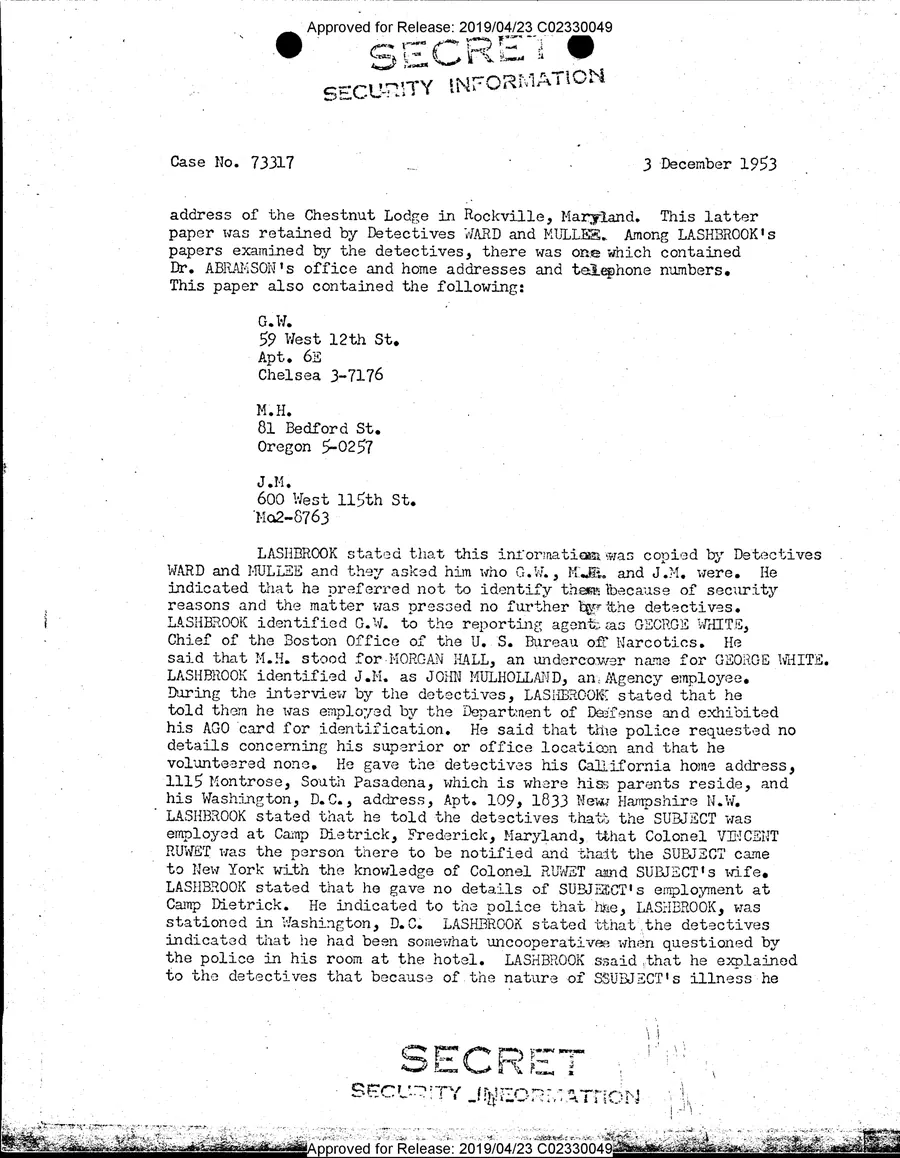
address of the Chestnut Lodge in Rockville, Maryland. This latter paper was retained by Detectives WARD and MULLEE. Among LASHBROOK's papers examined by the detectives, there was one which contained Dr. ABRAMSON's office and home addresses and telephone numbers. This paper also contained the following:

G.W.
59 West 12th St.
Apt. 6E
Chelsea 3-7176
M.H.
81 Bedford St.
Oregon 5-0257
J.M.
600 West 115th St.
Mo2-8763

LASHBROOK stated that this information was copied by Detectives WARD and MULLEE and they asked him who G.W., M.H. and J.M. were. He indicated that he preferred not to identify them because of security reasons and the matter was pressed no further by the detectives. LASHBROOK identified G.W. to the reporting agent as GEORGE WHITE, Chief of the Boston Office of the U. S. Bureau of Narcotics. He said that M.H. stood for MORGAN HALL, an undercower name for GEORGE WHITE. LASHBROOK identified J.M. as JOHN MULHOLLAND, an Agency employee. During the interview by the detectives, LASHBROOK stated that he told them he was employed by the Department of Defense and exhibited his AGO card for identification. He said that the police requested no details concerning his superior or office location and that he volunteered none. He gave the detectives his California home address, 1115 Montrose, South Pasadena, which is where his parents reside, and his Washington, D.C., address, Apt. 109, 1833 New Hampshire N.W. LASHBROOK stated that he told the detectives that the SUBJECT was employed at Camp Dietrick, Frederick, Maryland, that Colonel VINCENT RUWET was the person there to be notified and that the SUBJECT came to New York with the knowledge of Colonel RUWET and SUBJECT's wife. LASHBROOK stated that he gave no details of SUBJECT's employment at Camp Dietrick. He indicated to the police that he, LASHBROOK, was stationed in Washington, D.C. LASHBROOK stated that the detectives indicated that he had been somewhat uncooperative when questioned by the police in his room at the hotel. LASHBROOK said that he explained to the detectives that because of the nature of SUBJECT's illness he

Textual notes on this leaf (4)
an undercower name for GEORGE WHITE
The glyph is a w; the document's own error for 'undercover'. PRESERVED.
Mo2-8763
Typed with a capital M and a lower-case o where the other two entries spell the exchange out. Read as typed. CONFIRM.
Camp Dietrick
The installation is Camp Detrick. The document's own spelling, twice on this leaf. PRESERVED.
1833 New Hampshire N.W.
No thoroughfare word after the street name, as typed. PRESERVED.
Printed page 5 Leaf 20 of 64 · source page 20
FRANK R. OLSON — leaf 20, printed page 5, facsimile of the released scan
Approved for Release: 2019/04/23 C02330049 (head and foot) · SECRET / SECURITY INFORMATION (head and foot) · Security Office property stamp, lower right: data to be returned when it has served its purpose; existence or contents not to be disclosed except to CIA Staff Officers directly concerned.

Case No. 73317 3 December 1953

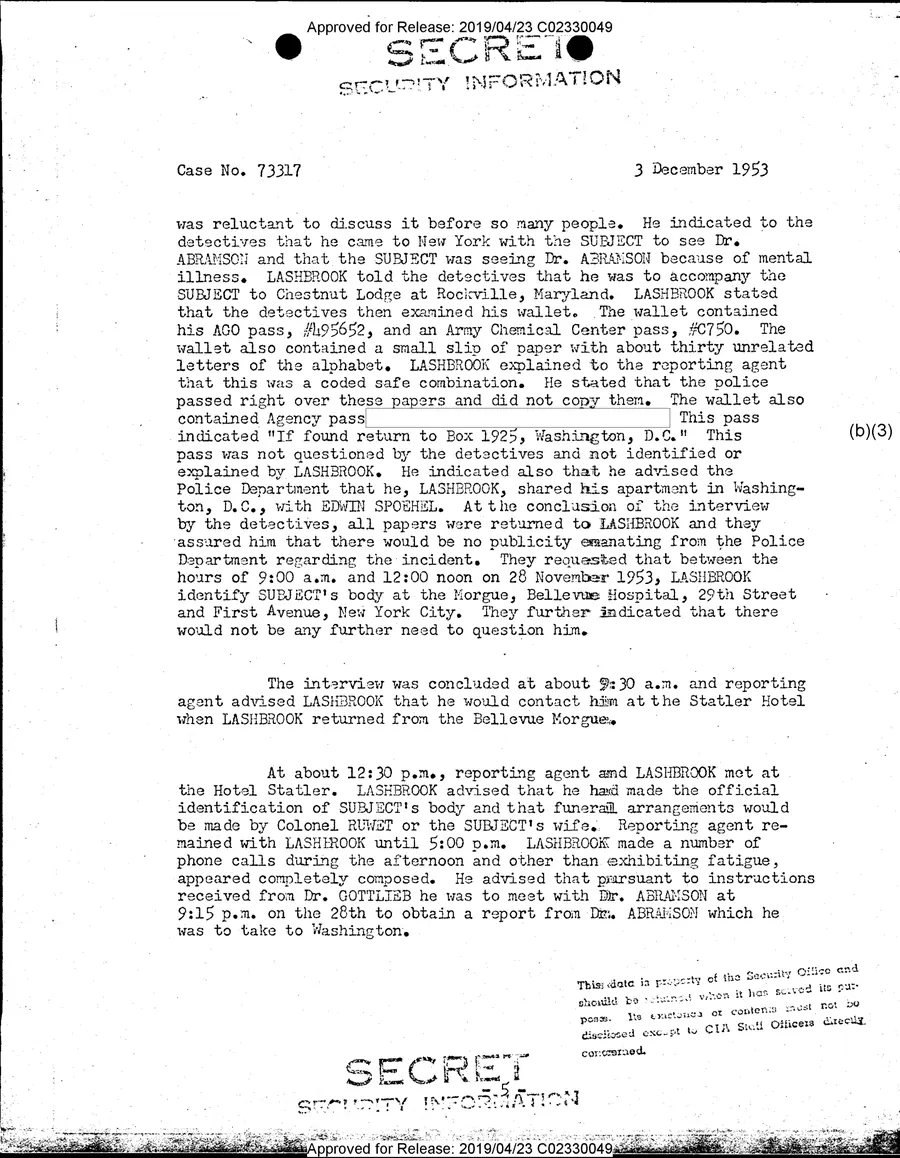
was reluctant to discuss it before so many people. He indicated to the detectives that he came to New York with the SUBJECT to see Dr. ABRAMSON and that the SUBJECT was seeing Dr. ABRAMSON because of mental illness. LASHBROOK told the detectives that he was to accompany the SUBJECT to Chestnut Lodge at Rockville, Maryland. LASHBROOK stated that the detectives then examined his wallet. The wallet contained his AGO pass, #495652, and an Army Chemical Center pass, #C750. The wallet also contained a small slip of paper with about thirty unrelated letters of the alphabet. LASHBROOK explained to the reporting agent that this was a coded safe combination. He stated that the police passed right over these papers and did not copy them. The wallet also contained Agency pass [redacted] This pass indicated "If found return to Box 1925, Washington, D.C." This pass was not questioned by the detectives and not identified or explained by LASHBROOK. He indicated also that he advised the Police Department that he, LASHBROOK, shared his apartment in Washington, D.C., with EDWIN SPOEHEL. At the conclusion of the interview by the detectives, all papers were returned to LASHBROOK and they assured him that there would be no publicity emanating from the Police Department regarding the incident. They requested that between the hours of 9:00 a.m. and 12:00 noon on 28 November 1953, LASHBROOK identify SUBJECT's body at the Morgue, Bellevue Hospital, 29th Street and First Avenue, New York City. They further indicated that there would not be any further need to question him.

The interview was concluded at about 9:30 a.m. and reporting agent advised LASHBROOK that he would contact him at the Statler Hotel when LASHBROOK returned from the Bellevue Morgue.

At about 12:30 p.m., reporting agent and LASHBROOK met at the Hotel Statler. LASHBROOK advised that he had made the official identification of SUBJECT's body and that funeral arrangements would be made by Colonel RUWET or the SUBJECT's wife. Reporting agent remained with LASHBROOK until 5:00 p.m. LASHBROOK made a number of phone calls during the afternoon and other than exhibiting fatigue, appeared completely composed. He advised that pursuant to instructions received from Dr. GOTTLIEB he was to meet with Dr. ABRAMSON at 9:15 p.m. on the 28th to obtain a report from Dr. ABRAMSON which he was to take to Washington.

Printed page 6 Leaf 21 of 64 · source page 21
FRANK R. OLSON — leaf 21, printed page 6, facsimile of the released scan
Approved for Release: 2019/04/23 C02330049 (head and foot) · SECRET / SECURITY INFORMATION (head and foot)

Case No. 73317 3 December 1953

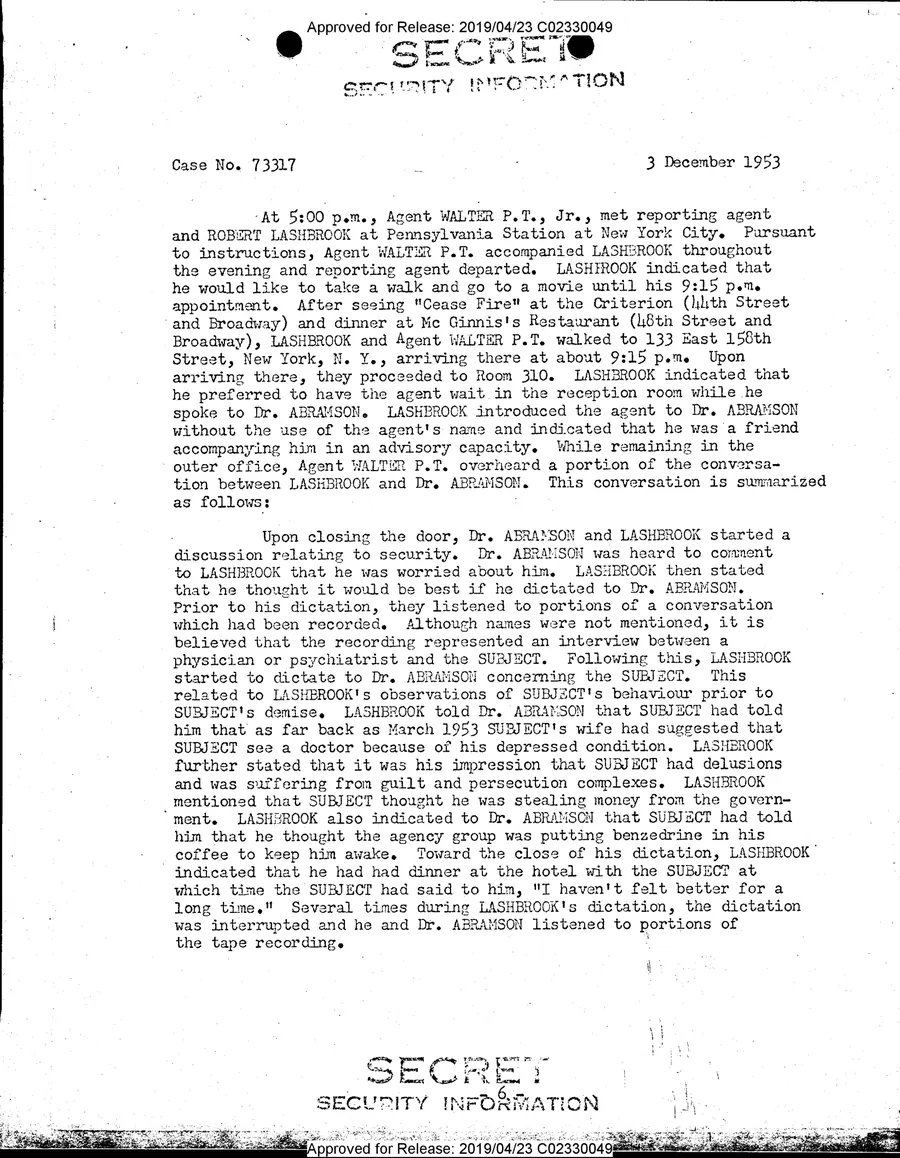
At 5:00 p.m., Agent WALTER P.T., Jr., met reporting agent and ROBERT LASHBROOK at Pennsylvania Station at New York City. Pursuant to instructions, Agent WALTER P.T. accompanied LASHBROOK throughout the evening and reporting agent departed. LASHBROOK indicated that he would like to take a walk and go to a movie until his 9:15 p.m. appointment. After seeing "Cease Fire" at the Criterion (44th Street and Broadway) and dinner at Mc Ginnis's Restaurant (48th Street and Broadway), LASHBROOK and Agent WALTER P.T. walked to 133 East 158th Street, New York, N. Y., arriving there at about 9:15 p.m. Upon arriving there, they proceeded to Room 310. LASHBROOK indicated that he preferred to have the agent wait in the reception room while he spoke to Dr. ABRAMSON. LASHBROOK introduced the agent to Dr. ABRAMSON without the use of the agent's name and indicated that he was a friend accompanying him in an advisory capacity. While remaining in the outer office, Agent WALTER P.T. overheard a portion of the conversation between LASHBROOK and Dr. ABRAMSON. This conversation is summarized as follows:

Upon closing the door, Dr. ABRAMSON and LASHBROOK started a discussion relating to security. Dr. ABRAMSON was heard to comment to LASHBROOK that he was worried about him. LASHBROOK then stated that he thought it would be best if he dictated to Dr. ABRAMSON. Prior to his dictation, they listened to portions of a conversation which had been recorded. Although names were not mentioned, it is believed that the recording represented an interview between a physician or psychiatrist and the SUBJECT. Following this, LASHBROOK started to dictate to Dr. ABRAMSON concerning the SUBJECT. This related to LASHBROOK's observations of SUBJECT's behaviour prior to SUBJECT's demise. LASHBROOK told Dr. ABRAMSON that SUBJECT had told him that as far back as March 1953 SUBJECT's wife had suggested that SUBJECT see a doctor because of his depressed condition. LASHBROOK further stated that it was his impression that SUBJECT had delusions and was suffering from guilt and persecution complexes. LASHBROOK mentioned that SUBJECT thought he was stealing money from the government. LASHBROOK also indicated to Dr. ABRAMSON that SUBJECT had told him that he thought the agency group was putting benzedrine in his coffee to keep him awake. Toward the close of his dictation, LASHBROOK indicated that he had had dinner at the hotel with the SUBJECT at which time the SUBJECT had said to him, "I haven't felt better for a long time." Several times during LASHBROOK's dictation, the dictation was interrupted and he and Dr. ABRAMSON listened to portions of the tape recording.

Textual notes on this leaf (4)
133 East 158th Street
Folio 1 gives Dr. ABRAMSON's office as 133 East 58th Street. The document's own inconsistency. PRESERVED.
SUBJECT's behaviour
British spelling, as typed. PRESERVED.
Mc Ginnis's Restaurant
Typed as two words. PRESERVED.
the agency group
Lower case here where the report elsewhere types Agency. PRESERVED.
Printed page 7 Leaf 22 of 64 · source page 22
FRANK R. OLSON — leaf 22, printed page 7, facsimile of the released scan
Approved for Release: 2019/04/23 C02330049 (head and foot) · SECRET / SECURITY INFORMATION (head and foot)

Case No. 73317 3 December 1953

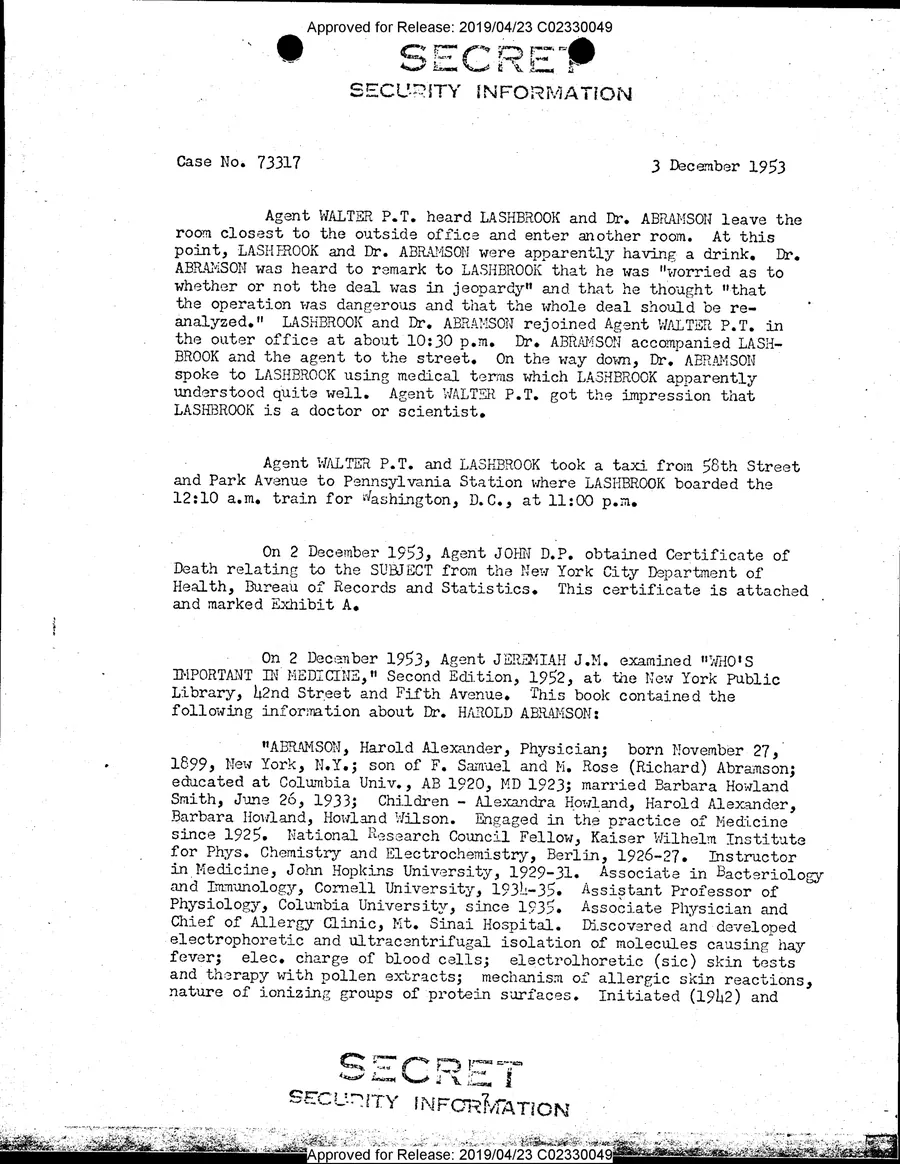
Agent WALTER P.T. heard LASHBROOK and Dr. ABRAMSON leave the room closest to the outside office and enter another room. At this point, LASHBROOK and Dr. ABRAMSON were apparently having a drink. Dr. ABRAMSON was heard to remark to LASHBROOK that he was "worried as to whether or not the deal was in jeopardy" and that he thought "that the operation was dangerous and that the whole deal should be reanalyzed." LASHBROOK and Dr. ABRAMSON rejoined Agent WALTER P.T. in the outer office at about 10:30 p.m. Dr. ABRAMSON accompanied LASHBROOK and the agent to the street. On the way down, Dr. ABRAMSON spoke to LASHBROOK using medical terms which LASHBROOK apparently understood quite well. Agent WALTER P.T. got the impression that LASHBROOK is a doctor or scientist.

Agent WALTER P.T. and LASHBROOK took a taxi from 58th Street and Park Avenue to Pennsylvania Station where LASHBROOK boarded the 12:10 a.m. train for Washington, D.C., at 11:00 p.m.

On 2 December 1953, Agent JOHN D.P. obtained Certificate of Death relating to the SUBJECT from the New York City Department of Health, Bureau of Records and Statistics. This certificate is attached and marked Exhibit A.

On 2 December 1953, Agent JEREMIAH J.M. examined "WHO'S IMPORTANT IN MEDICINE," Second Edition, 1952, at the New York Public Library, 42nd Street and Fifth Avenue. This book contained the following information about Dr. HAROLD ABRAMSON:

"ABRAMSON, Harold Alexander, Physician; born November 27, 1899, New York, N.Y.; son of F. Samuel and M. Rose (Richard) Abramson; educated at Columbia Univ., AB 1920, MD 1923; married Barbara Howland Smith, June 26, 1933; Children - Alexandra Howland, Harold Alexander, Barbara Howland, Howland Wilson. Engaged in the practice of Medicine since 1925. National Research Council Fellow, Kaiser Wilhelm Institute for Phys. Chemistry and Electrochemistry, Berlin, 1926-27. Instructor in Medicine, John Hopkins University, 1929-31. Associate in Bacteriology and Immunology, Cornell University, 1934-35. Assistant Professor of Physiology, Columbia University, since 1935. Associate Physician and Chief of Allergy Clinic, Mt. Sinai Hospital. Discovered and developed electrophoretic and ultracentrifugal isolation of molecules causing hay fever; elec. charge of blood cells; electrolhoretic (sic) skin tests and therapy with pollen extracts; mechanism of allergic skin reactions, nature of ionizing groups of protein surfaces. Initiated (1942) and
Textual notes on this leaf (2)
John Hopkins University
The institution is Johns Hopkins. The document's own error. PRESERVED.
electrolhoretic (sic)
The '(sic)' is the report's own, marking the misspelling it found in the printed entry. PRESERVED.
Printed page 8 Leaf 23 of 64 · source page 23
FRANK R. OLSON — leaf 23, printed page 8, facsimile of the released scan
Approved for Release: 2019/04/23 C02330049 (head and foot) · SECRET / SECURITY INFORMATION (head and foot) · Security Office property stamp, lower right: data to be returned when it has served its purpose; existence or contents not to be disclosed except to CIA Staff Officers directly concerned.

Case No. 73317 3 December 1953

directed penicillin aerosol therapy for lungs for Tech. Div., Chem. War Service, World War II. Assistant Chief and Chief, Defense Materiel. Fellow: N.Y. Academy of Medicine; American College of Allergists (Pres. 1951-52). Member: American Assn. for Advancement of Science; American Academy of Allergy; American Psychosomatic Society; N.Y. Academy of Science; N.Y. Allergy Society (Pres. 1951-52); American Society of Certified Allergists; American Society of Biological Chemists; N.Y. County Medical Society; Society for Experimental Biol. and Med.; Society for Investigative Dermatology; Alpha Omega Alpha; Epsilon Chi; Member, Board of Trustees, Biology Lab., Cold Spring Harbor, L.I. Awarded Meyerhof Prize, Columbia Medical College, 1921; Stevens Triennial Prize, Col. Univ., 1935; Legion of Merit, World War II. Member of Editorial Board: Annals of Allergy; Psychosomatic Medicine; Archives of Allergy and Immunology. Lt.-Col., Med. Corps Res. (inactive). Res: Cold Spring Harbor, N.Y. Off: 133 East 58 St., N.Y. 22, N.Y."

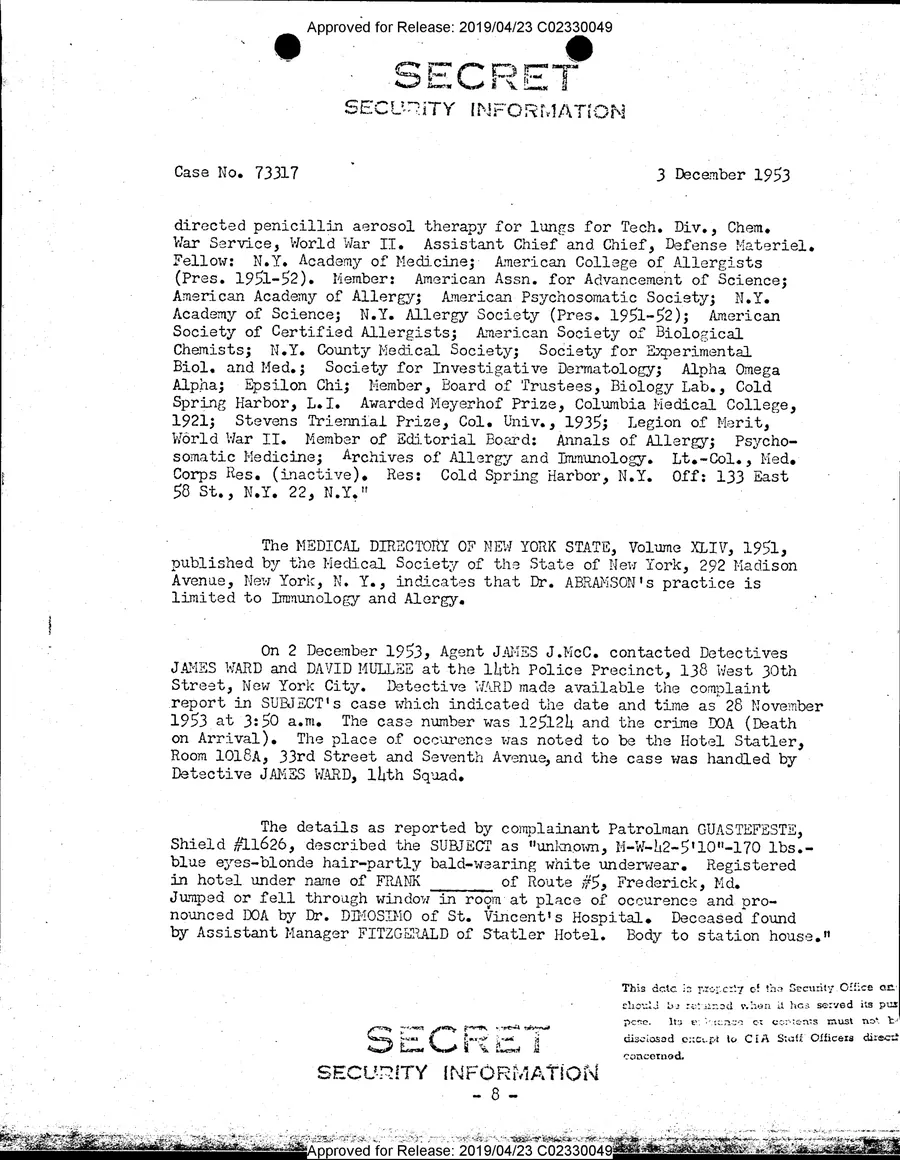
The MEDICAL DIRECTORY OF NEW YORK STATE, Volume XLIV, 1951, published by the Medical Society of the State of New York, 292 Madison Avenue, New York, N. Y., indicates that Dr. ABRAMSON's practice is limited to Immunology and Alergy.

On 2 December 1953, Agent JAMES J.McC. contacted Detectives JAMES WARD and DAVID MULLEE at the 14th Police Precinct, 138 West 30th Street, New York City. Detective WARD made available the complaint report in SUBJECT's case which indicated the date and time as 28 November 1953 at 3:50 a.m. The case number was 125124 and the crime DOA (Death on Arrival). The place of occurence was noted to be the Hotel Statler, Room 1018A, 33rd Street and Seventh Avenue, and the case was handled by Detective JAMES WARD, 14th Squad.

The details as reported by complainant Patrolman GUASTEFESTE, Shield #11626, described the SUBJECT as "unknown, M-W-42-5'10"-170 lbs.- blue eyes-blonde hair-partly bald-wearing white underwear. Registered in hotel under name of FRANK [redacted] of Route #5, Frederick, Md. Jumped or fell through window in room at place of occurence and pronounced DOA by Dr. DIMOSIMO of St. Vincent's Hospital. Deceased found by Assistant Manager FITZGERALD of Statler Hotel. Body to station house."

Textual notes on this leaf (4)
limited to Immunology and Alergy
'Alergy' for allergy. The document's own spelling. PRESERVED.
the place of occurence
'occurence' for occurrence, twice on this leaf. The document's own spelling. PRESERVED.
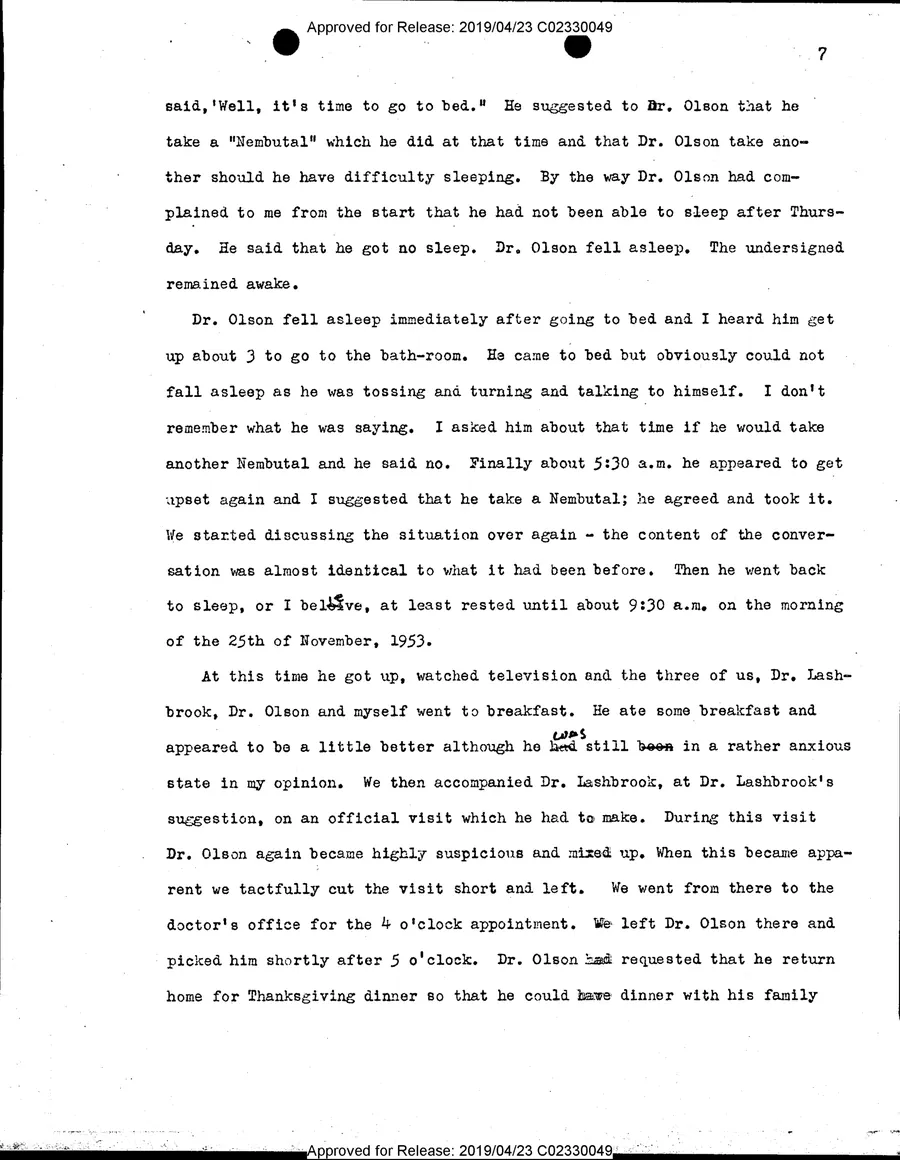
Hotel Statler, Room 1018A
Folio 2 gives the room as #1018. The document's own inconsistency. PRESERVED.
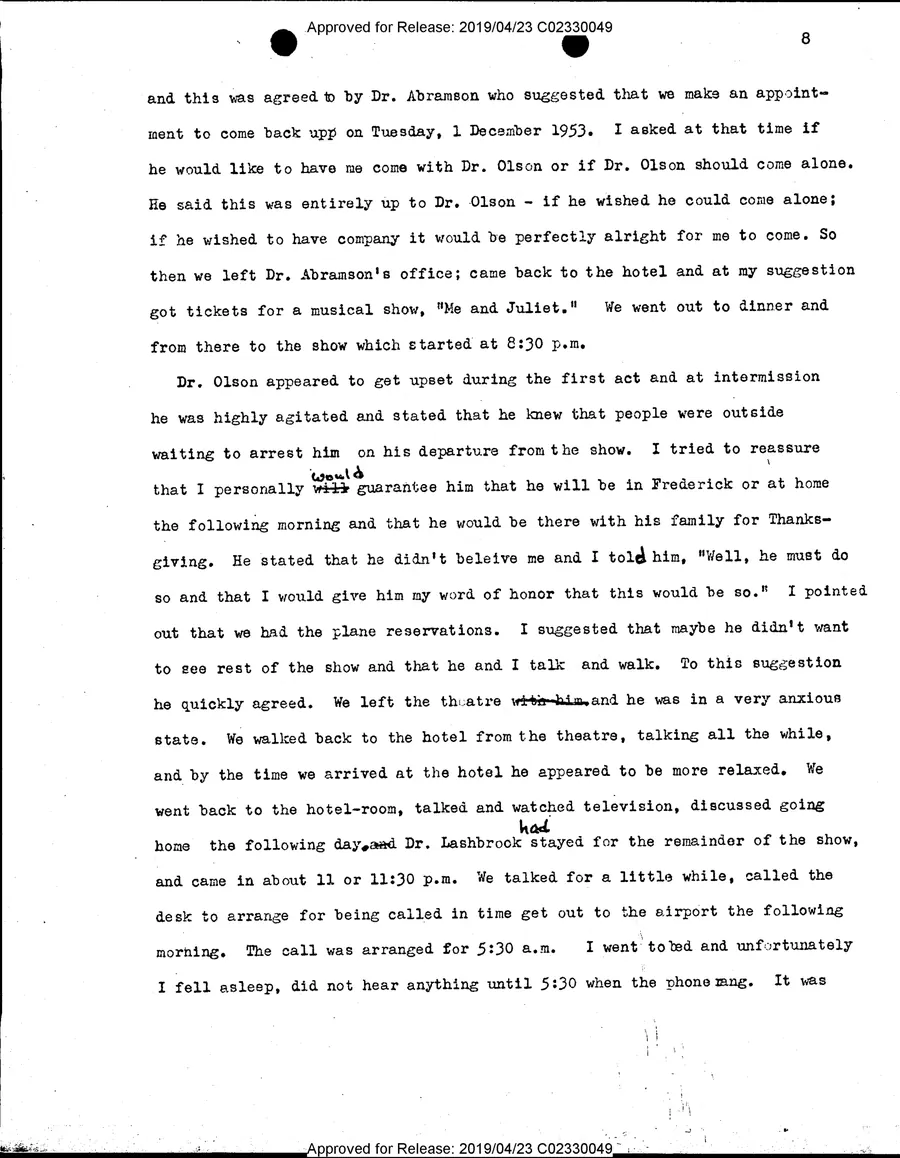
Dr. DIMOSIMO
Surname read from a blotted typing; DIMOSIMO is the best reading. CONFIRM.
Printed page 9 Leaf 24 of 64 · source page 24
FRANK R. OLSON — leaf 24, printed page 9, facsimile of the released scan
Approved for Release: 2019/04/23 C02330049 (head and foot) · SECRET / SECURITY INFORMATION (head and foot)

Case No. 73317 3 December 1953

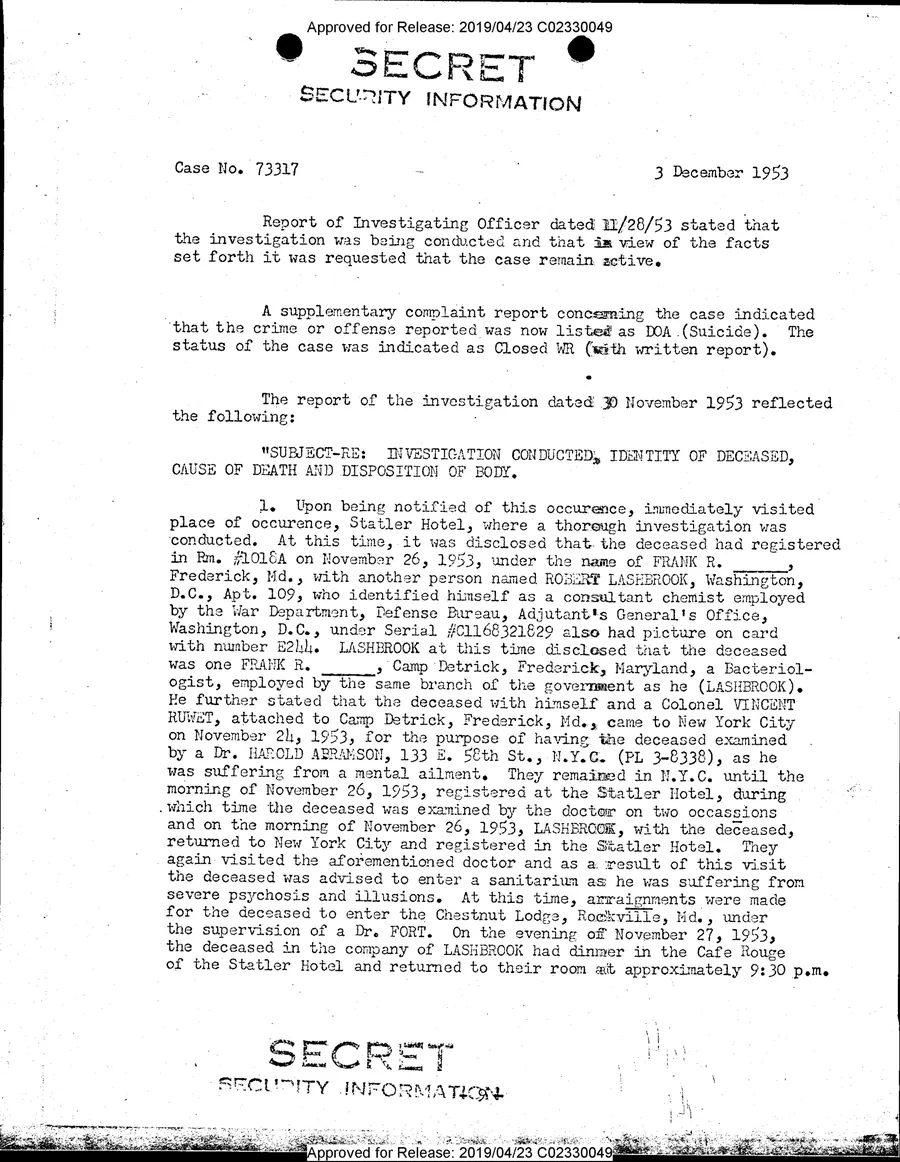
Report of Investigating Officer dated 11/28/53 stated that the investigation was being conducted and that in view of the facts set forth it was requested that the case remain active.

A supplementary complaint report concerning the case indicated that the crime or offense reported was now listed as DOA (Suicide). The status of the case was indicated as Closed WR (with written report).

The report of the investigation dated 30 November 1953 reflected the following:

"SUBJECT-RE: INVESTIGATION CONDUCTED, IDENTITY OF DECEASED, CAUSE OF DEATH AND DISPOSITION OF BODY.
1. Upon being notified of this occurence, immediately visited place of occurence, Statler Hotel, where a thorough investigation was conducted. At this time, it was disclosed that the deceased had registered in Rm. #1018A on November 26, 1953, under the name of FRANK R. [redacted], Frederick, Md., with another person named ROBERT LASHBROOK, Washington, D.C., Apt. 109, who identified himself as a consultant chemist employed by the War Department, Defense Bureau, Adjutant's General's Office, Washington, D.C., under Serial #C1168321829 also had picture on card with number E244. LASHBROOK at this time disclosed that the deceased was one FRANK R. [redacted], Camp Detrick, Frederick, Maryland, a Bacteriologist, employed by the same branch of the government as he (LASHBROOK). He further stated that the deceased with himself and a Colonel VINCENT RUWET, attached to Camp Detrick, Frederick, Md., came to New York City on November 24, 1953, for the purpose of having the deceased examined by a Dr. HAROLD ABRAMSON, 133 E. 58th St., N.Y.C. (PL 3-8338), as he was suffering from a mental ailment. They remained in N.Y.C. until the morning of November 26, 1953, registered at the Statler Hotel, during which time the deceased was examined by the doctor on two occassions and on the morning of November 26, 1953, LASHBROOK, with the deceased, returned to New York City and registered in the Statler Hotel. They again visited the aforementioned doctor and as a result of this visit the deceased was advised to enter a sanitarium as he was suffering from severe psychosis and illusions. At this time, arraignments were made for the deceased to enter the Chestnut Lodge, Rockville, Md., under the supervision of a Dr. FORT. On the evening of November 27, 1953, the deceased in the company of LASHBROOK had dinner in the Cafe Rouge of the Statler Hotel and returned to their room at approximately 9:30 p.m.
Textual notes on this leaf (6)
this occurence, immediately visited place of occurence
'occurence' for occurrence, twice. The quoted report's own spelling. PRESERVED.
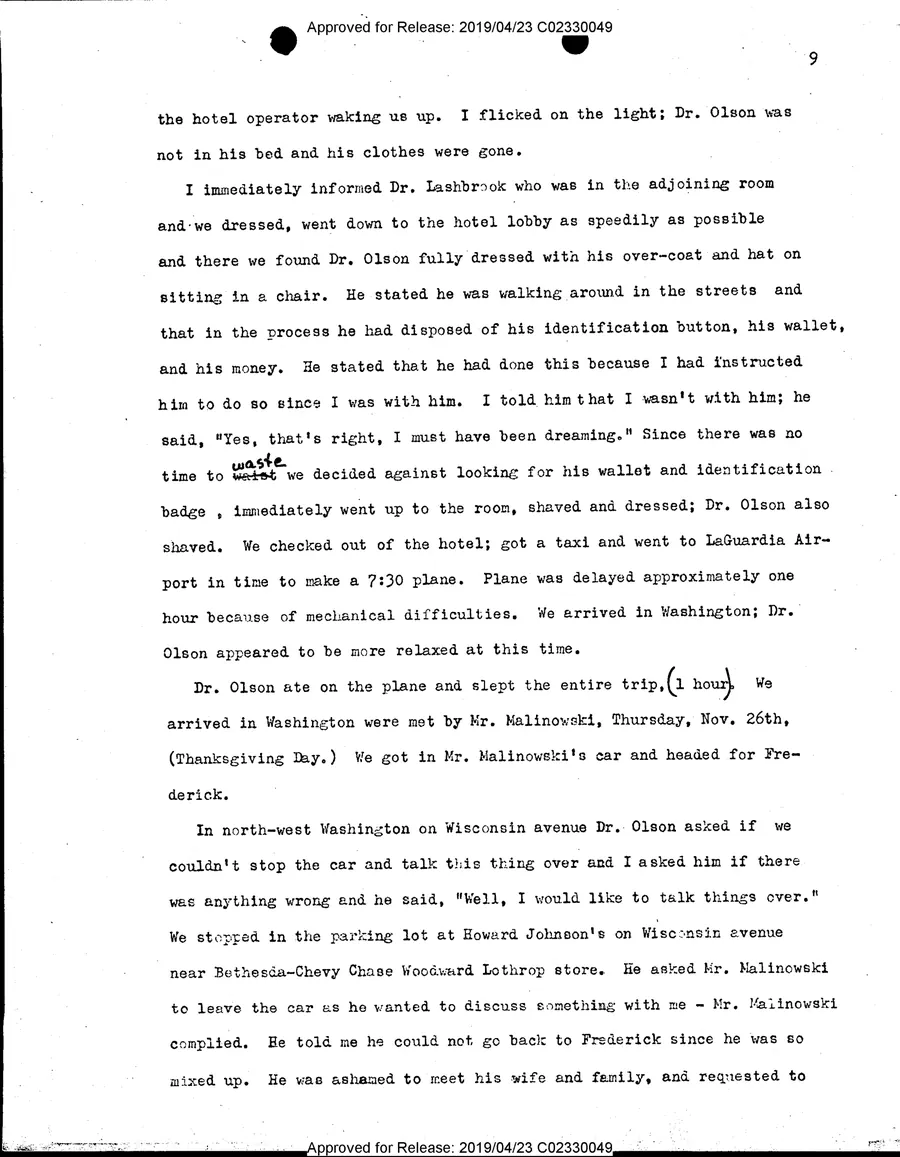
on two occassions
'occassions' for occasions. The quoted report's own spelling. PRESERVED.
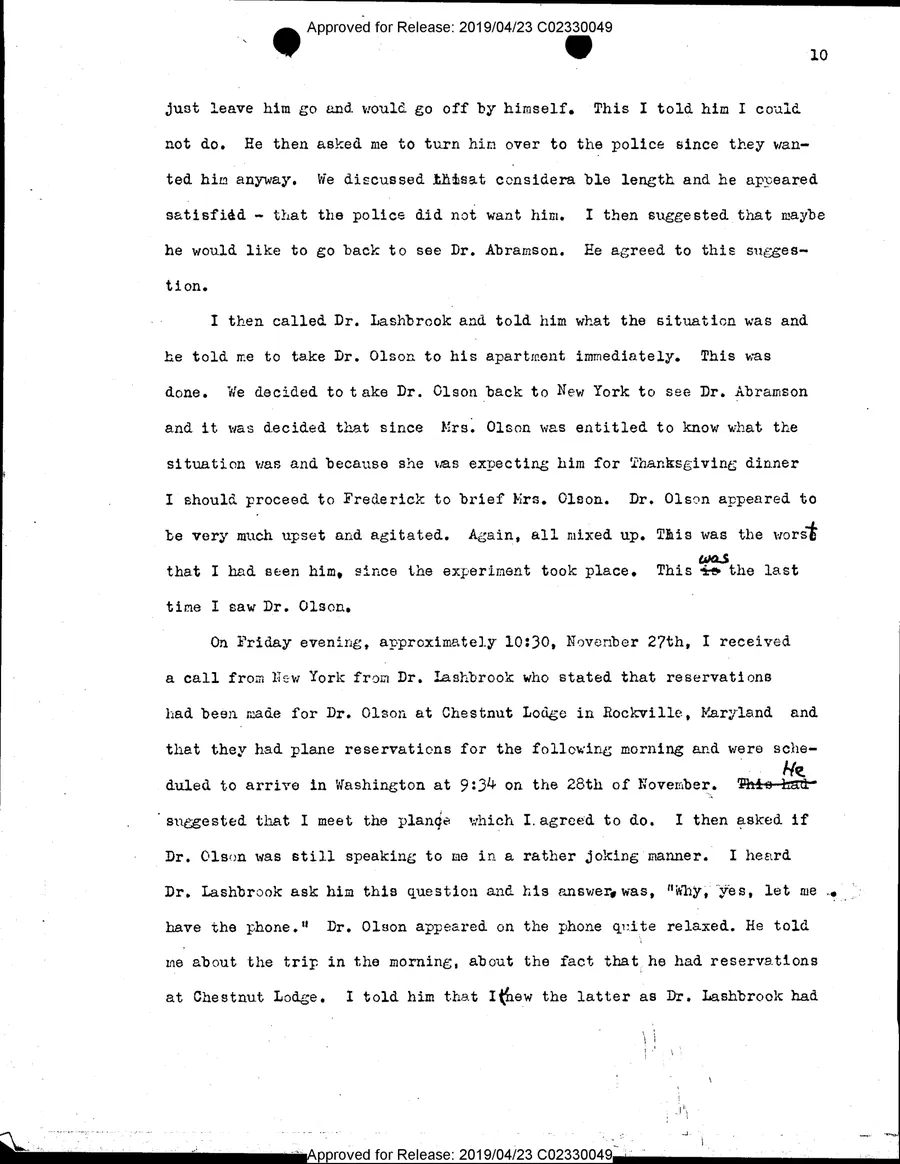
severe psychosis and illusions
'illusions' where delusions is meant. The quoted report's own word. PRESERVED.
arraignments were made
'arraignments' for arrangements. The quoted report's own word. PRESERVED.
Adjutant's General's Office
Doubled possessive, as typed. PRESERVED.
Camp Detrick
Spelled correctly in this quoted police report, where the Agency's own text on folios 1, 4 and 5 has Camp Dietrick. PRESERVED.
Printed page 10 Leaf 25 of 64 · source page 25
FRANK R. OLSON — leaf 25, printed page 10, facsimile of the released scan
Approved for Release: 2019/04/23 C02330049 (head and foot) · SECRET / SECURITY INFORMATION (head and foot)

Case No. 73317 3 December 1953

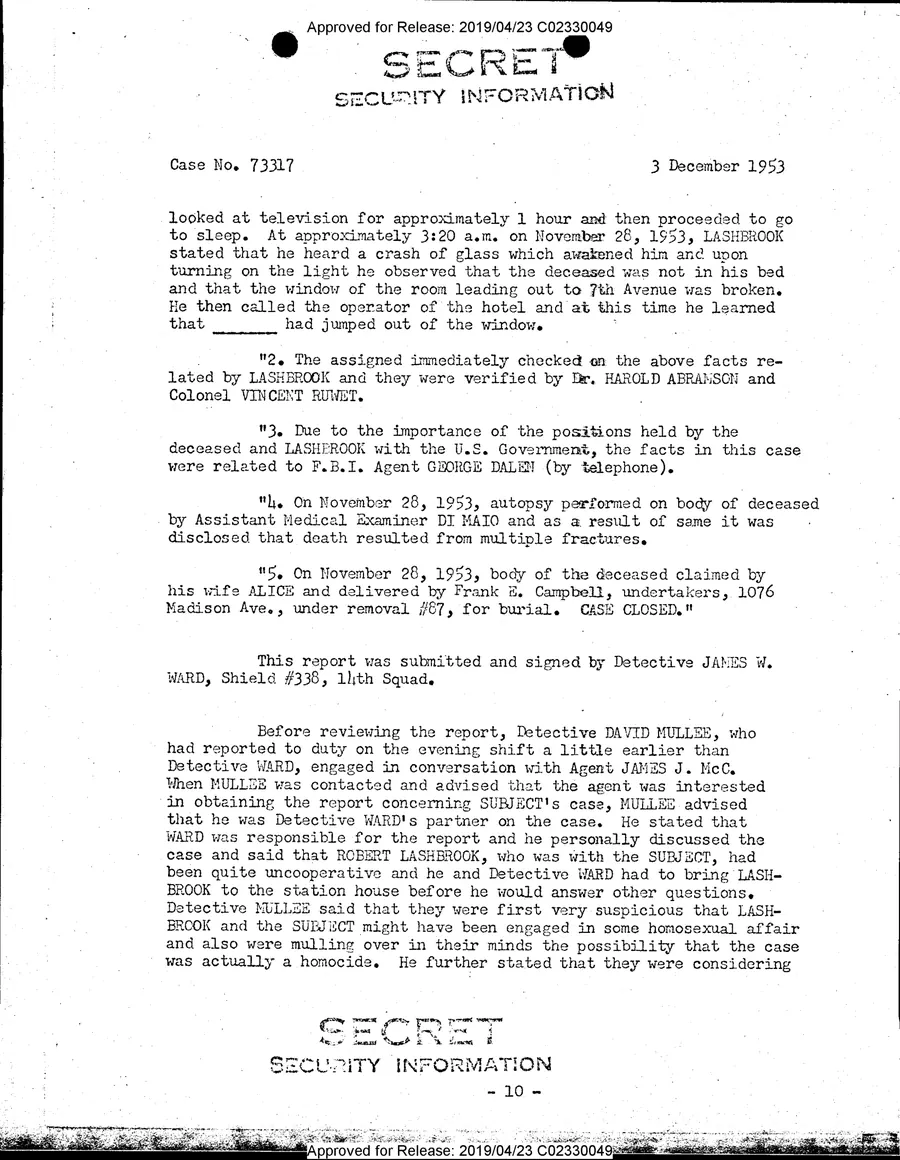
looked at television for approximately 1 hour and then proceeded to go to sleep. At approximately 3:20 a.m. on November 28, 1953, LASHBROOK stated that he heard a crash of glass which awakened him and upon turning on the light he observed that the deceased was not in his bed and that the window of the room leading out to 7th Avenue was broken. He then called the operator of the hotel and at this time he learned that [redacted] had jumped out of the window.
"2. The assigned immediately checked on the above facts related by LASHBROOK and they were verified by Dr. HAROLD ABRAMSON and Colonel VINCENT RUWET.
"3. Due to the importance of the positions held by the deceased and LASHBROOK with the U.S. Government, the facts in this case were related to F.B.I. Agent GEORGE DALEN (by telephone).
"4. On November 28, 1953, autopsy performed on body of deceased by Assistant Medical Examiner DI MAIO and as a result of same it was disclosed that death resulted from multiple fractures.
"5. On November 28, 1953, body of the deceased claimed by his wife ALICE and delivered by Frank E. Campbell, undertakers, 1076 Madison Ave., under removal #87, for burial. CASE CLOSED."

This report was submitted and signed by Detective JAMES W. WARD, Shield #338, 14th Squad.

Before reviewing the report, Detective DAVID MULLEE, who had reported to duty on the evening shift a little earlier than Detective WARD, engaged in conversation with Agent JAMES J. McC. when MULLEE was contacted and advised that the agent was interested in obtaining the report concerning SUBJECT's case, MULLEE advised that he was Detective WARD's partner on the case. He stated that WARD was responsible for the report and he personally discussed the case and said that ROBERT LASHBROOK, who was with the SUBJECT, had been quite uncooperative and he and Detective WARD had to bring LASHBROOK to the station house before he would answer other questions. Detective MULLEE said that they were first very suspicious that LASHBROOK and the SUBJECT might have been engaged in some homosexual affair and also were mulling over in their minds the possibility that the case was actually a homocide. He further stated that they were considering

Textual notes on this leaf (2)
was actually a homocide
'homocide' for homicide. The document's own spelling. PRESERVED.
delivered by Frank E. Campbell, undertakers
'by' where 'to' is meant. As typed in the quoted report. PRESERVED.
Printed page 11 Leaf 26 of 64 · source page 26
FRANK R. OLSON — leaf 26, printed page 11, facsimile of the released scan
Approved for Release: 2019/04/23 C02330049 (head and foot) · SECRET / SECURITY INFORMATION (head and foot) · Security Office property stamp, lower right: data to be returned when it has served its purpose; existence or contents not to be disclosed except to CIA Staff Officers directly concerned.

Case No. 73317 3 December 1953

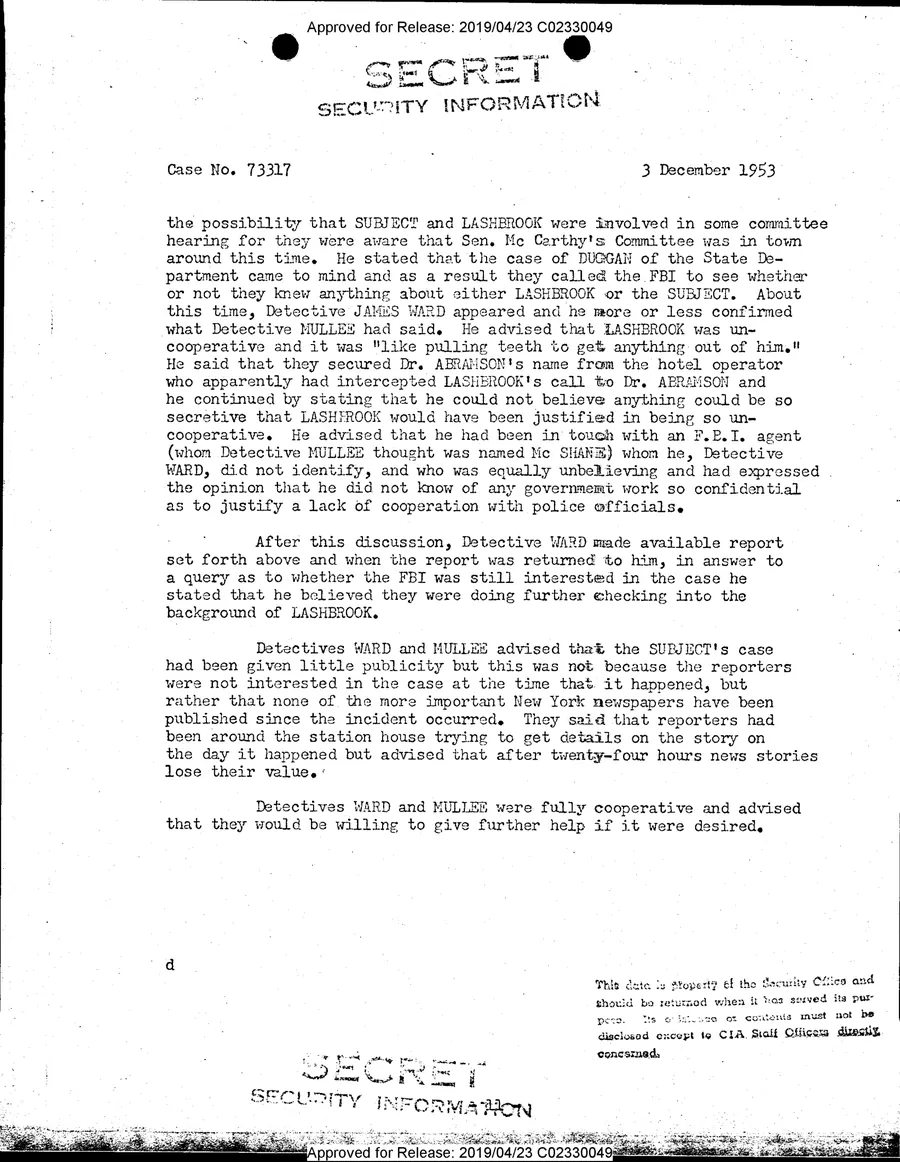
the possibility that SUBJECT and LASHBROOK were involved in some committee hearing for they were aware that Sen. Mc Carthy's Committee was in town around this time. He stated that the case of DUGGAN of the State Department came to mind and as a result they called the FBI to see whether or not they knew anything about either LASHBROOK or the SUBJECT. About this time, Detective JAMES WARD appeared and he more or less confirmed what Detective MULLEE had said. He advised that LASHBROOK was uncooperative and it was "like pulling teeth to get anything out of him." He said that they secured Dr. ABRAMSON's name from the hotel operator who apparently had intercepted LASHBROOK's call to Dr. ABRAMSON and he continued by stating that he could not believe anything could be so secretive that LASHBROOK would have been justified in being so uncooperative. He advised that he had been in touch with an F.B.I. agent (whom Detective MULLEE thought was named Mc SHANE) whom he, Detective WARD, did not identify, and who was equally unbelieving and had expressed the opinion that he did not know of any government work so confidential as to justify a lack of cooperation with police officials.

After this discussion, Detective WARD made available report set forth above and when the report was returned to him, in answer to a query as to whether the FBI was still interested in the case he stated that he believed they were doing further checking into the background of LASHBROOK.

Detectives WARD and MULLEE advised that the SUBJECT's case had been given little publicity but this was not because the reporters were not interested in the case at the time that it happened, but rather that none of the more important New York newspapers have been published since the incident occurred. They said that reporters had been around the station house trying to get details on the story on the day it happened but advised that after twenty-four hours news stories lose their value.

Detectives WARD and MULLEE were fully cooperative and advised that they would be willing to give further help if it were desired.

Textual notes on this leaf (4)
Sen. Mc Carthy's Committee
Typed as two words. PRESERVED.
named Mc SHANE
Typed as two words; the surname is read as Mc SHANE and is the detectives' own guess at the F.B.I. agent's name. CONFIRM.
the case of DUGGAN of the State Department
Read as DUGGAN. CONFIRM.
d
A single lower-case letter d is struck alone at the left, below the last paragraph, on the otherwise blank lower half of the leaf. Not part of the running text; recorded where it falls.
Unnumbered leaf Leaf 27 of 64 · source page 27
FRANK R. OLSON — leaf 27, facsimile of the released scan
Approved for Release: 2019/04/23 C02330049 (head and foot) · Security Office caveat, struck diagonally across the lower half of the otherwise blank sheet: "This data is property of the Security Office and should be returned when it has served its purpose. Its existence or contents must not be disclosed except to CIA Staff Officers directly concerned."

Order restored. The leaf is blank because the exhibit was taken out of the file. The manuscript note records where it went.

EXHIBIT "A"

Textual notes on this leaf (3)
EXHIBIT "A"
The exhibit itself, a photostat of the death certificate, is not in the file. This leaf is the backing sheet alone: no typed body text survives on it, only the Security Office caveat and the manuscript note recording that the photostat was forwarded with the claim.
Rem/O/IS
Manuscript initials and office string below the note. The characters after the second stroke are indistinct in this copy; best reading given. CONFIRM.
BEC
Read as the initials B E C in the manuscript note. The sheet gives no expansion. CONFIRM.
Printed page 1 Leaf 28 of 64 · source page 28
FRANK R. OLSON — leaf 28, printed page 1, facsimile of the released scan
Approved for Release: 2019/04/23 C02330049 (head and foot)

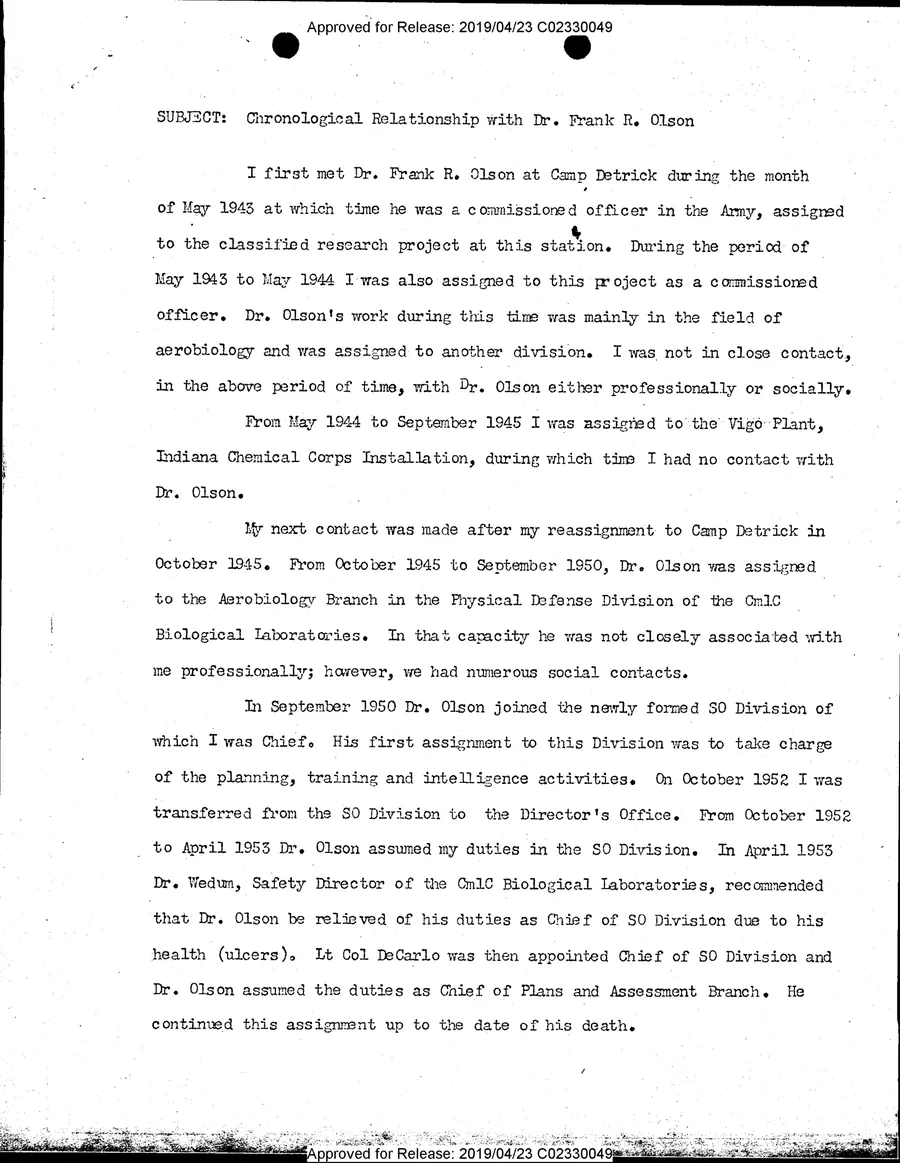
SUBJECT: Chronological Relationship with Dr. Frank R. Olson

I first met Dr. Frank R. Olson at Camp Detrick during the month of May 1943 at which time he was a commissioned officer in the Army, assigned to the classified research project at this station. During the period of May 1943 to May 1944 I was also assigned to this project as a commissioned officer. Dr. Olson's work during this time was mainly in the field of aerobiology and was assigned to another division. I was not in close contact, in the above period of time, with Dr. Olson either professionally or socially.

From May 1944 to September 1945 I was assigned to the Vigo Plant, Indiana Chemical Corps Installation, during which time I had no contact with Dr. Olson.

My next contact was made after my reassignment to Camp Detrick in October 1945. From October 1945 to September 1950, Dr. Olson was assigned to the Aerobiology Branch in the Physical Defense Division of the CmlC Biological Laboratories. In that capacity he was not closely associated with me professionally; however, we had numerous social contacts.

In September 1950 Dr. Olson joined the newly formed SO Division of which I was Chief. His first assignment to this Division was to take charge of the planning, training and intelligence activities. On October 1952 I was transferred from the SO Division to the Director's Office. From October 1952 to April 1953 Dr. Olson assumed my duties in the SO Division. In April 1953 Dr. Wedum, Safety Director of the CmlC Biological Laboratories, recommended that Dr. Olson be relieved of his duties as Chief of SO Division due to his health (ulcers). Lt Col DeCarlo was then appointed Chief of SO Division and Dr. Olson assumed the duties as Chief of Plans and Assessment Branch. He continued this assignment up to the date of his death.

Textual notes on this leaf (3)
aerobiology and was assigned to another division
The clause attaches the assignment to the work rather than to the man, as typed. PRESERVED.
On October 1952 I was
On for In before a month and year, as typed. PRESERVED.
CmlC
The Chemical Corps abbreviated CmlC, with a lower-case l, as typed throughout this statement. PRESERVED.
Printed page 2 Leaf 29 of 64 · source page 29
FRANK R. OLSON — leaf 29, printed page 2, facsimile of the released scan
Approved for Release: 2019/04/23 C02330049 (head and foot)

2

SUBJECT: Chronological Relationship with Dr. Frank R. Olson (Contd)

Dr. Olson was considered as an authority in the field of aerobiology, a science which was developed considerably during the years 1943 to 1953 at Camp Detrick, Both his superiors and subordinates regarded him as a highly qualified scientist in this field.

During the years I have known Dr. Olson I have had numerous social contacts with him and his family, visiting often at his home. He was always extremely cheerful, more than willing to help anyone in distress, often times making it a point to cheer not only his friends but others who were in a depressed mood. Dr. Olson enjoyed an occasional alcoholic drink but did not indulge excessively. His general state of mind and outlook on life was always that of extreme optimism. Never was there any indication of pessimism.

Dr. Olson could be classified as a family man, taking great interest in his home and the activities of his family. He imbedded in the minds of his children the need of religion in life, making sure that they attended their Sunday School regularly and would also encourage his friends' children to attend with them.

My last personal contact with Dr. Olson was on November 11, 1953, at which time he brought his children to visit and play with my children. At this time he appeared normal in all respects and as cheerful as ever.

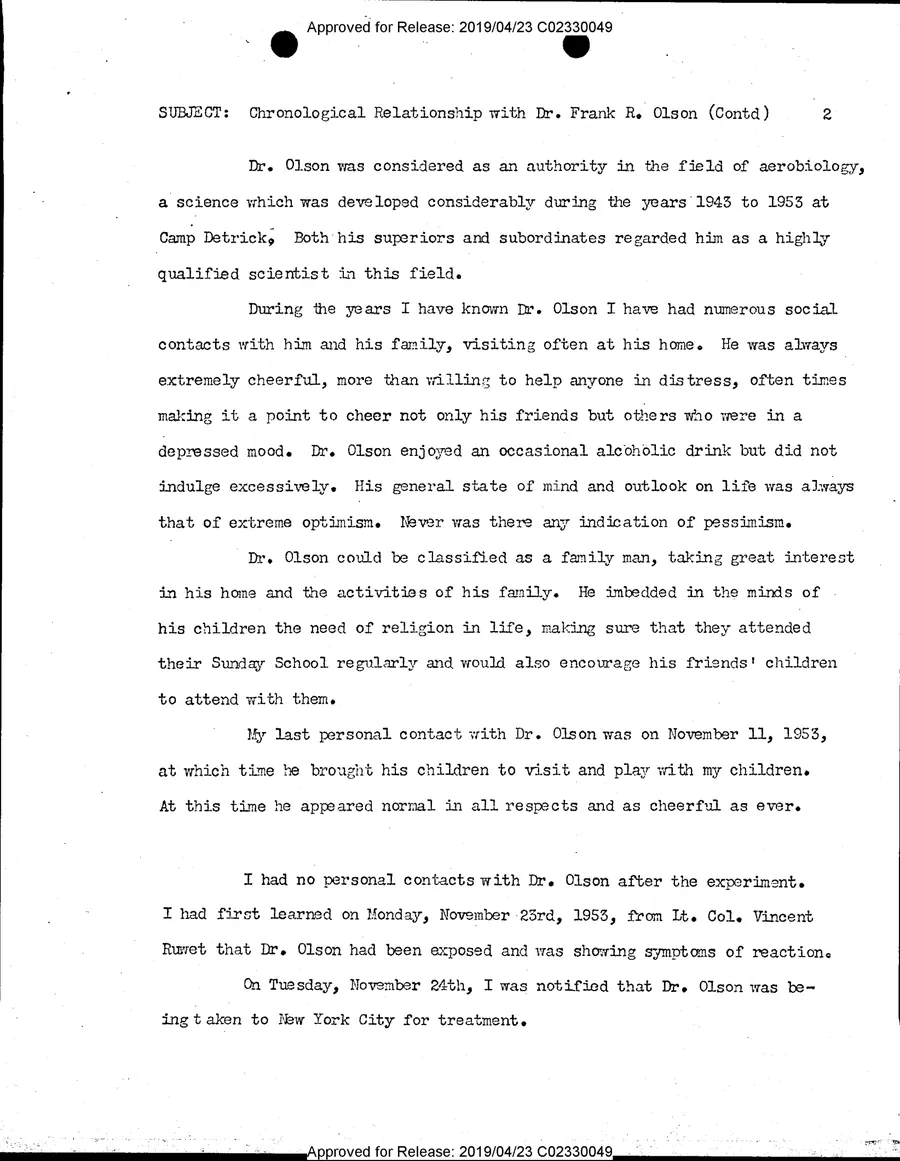
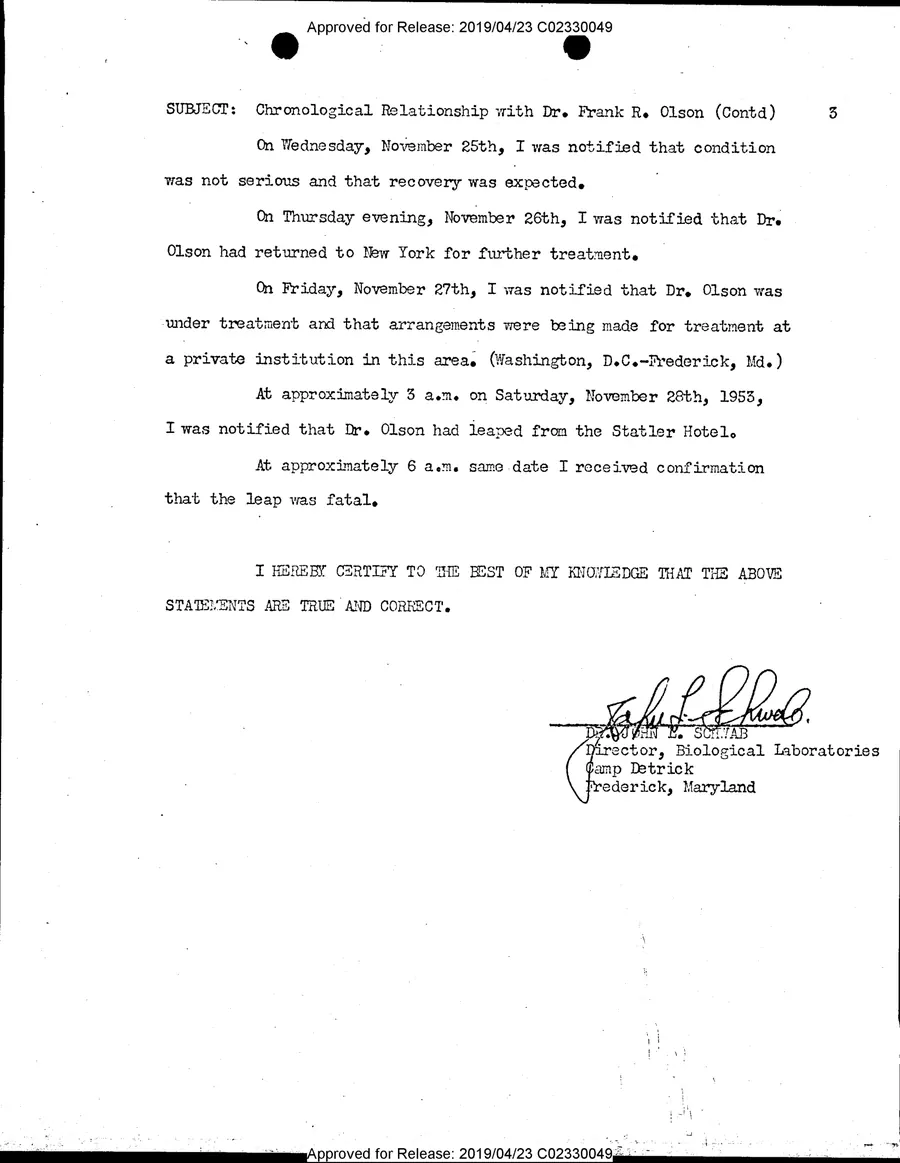
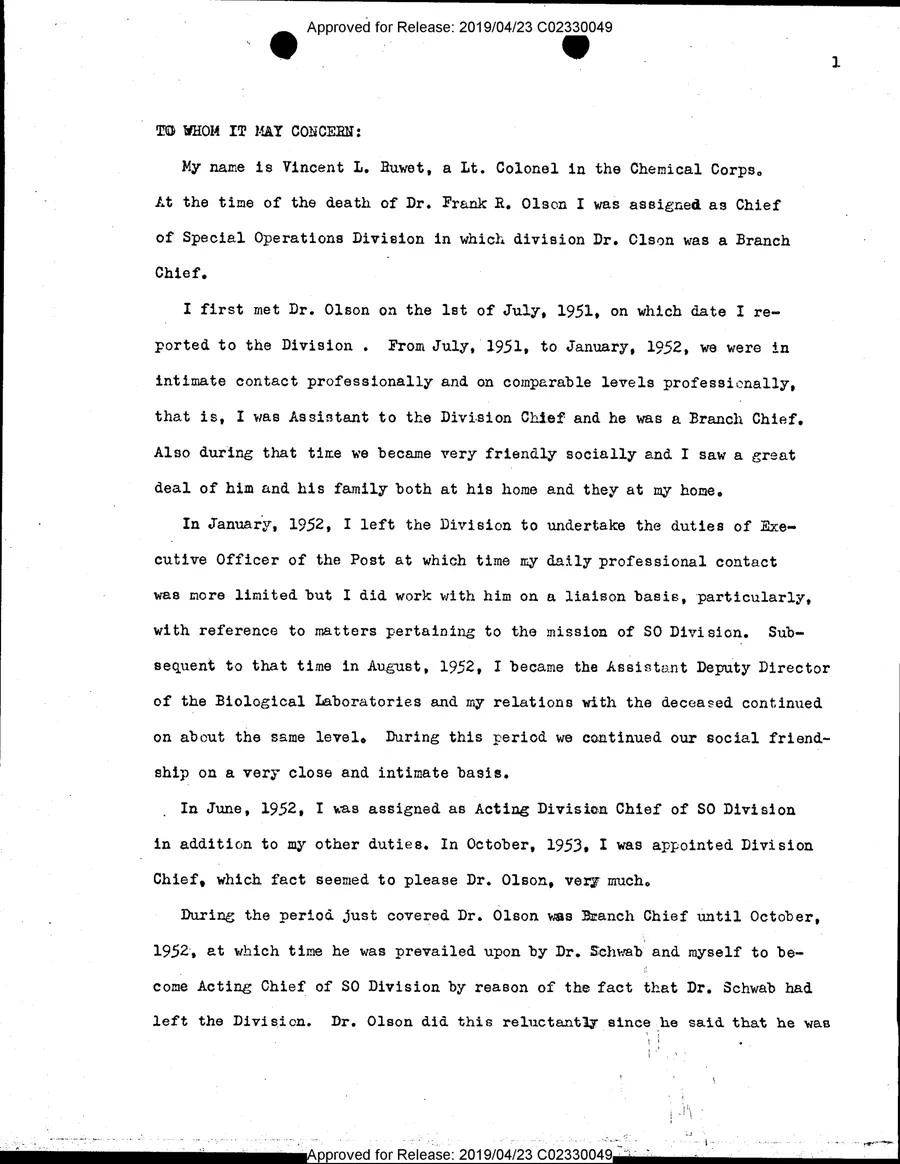
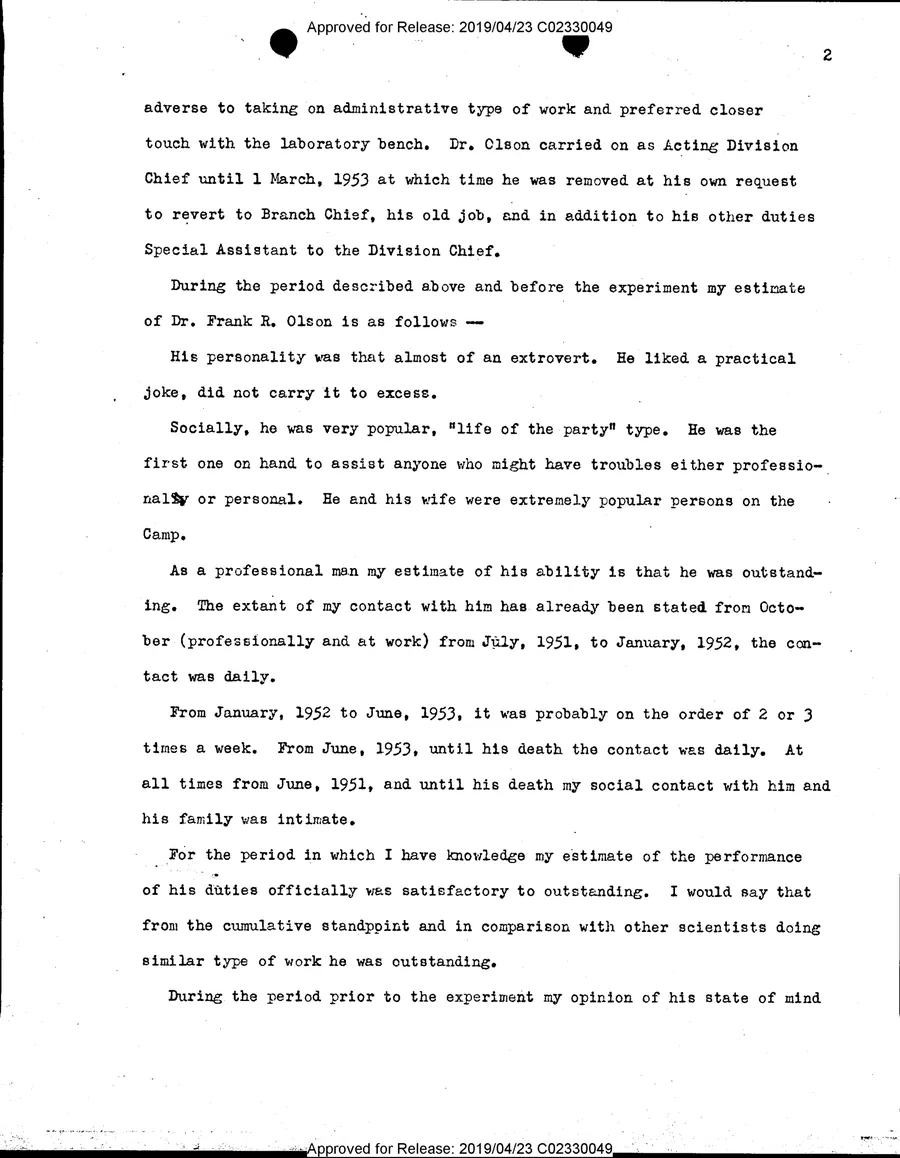
I had no personal contacts with Dr. Olson after the experiment. I had first learned on Monday, November 23rd, 1953, from Lt. Col. Vincent Ruwet that Dr. Olson had been exposed and was showing symptoms of reaction.

On Tuesday, November 24th, I was notified that Dr. Olson was being taken to New York City for treatment.

Textual notes on this leaf (4)
Camp Detrick, Both his superiors
A comma typed where the sentence ends and a new one begins. The mark carries a descending tail and is a comma, not a period. As typed. PRESERVED.
often times
Typed as two words. PRESERVED.
He imbedded in the minds of his children
The variant spelling imbedded, as typed. PRESERVED.
I had first learned on Monday
Past perfect where the simple past is wanted, as typed. PRESERVED.
Printed page 3 Leaf 30 of 64 · source page 30
FRANK R. OLSON — leaf 30, printed page 3, facsimile of the released scan
Approved for Release: 2019/04/23 C02330049 (head and foot)

3

SUBJECT: Chronological Relationship with Dr. Frank R. Olson (Contd)

On Wednesday, November 25th, I was notified that condition was not serious and that recovery was expected.

On Thursday evening, November 26th, I was notified that Dr. Olson had returned to New York for further treatment.

On Friday, November 27th, I was notified that Dr. Olson was under treatment and that arrangements were being made for treatment at a private institution in this area. (Washington, D.C.-Frederick, Md.)

At approximately 3 a.m. on Saturday, November 28th, 1953, I was notified that Dr. Olson had leaped from the Statler Hotel.

At approximately 6 a.m. same date I received confirmation that the leap was fatal.

I HEREBY CERTIFY TO THE BEST OF MY KNOWLEDGE THAT THE ABOVE STATEMENTS ARE TRUE AND CORRECT.

[signed] DR. JOHN L. SCHWAB Director, Biological Laboratories Camp Detrick Frederick, Maryland

Textual notes on this leaf (3)
I was notified that condition
A word is missing before condition, as typed. PRESERVED.
DR. JOHN L. SCHWAB
The middle initial is crossed by the descending stroke of the ink signature and could be read as E. Read here as L. CONFIRM.
same date
Typed as two words, without the article. PRESERVED.
Printed page 1 Leaf 31 of 64 · source page 31
FRANK R. OLSON — leaf 31, printed page 1, facsimile of the released scan
Approved for Release: 2019/04/23 C02330049 (head and foot)

1

TO WHOM IT MAY CONCERN:

My name is Vincent L. Ruwet, a Lt. Colonel in the Chemical Corps. At the time of the death of Dr. Frank R. Olson I was assigned as Chief of Special Operations Division in which division Dr. Clson was a Branch Chief.

I first met Dr. Olson on the 1st of July, 1951, on which date I reported to the Division . From July, 1951, to January, 1952, we were in intimate contact professionally and on comparable levels professionally, that is, I was Assistant to the Division Chief and he was a Branch Chief. Also during that time we became very friendly socially and I saw a great deal of him and his family both at his home and they at my home.

In January, 1952, I left the Division to undertake the duties of Executive Officer of the Post at which time my daily professional contact was more limited but I did work with him on a liaison basis, particularly, with reference to matters pertaining to the mission of SO Division. Subsequent to that time in August, 1952, I became the Assistant Deputy Director of the Biological Laboratories and my relations with the deceased continued on about the same level. During this period we continued our social friendship on a very close and intimate basis.

In June, 1952, I was assigned as Acting Division Chief of SO Division in addition to my other duties. In October, 1953, I was appointed Division Chief, which fact seemed to please Dr. Olson, very much.

During the period just covered Dr. Olson was Branch Chief until October, 1952, at which time he was prevailed upon by Dr. Schwab and myself to become Acting Chief of SO Division by reason of the fact that Dr. Schwab had left the Division. Dr. Olson did this reluctantly since he said that he was

Textual notes on this leaf (3)
Dr. Clson was a Branch Chief
C struck for O in the surname. The letter is open at the right and differs plainly from the closed O of Olson elsewhere on the same leaf. The document has its own error here. PRESERVED.
ported to the Division .
A space typed before the period. PRESERVED.
to please Dr. Olson, very much
A comma typed between the object and the adverb. PRESERVED.
Printed page 2 Leaf 32 of 64 · source page 32
FRANK R. OLSON — leaf 32, printed page 2, facsimile of the released scan
Approved for Release: 2019/04/23 C02330049 (head and foot)

2

adverse to taking on administrative type of work and preferred closer touch with the laboratory bench. Dr. Clson carried on as Acting Division Chief until 1 March, 1953 at which time he was removed at his own request to revert to Branch Chief, his old job, and in addition to his other duties Special Assistant to the Division Chief.

During the period described above and before the experiment my estimate of Dr. Frank R. Olson is as follows --

His personality was that almost of an extrovert. He liked a practical joke, did not carry it to excess.

Socially, he was very popular, "life of the party" type. He was the first one on hand to assist anyone who might have troubles either professionally or personal. He and his wife were extremely popular persons on the Camp.

As a professional man my estimate of his ability is that he was outstanding. The extant of my contact with him has already been stated from October (professionally and at work) from July, 1951, to January, 1952, the contact was daily.

From January, 1952 to June, 1953, it was probably on the order of 2 or 3 times a week. From June, 1953, until his death the contact was daily. At all times from June, 1951, and until his death my social contact with him and his family was intimate.

For the period in which I have knowledge my estimate of the performance of his duties officially was satisfactory to outstanding. I would say that from the cumulative standppint and in comparison with other scientists doing similar type of work he was outstanding.

During the period prior to the experiment my opinion of his state of mind

Textual notes on this leaf (6)
Dr. Clson carried on as Acting Division Chief
C struck for O in the surname, as on folio 1. The letter is open at the right. PRESERVED.
nally or personal
The second l of professionally is typed over an earlier letter and prints as a blot. The word reads professionally. PRESERVED.
The extant of my contact
extant for extent. The document has its own error here. PRESERVED.
from the cumulative standppint
standppint for standpoint, with a doubled p and no o. PRESERVED.
He liked a practical joke, did not carry it to excess.
Two clauses joined by a comma with no conjunction, as typed. PRESERVED.
troubles either professionally or personal
Adverb and adjective coupled, as typed. PRESERVED.
Printed page 3 Leaf 33 of 64 · source page 33
FRANK R. OLSON — leaf 33, printed page 3, facsimile of the released scan
Approved for Release: 2019/04/23 C02330049 (head and foot)

3

was that I noticed nothing which would lead me to beleive that he was of unsound mind. He had the normal family worries, (worries that I consider to be normal). Occassionally he had trouble with his ulcers but was always reluctant to discuss personal troubles with anyone.

Professionally he was making very fine progress particularly in the last year and was most successful in the work he was doing.

I would further like to insert as regards to this personality or personal habits that he did smoke and did take social drinks but did not use either to excess.

The experiment took place Thursday, November 19th, 1953 in the evening. I saw Dr. Olson on Friday morning. We had breakfast and he appeared to be agitated and at the time I did not consider this to be abnormal under the circumstances.

Immediately after breakfast on Friday morning, November 20th, Dr. Olson came to me and had asked if I would object if he rode back to "home-station" with Mr. Champlin. I stated, "Of course, not: that it was perfectly alright with me."

The next time I saw Dr. Olson was on Monday morning, 23rd of November, 1953. I came to work about 7:30 and Dr. Olson was waiting for me in his office. He appeared to be agitated and asked me if I should fire him or should he quit. I was taken "a-back" by this and asked him what was wrong. He stated that in his opinion he had messed up the experiment and did not do well at the meetings. I talked with Dr. Olson for about a half hour and further discussed it with him stating that in my opinion he had the wrong impression - that I thought he did very well at the meetings and in

Textual notes on this leaf (6)
beleive
Misspelling of believe. The document has its own error here. PRESERVED.
Occassionally
Misspelling of occasionally, with a doubled s. PRESERVED.
as regards to this personality
A pen stroke is drawn through the t of this, cancelling it so that the phrase reads his personality. The typed word is kept here and the stroke recorded as handwriting.
making very fine progress particularly
A comma-shaped mark is struck at the foot of the final s of progress, apparently supplying the comma before particularly. The letters are transcribed as typed. CONFIRM.
as regards to
Doubled preposition, as typed. PRESERVED.
Of course, not: that it was perfectly alright with me.
The colon is two dots with no tail and is a colon, not a semicolon. The quotation opens before Of and closes after me. PRESERVED as typed.
Printed page 4 Leaf 34 of 64 · source page 34
FRANK R. OLSON — leaf 34, printed page 4, facsimile of the released scan
Approved for Release: 2019/04/23 C02330049 (head and foot)

4

his participation in the experiment was above reproach. He appeared to be satisfied and relieved.

We attended two professional appointments together and I noticed nothing unusual except that he appeared to have some difficulty in concentrating. We also had lunch together on that date. He did not eat very well; I did notice that. We attended an official movie and meeting at 1530 that afternoon.He was riding home in a car-pool that night and immediately after the movie he said, "so-long," and ran to catch his car.

The next time I saw him was the following morning, Tuesday, 24 November, 1953, when he again was waiting for me in my office when I came to work, about 7:30 a.m. He appeared to be greatly agitated and in his own words, "all mixed up." He said he felt that he was not competent, that he had done something wrong. When questioned closely he could not say exactly what he thought he had done wrong. He made reference to the fact that he thought he should not have been retired for physical reasons but when this was pushed he shifted to the fact that he felt incompetent to the type of work he was doing - when this was pursued he seemed to look for something else which he had done wrong.

After about an hour of discussion it became apparent to me that Dr. Olson needed psychiatric attention. I continued the discussion in such a way as to attempt to get him to suggest that he needed some help. This he did, finally. Dr. Stubbs, who was present, and I immediately agreed that this was our opinion also and I suggested to him that I call Mr. Robert Lashbrook and arrange for such assistance. This he agreed to and said that he would go home at once and discuss the situation with his wife, which he did.

I immediately called Mr. Lashbrook and explained to him what the situation

Textual notes on this leaf (5)
that afternoon.He was riding home
The H is struck over an earlier ll and there is no space after the stop. Best reading He. PRESERVED as printed. CONFIRM.
I continued the discussion in such a way as
The word but is typed above the line over the gap between way and as. It is recorded as an interlineation and is not run into the sentence; the reading it was meant to give is not clear from the leaf. CONFIRM.
that I call Mr. Robert Lashbrook
The stop after Mr is struck over an earlier character. Best reading Mr. PRESERVED. CONFIRM.
This he did, finally.
finally is broken across the line end as fina- lly and the two halves stand in the wrong order in the OCR layer; restored here. PRESERVED as typed.
he felt incompetent to the type of work
incompetent to for incompetent for, as typed. PRESERVED.
Printed page 5 Leaf 35 of 64 · source page 35
FRANK R. OLSON — leaf 35, printed page 5, facsimile of the released scan
Approved for Release: 2019/04/23 C02330049 (head and foot)

5

was and expressed the opinion that Dr. Olson was in serious trouble and needed immediate professional attention. Dr. Lashbrook said that he understood and would take immediate action. Meanwhile Dr. Olson had been discussing this with his wife. I received a call from his wife asking if she could come along and I told her that she could. We were to go to Washington, D.C. for further assistance.

Shortly after this Dr. Lashbrook called back and wanted to know what time we would be in Washington since he had arranged for an appointment in New York with a psychiatrist and that he would obtain air reservations for us to go to New York. About 5 minutes after that Dr. and Mrs. Olson arrived at the office. We went from there to my home where I changed from uniform to civilian clothes and we driven from my home to Washington by Mr. John C. Malinowski.

En route Dr. Olson appeared to be greatly agitated, highly suspicious, and in his own words, "all mixed up." We stopped at the Hot Shoppe restaurant in Bethesda, Md., to have lunch. Dr. Olson ordered lunch but ate or drank very little. He appeared to be highly suspicious of food or drink. We then proceeded to Dr. Lashbrook's office. I went in and saw Dr. Lashbrook and explained the situation to him again. Dr. Olson stayed out in the car with his wife and Mr. Malinowski. I found out later that he had asked Mr. Malinowski to leave the car so that he could talk to his wife, which was done.

After about 15 minutes I came out and suggested to Mr. Malinowski and Mrs. Olson that they leave us there and that we would get to the air-port with Dr. Lashbrook who was going with us. We proceeded for the air-port and left for New York as I can estimate the time now, about 2:30 p.m. Nov. 24.

Textual notes on this leaf (4)
and we were driven from my home
The typed line reads and we driven. The word were is written in ink above a caret between we and driven. The typescript is given as typed and the insertion recorded as handwriting.
I told her that she could. We were to go to Washington
Two or three characters at the end of could are struck over and print as a solid block; the stop after them is legible. Best reading could. CONFIRM.
Dr. Olson was in serious trouble
was and in are each struck twice and print doubled. PRESERVED as read.
Hot Shoppe
The restaurant name as typed, with the doubled p and final e. PRESERVED.
Printed page 6 Leaf 36 of 64 · source page 36
FRANK R. OLSON — leaf 36, printed page 6, facsimile of the released scan
Approved for Release: 2019/04/23 C02330049 (head and foot)

6

During the trip Dr. Olson's condition appeared to be about the same. He was very anxious and he had the feeling that someone was out to get him. He didn't appear to be quite sure why, etc.,

We arrived in New York without incident, proceeded from LaGuardia Airport to Dr. Abramson's office; arrived there approximately 5 p.m. We left Dr. Olson with Dr. Abramson who requested us to come back in about 1 hour.

After an hour we came back and Dr. Abramson suggested that we go to a hotel and we told him we had reservations at the Statler Hotel. He stated that he would come up to our room about 10:30 with some sedatives and also suggested that we have a "high-ball." Dr. Olson, Dr. Lashbrook and I went directly to the hotel, sat and talked for a while, then went to the cocktail-lounge, had a Martini and then went to dinner. Dr. Olson drank a Martini but refused to drink a second one. He ate very little; still appeared to very suspicious, of Dr. Lashbrook and myself.

After dinner we went back to our rooms, disccussed various things and Dr. Olson asked to talk with me alone. Again he appeared to very anxious, upset and kept asking, "What's behind all this? Give me the low-down; What are they trying to do with me; are they checking me for security, etc.,? I did my best to re-assure him and tried to show him wherein factually he was imagining these difficulties and thought I had convinced him, at least, he said that he thought things were clearing up and also he said that he thought Dr. Abramson could help him.

About 10:30 p.m. Dr. Abramson came and brought a bottle of bourbon and some "Nembutal." for Dr. Olson. We sat around and had just a good, social discussion and a couple of "high-balls." About mid-night Dr. Abramson

Textual notes on this leaf (7)
still appeared to very suspicious
A word is missing after appeared to, as typed. PRESERVED.
Again he appeared to very anxious
The same omission after appeared to, as typed. PRESERVED.
disccussed
Misspelling of discussed, with a doubled c; the second s is struck twice. PRESERVED.
drank a Martini but refused
The last letter of Martini is struck over and prints as a blot with a dot above it. Best reading Martini. CONFIRM.
for security, etc.,?
The mark after etc., has the hook and stem of a question mark but no printed dot. Best reading a question mark. CONFIRM.
upset and kept asking, "What's behind all this?
The quotation opened here is never closed on this leaf. PRESERVED as typed.
sure why, etc.,
A sentence closed with a comma after etc., as typed here and again two paragraphs later. PRESERVED.
Printed page 7 Leaf 37 of 64 · source page 37
FRANK R. OLSON — leaf 37, printed page 7, facsimile of the released scan
Approved for Release: 2019/04/23 C02330049 (head and foot)

7

said,'Well, it's time to go to bed." He suggested to Dr. Olson that he take a "Nembutal" which he did at that time and that Dr. Olson take another should he have difficulty sleeping. By the way Dr. Olson had complained to me from the start that he had not been able to sleep after Thursday. He said that he got no sleep. Dr. Olson fell asleep. The undersigned remained awake.

Dr. Olson fell asleep immediately after going to bed and I heard him get up about 3 to go to the bath-room. He came to bed but obviously could not fall asleep as he was tossing and turning and talking to himself. I don't remember what he was saying. I asked him about that time if he would take another Nembutal and he said no. Finally about 5:30 a.m. he appeared to get upset again and I suggested that he take a Nembutal; he agreed and took it. We started discussing the situation over again - the content of the conversation was almost identical to what it had been before. Then he went back to sleep, or I beleive, at least rested until about 9:30 a.m. on the morning of the 25th of November, 1953.

At this time he got up, watched television and the three of us, Dr. Lashbrook, Dr. Olson and myself went to breakfast. He ate some breakfast and appeared to be a little better although he had still been in a rather anxious state in my opinion. We then accompanied Dr. Lashbrook, at Dr. Lashbrook's suggestion, on an official visit which he had to make. During this visit Dr. Olson again became highly suspicious and mixed up. When this became apparent we tactfully cut the visit short and left. We went from there to the doctor's office for the 4 o'clock appointment. We left Dr. Olson there and picked him shortly after 5 o'clock. Dr. Olson had requested that he return home for Thanksgiving dinner so that he could have dinner with his family

Textual notes on this leaf (5)
said,'Well, it's time to go to bed."
The quotation opens with a single mark and closes with a double one, as typed. PRESERVED.
or I beleive, at least rested
Two characters in the middle of the word are struck over and print as a blot. The statement spells the word beleive on folio 3, and that is the reading given here. CONFIRM.
although he had still been in a rather anxious state
had and been are struck through in ink and was is written above the line. The typescript is given as typed and the correction recorded as handwriting.
picked him shortly after 5 oclock
A word is missing after picked him, as typed. PRESERVED.
By the way Dr. Olson had complained
By the way for by that time or similar, as typed. PRESERVED.
Printed page 8 Leaf 38 of 64 · source page 38
FRANK R. OLSON — leaf 38, printed page 8, facsimile of the released scan
Approved for Release: 2019/04/23 C02330049 (head and foot)

8

and this was agreed to by Dr. Abramson who suggested that we make an appointment to come back upp on Tuesday, 1 December 1953. I asked at that time if he would like to have me come with Dr. Olson or if Dr. Olson should come alone. He said this was entirely up to Dr. Olson - if he wished he could come alone; if he wished to have company it would be perfectly alright for me to come. So then we left Dr. Abramson's office; came back to the hotel and at my suggestion got tickets for a musical show, "Me and Juliet." We went out to dinner and from there to the show which started at 8:30 p.m.

Dr. Olson appeared to get upset during the first act and at intermission he was highly agitated and stated that he knew that people were outside waiting to arrest him on his departure from the show. I tried to reassure that I personally will guarantee him that he will be in Frederick or at home the following morning and that he would be there with his family for Thanksgiving. He stated that he didn't beleive me and I told him, "Well, he must do so and that I would give him my word of honor that this would be so." I pointed out that we had the plane reservations. I suggested that maybe he didn't want to see rest of the show and that he and I talk and walk. To this suggestion he quickly agreed. We left the theatre with him and he was in a very anxious state. We walked back to the hotel from the theatre, talking all the while, and by the time we arrived at the hotel he appeared to be more relaxed. We went back to the hotel-room, talked and watched television, discussed going home the following day. and Dr. Lashbrook stayed for the remainder of the show, and came in about 11 or 11:30 p.m. We talked for a little while, called the desk to arrange for being called in time get out to the airport the following morning. The call was arranged for 5:30 a.m. I went to bed and unfortunately I fell asleep, did not hear anything until 5:30 when the phone rang. It was

Textual notes on this leaf (6)
come back upp on Tuesday
upp for up, with a doubled p, as typed. PRESERVED.
I tried to reassure that I personally will guarantee him
A word is missing after reassure, and will stands where the sequence of tenses wants would. will is struck through in ink and would written above. The typescript is given as typed. PRESERVED.
He stated that he didn't beleive me
Misspelling of believe, as on folio 3 of this statement. PRESERVED.
to see rest of the show
The article is missing before rest, as typed. PRESERVED.
called in time get out to the airport
A word is missing before get, as typed. PRESERVED.
the following day. and Dr. Lashbrook
The mark after day is round and sits on the baseline, and reads as a period rather than a comma; the following and is struck through in ink. CONFIRM.
Printed page 9 Leaf 39 of 64 · source page 39
FRANK R. OLSON — leaf 39, printed page 9, facsimile of the released scan
Approved for Release: 2019/04/23 C02330049 (head and foot)

9

the hotel operator waking us up. I flicked on the light; Dr. Olson was not in his bed and his clothes were gone.

I immediately informed Dr. Lashbrook who was in the adjoining room and we dressed, went down to the hotel lobby as speedily as possible and there we found Dr. Olson fully dressed with his over-coat and hat on sitting in a chair. He stated he was walking around in the streets and that in the process he had disposed of his identification button, his wallet, and his money. He stated that he had done this because I had instructed him to do so since I was with him. I told him that I wasn't with him; he said, "Yes, that's right, I must have been dreaming." Since there was no time to waist we decided against looking for his wallet and identification badge , immediately went up to the room, shaved and dressed; Dr. Olson also shaved. We checked out of the hotel; got a taxi and went to LaGuardia Airport in time to make a 7:30 plane. Plane was delayed approximately one hour because of mechanical difficulties. We arrived in Washington; Dr. Olson appeared to be more relaxed at this time.

Dr. Olson ate on the plane and slept the entire trip,(1 hour). We arrived in Washington were met by Mr. Malinowski, Thursday, Nov. 26th, (Thanksgiving Day.) We got in Mr. Malinowski's car and headed for Frederick.

In north-west Washington on Wisconsin avenue Dr. Olson asked if we couldn't stop the car and talk this thing over and I asked him if there was anything wrong and he said, "Well, I would like to talk things over." We stopped in the parking lot at Howard Johnson's on Wisconsin avenue near Bethesda-Chevy Chase Woodward Lothrop store. He asked Mr. Malinowski to leave the car as he wanted to discuss something with me - Mr. Malinowski complied. He told me he could not go back to Frederick since he was so mixed up. He was ashamed to meet his wife and family, and requested to

Textual notes on this leaf (6)
time to waist we decided
waist for waste, as typed; the word is struck through in ink and waste written above. The typescript is given as typed. PRESERVED.
slept the entire trip,(1 hour).
The parentheses are drawn in ink around typed matter. The stop after the closing bracket is small and round and reads as a typed period. CONFIRM.
We arrived in Washington were met by Mr. Malinowski
A conjunction is missing before were met, as typed. PRESERVED.
badge , immediately went up
A space typed before the comma. PRESERVED.
on Wisconsin avenue
avenue in lower case, here and again three lines below. PRESERVED.
near Bethesda-Chevy Chase Woodward Lothrop store
The two place names run together without punctuation, as typed. PRESERVED.
Printed page 10 Leaf 40 of 64 · source page 40
FRANK R. OLSON — leaf 40, printed page 10, facsimile of the released scan
Approved for Release: 2019/04/23 C02330049 (head and foot)

10

just leave him go and would go off by himself. This I told him I could not do. He then asked me to turn him over to the police since they wanted him anyway. We discussed thisat considera ble length and he appeared satisfied - that the police did not want him. I then suggested that maybe he would like to go back to see Dr. Abramson. He agreed to this suggestion.

I then called Dr. Lashbrook and told him what the situation was and he told me to take Dr. Olson to his apartment immediately. This was done. We decided to take Dr. Clson back to New York to see Dr. Abramson and it was decided that since Mrs. Olson was entitled to know what the situation was and because she was expecting him for Thanksgiving dinner I should proceed to Frederick to brief Mrs. Clson. Dr. Olson appeared to be very much upset and agitated. Again, all mixed up. This was the worst that I had seen him, since the experiment took place. This is the last time I saw Dr. Olson.

On Friday evening, approximately 10:30, November 27th, I received a call from New York from Dr. Lashbrook who stated that reservations had been made for Dr. Olson at Chestnut Lodge in Rockville, Maryland and that they had plane reservations for the following morning and were scheduled to arrive in Washington at 9:34 on the 28th of November. This had suggested that I meet the plane which I agreed to do. I then asked if Dr. Olson was still speaking to me in a rather joking manner. I heard Dr. Lashbrook ask him this question and his answer was, "Why, yes, let me have the phone." Dr. Olson appeared on the phone quite relaxed. He told me about the trip in the morning, about the fact that he had reservations at Chestnut Lodge. I told him that I knew the latter as Dr. Lashbrook had

Textual notes on this leaf (7)
Dr. Clson back to New York
C struck for O in the surname, as on folios 1 and 2. PRESERVED.
to brief Mrs. Clson
The same substitution in the same line of typing. PRESERVED.
We discussed thisat considera ble length
this and at are typed without a space and overstruck, and considerable is broken into considera and ble with a space. Both as typed. PRESERVED.
just leave him go
leave him go for let him go, as typed. PRESERVED.
This was the worst that I had seen him
A word is missing after worst, as typed. PRESERVED.
This is the last time I saw Dr. Olson
is is struck through in ink and was written above. The typescript is given as typed. PRESERVED.
This had suggested that I meet the plane
This had is struck through in ink and He written above, giving the reading He suggested that I meet the plane. The typescript is given as typed. PRESERVED.
Printed page 11 Leaf 41 of 64 · source page 41
FRANK R. OLSON — leaf 41, printed page 11, facsimile of the released scan
Approved for Release: 2019/04/23 C02330049 (head and foot)

11

told me so. I also told him I would meet the plane. He suggested that I not do so since that day was Saturday and he knew that I probably had work to do around the house. I told him to think nothing of that and that I would meet him. He said, "fine. I'll see you in the morning." This is the last time I spoke to Dr. Olson.

At approximately 2:45 a.m. Sat. Nov. 28th, 1953, I received a call from Dr. Gottlieb with a message that Dr. Clson had died.

I HEREBY CERTIFY TO THE BEST OF MY KNOWLEDGE THAT THE ABOVE STATEMENTS ARE TRUE AND CORRECT.

[signed] VINCENT L. RUWET Lt. Col. CmlC Chief, SO Division Camp Detrick Frederick, Maryland

Textual notes on this leaf (3)
that Dr. Clson had died
C struck for O in the surname, as on folios 1, 2 and 10, in the closing sentence of the account. PRESERVED.
He said, "fine. I'll see you in the morning."
The quotation opens on a lower-case f. PRESERVED as typed.
Lt. Col. CmlC
The Chemical Corps abbreviated CmlC, with a lower-case l, as throughout. PRESERVED.
Unnumbered leaf Leaf 42 of 64 · source page 42
FRANK R. OLSON — leaf 42, facsimile of the released scan
Approved for Release: 2019/04/23 C02330049 (head and foot) · SECRET, printed at head and foot of the form · BY HAND, rubber stamp in the COMMENTS column, upper right · EYES ONLY, rubber stamp in the COMMENTS column below BY HAND

ROUTING AND RECORD SHEET

INSTRUCTIONS: Officer designations should be used in the "TO" column. Under each comment a line should be drawn across sheet and each comment numbered to correspond with the number in the "TO" column. Each officer should initial (check mark insufficient) before further routing. This Routing and Record Sheet should be returned to Registry.

FROM: Chief, I&R

1 December 1953

NO.

DATE

TO ROOM NO. DATE REC'D FWD'D OFFICER'S INITIALS COMMENTS

1. Inspector General

2. 3. 4. 5. 6. 7. 8. 9. 10. 11. 12. 13. 14. 15.

FORM NO. 51-10 FEB 1950

16-61155-1 U. S. GOVERNMENT PRINTING OFFICE

Textual notes on this leaf (5)
Kirk:
The salutation of the first manuscript note. The final letter is a k or a c. CONFIRM.
We have not coordinated with DD/P
The ends of the first two lines of this note run past the ruled border of the form and are cut by the edge of the sheet as scanned; coordinated and knowledge are completed from their surviving heads and tails. CONFIRM.
have held knowledge to Glenn, Joyce and me
The word read here as held could be field. The sense of the sentence, that knowledge was restricted to three named men, favours held; the letterforms are indistinct in this copy. CONFIRM.
Glenn, Joyce
Two surnames in the second manuscript note. CONFIRM.
rows 2 to 15
The remaining fourteen numbered rows of the routing table are printed but not filled in.
Unnumbered leaf Leaf 43 of 64 · source page 43
FRANK R. OLSON — leaf 43, facsimile of the released scan

Order restored. The last leaves of the 1953-54 file: what the Agency wrote down about the experiment three months after the death.

10 Feb 54

MEMORANDUM FOR: Helms

Please hand carry to

Gibbons Drum Gottlieb

Have them note having read + return to Kirk for Eyes Only file. These are not reprimands + no personnel file notation being made

CPC

FORM NO. 10-101 JAN 1952 (47)

Textual notes on this leaf (3)
Gottlieb
Third name in the hand-carry list. The strokes read as either Gottlieb or Gottleib; best reading given. CONFIRM.
read + return
The word and is written throughout as a crossed stroke, transcribed here as a plus sign. It occurs twice. CONFIRM.
file notation being made
The last word is written across the printed (DATE) rule of the form and is partly obscured by it. Best reading given. CONFIRM.
Unnumbered leaf Leaf 44 of 64 · source page 44
FRANK R. OLSON — leaf 44, facsimile of the released scan
FEB 10 1954 (date stamp, upper right, below the letterhead)

CENTRAL INTELLIGENCE AGENCY

WASHINGTON 25, D. C.

OFFICE OF THE DIRECTOR

"EYES ONLY"

MEMORANDUM FOR: Chief, Technical Services Staff

SUBJECT : Unwitting Application of LSD

1. This is to advise you that I consider the unwitting application of LSD in an experiment with which you are familiar to be an indication of bad judgment on the part of two members of your staff: James H. Drum and Dr. Sidney Gottlieb.

2. The purpose of this memorandum is to inform you officially of this conclusion and to advise you to take all appropriate steps to insure a thorough and careful review within TSS of all experiments. The Deputy Director (Plans) has been instructed to constitute a review board composed of the appropriate officials from within the Agency periodically to review TSS research and experiments.

[signed] ALLEN W. DULLES Director

Textual notes on this leaf (3)
WASHINGTON 25, D. C.
The engraved letterhead is broken on this leaf and the second digit could be read as 3; the same letterhead prints clearly as 25 on the two letters that follow. Read as 25.
review within TSS of all experiments
The first TSS prints with a broken S that reads as C or G; the second occurrence, TSS research, is clear. Read as TSS both times. CONFIRM.
James H. Drum
Middle initial reads H in this copy; the strike is faint. CONFIRM.
Unnumbered leaf Leaf 45 of 64 · source page 45
FRANK R. OLSON — leaf 45, facsimile of the released scan
FEB 10 1954 (date stamp, upper right, below the letterhead) · SECRET (faint stamp at the foot, centre of the sheet; broken and largely illegible)

CENTRAL INTELLIGENCE AGENCY

WASHINGTON 25, D. C.

OFFICE OF THE DIRECTOR

PERSONAL

Colonel James H. Drum Chief, Technical Operations Technical Services Staff

Dear Colonel Drum:

I have personally reviewed the case in which your staff employed the use of a drug on a group of subjects not entirely witting that such an experiment was to be made on themselves. It is my view that poor judgment was demonstrated by you in authorizing the use of this drug on such an unwitting basis and without proximate medical safeguards.

This is to advise you that in the position of responsibility which you hold you are expected to exercise greater judgment than was indicated in this case.

Sincerely, [signed] Allen W. Dulles Director

Textual notes on this leaf (3)
SECRET
Foot stamp. Only the letter shapes survive; six characters, read as SECRET. CONFIRM.
Colonel James H. Drum
Middle initial is broken in every occurrence on this leaf; read as H. CONFIRM.
11 Feb 54
Manuscript date at the foot; the final digit is faint. CONFIRM.
Unnumbered leaf Leaf 46 of 64 · source page 46
FRANK R. OLSON — leaf 46, facsimile of the released scan
FEB 10 1954 (date stamp, upper right, below the letterhead) · SECRET (faint stamp at the foot, centre of the sheet; broken and largely illegible)

CENTRAL INTELLIGENCE AGENCY

WASHINGTON 25, D. C.

OFFICE OF THE DIRECTOR

PERSONAL

Dr. Sidney Gottlieb Chief, Chemical Division Technical Services Staff

Dear Dr. Gottlieb:

I have personally reviewed the files from your office concerning the use of a drug on an unwitting group of individuals. In recommending the unwitting application of the drug to your superior, you apparently did not give sufficient emphasis to the necessity for medical collaboration and for proper consideration of the rights of the individual to whom it was being administered. This is to inform you that it is my opinion that you exercised poor judgment in this case.

Sincerely, [signed] Allen W. Dulles Director

Textual notes on this leaf (3)
SECRET
Foot stamp. Broken and largely illegible; read from the letter shapes. CONFIRM.
SB Feb 11
Manuscript initials and date below the signature block. The initials are indistinct; best reading given. CONFIRM.
With Gottlieb [illegible]
Second line of the manuscript file note at the foot. The word after the name will not resolve at 300 dpi. CONFIRM.
Unnumbered leaf Leaf 47 of 64 · source page 47
FRANK R. OLSON — leaf 47, facsimile of the released scan
20 MAY 1975 (date stamp, upper right) · classification line at the head of the sheet, trimmed by the top edge and struck through with a ruled line; only the feet of the letters survive

MEMORANDUM FOR: Director of Central Intelligence

SUBJECT : CIA Activities at Fort Detrick, Frederick, Maryland

1. In early 1952, CIA effected an agreement with the Army Chemical Corp for the performance of certain research and development work by the Army Chemical Corp at the laboratory facilities of Special Operations Division, Army Biological Laboratories, Frederick, Maryland.

2. The purpose of the CIA (TSD) project at Camp Detrick was to maintain a research and development competence in the biological and engineering sciences in a special security environment to assist in meeting the need for a minimal support capability in defensive and offensive BW/CW. The program was divided into four functional categories as follows:

a. Maintenance of a stockpile of incapacitating and lethal agents in readiness for operational use;

b. Maintenance, assessment and evaluation of a designated balance of biological and chemical disseminating systems for operational readiness;

c. Adaptation and testing of a non-discernible microbioinoculator (device for the clandestine inoculation with BW/CW agents) to determine compatability with various materials and to assure that the microbioinoculator cannot be identified structurally or easily detected upon a detailed autopsy; and

d. Provide technical support and consultation on request to meet ad hoc requirements related to offensive and defensive BW/CW.

3. This program, which continued until early 1970, was budgeted, on the average, for approximately [redacted] per year. Currently available figures indicate the following expenditures for this activity:

Textual notes on this leaf (5)
Army Chemical Corp
Corp for Corps, twice in paragraph 1. The document’s own spelling. PRESERVED.
compatability
For compatibility, in subparagraph c. The document’s own spelling. PRESERVED.
Camp Detrick
The subject line gives Fort Detrick and paragraph 2 gives Camp Detrick. Both as typed. PRESERVED.
microbioinoculator
Broken across a line in subparagraph c as micro- / bioinoculator and printed unbroken later in the same sentence; set here as one word.
classification line at the head
Struck through and trimmed by the top edge; the surviving letter feet are consistent with SECRET but the word cannot be read. Not transcribed. CONFIRM.
Unnumbered leaf Leaf 48 of 64 · source page 48
FRANK R. OLSON — leaf 48, facsimile of the released scan

SUBJECT: CIA Activities at Fort Detrick, Frederick, Maryland

*Estimated FY figures.

4. On 25 November 1969, President Nixon ordered the Department of Defense to recommend plans for the disposal of existing stocks of bacteriological weapons. On 14 February 1970, he included all toxin weapons. It is our understanding that all these materials were destroyed in compliance with President Nixon's directives. We cannot, however, locate records that establish this fact.

[signed] Donald F. Chamberlain Inspector General

Textual notes on this leaf (2)
SUBJECT:
The initial S is trimmed by the left edge of the sheet; the line reads UBJECT: on this copy. Supplied.
*Estimated FY figures.
Footnote to the withheld table. It is the only surviving text of that table.
Printed page 37 Leaf 49 of 64 · source page 49
FRANK R. OLSON — leaf 49, printed page 37, facsimile of the released scan
a circular stamp overlaps the lower right margin of the printed block; only an arc of its rule and two or three letters fall on the page, and it cannot be read

Order restored. One leaf of the Rockefeller Commission's report, printed page 37 - the finding that put the death into public print. The Commission's fuller account at printed pages 226 to 227 is not reproduced here; see the Absent Page.

37

Beginning in the fall of 1973, the Directorate monitored conversations between the United States and Latin America in an effort to identify narcotics traffickers. Three months after the program began, the General Counsel of the CIA was consulted. He issued an opinion that the program was illegal, and it was immediately terminated.

This monitoring, although a source of valuable information for enforcement officials, was a violation of a statute of the United States. Continuation of the operation for over three months without the knowledge of the Office of the General Counsel demonstrates the need for improved internal consultation. (See Recommendation 10.)

8. Domestic Activities of the Directorate of Science and Technology (Chapter 16)

Findings and Conclusions

The CIA's Directorate of Science and Technology performs a variety of research and development and operational support functions for the Agency's foreign intelligence mission.

Many of these activities are performed in the United States and involve cooperation with private companies. A few of these activities were improper or questionable.

As part of a program to test the influence of drugs on humans, research included the administration of LSD to persons who were unaware that they were being tested. This was clearly illegal. One person died in 1953, apparently as a result. In 1963, following the Inspector General's discovery of these events, new stringent criteria were issued prohibiting drug testing by the CIA on unknowing persons. All drug testing programs were ended in 1967.

In the process of testing monitoring equipment for use overseas, the CIA has overheard conversations between Americans. The names of the speakers were not identified; the contents of the conversations were not disseminated. All recordings were destroyed when testing was concluded. Such testing should not be directed against unsuspecting persons in the United States. Most of the testing undertaken by the Agency could easily have been performed using only Agency personnel and with the full knowledge of those whose conversations were being recorded. This is the present Agency practice.

Other activities of this Directorate include the manufacture of alias credentials for use by CIA employees and agents. Alias credentials are necessary to facilitate CIA clandestine operations, but the strictest controls and accountability must be maintained over the use of such

Textual notes on this leaf (2)
controls and accountability must be maintained over the use of such
The sentence breaks at the foot of the printed page and is completed on page 38, which is not in this file. Left as it ends.
One person died in 1953, apparently as a result.
The Commission finding on the death of Frank Olson. Olson is not named anywhere on this page.
Unnumbered leaf Leaf 50 of 64 · source page 50
FRANK R. OLSON — leaf 50, facsimile of the released scan
SECRET, typed at the left above the memorandum block and struck through with a single ink stroke · declassification stamp at the foot, in four lines: "Determined to be an administrative marking / Cancelled per E.O. 12356, Sec. 1.3 and / Archivist’s memo of March 16, 1983 / By ________ NARS date ________", the two rules filled in by hand · a circular stamp in the lower right margin, faint and illegible

Order restored. The Ford Library's file carries this memorandum, the draft statement and the Justice Department report twice. The signed copy is printed; the carbon is not.

THE WHITE HOUSE

WASHINGTON

July 11, 1975

MEMORANDUM FOR: DON RUMSFELD

FROM: DICK CHENEY

SUBJECT: The Olson Matter/ CIA Suicide

Attached is a proposed brief statement for the President to use at his Press Conference. It would be best for him to use it in response to a question, although if he wished, he can use it as an opening statement.

There is also attached a four page memo prepared by the Civil Division, the Department of Justice, based upon information obtained from the CIA regarding the events surrounding Mr. Olson's death.

Rod Hills has questions concerning the last paragraph of the Justice Department memo which expresses the Justice Department opinion that court action against the U.S. would be barred. He will pursue the matter with the Attorney General.

At this point, we do not have enough information to be certain we know all of the details of this incident. Furthermore, there are serious legal questions that will have to be resolved concerning the Government's responsibility, the possibility of additional compensation, and the possibility that it might be necessary to disclose highly classified national security information in connection with any court suit, or legislative hearings on a private bill intended to provide additional compensation to the family.

Textual notes on this leaf (3)
DAD
Initials written on the By rule of the declassification stamp. Three letters, the middle one crossed; read as DAD. CONFIRM.
NARS date 5/30/85
The middle figure is written over and could be read as 3 or 30. CONFIRM.
The Olson Matter/ CIA Suicide
Solidus set close against Matter and spaced before CIA, as typed. PRESERVED.
Printed page 2 Leaf 51 of 64 · source page 51
FRANK R. OLSON — leaf 51, printed page 2, facsimile of the released scan
a circular stamp in the lower right margin, faint and illegible

-2-

Therefore, Marsh, Hills and Cheney strongly recommend that the President limit his remarks to an expression of regret over this tragic event and a willingness to meet personally with Mrs. Olson and her children to offer an apology on behalf of the Government. Any discussion that goes beyond those issues raises questions which we are not yet in a position to answer.

In response to any questions which go beyond the above, we would recommend that the President indicate that the entire matter, both with regard to the adequacy of compensation and circumstances surrounding Mr. Olson's death, are under review by the Justice Department.

Attachments

cc: Jerry Jones

Textual notes on this leaf (1)
Mr. Olson's death, are under review
Plural verb with a singular subject, as typed. PRESERVED.
Unnumbered leaf Leaf 52 of 64 · source page 52
FRANK R. OLSON — leaf 52, facsimile of the released scan
a circular stamp in the lower right margin, faint and illegible

As An Answer To A Question or An Opening Statement

The recent disclosure of the facts concerning the death of Dr. Frank Olson are of great concern to me. I am equally distressed by the fact that the full details of Dr. Olson's death were not made known to Mrs. Olson and other members of his family.

Mrs. Olson and her family deserve our deepest sympathy. I hope to meet with the family at the earliest opportunity to personally extend an apology on behalf of the United States Government.

Textual notes on this leaf (1)
The recent disclosure of the facts concerning the death of Dr. Frank Olson are of great concern to me.
Plural verb with a singular subject, as typed. PRESERVED.
Unnumbered leaf Leaf 53 of 64 · source page 53
FRANK R. OLSON — leaf 53, facsimile of the released scan
a circular stamp in the lower right margin, faint and illegible

Justice Department Report

The Rockefeller Report states on p. 226:

"In the late 1940's, the CIA began to study the properties of certain behavior-influencing drugs (such as LSD) and how such drugs might be put to intelligence use. This interest was prompted by reports that the Soviet Union was experimenting with such drugs and by speculation that the confessions introduced during trials in the Soviet Union and other Soviet Bloc countries during the late 1940's might have been elicited by the use of drugs or hypnosis. Great concern over Soviet and North Korean techniques in 'brainwashing" continued to be manifested into the early 1950's. "

Dr. Frank A. Olson, a bio-chemist, was a civilian employee of the Army working at Fort Detrick in a cooperative effort with the CIA. On November 19, 1953, at one of the periodic meetings of Ft. Detrick and CIA personnel, a dosage of LSD was placed by CIA personnel in drinks consumed by Dr. Olson and others, all of whom were members of the group. Prior to receiving the LSD, Dr. Olson had participated in discussions where the testing of such substances on unsuspecting subjects was agreed to in principle. However, neither Dr. Olson, nor any of the others was made aware that they had been given LSD until about 20 minutes after the fact.

Textual notes on this leaf (4)
techniques in 'brainwashing" continued to be
Opened with a single quotation mark and closed with a double one, as typed. PRESERVED.
manifested into the early 1950's. "
A space stands between the full stop and the closing quotation mark, as typed. PRESERVED.
Fort Detrick ... Ft. Detrick
The installation is given in full and then abbreviated within the same paragraph, as typed. PRESERVED.
bio-chemist
Hyphenated, as typed. PRESERVED.
Printed page 2 Leaf 54 of 64 · source page 54
FRANK R. OLSON — leaf 54, printed page 2, facsimile of the released scan
a circular stamp in the lower right margin, faint and illegible

-2-

During the next several days Dr. Olson developed side effects, as a result of which he was taken to New York City on November 24, 1953, to be treated by a doctor who was a consultant to the agency on drug-related matters, Dr. Harold A. Abramson. On November 24, 25 and 26, he met with Dr. Abramson.

After seeing him on the 27th, Dr. Abramson believed that hospitalization would be in Dr. Olson's best interest. Arrangements were made for a hospital room near Dr. Olson's home (in the Washington area), but his room could not be prepared until the following day. Consequently, Dr. Lashbrook, of CIA, and Dr. Olson stayed at the Hotel Statler in New York on the night of November 27.

Dr. Lashbrook reported that during cocktails and dinner Dr. Olson appeared cheerful and spoke freely of his forthcoming hospitalization. Lashbrook and Olson retired at about 11:00 PM. They occupied separate twin beds in the same room on the tenth floor. At approximately 2:30 Saturday morning, Lashbrook was awakened by a loud noise; he reported that Olson had crashed through

Textual notes on this leaf (2)
a consultant to the agency
Agency in lower case here and capitalised elsewhere in the file, as typed. PRESERVED.
he reported that Olson had crashed through
The sentence breaks at the foot of the sheet and is completed on folio 3. Left as it ends.
Printed page 3 Leaf 55 of 64 · source page 55
FRANK R. OLSON — leaf 55, printed page 3, facsimile of the released scan
a circular stamp in the lower right margin, faint and illegible

-3-

the closed window blind and closed window and had fallen to his death.

The CIA General Counsel rendered an opinion that the death resulted from "circumstances arising out of an experiment undertaken in the course of his official duties for the U. S. Government.

The Bureau of Employee's Compensation adopted this view, thus awarding survivor benefits to the widow and children. To date $143, 582. 22 have been paid to the widow and three children. These tax-free benefits continue to be paid in the current total amount of $792. 00 per month. The payments to the children terminate when they reach majority (as two already have), but the widow's benefits continue until death or re-marriage, and are periodically adjusted for cost of living increases.

The CIA has never made any contact with the family. Prior to the publication of the Rockefeller Report, no government representative has ever disclosed the full details concerning Dr. Olson's death.

Textual notes on this leaf (3)
the death resulted from "circumstances arising out of an experiment undertaken in the course of his official duties for the U. S. Government.
The quotation is opened and never closed, as typed. PRESERVED.
Bureau of Employee's Compensation
Apostrophe placed as typed; the agency is the Bureau of Employees' Compensation. PRESERVED.
To date $143, 582. 22 have been paid
Figures spaced after the comma and the point, as typed, here and at $792. 00 below. PRESERVED.
Printed page 4 Leaf 56 of 64 · source page 56
FRANK R. OLSON — leaf 56, printed page 4, facsimile of the released scan
a circular stamp in the lower right margin, faint and illegible

-4-

Upon a preliminary review of the facts, it is the opinion of Justice Department lawyers that any tort action against the United States arising out of the above-stated facts would be barred by the Federal Employees' Compensation Act, and specifically 5 USC 8116(c). This Act would not bar suit against any individuals.

Textual notes on this leaf (1)
above-stated
Hyphenated across the line end, as typed; set here as one word.
Unnumbered leaf Leaf 57 of 64 · source page 57
FRANK R. OLSON — leaf 57, facsimile of the released scan
Approved for Release / Date ________ (the date rule left blank), with the serial 001132 struck immediately above it, the last two figures overprinted · FEB 2000, printed in mirror image below the release stamp; an offset taken from the back of another sheet

11 August 1975

SUBJECT: Documents passed to Olson family not previously forwarded to Senat[e] Select Committee

Response:

Attached are the documents declassified by Mr. Colby on 24 July 1975--in sanitized form--for passage to the Olson family. Some of them were inadverte[ntly] omitted from a similar collection of documents forwarded to the SSC on or abou[t] 25 July 1975. They are forwarded now in response to a verbal request by Mr. Eliott Maxwell on 6 August 1975.. The first two documents in the package were forwarded to the Olson family subsequent to transmission of the main package.

Textual notes on this leaf (5)
forwarded to Senat[e]
The right edge of the typescript is cut off by the copy. The final letter is supplied in brackets. CONFIRM.
inadverte[ntly]
Cut off at the right edge of the copy; supplied in brackets from the sense of the sentence. CONFIRM.
on or abou[t]
Cut off at the right edge of the copy; supplied in brackets. CONFIRM.
Eliott Maxwell
Spelled Eliott in the typescript. PRESERVED.
6 August 1975..
Two full stops after the year, as typed. PRESERVED.
Unnumbered leaf Leaf 58 of 64 · source page 58
FRANK R. OLSON — leaf 58, facsimile of the released scan
REVIEW STAFF, in a ruled box at the head right · Approved for Release / Date ________ (the date rule left blank), stamped askew in the lower right corner, with a FEB 200- date stamp beneath it, the last figure obscured

29 October 1975

The President The White House Washington, D. C. 20500

Dear Mr. President:

Pursuant to your instructions, efforts were made to negotiate a settlement of the claim of the family of Mr. Frank R. Olson against the Government based on the circumstances of his untimely death. Although the family has agreed to settle its far larger initial claim for [redacted] the Attorney General is not prepared to certify under existing law that such a settlement is appropriate.

The Olson family is prepared to file suit. Such litigation would doubtless be prolonged and in the view of the Department of Justice, it would fail. Under the circumstances this would not appear to be in the best interests of the nation or the Olson family. I believe in good conscience that the circumstances of this case require an equitable response from the Government.

The only vehicle by which to obtain such recompense would be by passage of private legislation. Consequently, I recommend that you forward a request to the Congress for passage of a private bill in the sum of [redacted]

Respectfully, [signed] W. E. Colby Director

Textual notes on this leaf (3)
29 October 1975
The OCR layer reads the year as 1973; the typed figure on the sheet is 1975 and is clear at 300 dpi. Corrected.
initial claim for [redacted] the Attorney General
No punctuation survives between the withheld figure and the Attorney General; whatever stood there is under the bar. Not supplied.
in the sum of [redacted]
The letter ends inside the redaction. No terminal punctuation survives. Not supplied.
Printed page 394 Leaf 59 of 64 · source page 59
FRANK R. OLSON — leaf 59, printed page 394, facsimile of the released scan

Order restored. Printed pages 394 to 399 of Senate Report 94-755, Book I - the Committee's whole account of the death, unbroken. The printed page number is the leaf's own folio. Nothing of this chapter is reproduced beyond page 399; what was considered and cut is set out in The Absent Page.

394

Although the CIA recognized these effects of LSD to unwitting individuals within the United States, the project continued.24 As the Deputy Director for Plans, Richard Helms, wrote the Deputy Director of Central Intelligence during discussions which led to the cessation of unwitting testing:

While I share your uneasiness and distaste for any program which tends to intrude upon an individual's private and legal prerogatives, I believe it is necessary that the Agency maintain a central role in this activity, keep current on enemy capabilities the manipulation of human behavior, and maintain an offensive capability.25

There were no attempts to secure approval for the most controversial aspects of these programs from the executive branch or Congress. The nature and extent of the programs were closely held secrets; even DCI McCone was not briefed on all the details of the program involving the surreptitious administration of LSD until 1963. It was deemed imperative that these programs be concealed from the American people. As the CIA's Inspector General wrote in 1957:

Precautions must be taken not only to protect operations from exposure to enemy forces but also to conceal these activities from the American public in general. The knowledge that the Agency is engaging in unethical and illicit activities would have serious repercussions in political and diplomatic circles and would be detrimental to the accomplishment of its mission.26

2. The Death of Dr. Frank Olson

The most tragic result of the testing of LSD by the CIA was the death of Dr. Frank Olson, a civilian employee of the Army, who died on November 27, 1953. His death followed his participation in a CIA experiment with LSD. As part of this experiment, Olson unwittingly received approximately 70 micrograms of LSD in a glass of Cointreau he drank on November 19, 1953. The drug had been placed in the bottle by a CIA officer, Dr. Robert Lashbrook, as part of an experiment he and Dr. Sidney Gottlieb performed at a meeting of Army and CIA scientists.

Shortly after this experiment, Olson exhibited symptoms of paranoia and schizophrenia. Accompanied by Dr. Lashbrook, Olson sought psychiatric assistance in New York City from a physician, Dr. Harold Abramson, whose research on LSD had been funded indirectly by the CIA. While in New York for treatment, Olson fell to his death from a tenth story window in the Statler Hotel.

24 Even during the discussions which led to the termination of the unwitting testing, the DDP turned down the option of halting such tests within the U.S. and continuing them abroad despite the fact that the Technical Services Division had conducted numerous operations abroad making use of LSD. The DDP made this decision on the basis of security noting that the past efforts overseas had resulted in "making an inordinate number of foreign nationals witting of our role in the very sensitive activity." (Memorandum for the Deputy Director of Central Intelligence from the Deputy Director for Plans, 12/17/63, p. 2.)

25 Ibid., pp. 2–3.

26 I.G. survey of TSD, 1957, p. 217.

Textual notes on this leaf (2)
on enemy capabilities the manipulation of human behavior
Printed without a preposition after "capabilities"; the line reads as set. PRESERVED.
on November 27, 1953
The Committee prints November 27; the Agency documents in this file give the death as November 28, 1953. PRESERVED as printed.
Printed page 395 Leaf 60 of 64 · source page 60
FRANK R. OLSON — leaf 60, printed page 395, facsimile of the released scan

395

a. Background.—Olson, an expert in aerobiology who was assigned to the Special Operations Division (SOD) of the U.S. Army Biological Center at Camp Detrick, Maryland. This Division had three primary functions:

(1) assessing the vulnerability of American installations to biological attack;
(2) developing techniques for offensive use of biological weapons; and
(3) biological research for the CIA.27

Professionally, Olson was well respected by his colleagues in both the Army and the CIA. Colonel Vincent Ruwet, Olson's immediate superior at the time of his death, was in almost daily contact with Olson. According to Colonel Ruwet: "As a professional man . . . his ability . . . was outstanding." 28 Colonel Ruwet stated that "during the period prior to the experiment . . . I noticed nothing which would lead me to believe that he was of unsound mind." 29 Dr. Lashbrook, who had monthly contacts with Olson from early 1952 until the time of his death, stated publicly that before Olson received LSD, "as far as I know, he was perfectly normal." 30 This assessment is in direct contradiction to certain statements evaluating Olson's emotional stability made in CIA internal memoranda written after Olson's death.

b. The Experiment.—On November 18, 1953, a group of ten scientists from the CIA and Camp Detrick attended a semi-annual review and analysis conference at a cabin located at Deep Creek Lake, Maryland. Three of the participants were from the CIA's Technical Services Staff. The Detrick representatives were all from the Special Operations Division.

According to one CIA official, the Special Operations Division participants "agreed that an unwitting experiment would be desirable." 31 This account directly contradicts Vincent Ruwet's recollection. Ruwet recalls no such discussion, and has asserted that he would remember any such discussion because the SOD participants would have strenuously objected to testing on unwitting subjects.32

In May, 1953, Richard Helms, Assistant DDP, held a staff meeting which the Chief of Technical Services Staff attended. At this meeting Helms "indicated that the drug [LSD] was dynamite and that he should be advised at all times when it was intended to use it." 33 In addition, the then DDP, Frank Wisner, sent a memorandum to TSS stating the requirement that the DDP personally approve the use of LSD. Gottlieb went ahead with the experiment,34 securing the ap-

27 Staff summary of Vincent Ruwet Interview, 8/13/75, p. 3.

28 Memorandum of Col. Vincent Ruwet, To Whom It May Concern, no date, p. 2.

29 Ruwet Memorandum, p. 3.

30 Joseph B. Treaster, New York Times, 7/19/75, p. 1.

31 Memorandum for the Record from Lyman Kirkpatrick, 12/1/53, p. 1.

32 Ruwet (staff summary), 8/13/75, p. 6.

33 Inspector General Diary, 12/2/53.

34 Ibid. Dr. Gottleib has testified that he does not remember either the meeting with Helms nor the Wisner memorandum. (Gottlieb, 10/18/75, p. 16.)

Textual notes on this leaf (2)
Olson, an expert in aerobiology who was assigned to the Special Operations Division
The printed sentence has no main verb; set as printed. PRESERVED.
Dr. Gottleib has testified
Footnote 34 spells the name Gottleib here and Gottlieb in the parenthetical citation on the same note. PRESERVED.
Printed page 396 Leaf 61 of 64 · source page 61
FRANK R. OLSON — leaf 61, printed page 396, facsimile of the released scan

396

proval of his immediate supervisor. Neither the Chief of TSS nor the DDP specifically authorized the experiment in which Dr. Olson participated.35

According to Gottlieb36 a "very small dose" of LSD was placed in a bottle of Cointreau which was served after dinner on Thursday, November 19. The drug was placed in the liqueur by Robert Lashbrook. All but two of the SOD participants received LSD. One did not drink; the other had a heart condition.37 About twenty minutes after they finished their Cointreau, Gottlieb informed the other participants that they had received LSD.

Dr. Gottlieb stated that "up to the time of the experiment," he observed nothing unusual in Olson's behavior.37a Once the experiment was underway, Gottlieb recalled that "the drug had a definite effect on the group to the point that they were boisterous and laughing and they could not continue the meeting or engage in sensible conversation." The meeting continued until about 1:00 a.m., when the participants retired for the evening. Gottlieb recalled that Olson, among others, complained of "wakefulness" during the night.38 According to Gottlieb on Friday morning "aside from some evidence of fatigue, I observed nothing unusual in [Olson's] actions, conversation, or general behavior." 39 Ruwet recalls that Olson "appeared to be agitated" at breakfast, but that he "did not consider this to be abnormal under the circumstances." 40

c. The Treatment.—The following Monday, November 23, Olson was waiting for Ruwet when he came in to work at 7:30 a.m. For the next two days Olson's friends and family attempted to reassure him and help him "snap out" of what appeared to be a serious depression. On Tuesday, Olson again came to Ruwet and, after an hour long con-

35 Dr. Gottlieb testified that "given the information we knew up to this time, and based on a lot of our own self-administration, we thought it was a fairly benign substance in terms of potential harm." This is in conflict not only with Mr. Helms' statement but also with material which had been supplied to the Technical Services Staff. In one long memorandum on current research with LSD which was supplied to TSD, Henry Beecher described the dangers involved with such research in a prophetic manner. "The second reason to doubt Professor Rothland came when I raised the question as to any accidents which had arisen from the use of LSD-25. He said in a very positive way, 'none.' As it turned out this answer could be called overly positive, for later on in the evening I was discussing the matter with Dr. W. A. Stohl, Jr., a psychiatrist in Bleulera's Clinic in Zurich where I had gone at Rothland's insistence. Stohl, when asked the same question, replied, 'yes,' and added spontaneously, 'there is a case Professor Rothland knows about. In Geneva a woman physician who had been subject to depression to some extent took LSD-25 in an experiment and became severely and suddenly depressed and committed suicide three weeks later. While the connection is not definite, common knowledge of this could hardly have allowed the positive statement Rothland permitted himself. This case is a warning to us to avoid engaging subjects who are depressed, or who have been subject to depression.' " Dr. Gottlieb testified that he had no recollection of either the report or that particular section of it. (Sidney Gottlieb testimony, 10/19/75, p. 78.)

36 Memorandum of Sheffield Edwards for the record, 11/28/53, p. 2.

37 Lashbrook (staff summary), 7/19/75, p. 3.

37a Gottlieb Memorandum, 12/7/53. p. 2.

38 Edwards memorandum, 11/28/53, p. 3.

39 Gottlieb memorandum, 12/7/53, p. 3.

40 Ruwet memorandum, p. 3.

Textual notes on this leaf (2)
a psychiatrist in Bleulera's Clinic in Zurich
Footnote 35 prints Bleulera's; the clinic is Bleuler's. PRESERVED as printed.
Gottlieb Memorandum, 12/7/53. p. 2.
Footnote 37a prints a full stop, not a comma, before p. 2. PRESERVED.
Printed page 397 Leaf 62 of 64 · source page 62
FRANK R. OLSON — leaf 62, printed page 397, facsimile of the released scan

397

versation, it was decided that medical assistance for Dr. Olson was desirable.41

Ruwet then called Lashbrook and informed him that "Dr. Olson was in serious trouble and needed immediate professional attention." 42 Lashbrook agreed to make appropriate arrangements and told Ruwet to bring Olson to Washington, D.C. Ruwet and Olson proceeded to Washington to meet with Lashbrook, and the three left for New York at about 2:30 p.m. to meet with Dr. Harold Abramson.

At that time Dr. Abramson was an allergist and immunologist practicing medicine in New York City. He held no degree in psychiatry, but was associated with research projects supported indirectly by the CIA. Gottlieb and Dr. Lashbrook both followed his work closely in the early 1950s.43 Since Olson needed medical help, they turned to Dr. Abramson as the doctor closest to Washington who was experienced with LSD and cleared by the CIA.

Ruwet, Lashbrook, and Olson remained in New York for two days of consultations with Abramson. On Thursday, November 26, 1953, the three flew back to Washington so that Olson could spend Thanksgiving with his family. En route from the airport Olson told Ruwet that he was afraid to face his family. After a lengthy discussion, it was decided that Olson and Lashbrook would return to New York, and that Ruwet would go to Frederick to explain these events to Mrs. Olson.44

Lashbrook and Olson flew back to New York the same day, again for consultations with Abramson. They spent Thursday night in a Long Island hotel and the next morning returned to the city with Abramson. In further discussions with Abramson, it was agreed that Olson should be placed under regular psychiatric care at an institution closer to his home.45

d. The Death.—Because they could not obtain air transportation for a return trip on Friday night, Lashbrook and Olson made reservations for Saturday morning and checked into the Statler Hotel. Between the time they checked in and 10:00 p.m.; they watched television, visited the cocktail lounge, where each had two martinis, and dinner. According to Lashbrook, Olson "was cheerful and appeared to enjoy the entertainment." He "appeared no longer particulary depressed, and almost the Dr. Olson I knew prior to the experiment." 46

After dinner Lashbrook and Olson watched television for about an hour, and at 11:00, Olson suggested that they go to bed, saying that "he felt more relaxed and contented than he had since [they] came to New York." 47 Olson then left a call with the hotel operator to wake them in the morning. At approximately 2:30 a.m. Saturday, November 28, Lashbrook was awakened by a loud "crash of glass." In his report on the incident, he stated only that Olson "had crashed through the closed window blind and the closed window and he fell to his death from the window of our room on the 10th floor." 48

41 Ibid., p. 4.

42 Lashbrook memorandum, 12/7/53, p. 1.

43 Staff summary of Dr. Harold Abramson interview, 7/29/75, p. 2.

44 Lashbrook memorandum, 12/7/53, p. 3.

45 Abramson memorandum, 12/4/53.

46 Lashbrook memorandum, 12/7/53, p. 3.

47 Ibid., p. 4.

48 Ibid.

Textual notes on this leaf (1)
appeared no longer particulary depressed
The printed page spells it particulary. PRESERVED.
Printed page 398 Leaf 63 of 64 · source page 63
FRANK R. OLSON — leaf 63, printed page 398, facsimile of the released scan

398

Immediately after finding that Olson had leapt to his death, Lashbrook telephoned Gottlieb at his home and informed him of the incident.49 Gottlieb called Ruwet and informed him of Olson's death at approximately 2:45 a.m.50 Lashbrook then called the hotel desk and reported the incident to the operator there. Lashbrook called Abramson and informed him of the occurrence. Abramson told Lashbrook he "wanted to be kept out of the thing completely," but later changed his mind and agreed to assist Lashbrook.51

Shortly thereafter, uniformed police officers and some hotel employees came to Lashbrook's room. Lashbrook told the police he didn't know why Olson had committed suicide, but he did know that Olson "suffered from ulcers." 52

e. The Aftermath.—Following Dr. Olson's death, the CIA made a substantial effort to ensure that his family received death benefits, but did not notify the Olsons of the circumstances surrounding his demise. The Agency also made considerable efforts to prevent the death being connected with the CIA, and supplied complete cover for Lashbrook so that his association with the CIA would remain a secret.

After Dr. Olson's death the CIA conducted an internal investigation of the incident. As part of his responsibilities in this investigation, the General Counsel wrote the Inspector General, stating:

I'm not happy with what seems to be a very casual attitude on the part of TSS representatives to the way this experiment was conducted and the remarks that this is just one of the risks running with scientific experimentation. I do not eliminate the need for taking risks, but I do believe, especially when human health or life is at stake, that at least the prudent, reasonable measures which can be taken to minimize the risk must be taken and failure to do so was culpable negligence. The actions of the various individuals concerned after effects of the experiment on Dr. Olson became manifest also revealed the failure to observe normal and reasonable precautions.53

As a result of the investigation DCI Allen Dulles sent a personal letter to the Chief of Technical Operations of the Technical Services Staff who had approved the experiment criticizing him for "poor judgment ... in authorizing the use of this drug on such an unwitting basis and without proximate medical safeguards." 54 Dulles also sent a letter to Dr. Gottlieb, Chief of the Chemical Division of the Technical Services Staff, criticizing him for recommending the "unwitting application of the drug" in that the proposal "did not give sufficient emphasis for medical collaboration and for the proper consideration of the rights of the individual to whom it was being administered." 55

49 CIA Field Office Report, 12/3/53, p. 3.

50 Ruwet Memorandum, p. 11.

51 CIA Field Office Report, 12/3/53, p. 3.

52 Ibid.

53 Memorandum from the General Counsel to the Inspector General, 1/4/54.

54 Memorandum from DCI to Chief, Technical Operations, TSS, 2/12/54.

55 Memorandum from DCI to Sidney Gottlieb, 2/12/54.

Printed page 399 Leaf 64 of 64 · source page 64
FRANK R. OLSON — leaf 64, printed page 399, facsimile of the released scan

399

The letters were hand carried to the individuals to be read and returned. Although the letters were critical, a note from the Deputy Director of Central Intelligence to Mr. Helms instructed him to inform the individuals that: "These are not reprimands and no personnel file notation are being made." 56

Thus, although the Rockefeller Commission has characterized them as such, these notes were explicitly not reprimands. Nor did participation in the events which led to Dr. Olson's death have any apparent effect on the advancement within the CIA of the individuals involved.

3. The Surreptitious Administration of LSD to Unwitting Non-Volunteer Human Subjects by the CIA After the Death of Dr. Olson

The death of Dr. Olson could be viewed, as some argued at the time, as a tragic accident, one of the risks inherent in the testing of new substances. It might be argued that LSD was thought to be benign. After the death of Dr. Olson the dangers of the surreptitious administration of LSD were clear, yet the CIA continued or initiated 57 a project involving the surreptitious administration of LSD to non-volunteer human subjects. This program exposed numerous individuals in the United States to the risk of death or serious injury without their informed consent, without medical supervision, and without necessary follow-up to determine any long-term effects.

Prior to the Olson experiment, the Director of Central Intelligence had approved MKULTRA, a research program designed to develop a "capability in the covert use of biological and chemical agent materials." In the proposal describing MKULTRA Mr. Helms, then ADDP, wrote the Director that:

we intend to investigate the development of a chemical material which causes a reversible non-toxic aberrant mental state, the specific nature of which can be reasonably well predicted for each individual. This material could potentially aid in discrediting individuals, eliciting information, and implanting suggestions and other forms of mental control.58

On February 12, 1954, the Director of the Central Intelligence Agency wrote TSS officials criticizing them for "poor judgment" in administering LSD on "an unwitting basis and without proximate medical safeguards" to Dr. Olson and for the lack of "proper consideration of the rights of the individual to whom it was being administered." 59 On the same day, the Inspector General reviewed a report on Subproject Number 3 of MKULTRA, in which the same TSS officers who had just received letters from the Director were quoted as stating that one of the purposes of Subproject Number 3 was to

56 Note from DDCI to Richard Helms, 2/13/54.

57 The 1963 IG Report, which described the project involving the surreptitious administration of LSD, placed the project beginning in 1955. Other CIA documents reveal that it was in existence as early as February 1954. The CIA has told the Committee that the project began in 1953 and that the experiment which led to Dr. Olson's death was part of the project.

58 Memorandum from ADDP items to DCI Dulles, 4/3/53, tab A, p. 2.

59 Memorandum from DCI to Sidney Gottlieb, 2/12/54; and memorandum from DCI to Chief of Operations, TSS, 2/12/54.

Textual notes on this leaf (2)
no personnel file notation are being made
Printed as set, with the plural verb after a singular subject; the Committee is quoting the note. PRESERVED.
Memorandum from ADDP items to DCI Dulles
Footnote 58 reads "items" where a name is expected; the letters are clear on the page but the word is anomalous. PRESERVED. CONFIRM against another copy if one is to hand.

The printed edition

Everything above, bound. 176 pages, facsimile and transcription facing, 129 annotations, hardcover, printed to order.

$39.95 + shipping · two copies $34.95 each · digital pack free with the first 100 orders

No list rental, no daily mail. One message when a volume is ready.

Archive 005 · the printed edition $39.95 + shipping Get the hardcover