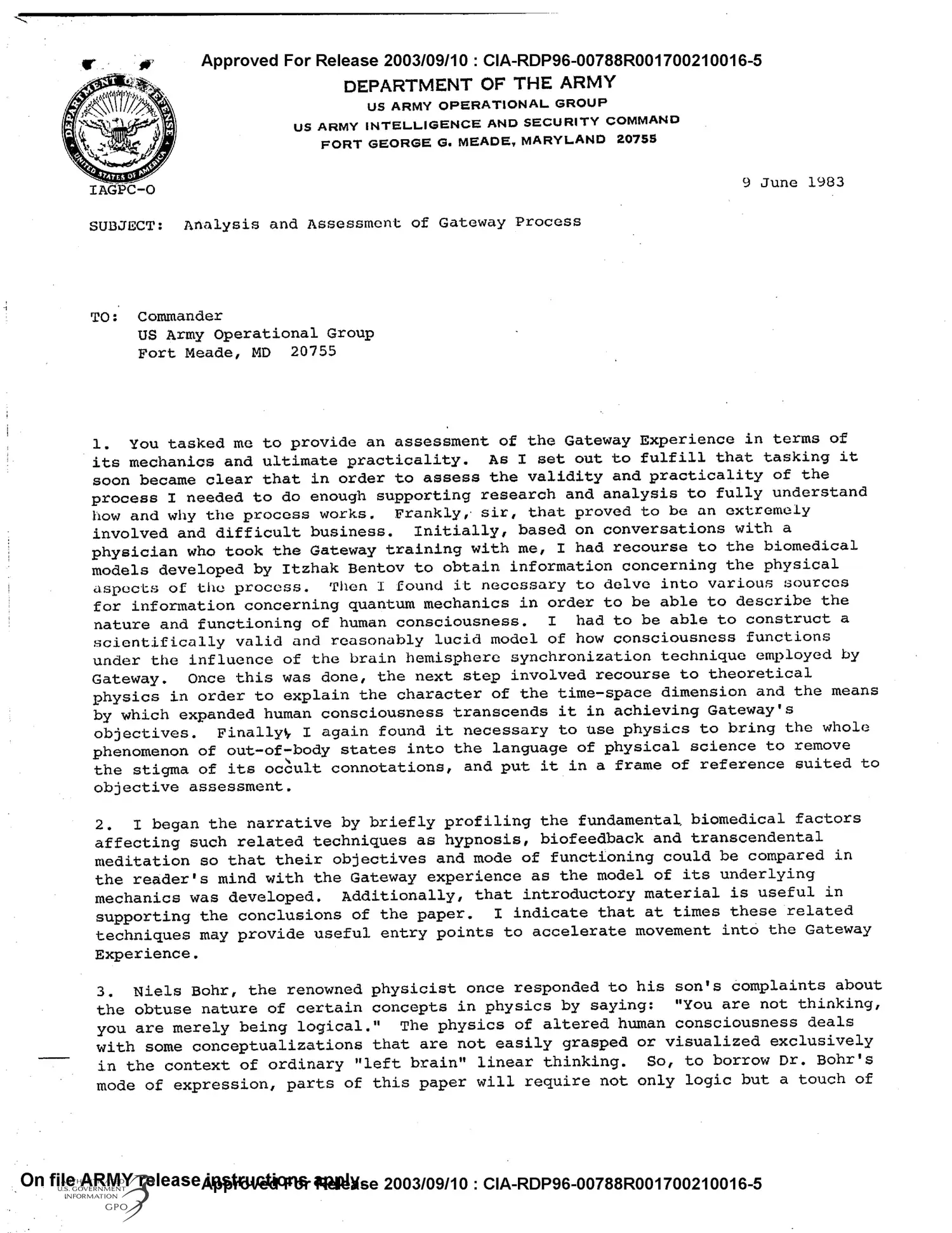
In 1983 an Army intelligence officer assessed the Monroe Institute's Gateway training, judged its essential objectives plausible and proposed steps toward out-of-body information gathering.
Page controls and the transcription load with JavaScript.
Publisher annotations
Commentary by The Declassified Collection, separate from the original source.
Source PDF page 1 · 5 notes
INSCOM
U.S. Army Intelligence and Security Command, formed on 1 January 1977 from several Army intelligence organisations. From 1978 it kept at Fort Meade a unit of remote viewers, soldiers trained to describe places they could not see (page 23). Project Stargate, Volumes One and Two, follow the unit to its closure in 1995.
IAGPC-O
An office symbol: the Army's short code for the office that prepared a document, an address rather than a code name. One letter along, under IAGPC-G, Joseph McMoneagle reported in July 1982 on his eight days at the Monroe Institute (reproduced in the printed book); he was later the unit's Viewer 001 (Project Stargate, Volume Two).
McDonnell on the course
McDonnell writes as a graduate: he took the course himself, with a physician he does not name, yet nowhere reports a session of his own.
Itzhak Bentov
Engineer and inventor, born in 1923, who helped develop the steerable heart catheter. His Stalking the Wild Pendulum (1977) supplies much of the memorandum's model of body and universe, and four of its five exhibits. He died on American Airlines Flight 191 at Chicago on 25 May 1979 (reproduced in the printed book), four years before McDonnell wrote.
Niels Bohr
Danish physicist (1885–1962), a founder of quantum physics, the physics of atoms and their particles. He held that what happens inside an atom cannot be pictured like everyday objects. McDonnell uses the rebuke to make room for the 'right brain' intuition his paper asks for (page 2).
Source PDF page 2 · 4 notes
Left brain, right brain
In the 1960s Roger Sperry tested patients whose brain halves had been surgically separated to control epilepsy, and found the left half leading in language, the right in shape and space. He shared the 1981 Nobel Prize in Physiology or Medicine for the work. Popular books, Drawing on the Right Side of the Brain (1979) among them, turned the finding into a logical left and an intuitive right. McDonnell writes two years after the prize, in that popular vocabulary, about a course sold on joining the two halves (page 3).
'Required'
For some of the command's people the course was an assignment. Joseph McMoneagle's report of July 1982 (reproduced in the printed book) recommended that the eight-day seminar 'be considered advanced mandatory training', and suggested pairing Monroe's techniques with 'a full sensory depravation chamber'. By the end of the summer of 1983 the commanding general, Albert Stubblebine, had been through one of the Institute's seminars himself, and Monroe had been paid $24,400 for one-on-one training due to begin that autumn (see the essay Why the Army Was Asking). The precedent is older: from 1953 the CIA's MKULTRA paid outside researchers to work on the mind, in hospitals, universities and prisons (The Safehouse Experiments).
LTC, MI
Lieutenant Colonel, Military Intelligence.
Det O
Detachment O. A detachment is a part of a larger military force set apart for a particular duty. McDonnell commanded this one; the memorandum never says what its duty was.
Source PDF page 3 · 3 notes
Hemi-Sync
Short for hemispheric synchronization, and a trademark of Robert Monroe's company. In 1983 a session was a tape played through stereo headphones: beneath the sound of ocean surf, each ear received a steady tone at a slightly different pitch. The company says this brings the electrical rhythms of the brain's two halves into step; see page 7.
Transcendental Meditation
Maharishi Mahesh Yogi's technique, known as TM: sitting with eyes closed, the meditator uses a mantra, a sound given by a TM teacher, and the practice is taught as effortless. What McDonnell describes under the name, energy drawn up the spine by intense concentration, belongs to kundalini yoga, which reaches him through Bentov (page 5).
Cortical homunculus
The body as the brain maps it. Two strips cross the top of each hemisphere's cortex, the brain's folded outer layer: one receives sensation, the other directs movement, the body laid out broadly in order, toes near the crown. Each hemisphere maps the opposite side, so a numb left leg registers in the right.
Source PDF page 4 · 2 notes
Homunculus
Latin for 'little man'. Drawings of it show each body part at roughly the size of its territory on the cortex, not its size on the body, so the hands, lips and tongue swell while the trunk shrinks: parts used for fine touch and precise movement claim the most brain. The map comes from the neurosurgeon Wilder Penfield, who stimulated the exposed cortex of awake patients with electric current during brain operations and recorded what they felt or moved. At the temporal lobe, near the ear, the same current now and then brought back vivid scenes from a patient's past. Popular books turned that into the belief that the brain records everything, the kind of reserve memory the memorandum has hypnosis reach (page 3). The handwritten credit in Figure A cites his 1950 book with Rasmussen.
Third and lateral ventricles
Deep inside the brain are four linked cavities, the ventricles, filled with cerebrospinal fluid: a clear, watery liquid that cushions the brain and spinal cord. The two lateral ventricles curve through the hemispheres, one in each; the third is a narrow slit between them at the brain's centre. Bentov treats them as a sounding chamber. A heart rhythm altered by long meditation sets their walls vibrating, and a standing wave forms within them: the fixed pattern of still points and peaks that a vibration makes when it reflects back and forth in a confined space, as in an organ pipe. The waves, he proposed, pass into the cortex of the right hemisphere and 'polarize' it, so that a signal runs along the body map of Figure A, from the toes up (page 5).
Source PDF page 5 · 3 notes
Kundalini
In Hindu tantric yoga, a divine feminine power pictured as a serpent coiled asleep at the base of the spine. Breath control and meditation are meant to raise her through energy centres, the chakras, to the crown, where union with the god Shiva, pure consciousness, is liberation. Sannella wrote to help doctors tell such awakenings from psychosis. Bentov's appendix makes the serpent a current circling the brain's body map (page 4); Sannella called such a purely bodily mechanism 'physio-Kundalini'.
Hertz (Hz)
Cycles per second; four to seven is theta, the tapes' target (page 7).
Biofeedback
Live readings of a bodily process, used to learn to control it. At the Menninger Foundation in Topeka, the team of Elmer and Alyce Green (cited by Jager, page 6) taught migraine patients to warm their hands by watching a thermometer. NASA built its own version for astronauts (both reproduced in the printed book).
Source PDF page 6 · 3 notes
Coherence
Waves are coherent when they keep step with one another, as light waves do in a laser: the picture behind Jager's lamp-and-laser metaphor below.
Monroe Institute
Robert A. Monroe (1915–1995), a radio producer, made his own out-of-body experiences (page 9) his subject; his is the voice on the tapes. The Army explained him to its Secretary in 1984 (reproduced in the printed book).
EEG
Electroencephalogram: a scalp recording of the brain's electrical rhythms.
Source PDF page 7 · 3 notes
Frequency Following Response (FFR)
Hearing researchers' name for a small, measurable effect: nerve activity that keeps time with a heard tone, cycle for cycle. The memorandum stretches it to a larger idea, that the brain's whole rhythm shifts to match a slow rhythm it hears; its word for that is 'entrain' (page 16).
Beta / Theta
Brainwave bands: beta, 13–30 a second, alert; alpha (8–13), relaxed; theta (4–8), drowsy. The 1982 report (reproduced in the printed book) has surf over a 4-hertz beat.
Binaural beat
Put numbers on the memorandum's example: 400 hertz in the left ear, 410 in the right. No 10-hertz sound exists outside the head, but the brainstem, where signals from both ears first meet, registers the tones drifting in and out of step ten times a second, and the listener hears a faint throb at that rate: the binaural beat. Whether it pulls the brain's own rhythm along is disputed; a 2023 review found five of fourteen studies for, eight against.
Source PDF page 8 · 3 notes
Bifurcation echo
Each heartbeat sends a pressure wave down the aorta, the body's main artery. Part of it bounces back from the fork low in the abdomen where the aorta divides for the legs, and from the leg arteries beyond; cardiologists measure this returning wave. Bentov has the echo collide with the next outgoing pulse. In deep relaxation, he says, the echo fades and a steady vibration builds: his bridge from lowered blood pressure to a stimulated brain.
Resonance
The strong response a system gives when it is pushed in time with its own natural rhythm. A playground swing is the familiar case: a small push each time it comes back builds a large arc, while pushes at the wrong moment achieve little. Once going, the swing needs only those small pushes to keep going, which is how McDonnell can say below that the body keeps its vibration up 'despite the minimal level of energy involved'.
Seismograph-type instrument
A seismograph records the shaking of the ground. Bentov devised a 'seismographlike' instrument to catch a far smaller shaking: with every beat, as the heart drives blood down the aorta, the whole body recoils slightly upward. First described in 1877, the recoil became a way of gauging how much blood the heart pumps when Isaac Starr introduced his ballistocardiograph in 1939.
Source PDF page 9 · 2 notes
Out-of-body state
The sense of perceiving the world, and sometimes one's own body, from a point outside it. Monroe's own episodes began in 1958; his Journeys Out of the Body (1971) drew scientists to his work and led to the laboratory that became the Monroe Institute of Applied Sciences. McDonnell treats the state as a skill to be trained. The 'later' he promises comes at page 16, where he calls it 'an extremely effective way' of reaching 'dimensions beyond time-space'.
Carrier wave
A radio carrier is a steady wave at one frequency, varied in step with a voice so a receiver can recover the sound. The 'ionospheric cavity' of page 8, the gap between the ground and the charged upper atmosphere, rings with radio waves, as Winfried Schumann predicted in 1952. Lightning keeps it ringing, lowest at about 7.8 cycles a second, in waves so long that one nearly circles the planet: Bentov's '40,000 Km'. In McDonnell's picture the body's tremor is the carrier, the ringing its channel.
Source PDF page 10 · 3 notes
Dennis Gabor
Physicist (1900–79) who invented holography, naming it from the Greek holos, 'whole'; Nobel Prize in Physics, 1971. The sharp laser holograms of 1963 came from Emmett Leith and Juris Upatnieks, drawing on Leith's radar work, which, Gabor said, 'at that time was classified'.
Lyall Watson
South African biologist (1939–2008), author of the best-seller Supernature: A Natural History of the Supernatural (1973). In November 1973 he introduced the spoon-bender Uri Geller to BBC viewers, months after Geller's tests at the Stanford Research Institute (page 11).
Hologram
An ordinary photograph records only how bright each part of a scene is. A hologram also records how the light waves line up: where the object's light and a second beam from the same laser meet crest to crest, the plate is exposed brightly, and where crest meets trough they cancel, leaving a mesh of fine stripes. Lit again by a similar beam, the plate rebuilds the light as it came from the object, so the image has real depth. Each part of the plate holds light from the whole object, the property paragraph 13 relies on.
Source PDF page 11 · 3 notes
Binary 'go/no-go'
Two possible answers, pass or fail, as a part fits a gauge or does not. Computers chain such choices, written 1 and 0.
Karl Pribram
Vienna-born neurosurgeon (1919–2015). His puzzle was memory: strokes and head injuries, as he saw it, never erase a single memory, as if each were spread across the brain like the image in every piece of a hologram. From the 1960s he proposed that the brain stores memories as hologram-like wave patterns. His Stanford was the university, not the Stanford Research Institute, independent since 1970, where the CIA began funding remote viewing in 1972 (Project Stargate, Volume One).
David Bohm
Physicist (1917–92) who argued that reality is an unbroken whole: in his 'implicate order' the separate things we see unfold from a deeper level where everything is folded into everything else. His illustration: ink dropped on glycerine between two nested cylinders smears out of sight when the inner one turns, and reappears when it turns back. Pribram took the holographic brain as an instance.
Source PDF page 12 · 1 notes
Exhibit 2
Exhibit 2 draws paragraphs 14 and 15 as two grids, one for each half of the brain. The right half's caption reads 'Reduces three dimension[al] holographic image to tw[o] dimensional go/no go' before the cut edge of the sheet takes the rest. The left half, 'the Mind's computer software', turns the result into 'verbal symbols and concepts'. The text at page 11 hands the reduction to the left half instead.
Source PDF page 13 · 3 notes
Time-space
The physical universe, in which energy is confined and moves.
The Absolute
McDonnell's infinite energy, still and conscious, the source of everything. Writers on India's Advaita Vedanta use the word for Brahman, the one reality; he later finds it in Hebrew mysticism and the Trinity (page 26).
Oscilloscope
An instrument that draws a signal as a moving line on a screen. Speed a wave up and its peaks crowd together until the trace looks solid (page 14).
Source PDF page 14 · 3 notes
'Click-out'
A pendulum stops for an instant at each end of its swing, as every vibration does; at that instant, the memorandum says, energy 'clicks out' of time-space. Bentov starts from a grandfather clock and concludes that matter, whose atoms vibrate, is very likely 'blinking off and on'.
Planck length
A distance of about 1.6 × 10⁻³³ centimetres. Enlarge it to a millimetre and a proton, enlarged by the same factor, would be eleven light-years across.
Entanglement
Erwin Schrödinger's word, from 1935, for particles that have interacted and then act as one system, however far apart they are. Einstein called it 'spooky'. In December 1982 Alain Aspect's team near Paris published a test that quantum theory passed; Gliedman's article (page 29) is dated June 1983, the month McDonnell signed. Physicists keep relativity whole because the link carries no message; McDonnell, by moving the exchange outside time-space.
Source PDF page 15 · 1 notes
Planck scale
Bentov's picture: time-space is the band between the lines marked 10⁻³³ CM, and the tip of each swing crosses them into the 'clicked out' strips that lie between them and the Absolute. The Planck length (page 14), built from three constants of nature, is the scale at which physicists expect gravity and quantum effects both to matter. In Monroe programmes 'clicking out' names a lapse in an exercise with no sense of the gap: 'No transition seems to have occurred,' as a post on the Institute's blog puts it.
Source PDF page 16 · 3 notes
Intervening dimensions
Levels McDonnell stacks between time-space and the Absolute, like the 'slightly agitated currents' of Bentov's sea (page 17). Bentov's 'grainy' space and time has a cousin in physics: in 1955 John Wheeler proposed that near the Planck length (page 14) spacetime itself fluctuates, what physicists now call 'spacetime foam'.
The out-of-body experience
The Army's remote viewers at Fort Meade worked under a name chosen to avoid this picture: Ingo Swann coined 'remote viewing' in 1971 so that it would not be taken for astral travel (Project Stargate, Volume Two). In 2002 a Geneva team produced the experience repeatedly by stimulating one spot in an epilepsy patient's brain; their Nature paper describes consciousness seeming to 'take up a remote viewing position'.
Entrainment
One rhythm pulling another into step. In 1665 the Dutch scientist Christiaan Huygens noticed that two of his pendulum clocks, hung from the same wooden bar, soon swung at exactly the same rate, passing tiny vibrations to each other through the wood. The memorandum first uses the word for the brain following the rhythm it hears (page 7); here, for consciousness beyond time-space falling into step with its new surroundings.
Source PDF page 17 · 3 notes
Big Bang
About 13.8 billion years ago the universe was extremely hot and dense; since then space itself has been stretching everywhere at once. Bentov instead pictures a single jet of matter fired from a dense core.
Torus
The shape of a ring doughnut. Figure C (page 18) draws McDonnell's 'spiral' as a coil wound round a twisted core.
Quasar
The brilliant centre of a very distant galaxy. Gas swirling towards a giant black hole there (a mass whose gravity lets nothing, not even light, escape) heats up and can outshine entire galaxies, yet through a telescope it looks like a single point of light: hence 'quasi-stellar', or star-like. Some quasars shoot out narrow jets of matter, and Bentov takes his cue from those jets.
Source PDF page 18 · 3 notes
White hole
A black hole (page 17) run backwards in time: a region that matter and light can only pour out of, never fall into. Einstein's theory of gravity allows white holes on paper, but none has been observed. In 2011 the astrophysicists Alon Retter and Shlomo Heller wrote: 'The only known white hole is the Big Bang.' Bentov's white hole plays that part, the spout from which his universe pours.
Cosmic egg
An ancient image of creation: in the Chandogya Upanishad, a Hindu scripture, the universe grows into an egg that splits in two, the golden half becoming the sky and the silver half the earth. Bentov's egg does not split; it circulates. Matter enters at the white hole, travels round the shell and leaves by the black hole, and time is 'a measure of the change' along the way. McDonnell points to the idea's Eastern roots at page 26.
Jill Purce
Jill Purce (born 1947), a British author, wrote The Mystic Spiral: Journey of the Soul (1974; the memorandum cites the 1980 New York printing). Figure C, the exhibit's one image not from Bentov, comes from it. Her research of 1968 to 1974 traced the spiral and the labyrinth through nature, art and sacred traditions, so the book may be where McDonnell found the labyrinth and spiralled Tree of Life he lists in paragraph 34. Since the early 1970s Purce has taught group overtone chanting, one sustained note sung so that its harmonics ring out: a cousin of the Gateway humming on page 21.
Source PDF page 19 · 2 notes
Laplace's intellect
In 1814 the French mathematician Pierre-Simon Laplace imagined an intelligence that knew every force and the position of every particle: 'for it, nothing would be uncertain and the future, as the past, would be present to its eyes.' McDonnell gives that sight to a focused mind; his step H (page 28) posts an observer in the immediate future. Project Stargate, Volume Two records the government later asking its remote viewers for such sight: a 'prognosis of future intentions and actions' in North Korea.
Quality of consciousness
'Distinctly separate from and superior to' the body: this is dualism, the view that mind and body are different kinds of thing, best known from René Descartes (1641). McDonnell goes further. Each mind is a 'differentiated aspect' of the universal consciousness, has 'neither beginning nor end', and returns to it with its memories and identity intact. The intelligence proposal rests on this: a consciousness that can leave the body can be sent to gather information.
Source PDF page 20 · 1 notes
Galactic north
The direction at right angles to the flat disc of the Milky Way, towards the constellation Coma Berenices; compass north means nothing out there. Bentov sets our galaxy near the top of his egg, where the stream of matter turns, to explain why galaxies to the north recede faster (page 17). Looking that way, out of the disc and away from the dust that hides about a fifth of the sky along it, astronomers see deep into space: the Coma Cluster, more than a thousand galaxies, lies within a few degrees of galactic north.
Source PDF page 21 · 3 notes
Energy conversion box
An imagined container that each listener designs, which the Monroe Institute's home-study course suggests might be a wooden chest or a sphere of light. At the start of an exercise, worries and distractions go inside, often as symbols (a wallet for money troubles), and stay there until it is over.
Gateway affirmation
The Institute's current text opens 'I am more than my physical body' and declares a wish to expand, experience, know, understand, control and use greater energies. A second half, taught later in the course, asks those whose wisdom equals or exceeds one's own for help, guidance and protection; the Institute says it grew out of laboratory sessions in which subjects reported non-physical helpers.
Pink and white noise
White noise is a hiss with equal energy at every frequency; since each higher octave spans more frequencies, it sounds bright, even harsh. Pink noise turns the treble down so that each octave carries equal energy, and sounds more balanced. The home-study course calls the hiss on its recordings 'pink sound', a bed for the Hemi-Sync signals, and tells listeners it is not a manufacturing defect.
Source PDF page 22 · 2 notes
Focus 10 / Focus 12
The Institute's home-study course calls the Focus numbers arbitrary labels for points along a continuum of consciousness. Focus 10, 'mind awake, body asleep', is where the relaxation steps on page 21 lead: the body relaxed to the edge of sleep while the mind stays alert. Focus 12, 'expanded awareness', is the state in which the tools that follow are practised.
Patterning
Patterning resembles New Thought, the American movement that grew from the healer Phineas Quimby (1802–1866) and taught that thoughts draw matching events into a life. The line runs through Napoleon Hill's Think and Grow Rich (1937), with its 'thoughts are things', to today's 'manifesting'. McDonnell's steps K and L (page 28) would put it to Army use: groups patterning defences around sensitive areas, and advanced trainees patterning success for their colleagues.
Source PDF page 23 · 3 notes
Color breathing
In the Institute's later home-study course the listener, in Focus 12, calls up a colour and directs it through the body, each colour with a task: green to drain off harmful emotion, red for strength, purple to restore health.
Energy bar tool
An imagined rod of energy for healing, then a doorway to remote viewing. The same manual traces it from Moses' staff to Star Wars lightsabers.
Remote viewing
The attempt to describe a place hidden from the senses. The Gateway exercise is looser: imagination goes through the vortex 'in search of new and illuminating insights'. The Army's own unit at Fort Meade was Grill Flame from 1978 and, by 1983, Center Lane.
Source PDF page 24 · 3 notes
Focus 15
The Institute's 'no time'. In September 1980 Frederick Atwater, the first member of the Army's remote-viewing unit to take the course, reported that its 'Time Wheel' let a viewer turn 'either to the future or to the past while Remote Viewing', and urged that the unit's viewers attend.
Focus 21
The Institute's 'bridge': the edge of time and space, where physical reality meets what it calls other energy systems, realities beyond the physical.
CPS
An older name for hertz. At 2,877 cycles per second the figure describes a sound: a high, thin tone in the top octave of a piano. McDonnell's 'recent magazine article' is Pat Stone's interview with Monroe in The Mother Earth News (page 29), where Monroe adds that to most researchers 'the high beta signals we use here are not analogous to any known brain-wave patterns'; such scientists 'think of beta signals as going up to 30 or 40 CPS'. McDonnell took his range from that sentence.
Source PDF page 25 · 2 notes
REM sleep
Rapid-eye-movement sleep, when most dreaming happens: the brain runs close to waking while circuits in the brainstem hold the muscles slack. If that stillness outlasts the dream, the sleeper wakes unable to move, a state called sleep paralysis, in which some feel themselves floating or outside the body.
Information collection potential
Using the out-of-body state to gather intelligence. In the trainer's tests most travellers read enough of the ten numbers to show their consciousness was present, none all ten; McDonnell explains the misses at page 26 and gives his remedy, step H, at page 28. The Fort Meade unit did it by other means. Its 1983 briefing script tells how a drawing it sent to Italy was used to brief that the search for the kidnapped General Dozier 'should be concentrated in the Padua area' (Project Stargate, Volume Two).
Source PDF page 26 · 3 notes
Pseudoscopic
Depth turned inside out: near parts look far and far parts near, so a ball can look like a cup. Swapping the two pictures in a 3-D viewer, so that each eye gets the other's, does it; so does lighting a hologram from the reverse direction. McDonnell suggests an out-of-body viewer might misread a target's holographic 'energy patterns' in the same way.
Alexandra David-Neel / Lama Yongden
The French traveller Alexandra David-Neel and the lama Aphur Yongden, her companion and adopted son; McDonnell's 1967 is the date of the San Francisco edition. The passage he quotes holds that the tangible world is not moving objects but movement itself, a rapid succession of 'flashes of energy'. Her Magic and Mystery in Tibet (French original 1929) tells of the tulpa, a being made by concentrated thought, and of one she says she made herself. That may be why McDonnell turns to her a few lines after 'thought forms'.
Indra's net
In the heaven of the god Indra hangs a net with a jewel at every knot; each jewel reflects all the others, so the whole net shows in every one. The image comes from a Buddhist scripture, the Avatamsaka or Flower Ornament Sutra; Indra is a Hindu god whom Buddhism adopted. McDonnell's sentence, pearls and all, is almost word for word from Sir Charles Eliot's Japanese Buddhism (1935). He offers it as the classic picture of the universal hologram, in which, as at page 10, every part holds the whole.
Source PDF page 27 · 3 notes
Conclusion
The Army's own chronology records what followed. In November 1983 INSCOM established RAPT, Rapid Acquisition Personnel Training, a Monroe course, and in March 1984 the Army Staff cancelled it as a 'personnel screening vehicle' for Center Lane, the remote-viewing unit of page 23. The essay Why the Army Was Asking carries the story on to the unit's transfer to the Defense Intelligence Agency.
Step B
Sound into sleep, then suggestion. From 1957 MKULTRA Subproject 68 paid Ewen Cameron in Montreal to study 'the repetition of verbal signals': taped phrases played thousands of times to patients in drugged sleep, who were never asked (The Safehouse Experiments). Gateway's listener acts 'based on his own volition' (page 7).
Autohypnotic
Self-hypnosis on a practised cue, which steps C and D teach.
Source PDF page 28 · 4 notes
Multi-focus approach
Three viewers would watch one target at once, in the present, the immediate past and the immediate future, and their accounts would be compared. Within a year an Army training session sent a viewer a million years back. On 22 May 1984 a monitor handed the viewer a sealed envelope; the card inside read 'The planet Mars. Time of interest approximately 1 million years B.C.' Joseph McMoneagle has said he was the viewer and Robert Monroe the monitor; the file names neither (Project Stargate, Volume Two).
'Experiments'
McDonnell's word for his twelve steps, to be tried on people of his own command. In November 1953 CIA officers gave Frank Olson, an Army biochemist, LSD without his knowledge, in what the CIA's and the Army's own statements call 'the experiment'; from 1955 to 1958 the Army Chemical Corps gave the drug to more than a thousand volunteers (The Frank Olson Files).
Non-corporeal
Without a body. The remote-viewing unit's training files of the late 1980s include folders on 'ET activity against US programs' and a UFO abduction, each marked TRAINING (Project Stargate, Volume Two).
Step K
A psychic fence: groups in Focus 12 would build a barrier around 'sensitive areas' against 'unwanted out-of-body presences'. The Army's first use for Monroe was to play those presences. In August 1978 the 902d Military Intelligence Group's GONDOLA WISH report recorded choosing the Institute to train intelligence personnel in out-of-body travel 'so that they can mimic Soviet collectors', then 'determine vulnerabilities, and develop and recommend countermeasures'. Step K is one; the 'energy balloon' of page 21 is the same idea for a single person.
Source PDF page 29 · 2 notes
The source mixture
Nine entries, seven of them traceable to a page. Bentov supplies the physical and cosmic model; Ferguson brings in Pribram and Bohm (page 11); Gliedman the subatomic particles said to go on communicating after colliding (page 14); Jager the lamp-and-laser metaphor and the definition of Hemi-Sync (page 6); Sannella's book carries Bentov's kundalini model (page 5); Purce a figure in Exhibit 4 (page 18). Pat Stone's Mother Earth News report of a week on the Gateway course is the 'recent magazine article' behind Monroe's 2877.3 CPS figure (page 24). Monroe's book and Tart's are listed but never quoted.
Marilyn Ferguson
Writer (1938–2008) who edited Brain/Mind Bulletin, a newsletter on brain and consciousness research, and wrote The Aquarian Conspiracy (1980), the best-seller that USA Today called 'the handbook of the New Age'. McDonnell quotes her at two turns of his argument: on the hologram's efficiency (page 10) and on the theories of Pribram and Bohm, which she says 'appear to account for all transcendental experience' (page 11).