Record number 202-10002-10104
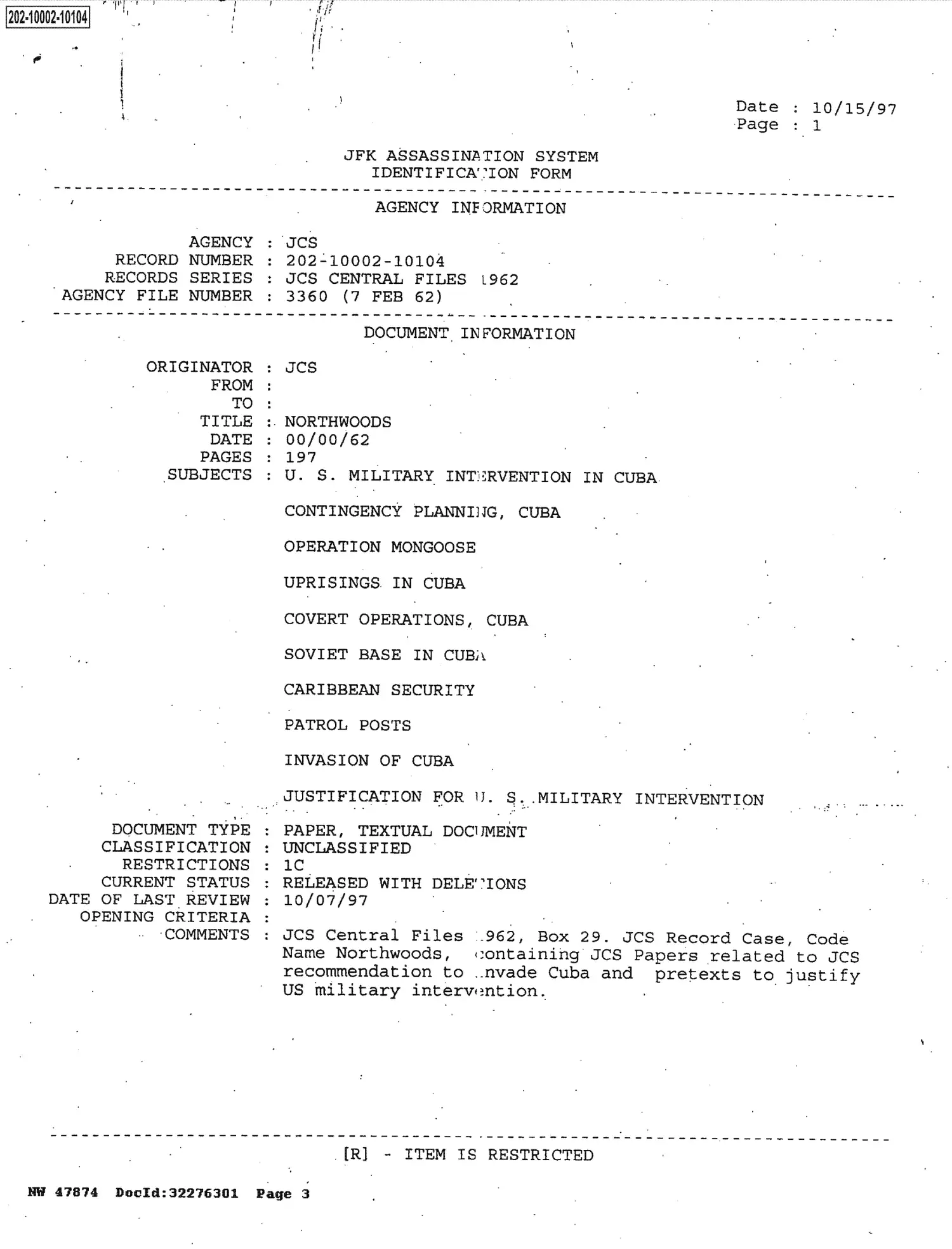
The number this file is cited by. 202 is the Joint Chiefs' agency prefix in the JFK Assassination Records Collection. The form was printed 15 October 1997.
13 March 1962 · 212 source pages
The pretexts the Joint Chiefs proposed in March 1962 for intervening in Cuba included staged attacks on Guantanamo, a “Remember the Maine” incident and a faked airliner shootdown.
Interactive page controls and reviewed transcription load with JavaScript.
Commentary by The Declassified Collection, separate from the original source.
The number this file is cited by. 202 is the Joint Chiefs' agency prefix in the JFK Assassination Records Collection. The form was printed 15 October 1997.
The form counts the case at 197 pages. The file the National Archives posted in 2018 runs to 212, the release paperwork among them.
Five passages were withheld under the JFK Act in 1997. The next two leaves name each one. None falls on the March 1962 memorandum.
The civilian board created by the JFK Assassination Records Collection Act of 1992 to decide what agencies could still withhold. This determination is dated 20 October 1997.
Each postponement names the paper and page it falls on. DJSM is a memorandum from the Director, Joint Staff. That paper is not in this volume.
A second clearance, stamped MAR 2016 — nineteen years after the Board's determination, ahead of the 2017 and 2018 releases.
A Navy office symbol and serial. OP-605F was a section of the Office of the Chief of Naval Operations; the postponed paper is the Navy's, dated 24 April 1962.
What a reader saw in place of each withheld passage: three words, with a release date of October 2017 printed beneath them.
The Board finished with the file on 14 October and signed the determination on the preceding leaf six days later.
Every other agency with an interest had to clear the file. Five stamps on this leaf record it: CIA, State, the National Security Council, USIA and the Joint Staff.
The reviewer's instruction, in pen, with a second line: 'Berlin' documents not responsive. Papers in the same case about Berlin were left unreviewed.
The subsection of the JFK Act the five postponements were taken under — military defense, intelligence operations or the conduct of foreign relations.
The government's overseas information and broadcasting arm, 1953 to 1999. Its general counsel's declassification unit cleared its holdings in this file on 6 August 1997.
Written by hand on the cover sheet. NORTHWOODS is the code name of the Joint Chiefs' case file, not of any operation described inside it.
The case number and the day it was opened. Every paper listed below was filed into it. The last entry on this sheet is dated 31 August 1962.
The row for the memorandum this volume is named for. Its source is CJCS, the Chairman. The column for a JCS memorandum number beside it is empty.
The security classification column. Every row on the sheet reads T — Top Secret — from the first paper to the last.
The case is cross-indexed under Brigadier General William H. Craig, the Defense Department and Joint Chiefs representative on the Caribbean Survey Group.
The number the Joint Secretariat gave the Northwoods report when it went to the Chiefs. The decision on it is entered the following day.
Typed twice, for JCS 1969/310 and 1969/311, in a case opened in February 1962. The decisions on both papers are dated 20 Feb 62 two lines below.
The last substantial paper in the case and the last document in this volume: what intervention in Cuba would cost. Decision, 8 August 1962.
The case closes with a report referred to the Joint Chiefs on 1 September 1962. Nothing later is filed in it.
Printed along the foot. The sheet had to go back to the Research and Records Analysis Branch, Room 2D940 of the Pentagon, within five days of being borrowed.
The same office that asked the Joint Chiefs for pretexts in March. In August it asked what an invasion would cost.
The interagency committee that directed Operation Mongoose. This memorandum exists to put a paper in front of it on 8 August 1962.
The clean impression of the review stamp. On the first leaf of the March memorandum the same stamp is inked so badly its middle line cannot be read.
The three-star deputies who work a paper over before the Chiefs themselves take it. This material was submitted after their meeting the same day.
The Marine Corps dissent, quoted in full: the paper is unduly optimistic about the force needed, how long it would take, and what would follow.
The partial mobilisation of 1961. Restoring the ability to react elsewhere after Cuba might, the Marine Corps argues, require another of the same size.
Continental United States: the home base the strategic reserve returns to, refits in, and is counted from.
The intelligence community's standing assessment, quoted here for Cuban defensive plans and for the political reliability of Castro's military establishment.
The size of Cuba, set beside a population of 6,743,000, to argue that one division would not be enough to hold it.
Major General, US Marine Corps, Deputy Chief of Staff (Plans) - the officer who signed the Commandant's reservations.
The occupation apparatus. The estimate on this leaf is that transition, reorganisation and economic rehabilitation might continue for several years.
How the Joint Chiefs recorded approval: not a signature on the paper but a sheet listing, one by one, the words they changed first.
Four words inserted after seize control of. Ten amendments were made to the paper before the Chiefs approved it.
Written and ticked in pen at the foot of this sheet, and again at the foot of the tentative decision of the day before.
An amendment that raises the paper's own estimate by more than half again, on a sheet otherwise given over to deletions.
One of three amendments that end a sentence early rather than rewrite it. What the paper said past that point is not recorded here.
Colonel, US Air Force, Secretary. The Joint Secretariat records the decision; the Chiefs themselves sign nothing on it.
The last amendment, and the only one on this leaf: what the force after the assault would consist of.
Roswell L. Gilpatric, Deputy Secretary of Defense. The changes on this leaf were drafted because he asked for them on 6 August 1962.
Reserve airlift the plan would call up. Replacing it would cost most of the Air Force's transport capacity in Europe or the Pacific for about fifteen days.
Vice Admiral, US Navy, Director of the Joint Staff - the officer running the staff that produced every paper in this file.
Pacific Air Forces and United States Air Forces in Europe. Three ways to find the lift for Cuba, each of them taken out of another theatre.
The Chiefs approved the paper on 7 August subject to further change, and took the final decision the next day. Both sheets are in the file.
Commander in Chief, Atlantic: the unified command that would have run the operation. It and Headquarters USAF were asked for plans not involving mobilisation.
The Corps stopped the paper on 7 August and reserved a telephone vote. The reservations it wanted written in are printed three leaves back.
The rescheduling that produced the decision at the head of this paper. Wednesday 8 August 1962 is where the Chiefs approved it.
Typed at the foot and ticked in pen, as on the decision sheet of the day before and the one of the day after.
The interagency committee that directed Operation Mongoose. The two assumptions quoted on this leaf are the committee's own, not the Joint Staff's.
The Guidelines are dated 14 March 1962, the day after the memorandum. Justifying intervention was already an agreed assumption of the project.
Pencilled at the foot. The number of the papers this leaf is filed behind, a decision of late March 1962, not a number of the Guidelines.
The office that asked. The memorandum names the office, never the officer; elsewhere in this file the office signs as Brig. Gen. Edward G. Lansdale.
As typed, with no 'to'. The same words recur on printed pages 4 and 6, so it is the drafter's construction, kept all three times.
A review stamp of 21 May 1984: twenty-two years on, the paper was looked at and kept classified. Its middle line is unreadable here; a clean impression is on the August memorandum.
The only place the name appears in the March package: the Joint Secretariat's title for the paper. The (S) marks the title itself Secret.
The paper's number. The Joint Staff filed its Cuba papers in the 1969 series; 321 is this paper's place in it. 'Page 2165' is the series pagination.
The Secretaries circulated the covering note with the report held 'on file'. In this file copy the report follows on the next leaf.
The body whose Department of Defense and Joint Chiefs representative wrote the report: Brig. Gen. William H. Craig, the 'General Craig' of the footnotes.
The deadline the request set. The report is dated 9 March, the Secretaries' note 12 March, the Chairman's memorandum 13 March. It was on time.
No space before the parenthesis, as typed. The same subject line elsewhere in the package has the space; both settings are kept.
The subject line of the 5 March request the report answers. Within the package the effort is otherwise the 'Cuba Project'. The request itself is not in this file.
A Navy paper of 8 March, from the Chief of Naval Operations to the Chairman, which paragraph 3 acknowledges. It is not in this file either.
The joint operational commands in the field. Recommendations b to d keep the paper from them, from officers at NATO and from the UN Military Staff Committee.
The Soviet-led alliance of 1955. The premise holds only while Cuba is outside it and no Soviet bases stand there on the pattern of US bases in Western Europe.
Set without 'should', carrying on from 'It is recommended that:'. The capitals are the document's own emphasis, in ordinary type.
The text the Chairman signed on 13 March, four days later, unchanged except that this footnote was dropped. The first leaf of this volume is the signed copy.
The footnote abbreviates 'Gen Craig' and reads 'subject,' with a comma where printed page 2 has 'General Craig' and 'subject:'. Both kept as typed.
The plan's stated method: a 'logical build-up of incidents' among 'seemingly unrelated events', so that the aim, intervention, is not visible. The words are the document's.
Two small handwritten ticks sit above the word 'plan' in paragraph 3: a reader's marks on this file copy. Reproduced in the facsimile, not transcribed.
'Within the next few months': the time frame the report gives on printed page 3, tied there to the absence of Soviet bases and of a Soviet-Cuban pact.
The Appendix ends a third of the way down; the rest of the sheet is empty apart from folio, label and stamps. The Annex of pretexts begins on the next leaf.
A task number from the Cuba Project's programme of numbered tasks. The task list is not in this file; the cover and deception plan it produced is cited, not attached.
Across the perimeter of the Guantanamo naval base, held by the United States under lease since 1903. The 'friendly Cubans' would stage the attack in uniform.
A broadcast whose source is concealed, the first of eleven listed incidents. The rumours it would spread are the only item marked '(many)'.
The battleship Maine blew up in Havana harbour in February 1898; the phrase became the slogan of the war with Spain. Here it labels an arranged loss of a US ship.
As typed; 'in' is not there. The sense is that the sinking and mock funerals of (11) could stand in place of the sabotaged ship of (10).
Naphthalene, misspelt on the page and kept: a flammable hydrocarbon, familiar as mothballs, named here as the means of the 'large fires'.
The landing of 14 June 1959 against the Trujillo government of the Dominican Republic by an expedition launched from Cuba. The report offers it as the model for a simulated raid.
In its older sense: an armed private expedition against a foreign state, the nineteenth-century usage, not the parliamentary one.
As typed. Checked at high magnification: an 'or', like the two before it in the line, not a damaged 'on'. 'On the beach' is what the sense wants.
Eglin Air Force Base, on the Florida panhandle. The duplicate airliner would be prepared there, and the real passengers landed at one of its auxiliary fields.
A company the Agency owns and runs behind a commercial front. The civil aircraft to be copied belongs to one 'in the Miami area'.
As typed, in clean type, where 'will begin transmitting' is evidently meant. The document's own error, kept.
As typed, in clean type, where 'faker' is evidently meant: the F-101s were to play hostile aircraft for an air-defence exercise over southern Florida. Kept.
Aircrew slang for the last aircraft in a formation. The pre-briefed pilot would fly there, 'at considerable interval', before broadcasting that he had been jumped.
Homestead Air Force Base, south of Miami. The F-101 Voodoo was the Air Force's supersonic interceptor of the day; 'disburse', two lines on, is the page's word for disperse.
The paper the footnote cites for the Chiefs' earlier position: their February report on the Cuba Project. It is printed after this one, as the record holds it.
A report of 27 February 1962, decided on 7 March, according to the case index printed at the front of this volume. The paper itself is not in the released record.
It reads '2', with a fragment where the leading digit should be; the run of the report makes it 12. The transcription prints what the page shows.
The folio is the pagination of the continuous JCS 1969 paper series, not a page of this paper. The March note in this volume carries 2165 the same way.
The Secretaries circulated the covering note with the report held on file. The 12 March note in this volume reads 'Not reproduced herewith'.
Typed, not stamped: this is copy number one of a restricted circulation. The report leaf behind it is marked by hand 'cy 1 of 20 copies'.
Not releasable to foreign nationals. Stamped head and foot beside SPECIAL HANDLING, and typed into the classification lines as well.
The order: the Chiefs note A and B, forward C to the Secretary of Defense, and only after his approval does D go to the four Service chiefs.
Typed at the foot, naming 20 February alone and without parentheses. The two amended leaves further on read '20 & 23 Feb' and open a parenthesis they never close.
Singular here, where the report title and every other enclosure of the paper read 'Procedures'. The draft's own slip, kept.
The 30 January meeting with Roswell Gilpatric. Enclosure B, on the next three leaves, is Craig's record of what was said at it.
Craig's block here sets no full stop after 'Brig' and no comma after 'Representative'; the same block three leaves on carries both. Each kept as typed.
Roswell Gilpatric, Deputy Secretary of Defense from 1961, second-ranking officer of the department. The paper he disliked is the original proposed policy named in the subject line.
Gilpatric's own phrase, not standard staff usage; it recurs below as 'a red line priority problem'. Here it carries 'the blessing of the President'.
Restated through both paragraphs. The Chiefs evaluate and recommend; the Secretary decides. The procedures drafted in Enclosure C and its appendix carry the same rule.
Robert F. Kennedy, the Attorney General. Shown the instructions, Gilpatric answered only: 'I can't add anything to that.'
Robert S. McNamara, Secretary of Defense. Craig records his apprehensions about security and about how many in the Department knew of the project.
Gilpatric left it to Craig to decide who needed to know. The decision sheet at the end of this paper extends the NORTHWOODS access list by seven officers.
The instruction that produced this paper. Enclosure C and the procedures behind it are the new proposal Gilpatric asked for on 30 January.
Craig's title. This block carries a full stop after 'Brig' and a comma after 'Representative' where the block on Enclosure A carries neither.
The memorandum to Craig that this paper answers, from the Assistant to the Secretary of Defense. Paragraph 2 quotes a single sub-paragraph of it, lettered b.
The document's own ellipsis: text left out of the quoted memorandum. The Northwoods report elsewhere in this volume uses three spaced hyphens for the same purpose.
The report's recommendation calls this 'Appendix 1 to Enclosure C'. It and Enclosure 2 belong on folios 7 to 9, and no leaf with those folios is filed.
The second leaf in this paper to carry folio 3 and the label Enclosure B. It comes from a later amended state and is bound out of order.
The office every request passes through, named the same way on the other leaf of this amended set. Requests go to the Secretary of Defense through it.
The draft is written for the Secretary of Defense to sign: the 'I' is his. It carries no signature block and no date.
One of the four Service chiefs. Recommendation c on the report's first leaf holds this draft until the Secretary of Defense approves the procedures.
The paper's last leaf. Its folio 10 follows folio 6, and the leaves filed between them belong to a later amended set.
Enclosures A, C and D are all drafts. Enclosure C letterspaces the word; this leaf and Enclosure A set it solid.
These are the procedures Enclosure C calls its 'Enclosure 1' and the report calls 'Appendix 1 to Enclosure C', renumbered A in the amended state.
The line stops at 'Feb': no year, no closing parenthesis. The next leaf sets the same note with the year and without the 'on'. Both kept.
The amended text asks only for equipment. The third leaf of this same set, filed two leaves back, still reads 'personnel and/or equipment best suited'.
A comma where a solidus is meant. The same amended set sets 'and/or' with a clean solidus on its third leaf, filed three leaves back.
The Defense Department's security directive. The regrading note typed and stamped on other leaves of this paper cites a different one, 5200.10.
As typed, with no 'to'. The same elision runs through the Northwoods report elsewhere in this volume: 'be assigned the Joint Chiefs of Staff'.
The second Note to Holders on this paper, nine days after it. Holders are the offices issued a copy; this one is copy number 1.
The revised sheet is not filed behind this leaf: the next leaf decides JCS 1969/303. The Decision On for this paper sits ahead of the report.
Typed, not stamped, and spelled out where the paper's first leaf types 'DOD DIR' and ends with a full stop. The boxed rubber stamp abbreviates it too.
Not 1969/311, the paper this file runs on; the number is clean type. It decides the February report, thirteen days before the paper it is filed behind.
A contemporary hand has written in block capitals across this line that Admiral Wellings says this was not included. A filing note, not part of the typescript.
The 1984 review stamp, dated by hand 22 May 84. The same stamp on two other leaves of this volume is dated 21 May 84.
The paper the March report cites for the Chiefs' earlier position. The case index at the front of this volume opens Record Case 3360 on this day, 7 February 1962.
Dated by hand 22 May 84. The same stamp on the March and August memoranda in this volume reads 21 May 84, in a different hand.
The decision sheet's own classification, stencilled at head and foot. It is the one leaf of this paper not stencilled TOP SECRET; every leaf that follows is.
They cover the lower quarter of the leaf, the zone that would carry the typed foot classification block. No redaction notation appears anywhere near them.
The line prints twice in the six-line title block, third and sixth. On this form the third line names the paper being decided, which is a Report.
The typed head block classifies the sheet SECRET while the stencils struck at head and foot of the same leaf read TOP SECRET NOFORN SPECIAL HANDLING.
The report is addressed to the Chairman, not to the Joint Chiefs. The March report on its title page is addressed to the Joint Chiefs of Staff.
The title page has CUBAN PROJECT. The report's own title on the next leaf, and Appendix 1 to Enclosure A, both have CUBA PROJECT.
Written in ink at the lower right: a control number of the Caribbean Survey Group Working Group, the body whose representative wrote the report.
The office that asked for the paper. The footnote names the officer: Brigadier General E. G. Lansdale, in a memorandum of 17 January 1962 headed "Special Project".
Paragraph 2 dates the National Security Council meeting 9 May 1961, paragraph 6 dates it 5 May 1961, and both cite the same footnote. Appendix 1 has 9 May.
The typed foot classification block misspells NOFORN, no foreign nationals. The head block on the same leaf spells it correctly.
With paragraph 8 and recommendation 13 a, this is the paper's only statement of its own structure. It names three enclosures, A, B and C, and no others.
A band of dark vertical streaking runs from this line down through the foot classification block. A mimeograph fault; every character under it reads.
Typed with no space, eight words after "the Western Hemisphere" in the same sentence. The document's own error, kept.
Appendix 1 to Enclosure A restates this paragraph almost word for word, and so does Enclosure C. The three settings differ in small things only.
Five character cells of white paper stand mid-sentence, with specks at the feet of erased letters. A word was probably typed and rubbed out.
The last two lines of d and the whole of paragraph 12 are typed at half the leading of the leaf: matter fitted in after the sheet was set.
Conditions a, b and c each open "If". Item d opens "Or,", an alternative to the three rather than a fourth requirement alongside them.
A reader's ink stroke in the right margin, level with recommendation 13 a: that Enclosure A be forwarded to the Secretary of Defense.
The clerk's line that makes this the amended Enclosure A, misspelt as typed. It answers the Decision sheet's "as amended by changes in the second paragraph".
The leaf is not headed DRAFT and carries no typed classification blocks, only the large stencil struck across head and foot: a sheet typed apart from the report body.
Set as one word, twice. The same citation is "Brigadier General" on the first report leaf and "BrigGen" on the next: three settings in one paper.
The draft memorandum, headed DRAFT, addressed to the officer whose 17 January request the report answers. Enclosure A recommends it be adopted as the official DOD position.
The typed foot block misspells NOFORN again, and differently: the first leaf of the report body has NORORN. The head blocks of both leaves are correct.
The draft restates the report's assumptions rather than quoting them: printed page 1 has "the Castro government" and "covert in the initial stages".
No typed classification block prints at head or foot, only the stencils. Enclosure A is set the same way; every other leaf of the report carries both.
Enclosure C sets this same sub-paragraph with "materiels", and Enclosure B has the singular "materiel" twice. Three forms of one word in one paper.
A wavy ink underline runs beneath "incident", and two freehand strokes down the margin beside paragraph c. Reader's marks, in the same ink.
Six blank character cells, measured, with nothing printed in them and no erasure shadow. Enclosure C sets the same sentence with one ordinary space.
Two agencies named here. The closing paragraph of Enclosure C names one, then says "these agencies". The same text set twice, with small differences.
Enclosure B opens straight on its heading; no ENCLOSURE B line stands above it, where Enclosure C carries one. The foot label alone identifies it.
The quoted objective comes from Lansdale's Program Review of 18 January 1962, "The Cuba Project", which the footnote records as not on file in the Joint Secretariat.
A space stands before the first hyphen, as typed. Three lines above, "crystalize" carries a single l. Both kept.
The source for this leaf: a Department of State White Paper, not on file in the Joint Secretariat and, on the paper's own account, undated.
Early-warning radar. The list of equipment in Cuba runs on to fire control systems, advanced fighters, and short and possibly medium range rockets.
Commander in Chief, Atlantic. The unified command's contingency plan for Cuba, approved by the Joint Chiefs, provides a simultaneous amphibious and airborne assault within eighteen days.
The paper cited for the President's April 1961 request. The Joint Staff filed the case itself in the 2304 series; its Cuba reports run in the 1969 series.
Hyphenated mid-line here, as is "Castro-government" beside it, while the same leaf sets "overthrow" plain twice. The document's own hyphens, kept.
Enclosure C is headed; Enclosure B, three leaves back, is not. Two character cells stand between the word and the letter, as set.
As typed, the u and the s transposed. The sentence weighs the loss of Castro by assassination or natural causes and calls it not fatal to the regime.
J-2 is the Joint Staff's intelligence directorate. Its memorandum of 27 October 1961 is placed on file in J-2, not in the Joint Secretariat.
The discussion's conclusion: support a selected Cuban insurgent attempt from the outset and sustain it, overt US military intervention included. A month before the March report.
What the paper draws from the Batista years: US intelligence should evaluate the personalities and groups it may later have to recognize and support.
An extra i, as typed, and "communist" in lower case on the same line, where the leaf capitalises the word five times elsewhere.
Paragraphs 8 and 9 repeat Appendix 1's paragraphs 3 and 4 almost word for word, differing at two points: "materiels" for "materials", and a comma for a semicolon.
Item (4) of the four consequences the paper draws. The Canal Zone was then under US administration; the threat named is subversion and sabotage, not attack.
The sentence names one agency and then says "these agencies". Appendix 1's closing paragraph names two, CIA or State. Each leaf is kept as it sets it.
The record ends here: a complete sentence, half a blank leaf below it, the folio 4 completing Enclosure C's run. The paper is not cut off.