Adm. Stansfield Turner
3 August 1977, before two Senate committees sitting jointly, after seven boxes of MKULTRA records were found that year.
3 August 1977 · 173 source pages
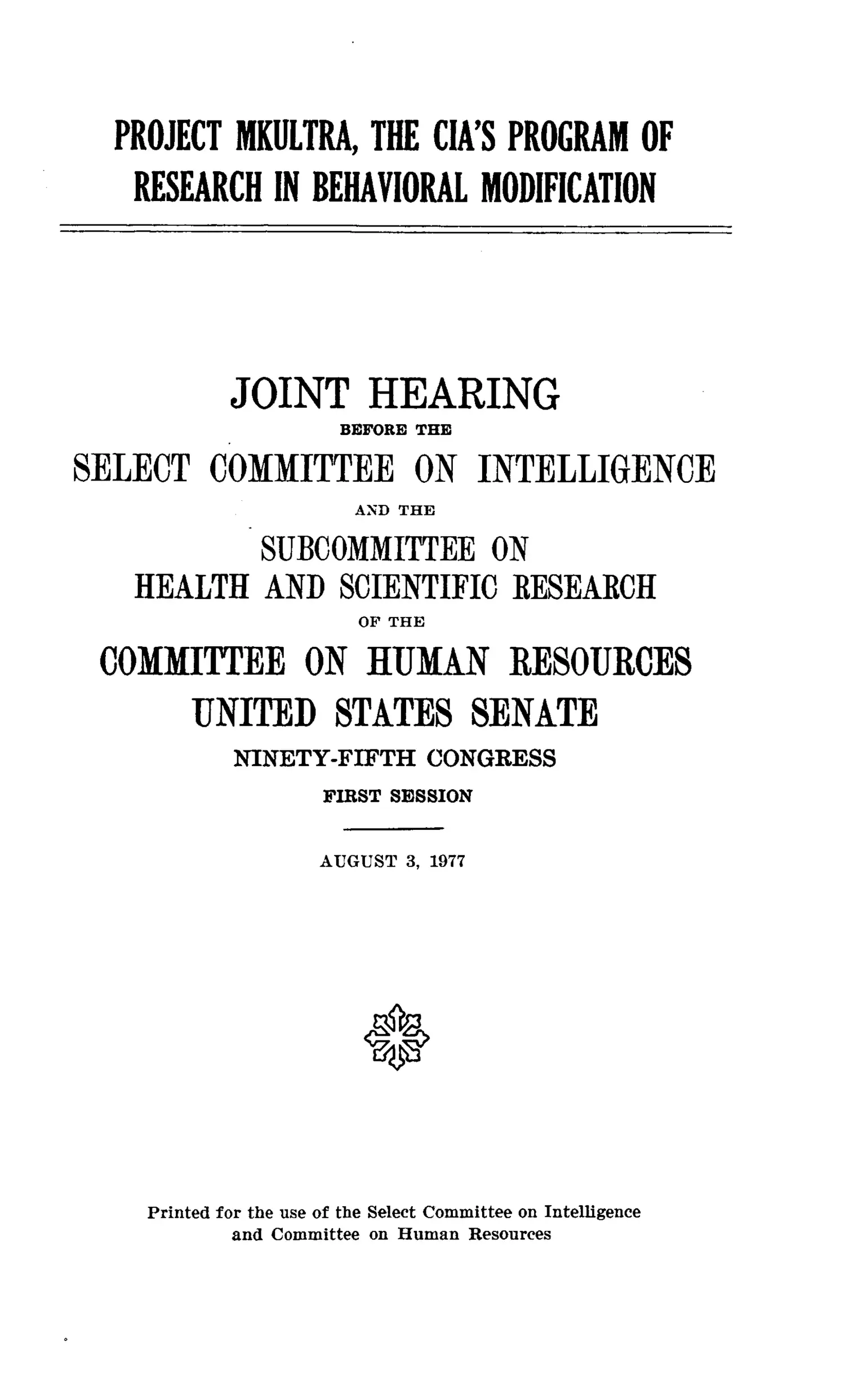
Seven newly found boxes of MKULTRA records brought CIA Director Stansfield Turner before senators in 1977 to explain what earlier inquiries had not uncovered.
Interactive page controls and reviewed transcription load with JavaScript.
Commentary by The Declassified Collection, separate from the original source.
3 August 1977, before two Senate committees sitting jointly, after seven boxes of MKULTRA records were found that year.
The Director of Central Intelligence, in 1977, on the 1963 report reproduced in Part I.
Turner quotes report page 14, reproduced at Report of Inspection of MKULTRA — 2019 release package — source PDF page 20. His explanation combines three losses: records never created in detail, officers who had retired, and the files destroyed in 1973.
Turner's explanation: financial paper filed under budget matters rather than the project title was missed twice.
The surviving contracts concern construction work. They let Turner establish dates, locations and some physical alterations, but do not provide the missing account of experiments. The distinction explains how the Agency could document a facility more closely than the treatment of its subjects.
Senator Schweiker quoting a New York Times account. The Director does not adopt it; he answers the question after it.
The denominator is subprojects, not people tested. Turner says six are substantiated as involving unwitting testing by the newly found documents; others remain ambiguous or clearly voluntary. The 1963 inspection's earlier count is 144 projects, twenty-five then active (Report of Inspection of MKULTRA — 2019 release package — source PDF page 27).
Senator Kennedy reading four words off an Agency paper. The subtitle uses the name associated with the work through John Marks's 1979 book.
From the decorator's bill of 30 June 1955, read aloud. The bill is in the folder and is not reproduced: the Agency did not write it.
The witness stops the questioner on the phrase two-way mirrors, added to a list he had been answering.
The project monitor describes the New York money as support for the Bureau of Narcotics. Compare the Agency's Subproject 3 summary at MKULTRA briefing book — source PDF page 12, which identifies the researcher and explicitly describes unwitting testing.
The witness correcting the title, not the name. What follows is the fullest first-hand account of the safehouse here.
Where the alias enters this hearing. The witness met the agent so named at the safe house, four or five times.
Gittinger's aside answers the decoration discussed earlier in the hearing. Kennedy reads the decorator's bill at hearing page 48 (The 1977 MKULTRA hearing — source PDF page 52); the bill itself is not reproduced in this volume.
Kennedy turns from Gittinger's visits and conversations to the officer who could explain the testing programme. The 1956 expenditure memorandum identifies Gottlieb as Chemical Division chief and requires individual operations to be reported to that office (Project MKULTRA, Subproject 42 (with attachments) — source PDF page 170).
Gittinger distinguishes a cinematic image of drug-produced control from his account of coercion through isolation, prolonged stress and interrogation. The distinction matters in a hearing about drugs: his explanation gives those other methods the central role, rather than claiming that coercive changes were impossible.
The hearing reproduces page 400 of the Church Committee's Book I under its own page number 80. The double numbering marks an inserted 1976 report page, not testimony spoken during the 1977 hearing.
The Church Committee's description is followed by quotations from the 1963 inspection. Compare the account of unqualified observers, short follow-up and hospitalization on report page 12 (Report of Inspection of MKULTRA — 2019 release package — source PDF page 18).
Cary answers the outstanding question about dismissals over Subproject 3: the record search found none. The wording concerns termination of Agency employees for participation in that subproject, not every possible personnel action or every MKULTRA project.