INSCOM
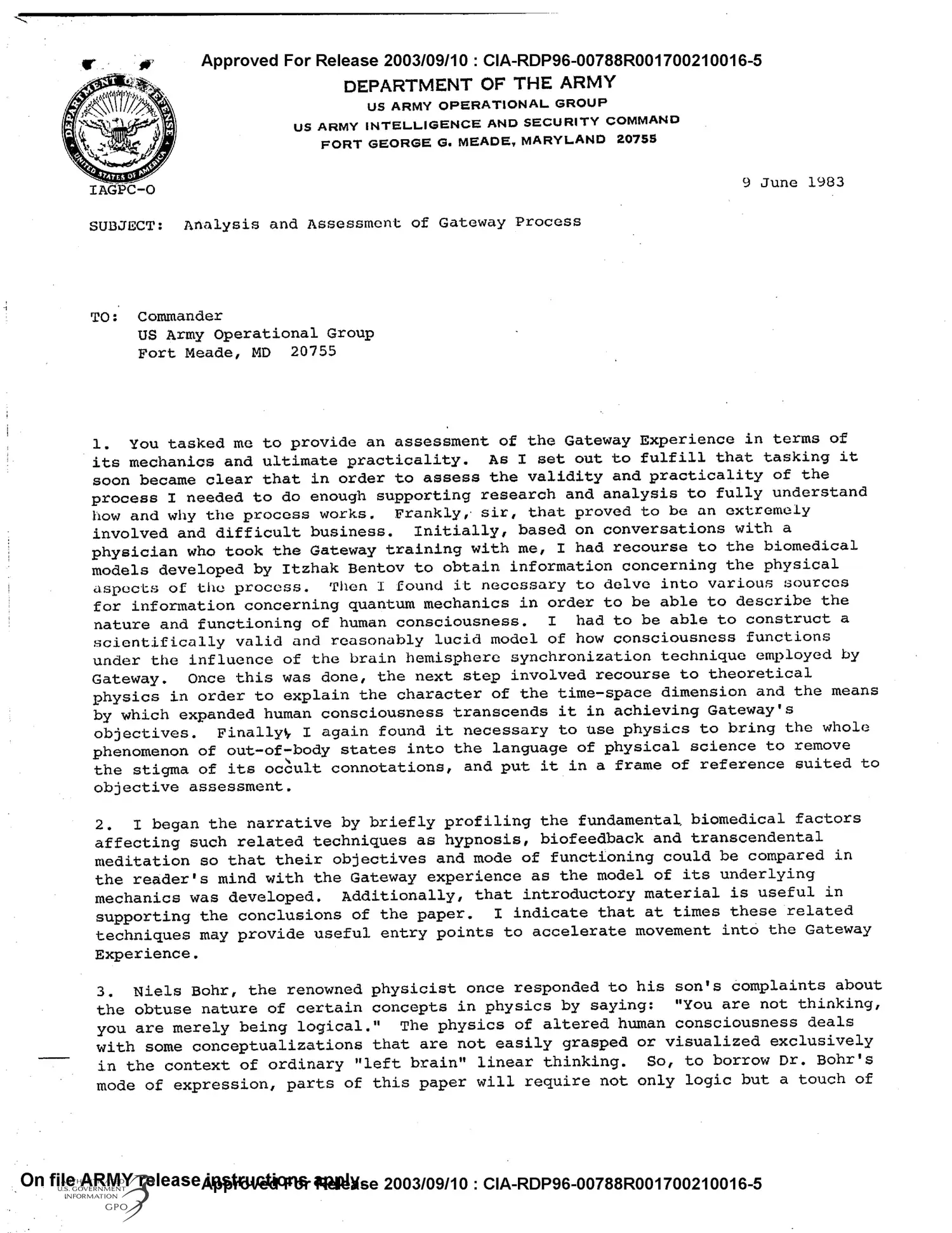
U.S. Army Intelligence and Security Command, the Army intelligence command named in the memorandum's letterhead.
9 June 1983 · 29 source pages
In 1983 an Army intelligence officer assessed Monroe Institute's Gateway training, judged its essential objectives plausible and proposed steps toward out-of-body information gathering.
Interactive page controls and reviewed transcription load with JavaScript.
Commentary by The Declassified Collection, separate from the original source.
U.S. Army Intelligence and Security Command, the Army intelligence command named in the memorandum's letterhead.
An Army office/routing symbol on the memorandum; it is an administrative identifier, not a classification marking.
Engineer and inventor whose 1977 book Stalking the Wild Pendulum supplies much of the report's biomedical and cosmological model.
Danish physicist and Nobel laureate. McDonnell invokes a saying attributed to Bohr to signal that the paper will rely on highly conceptual reasoning.
Lieutenant Colonel, Military Intelligence.
Detachment O, the unit McDonnell identifies himself as commanding.
Monroe Institute term for audio exercises intended to produce synchronized activity between the brain's hemispheres.
A body map showing how different body regions are represented across the sensory and motor cortex.
A meditation movement founded by Maharishi Mahesh Yogi; the report treats it as a comparison technique for altered states.
Fluid-filled cavities within the brain. The report uses them in Bentov's proposed vibration model.
Latin for 'little man'; here, the mapped representation of the body on sensory and motor cortex.
A concept from Indian yogic traditions. The report discusses it through Bentov and Lee Sannella's physiological interpretation.
Cycles per second, the unit used for frequency.
Training in which a person uses real-time measurements of bodily activity to learn voluntary control over some physiological responses.
Electroencephalogram: a recording of electrical activity measured at the scalp.
Virginia organization founded by Robert Monroe that developed the Gateway training program and Hemi-Sync audio exercises.
In this report, a condition in which left- and right-hemisphere EEG patterns are described as matching in frequency and amplitude.
A tendency for neural activity to synchronize with rhythmic sensory stimulation; the report uses it as part of its explanation of Hemi-Sync.
An auditory percept produced when slightly different tones are presented separately to the two ears; the perceived beat corresponds to their frequency difference.
Conventional EEG frequency bands. The report associates beta with wakefulness and theta with drowsiness or sleep.
A system's tendency to respond strongly when driven near one of its natural frequencies.
Bentov's pressure-wave reflection at the aorta's branching. In the model, the returning pulse interferes with the next outward pulse; deep relaxation is supposed to weaken that echo and let a regular vibration build through the body. This is the proposed bridge from lowered blood pressure to brain stimulation.
The tough outer membrane surrounding the brain and spinal cord.
In communications engineering, a signal used to carry information. The report applies the term analogically to bodily resonance.
Terminology used by Bentov and the report for atomic and biological structure; it is not a standard technical name in modern physics.
A reported experience of perceiving oneself or one's awareness as located outside the physical body; the memorandum treats it as a possible operational state.
A recording of an interference pattern that can reconstruct the wavefront of light from an object.
Light whose waves maintain a stable phase relationship; lasers are a standard source.
Physicist who developed the theoretical basis of holography and received the 1971 Nobel Prize in Physics.
Neuroscientist associated with holographic models of brain function.
Physicist whose ideas about an 'implicate order' influenced later holographic interpretations of reality.
The computer comparison does two jobs in McDonnell's model: the right hemisphere receives a whole pattern, and the left reduces it to comparisons with stored information. This division of labour supplies his explanation of why hemispheric synchronization should improve perception.
The report's shorthand for reducing complex input to a binary comparison or decision.
The report's name for an infinite, motionless field of consciousness or energy. It is a metaphysical construct within the memorandum's model.
The memorandum's preferred term for ordinary spacetime.
Awareness of one's own thought processes - knowing that one knows.
The paragraph shifts units: its first threshold is expressed in centimetres per second, a speed, while Bentov's quotation gives centimetres, a distance. The Planck length is a distance scale. Treating it as a speed at which an oscillation leaves time-space is a step in McDonnell's argument, not a conversion of units.
Bentov's and the report's term for a claimed instant in which an oscillation reaches rest and exits time-space; it is not standard quantum-mechanics terminology.
A hypothetical faster-than-light particle. Tachyons have not been experimentally observed.
The figure uses the Planck-scale idea as the boundary in the report's speculative transition between time-space and 'the Absolute'.
The report's speculative layers between ordinary time-space and the Absolute.
Synchronization of one oscillating system with another; the memorandum extends the concept to consciousness and its proposed energy environment.
The cosmological model in which the observable universe evolved from an early hot, dense state.
A doughnut-shaped surface or topology. Bentov uses a toroidal/ovoid form as a model for the universe.
An extremely luminous active galactic nucleus powered by matter falling toward a supermassive black hole.
Bentov's ovoid schematic for the universe's proposed flow of matter and time.
A hypothetical time-reversed analogue of a black hole; unlike black holes, white holes have not been observed.
The report's model in which the history and structure of reality are encoded as an interference pattern across the universe.
The next section treats consciousness as an organizing principle distinct from the physical body - a premise of the memorandum's model.
A Gateway visualization exercise used to set aside distracting concerns before training.
A preparatory humming exercise intended to produce a felt bodily vibration.
A repeated statement of intention used in the training sequence before Hemi-Sync is introduced.
Monroe Institute labels for successive training states. The memorandum describes Focus 12 as 'expanded awareness' beyond the earlier preparatory state.
A named Gateway exercise in which a question is held in expanded awareness and an answer is expected through later intuition or imagery.
A visualization exercise intended to project a desired outcome as though it were already achieved.
A visualization exercise that associates imagined colors with desired bodily effects.
An imagined cylinder of light used as a focusing symbol in several Gateway exercises.
An attempted method of acquiring information about a distant or unseen target without ordinary sensory access.
A Monroe training state that the memorandum associates with access to the past.
A more advanced state that the memorandum associates with the future and with movement beyond ordinary time-space.
Cycles per second, an older expression equivalent to hertz (Hz).
Rapid-eye-movement sleep, a sleep stage associated with vivid dreaming and temporary suppression of most skeletal-muscle movement.
Brain regions involved in planning and executing voluntary movement.
The practical test described here is demanding and simple: read ten computer-generated digits at a distant laboratory. McDonnell reports partial readings but no complete ten-digit success. His next recommendations address that information distortion, including the three-viewer comparison at The Gateway Process — source PDF page 28.
A depth-reversed or inside-out view of a three-dimensional image; the memorandum cites this as one possible source of distorted perception.
Authors of Secret Oral Teachings in Tibetan Buddhist Sects, quoted here by the memorandum.
A Buddhist and Hindu metaphor of a network of jewels in which each reflects all the others; the report uses it as an analogy for a holographic universe.
Paragraph 38 is McDonnell's conclusion as author of the memorandum; the file does not contain a separate command approval of that conclusion.
Self-induced hypnosis, proposed here as one element of the accelerated training sequence.
Three observers would examine the same target from the present, immediate past and immediate future, then compare their accounts. McDonnell proposes this as a remedy for the distorted information discussed at The Gateway Process — source PDF page 25; the design makes simultaneous departure and a shared environment part of the test.
Without a physical body; the memorandum uses the phrase for possible intelligent 'energy forms'.
The nine entries combine books, magazine articles and a Monroe Institute monograph. Bentov provides the central physical model; Ferguson introduces the Pribram/Bohm connection; Monroe supplies an account of out-of-body experience. The bibliography makes visible how McDonnell assembled one explanation from several different kinds of writing.