W. Sterling Cole
Republican Representative from New York, chairman of the Joint Committee on Atomic Energy. His request of 22 October 1953 to Chairman Lewis L. Strauss produced this report.
1953-11-12 · 5 source pages
Interactive page controls and reviewed transcription load with JavaScript.
Commentary by The Declassified Collection, separate from the original source.
Republican Representative from New York, chairman of the Joint Committee on Atomic Energy. His request of 22 October 1953 to Chairman Lewis L. Strauss produced this report.
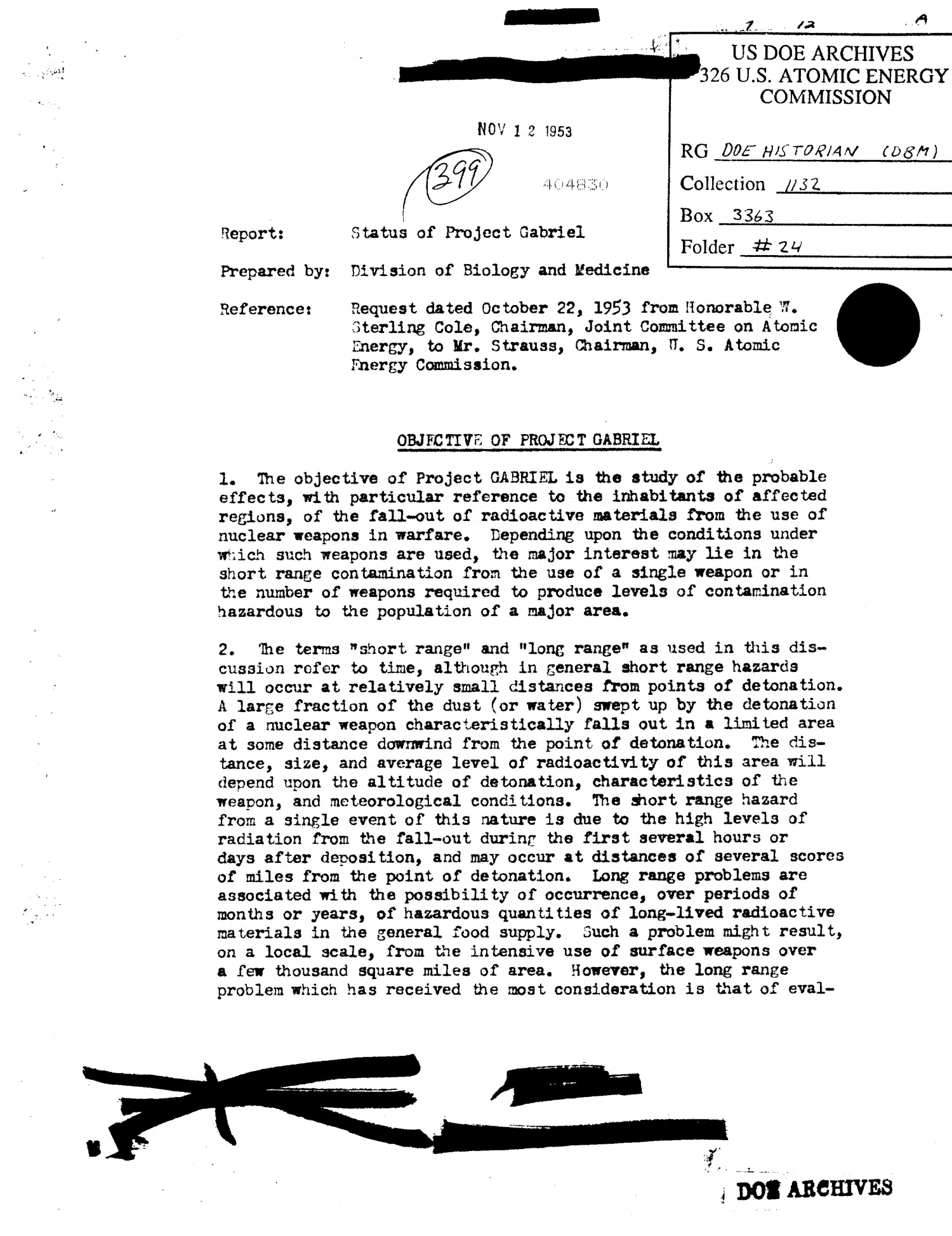
The box at head right records where the paper was found: record group DOE Historian, Collection 1132, Box 3363, Folder 24. The date stamp reads 12 November 1953.
The Commission division that prepared the report, under John C. Bugher. Paragraph 3 divides Gabriel into three phases; paragraph 4 lists the programmes it was funding.
About 100 fallout monitoring stations inside the United States and 70 outside it. The UCLA Atomic Energy Project's environmental studies are dated to the Trinity site, 1947.
Paragraph 8 dates the code name to the RAND conference of July 1953 and defines it as the part of Project Gabriel that samples strontium-90 directly.
Paragraph 9 gives the collecting arrangements: soil and milk through the Department of Agriculture, human material through arrangements with hospitals and physicians.
Willard F. Libby at the University of Chicago, J. Laurence Kulp at Columbia and the Commission's New York Operations Office ran the strontium-90 assays.
Paragraph 10a states that the strontium-90 already in people comes from about forty detonations, and that no single detonation's share can be worked out.
Physicist at Oak Ridge National Laboratory who made the first long-range Gabriel study for the Commission in 1949. His revised November 1951 estimate is quoted here.
Paragraph 13 lists what might be done if the hazard proved real: turning affected land over to crops that take up less strontium, or liming the soil.