General Advisory Committee
The Commission's statutory advisory body, created by the Atomic Energy Act of 1946. Its nine members were presidential appointees; Isidor I. Rabi chaired it 1952 to 1956.
17–19 August 1953 · 8 source pages
In August 1953, AEC advisers discussed a worldwide Sunshine sampling program; the surviving minutes include strontium-90 measurements from human remains, food and soil.
Interactive page controls and reviewed transcription load with JavaScript.
Commentary by The Declassified Collection, separate from the original source.
The Commission's statutory advisory body, created by the Atomic Energy Act of 1946. Its nine members were presidential appointees; Isidor I. Rabi chaired it 1952 to 1956.
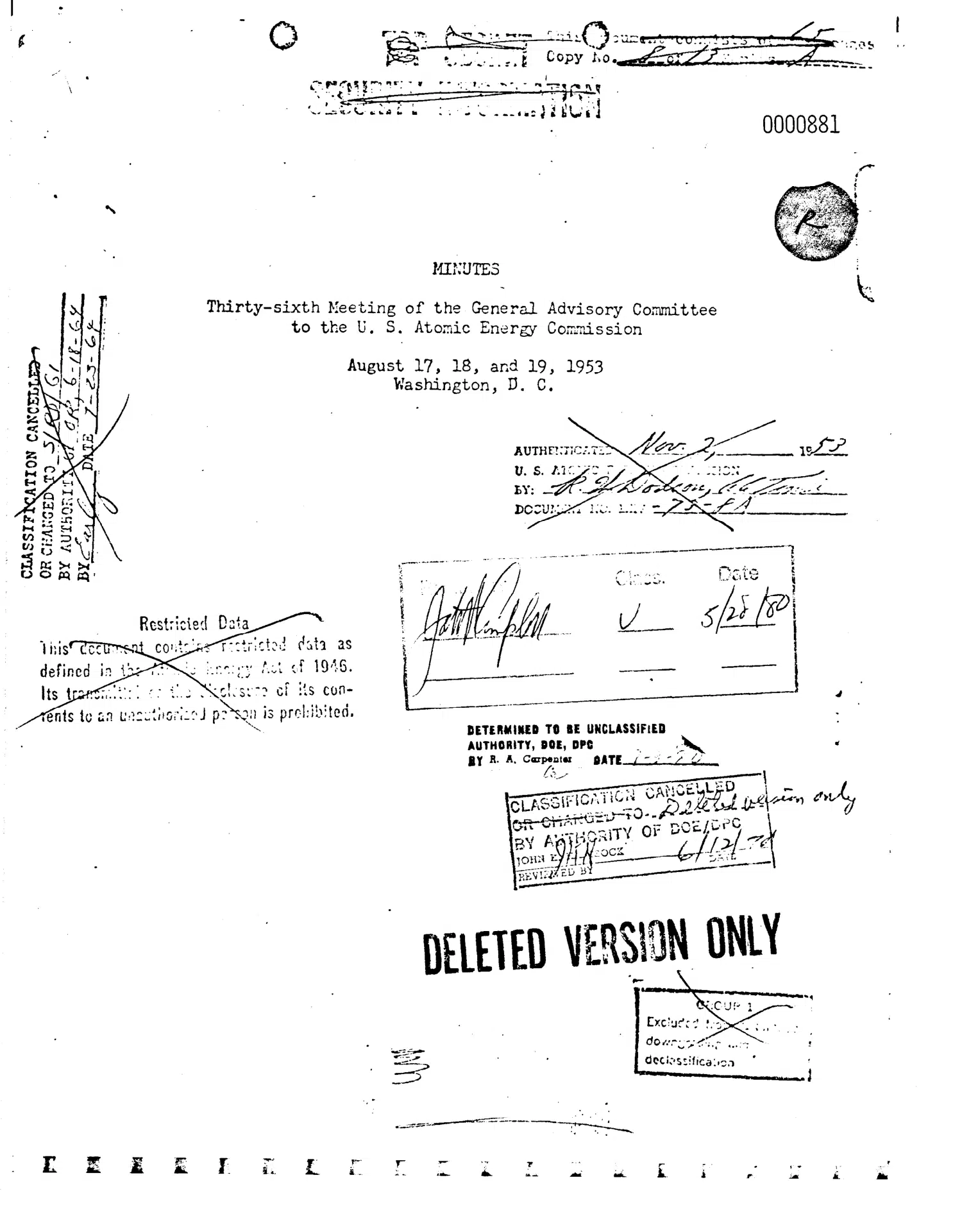
The stamp gives the release class of the whole record. R. W. Dodson authenticated the minutes on 2 November 1953 as document GAC-75-FA; that block is struck through.
Chemist at the University of Chicago, Nobel laureate in chemistry in 1960 and an Atomic Energy Commissioner from 1954. Here he raises where human material might be found.
Folio 17 carries the secretary's signature, the attachment count and a lone deletion mark. In the scan it sits second of eight leaves; this edition returns it to the end.
A release in which withheld leaves are pulled and a printed notice substituted for them. This sheet stands in place of eleven pages, so the minutes as published begin partway through the meeting, at folio 12.
The line is set in a sans-serif review typeface rather than the elite serif face of the minutes. Department of Energy reviewers added it during declassification; the stamps carrying their authority are on the title leaf.
Director of the Commission's Division of Biology and Medicine, in succession to Shields Warren. He opened the discussion here, and left the post in 1955.
The RAND Corporation's summer-study report of 6 August 1953, summarised here by Arnold Kramish, a RAND senior staff member from 1951. It is contractor work and is not reproduced in this edition.
Strontium-90 follows calcium through the body's chemistry and deposits in bone, where it remains. The term names that behaviour, and the leaf gives bone cancer as the hazard it creates.
Seven numbered assumptions, set out here: strontium-90 spread evenly over the globe, no decay before deposit, full availability to the biosphere, no separation in bone.
The International Commission on Radiological Protection, founded 1928, renamed 1950. Its one-microcurie limit is reasoned here from radium experience, not strontium data.
Princeton physicist, a member of the General Advisory Committee from 1952 to 1957 and Nobel laureate in 1963. He pressed the meeting on inhaled insoluble particles.
Columbia physicist and Nobel laureate in 1944, chairman of the General Advisory Committee from 1952 to 1956 in succession to J. Robert Oppenheimer. He chaired this meeting.
Henry DeWolf Smyth and Thomas E. Murray, both then Commissioners of the Atomic Energy Commission, joined the session in progress. The secretary gives Murray the courtesy title Mr. rather than his office.
The pilot programme proposed here names Utah for heavy fallout, Kansas as grain country, England, Japan and an unnamed South American country.
Merril Eisenbud, founding director of the Commission's Health and Safety Laboratory in New York, and J. Laurence Kulp of Columbia's Lamont Geological Observatory.