Alderson Reporting Company
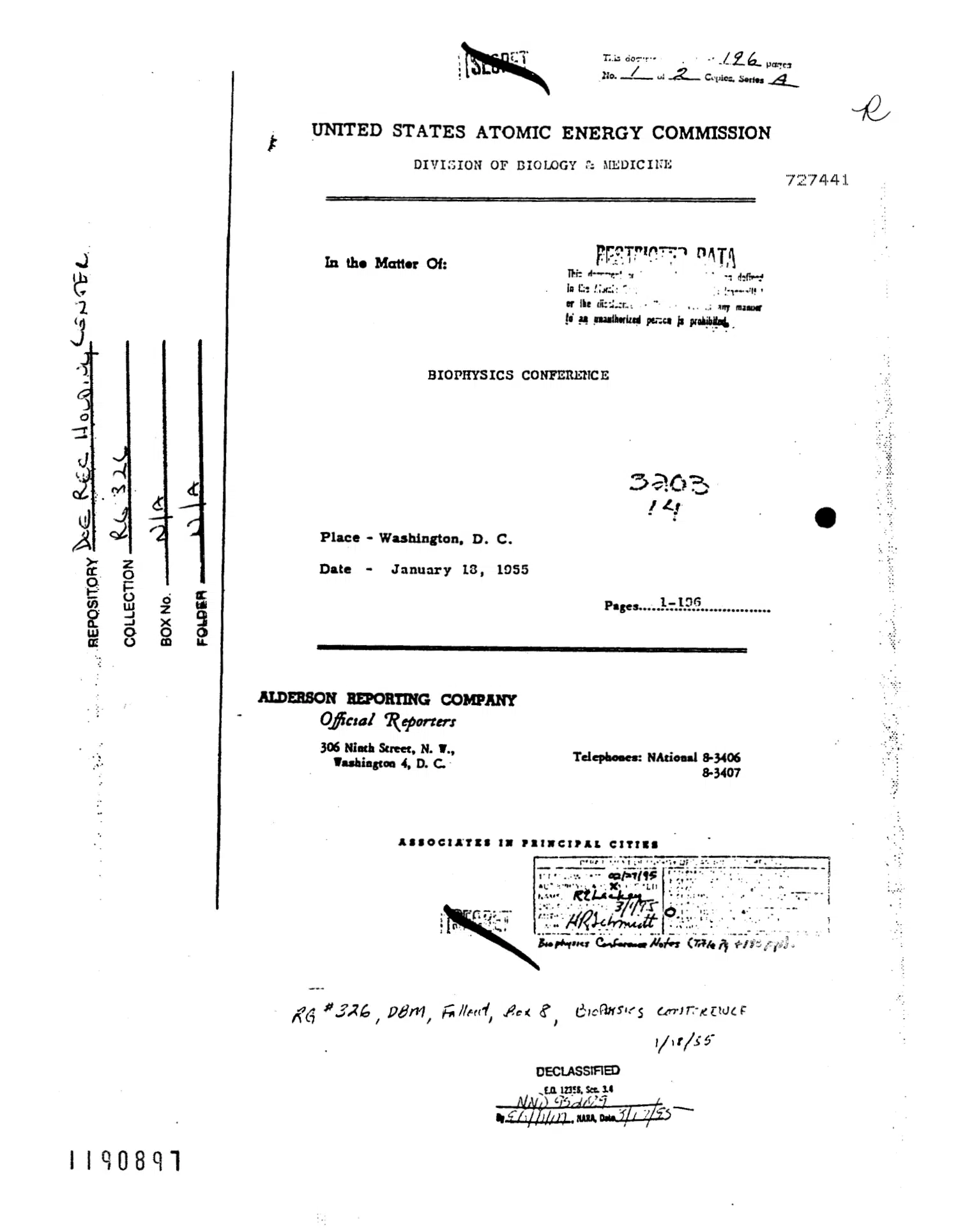
The caption sheet is the printed stationery of the Alderson Reporting Company, official reporters, of 306 Ninth Street N.W., Washington. The Commission convened the conference.
1955-01-18 · 197 source pages
Human samples were Sunshine's most important gap, Commissioner Libby told the 1955 Biophysics Conference: anyone who could do a good job of body snatching would be serving their country.
Interactive page controls and reviewed transcription load with JavaScript.
Commentary by The Declassified Collection, separate from the original source.
The caption sheet is the printed stationery of the Alderson Reporting Company, official reporters, of 306 Ninth Street N.W., Washington. The Commission convened the conference.
The head block records 196 pages, copy one of two, Series A. A National Archives stamp at the foot cancels the classification under Executive Order 12356 in March 1995.
Thirty names open the record: Commission staff, and men from the Weather Bureau, Agriculture, the Armed Forces Special Weapons Project, RAND, Sandia, Chicago, Johns Hopkins, UCLA and Columbia.
Willard Frank Libby, radiochemist of the University of Chicago, became an Atomic Energy Commissioner on 1 October 1954. He won the 1960 Nobel Prize in Chemistry and died in 1980.
John C. Bugher, physician and pathologist, directed the Commission's Division of Biology and Medicine and takes the chair. He left in 1955 for the Rockefeller Foundation.
Gabriel was the Commission's study of the worldwide fission-product hazard; Sunshine measured it. Castle was the Pacific test series of spring 1954. This leaf carries no folio.
Three leaves are omitted before this one. They carry the rest of Dr. Bugher's opening remarks, which run on to the head of this leaf, where the sentence resumes without a speaker label.
Libby had been three months in office. The stenographer heads his turns COMMISSIONER LIBBY. He sets out the project's standing and the gaps in its data.
The leaf opens mid-sentence with no speaker label; the turn is Commissioner Libby's. He explains why the measurement requires the young rather than adults, and what the project had been receiving.
A Sunshine Unit is one picocurie of strontium-90 per gram of calcium. The fractions on this leaf are given against tolerance, the maximum permissible body burden then in use, not against the unit.
Bugher, the division's director, interrupts with a one-line answer and Libby resumes. He had come to the Commission from the Rockefeller Foundation, whose yellow-fever work he cites later.
Libby turns from the adequacy of small bone samples to a second gap: no one had measured strontium-90 in ocean water. He reports a Chicago result on how deep and how fast the oceans mix.
Three leaves are omitted before this one. They carry Commissioner Libby on tritium in ocean water and rain, on ocean mixing, and on fission-product disposal at sea.
Libby, still speaking, dates the project to a RAND Corporation summer study in 1953, and refers to a law firm's compendium on the law governing the taking of bodies, obtained for that study.
Three leaves are omitted before this one. They carry the discussion that follows Commissioner Libby's opening statement and leads into Dr. Kulp's account of what his laboratory had collected and measured.
J. Laurence Kulp (1921-2006), geochemist at Columbia University's Lamont Geological Observatory, set on the appearance leaf as J. LAWRENCE KULP. He later went to Weyerhaeuser.
The appearance leaf gives H. Wechsler of the Weather Bureau. This leaf spells the name three ways, WESCHLER at his first turn and WECHSLER at the next two. The record does not settle the man.
Merril Eisenbud (1915-1997) directed the Commission's Health and Safety Laboratory at the New York Operations Office, which measured fallout. He later taught at New York University.
Sixty-three leaves are omitted before this one, most of the day's earlier sessions. The extract resumes inside Dr. Kulp's report, which begins on the preceding folio and runs unbroken across this leaf.
Kulp reads out measured values, each with its error, for individuals by age, sex and city, drawn from New York and Houston, and describes how the material reached him.
One leaf is omitted before this one. It continues the same tabulation of measured values by city and age, and carries a short exchange with Dr. Mitchell of the Armed Forces Special Weapons Project.
Kulp reports approaching the dean of Columbia's medical school about extending the same collection to Australia, South America, Africa, the Near East and Scandinavia.
A hundred and two leaves are omitted before this one, the rest of the day's sessions. The extract resumes near the close, where the conference returns to how human material is to be obtained.
Lyle T. Alexander (1905-1983), soil chemist at the Agriculture Department's Beltsville laboratories and later chief of its Soil Survey Laboratories, opens the leaf.
Dr. John C. Bugher, director of the Division of Biology and Medicine, tells the room the Commission hopes to declassify the existence and objectives of Project Sunshine.
Under the Atomic Energy Act of 1954 an L clearance gave restricted-data access on a preliminary check, short of the full Q. Bugher raises it for hospital directors and pathologists.
Eight leaves are omitted before this one. They carry the last of the discussion on obtaining human material abroad, Dr. Bugher on paying local collectors, and closing remarks from Dr. Claus of the division.
Dr. Bugher thanks the room and the conference closes at 5:35 p.m., having convened at nine that morning. This is folio 196, the last leaf of the record and the count declared on the caption sheet.